
On a January morning in Bhaktapur, the dhara’s water steams in the cold air and people wrap up in shawls until the Sun climbs over the hills. The average early-morning low in Kathmandu in January is about 3 °C. In June the afternoons reach about 30 °C.
What makes the difference? Many people, even many adults, will tell you that in summer the Earth is closer to the Sun. It is a sensible guess. A fire feels hotter when you stand closer to it. But it is wrong: the Earth is closest to the Sun in early January, in the middle of Nepal’s winter. And while you shiver in January, children in Sydney and Buenos Aires are going to the beach, because for them it is summer.
So the reason must be something else. In this topic you will build a model of the Earth and the Sun that explains it: why winter is cold, why Nepal’s days are short in Poush and long in Asar, and why some places have days when the Sun never sets. Then you will use the same model for the Moon, and find out why there isn’t an eclipse every month.
It isn’t the distance
The Earth goes round the Sun once a year in a path called its orbit. The orbit is very nearly a circle, but not quite, so the distance changes a little through the year:
| Date (2026) | Distance from the Sun | |
|---|---|---|
| closest, perihelion | 3 January | 147.1 million km |
| farthest, aphelion | 6 July | 152.1 million km |
The difference is 5 million km. That sounds like a lot, but it is only about 3% of the distance. Sunlight does get stronger closer to the Sun, and you can work out by how much.
A 7% change is real, but small. You will see later in this topic that the real reason changes the sunshine Bhaktapur gets by about a factor of two between June and December. And here is the clearest evidence that distance can’t be the cause: the whole Earth is at the same distance from the Sun at any moment, yet in January it is winter in the north and summer in the south. Whatever makes the seasons must be different for the two halves of the Earth.
In January the Earth is at its closest to the Sun. Which fact best shows that this closeness does not cause the seasons?
Pick an answer to see why.
A tilted, spinning top
You learned in Grade 6 that the Earth spins on its axis, an imaginary line through the North and South Poles, once a day, and that the axis is tilted. Tilted compared with what? Imagine the Earth’s orbit as a huge flat sheet with the Sun in the middle. If the axis stood straight up from the sheet, it would be upright. It isn’t: it leans 23.4° away from upright. (Some books give the same tilt as 66.5° measured from the flat sheet instead: 90° − 66.5° = 23.5°. Today’s exact value is 23.44°.)
The important part is this: the axis keeps pointing the same way in space all year. Its north end points almost exactly at Dhruva Tara, the Pole Star, in June and in December, by day and by night Grade 8: Grade 8: The Pole Star. A spinning top behaves like this too: once it is spinning, its axis holds its direction.
So as the Earth goes round the Sun, the tilted axis stays parallel to itself, and something changes:
- Around 21 June, the north end of the axis leans towards the Sun. The northern half of the Earth, with Nepal in it, faces the Sun more directly. It is summer in the north.
- Around 21 December, the Earth is on the other side of the Sun. The axis still leans the same way in space, so now the north end leans away from the Sun. It is winter in the north.
- In March and September, the axis leans sideways, neither towards the Sun nor away. Both halves get the same share.
When the southern half leans towards the Sun, the northern half must lean away. That is why the seasons in the two halves are always opposite: Australia’s summer is December to February, and its winter is June to August.
These four days have names. The June solstice (about 21 June, in early Asar) and the December solstice (about 21 December, in early Poush) are when the axis leans most towards or away from the Sun. Solstice is Latin for “the Sun stands still”: around these days the noon Sun stops getting higher (or lower) and turns back. The March equinox (about 20 March) and the September equinox (about 23 September) are when it leans sideways. Equinox means “equal night”: on these days, day and night are about 12 hours each, everywhere on Earth.
In December, the north end of the Earth’s axis leans away from the Sun. Why?
Pick an answer to see why.
Why a high Sun heats more
Leaning towards the Sun does two things. The first is about the Sun’s height: how high it climbs in the sky.
You have felt this already. In the early morning and late afternoon, when the Sun is low, its light hardly warms you. At midday, when it is high, it is hot. The light is the same light. What changes is how it falls on the ground.
Hold a torch straight above a table, pointing down, and it makes a small, bright circle. Tilt it, and the same light spreads over a long oval, and the oval is dimmer. The same amount of light is shared out over more table, so each part of the table gets less. Sunlight does exactly the same. A high Sun’s light falls nearly square on the ground and is concentrated on a small area. A low Sun’s light comes in at a slant and is spread out thinly over a large area.
The numbers in the widget come from the shape of the slanting beam. Here they are for a few heights:
| Sun’s height | 90° | 80° | 70° | 60° | 50° | 40° | 30° | 20° |
|---|---|---|---|---|---|---|---|---|
| Ground lit by a 1 m beam | 1.00 m | 1.02 m | 1.06 m | 1.15 m | 1.31 m | 1.56 m | 2.00 m | 2.92 m |
| Sunlight on each m² | 100% | 98% | 94% | 87% | 77% | 64% | 50% | 34% |
The second row is just 1 ÷ the first: if the beam is spread over 2 m, each meter gets half. (If you have learned trigonometry, the share is the sine of the Sun’s height.) Notice that a high Sun loses very little by being a few degrees off overhead, but a low Sun loses a lot.
There is a smaller second effect: light from a low Sun also passes through much more air on its way to you, and the air scatters and absorbs some of it. That is why you can look at the setting Sun for a moment, but never at the midday Sun.
How high does the Sun get?
On the equinoxes, the noon Sun is straight overhead at the equator. If you go north from the equator, the noon Sun is lower by the same number of degrees as your latitude, your distance north of the equator in degrees. On the June solstice, the north leans 23.4° towards the Sun, so the noon Sun is 23.4° higher than on the equinox; on the December solstice it is 23.4° lower.
Why does the same sunlight warm the ground less when the Sun is low in the sky?
Pick an answer to see why.
Why the days change length
The second thing the tilt does is change how long the Sun stays up.
The Earth is a ball, and the Sun can only light one half of it at a time. The edge between the day half and the night half is a big circle around the Earth. As the Earth spins, each place is carried round once a day on a circle of its own latitude: part of the way through the day half, part through the night half. If more of your circle is in the day half, your day is longer than your night.
Without any tilt, the edge between day and night would run through both poles, cutting every circle of latitude exactly in half: 12 hours of day and 12 of night, everywhere, all year. With the tilt, in June, the north end leans into the day half. More of every northern circle is in daylight, so northern days are long. In December, the north leans into the night half, and northern days are short. Try it.
For Bhaktapur, the model gives (from sunrise to sunset, over a flat horizon; the hills round the valley take a little off each end):
| 21 June | 20 March, 23 September | 21 December | |
|---|---|---|---|
| Day length in Bhaktapur | 13 h 54 min | about 12 h 8 min | 10 h 23 min |
| Noon Sun’s height | 86° | 62° | 39° |
On the equinoxes, the day is a few minutes longer than 12 hours because sunrise and sunset are counted from the moment the Sun’s top edge touches the horizon, and because the air bends the Sun’s light, so it is seen a few minutes before it has really risen.
So on 21 June, Bhaktapur has three and a half hours more sunshine than on 21 December, and at a higher angle. Both effects come from the same tilt, and both work the same way: long days with a high Sun in summer, short days with a low Sun in winter.
In the widget, which place has about 12 hours of day all year round?
Pick an answer to see why.
Where the Sun doesn’t set
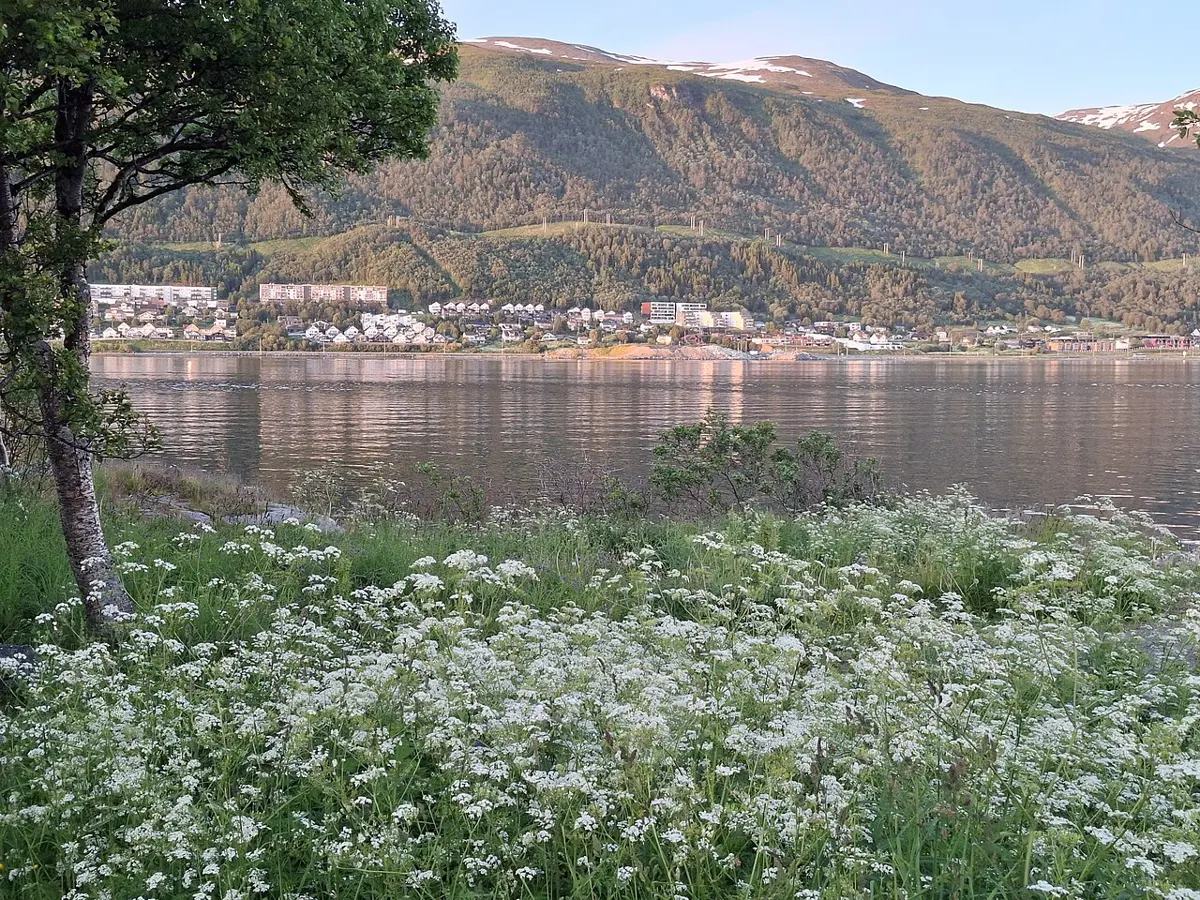
Move the widget to Tromsø, a town in the north of Norway at 69.7° N, inside the Arctic Circle (66.6° N). In June, its whole circle is on the day side: the Sun goes round the sky without setting. From about 20 May to 22 July, Tromsø has the midnight Sun. (Counted from the moment the Sun’s top edge stays above a flat horizon, as the widget does, it is a few days longer; the mountains round the town make it a few days shorter.) In December, its whole circle is on the night side, and from late November to about 15 January the Sun doesn’t rise at all: the polar night. It isn’t completely dark at midday, though: the Sun is only just below the horizon, so there is a few hours of blue twilight.
At the poles themselves, the year is one long day of six months and one long night of six months.
Putting the numbers together
How much do the two effects add up to? You can add up the sunshine falling on each square meter over a whole day, from sunrise to sunset, at every height the Sun passes through. (This is sunshine above the air; clouds and haze take some away.)
| Bhaktapur | 21 June | 21 December |
|---|---|---|
| Day length | 13 h 54 min | 10 h 23 min |
| Noon Sun’s height | 86° | 39° |
| Sunshine on 1 m² in the day | 11.3 kWh | 5.8 kWh |
Twice the sunshine in June. So why isn’t June twice as warm? And why isn’t 21 December the coldest day?
Look at Figure 22.3. The days are shortest on 21 December, but the coldest month is January, not December, and February is still colder than November. The ground, the air and the lakes and seas take time to cool down and warm up. All through December and early January, the ground and air are still losing more heat each night than the short days give back, so they keep getting colder. Only once the days have grown long enough for the gain to match the loss does it stop getting colder. The same happens every day: the warmest part of a sunny day is not noon, when the Sun is highest, but about 2 to 3 in the afternoon. This delay is called the lag of the seasons.
At the other end, Kathmandu’s summer is flattened by the monsoon: from June to September, clouds block much of the sunshine and the rain cools the ground, so June, July and August are all about 24.5 °C, and the hottest days of the year usually come in late May and June, before the rains set in.
The shortest day in Nepal is about 21 December. Why is January usually colder?
Pick an answer to see why.
The tilt itself changes slowly too, between about 22.1° and 24.5° every 41,000 years, and these slow changes helped start and end the ice ages: see Why Has the Climate Changed Before? in Going Further 9–12.
The same model: the Moon’s phases and eclipses
The model you have built, a lit ball going round the Sun, also explains the Moon. You learned in Grade 7 how the Moon’s phases come about. Briefly: the Sun always lights one half of the Moon. As the Moon goes round the Earth, once in about 29.5 days, we see different amounts of its lit half. At the new moon (aunsi), the Moon is between the Earth and the Sun, and its lit half faces away from us. At the full moon (purnima), the Moon is on the far side of the Earth from the Sun, and we see its whole lit half.
Why does the Moon look like a thin crescent a few days after the new moon?
Pick an answer to see why.
You also learned in Grade 7 that an eclipse of the Sun happens when the Moon comes exactly between the Sun and the Earth, so it can only happen at a new moon; and that an eclipse of the Moon happens when the Moon passes through the Earth’s shadow, so it can only happen at a full moon. But there is a new moon and a full moon every month. Why isn’t there an eclipse every month?
The Moon’s tilted orbit
The answer is another tilt. The Moon’s orbit round the Earth is not on the same flat sheet as the Earth’s orbit round the Sun: it is tilted to it by about 5°. That seems small. But the Moon is 384,000 km away, 60 times the Earth’s radius, and at that distance 5° lifts it about 34,000 km above or below the sheet. The Earth’s shadow, out where the Moon crosses it, is only about 9,000 km across in its dark middle. So at most full moons the Moon passes above or below the shadow and misses it completely, and at most new moons the Moon’s shadow passes above or below the Earth.
The Moon’s orbit crosses the Earth’s flat sheet at two points, on opposite sides. Only when the line joining those two points points at the Sun, or nearly, can the new or full Moon be in line with the Earth and the Sun. As the Earth goes round the Sun, that happens about twice a year, for about five weeks each time. These are the eclipse seasons. Every eclipse season has at least one eclipse of the Sun somewhere on Earth (often only partial) and at least one of the Moon two weeks before or after it (sometimes only a faint one, when the Moon passes through just the pale outer edge of the Earth’s shadow). That is why eclipses come in twos or threes, and the groups come about six months apart.
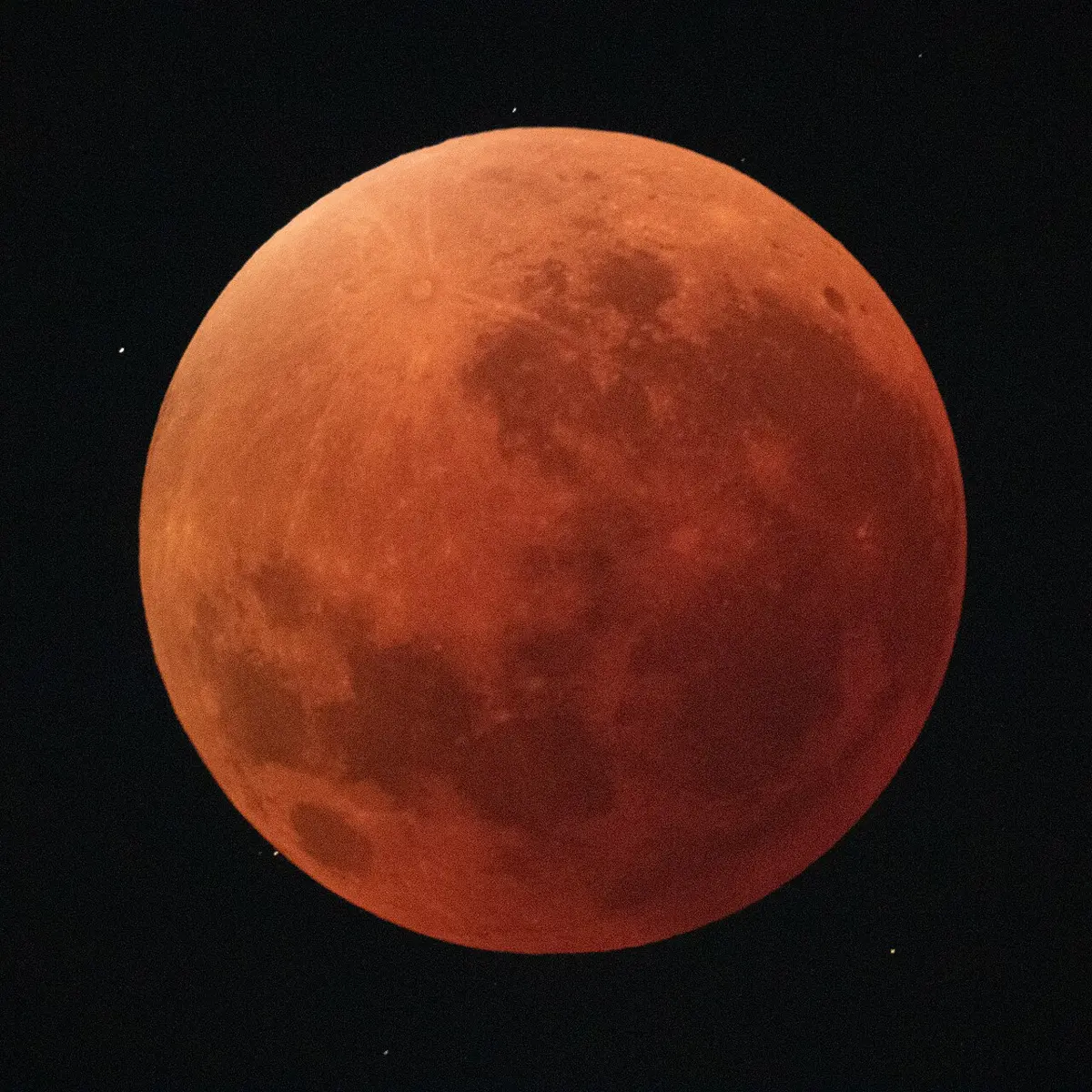
An eclipse of the Moon can be seen from the whole night side of the Earth at once: anyone who can see the Moon sees it darken. An eclipse of the Sun is different. The Moon is small, and its dark shadow on the Earth is at most a few hundred kilometers wide, so a total eclipse of the Sun is seen only along a narrow path; outside it, people see a partial eclipse, with only part of the Sun covered.
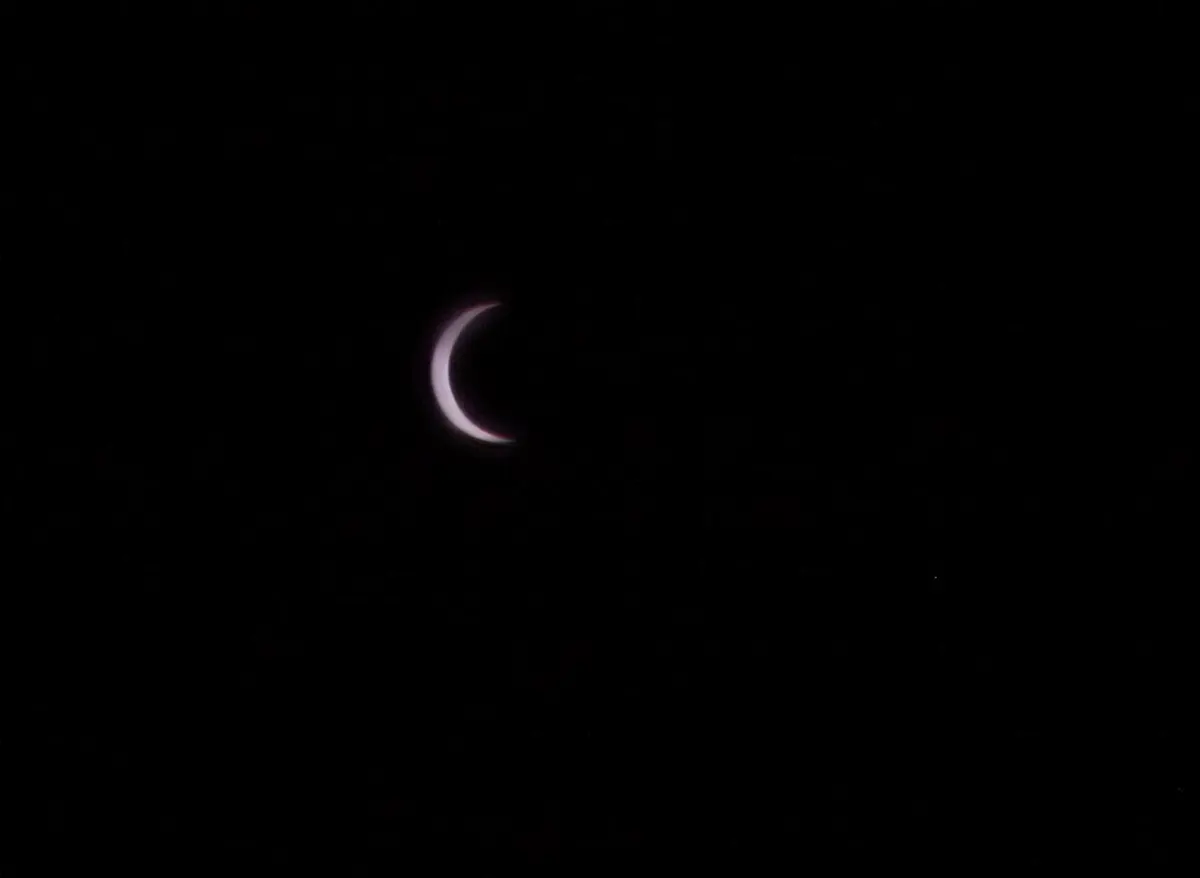
There is also a third kind. The Moon’s distance from the Earth changes, between about 356,000 and 407,000 km. When the Moon is far, it looks a little smaller than the Sun and can’t quite cover it, and a ring of the Sun shows round it: an annular (ring) eclipse. That is what happened on 21 June 2020. The ring was seen along a narrow path across northern India, through Dehradun and Joshimath in Uttarakhand, just west of Nepal; in Kathmandu nearly nine-tenths of the Sun was covered.
Questions
It is a hot summer’s day in Sydney, Australia. What season is it in Nepal?
Pick an answer to see why.
On which date does Bhaktapur have its longest day?
Pick an answer to see why.
Use the model of the tilted Earth going round the Sun to explain why Bhaktapur is warmer in June than in December. Give both reasons, and say why the Earth’s distance from the Sun is not one of them.
Answer
The Earth’s axis is tilted 23.4° and keeps pointing the same way in space all year. In June the Earth is on the side of its orbit where the north end of the axis leans towards the Sun; in December it is on the other side, where the north end leans away.
- The Sun is higher. Leaning towards the Sun, Bhaktapur’s noon Sun is 86° high in June, against 39° in December. High sunlight falls nearly square on the ground and is concentrated on a small area; low sunlight comes in at a slant and spreads over more ground, so each square meter gets less (about 63% at 39°).
- The days are longer. More of Bhaktapur’s daily circle is on the day side of the Earth: 13 h 54 min of day in June, against 10 h 23 min in December.
Together, each square meter gets about twice as much sunshine in a day in June as in December. The distance is not the reason: the Earth is closest to the Sun in early January, and at any moment both halves of the Earth are at the same distance, yet one has summer while the other has winter.
Nepalgunj is at latitude 28.1° N.
- i.Work out the height of its noon Sun on 21 June.
- ii.Work out the height of its noon Sun on 21 December.
- iii.Use the table in this topic to estimate how much sunlight each square meter gets at noon in December, as a share of June’s.
Answer
- i.90° − 28.1° + 23.4° = 85.3°.
- ii.90° − 28.1° − 23.4° = 38.5°.
- iii.At 85° each square meter gets almost 100%; at 38.5°, between the table’s 40° (64%) and 30° (50%), but close to 40°: about 62%. So at noon in December each square meter gets a little under two-thirds of June’s sunlight.
Look at Figure 22.3.
- a.Which month has the shortest days, and which is the coldest?
- b.Explain why they are not the same month.
- c.February has longer days than November, yet it is colder. Explain.
Answer
- a.The shortest days are in December (the shortest on about 21 December); the coldest month is January (average 11.0 °C).
- b.After 21 December the days get longer, but for some weeks the ground and air still lose more heat each day and night than the sunshine gives them, so they go on cooling. They stop cooling only when the gain catches up with the loss, in January. This is the lag of the seasons.
- c.In November the ground and air are still warm from the summer and autumn, and are only beginning to cool; in February they are just beginning to warm up again after the cold of December and January. The temperature depends on the heat stored up, not only on the sunshine that day.
A friend says: “The Earth is tilted, so in June the northern half is nearer the Sun, and that is why it’s summer.” What is right and what is wrong in this?
Answer
Right: the tilt causes the seasons, and in June the northern half leans towards the Sun. Wrong: leaning towards the Sun doesn’t matter because it brings the north nearer. The Earth is 12,700 km wide and the Sun is 150 million km away, so leaning moves the north by a tiny fraction of the distance, much less than 0.01%. What matters is the angle: leaning towards the Sun makes the Sun climb higher, so its light is less spread out, and it makes the days longer.
Explain, using a model of the Sun, the Earth and the Moon, why there is a full moon every month but an eclipse of the Moon only about twice a year or less.
Answer
At every full moon, the Moon is on the opposite side of the Earth from the Sun. But the Moon’s orbit is tilted about 5° to the Earth’s orbit. At the Moon’s distance, 384,000 km, that tilt lifts the Moon up to about 34,000 km above or below the line from the Sun through the Earth, while the dark middle of the Earth’s shadow there is only about 9,000 km across. So at most full moons the Moon passes above or below the shadow. The Moon’s orbit crosses the plane of the Earth’s orbit at two points; only when the line through them points at the Sun (about twice a year, the eclipse seasons) can a full Moon pass through the shadow. If a full moon happens in an eclipse season, there is an eclipse of the Moon; if not, that season has none.
On 31 December 2028 there will be a total eclipse of the Moon. Who will be able to see it?
Pick an answer to see why.
Where to go next
- Is the Earth Really Getting Warmer? The seasons come and go every year. How scientists tell a real, lasting warming from the ups and downs of the weather.
- Why Is Pokhara So Wet and Mustang So Dry? The Sun heats the Earth unevenly, at the equator more than at the poles. How that sets the winds, and how the winds and mountains decide a place’s climate.
- How Do Rocks Tell Time? The Earth’s year and day are its clocks; rocks keep a much longer one.