
About two thousand years ago, a Greek-speaking merchant in Egypt wrote a guide for traders sailing out of the Red Sea. It is a dry little book, a list of harbors and what to buy and sell in each, and it is full of timing. For the ports of East Africa, it says, ships leave Egypt about the month of July. For the mouth of the Indus, July again: the sea is rougher then, but the way is more direct. For the pepper ports on India’s southwest coast, the same. A Roman writer of the same years adds the other half: with the right wind behind them, ships reached India in forty days, and they started home in December, so that a merchant could go and come back within the year.
Why July out and December back? Because over this sea the wind turns round twice a year. In the hot months the land of South Asia heats up much faster than the ocean. The warm air over the land rises, and air from the sea flows in to take its place, from the southwest, wet with the rain that becomes Nepal’s monsoon. In winter it runs the other way: the land cools faster than the sea, and dry air pours off the land, from the northeast, out over the water. How the summer wind brings Nepal its rain is in The Monsoon, in Geography, for the Curious. For a sailor, what mattered was simpler. For about half the year the wind blew toward India, and for the other half away from it, and it did so steadily, month after month, year after year.
The guidebook gives a Greek pilot, Hippalus, the credit for first steering straight across the open ocean on this wind, and says the southwest wind was named after him. That is how the Greeks told it. The same guidebook also says that ships from western India were already sailing to the coast of Africa with wheat, rice, cotton cloth and sugar, and that Arab captains along that coast knew its people and its language well enough to marry into its families. The sea had its sailors long before the Greeks arrived. And not all its cargo was cloth and spices. At one market on the Horn of Africa, the guidebook notes, traders could buy enslaved people, and more of them were being shipped to Egypt every year.
This was a different kind of trade from the Silk Roads (Chapter 13). On land, goods went in short hops from oasis to oasis. On the sea, one ship with the wind behind it could cross from Arabia to India in weeks, and the wind set the timetable for everyone at once. Ports filled in one season and emptied in the next. A merchant who missed the turn of the wind waited months for the next one.
A ship full of bowls
A little over a quarter of a century ago, fishermen diving for sea cucumbers in the Java Sea, off the island of Belitung in Indonesia, found a wreck less than three kilometers from the shore. It had hit a reef that probably tore open its bottom, sailed on another hundred and fifty meters, and sank. In two seasons of diving, almost everything it carried was brought up.
Its cargo had been, by one count, about seventy thousand pieces of Chinese pottery, some twenty-five tons of it. Most were bowls from the kilns at Changsha, in central China, painted in brown and green, about fifty-five thousand of them. There were eighteen ingots of silver too. One bowl carries a date written in Chinese, a summer’s day, and star anise in the hold and the ship’s timbers gave dates from radiocarbon that agree with it. The ship had sailed about twelve hundred years ago.
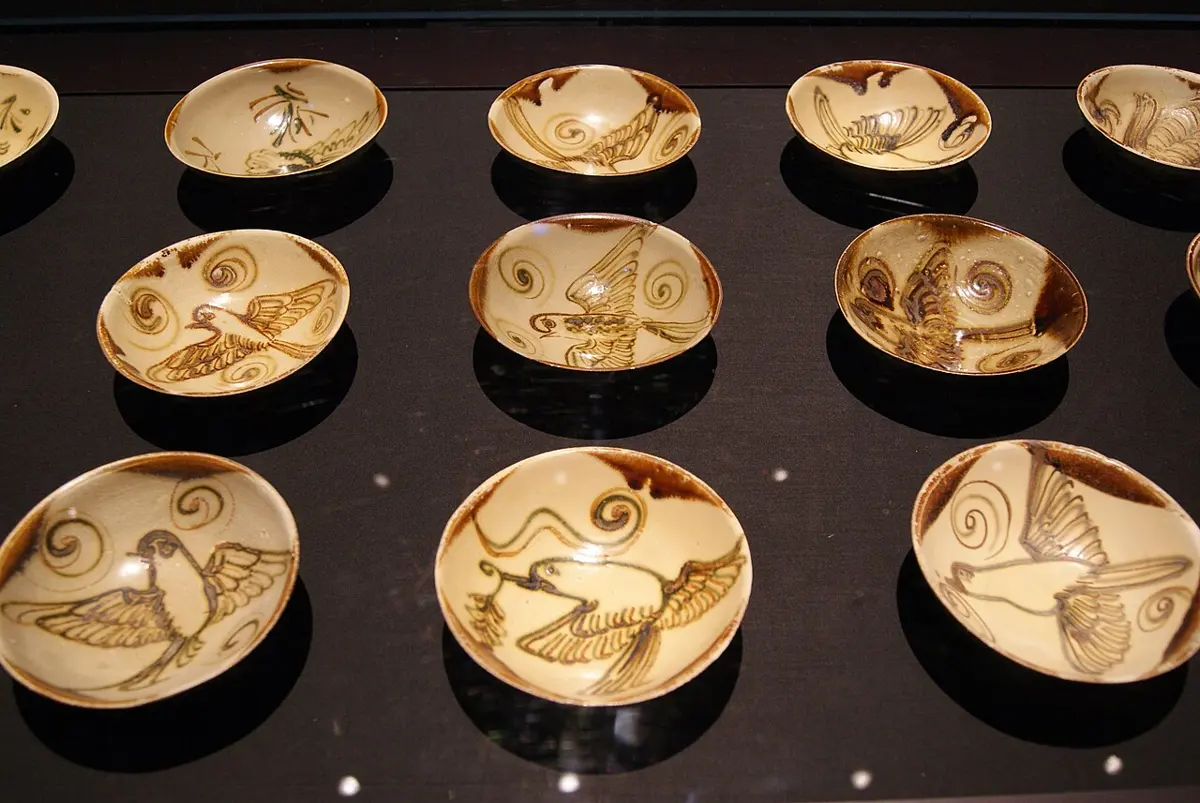
The ship was not Chinese. Its planks had been sewn together with cord made of coconut fiber, with no nails, the way boats were built around the Persian Gulf and India, and many of its timbers came from trees that grow in Africa. Those who studied it think it was most likely built in a port of the Gulf, or perhaps in Oman. Ships like it left the Gulf in autumn, as the northeast wind set in, worked their way along India’s coast and across to the straits, and then caught the southwest wind in the South China Sea to carry them up to China. When this one sank, it seems to have been on its way home, heading for the narrow sea between Sumatra and Java. People had long believed that ships from the Gulf carried the trade with China. This was the first one ever found.
How it was found matters too. The wreck was raised by a private salvage company, and the cargo was sold, in the end to Singapore, where it is shown today. Many archaeologists object to selling finds from the seabed, and a museum in the United States canceled a show of it after they protested. Much of what the ship could have told, about how it lay, what was stowed where, was lost.
Monks, kings and the straits
Between India and China, every ship had to pass the narrow seas around Sumatra and the Malay peninsula, and whoever held them grew rich. For several centuries that was a kingdom that Chinese travelers called Foshi and historians call Srivijaya, with its center near today’s Palembang, on Sumatra.
It was also a place of learning. A Chinese monk named Yijing, sailing to India to study, stopped there for six months to learn Sanskrit grammar before going on. On his way home he stayed for several years more, copying and translating books. More than a thousand Buddhist monks lived in the city, he wrote, studying every subject just as monks did in the heart of India.
About three centuries later, a monk from Bengal made the journey the other way round. अतीश दीपङ्कर (Atīśa Dīpaṅkara), already a famous teacher, sailed for many months, his Tibetan biographers say, to study with a master in Sumatra, and stayed there for twelve years. Then he sailed home to India. Years later he was invited to Tibet, and on his way north he spent about a year in Nepal. Tibetan books say he was welcomed at Swayambhu, in Kathmandu, and by Nepal’s king, and that a monastery was built there at his word. It is usually taken to be थँबहिल (Thã Bahī), in what is now Thamel, though it seems older than his visit, so he may only have rebuilt it. Nepal’s own chronicles and inscriptions, oddly, say nothing of him: the story is Tibet’s. He went on to spend his last thirteen years in Tibet, where he is remembered as one of its great teachers. A monk who carried learning from Sumatra to Tibet passed through Kathmandu on the way, by Tibet’s account.
The kings of Srivijaya and the Chola kings of south India had once been friends. Some years before अतीश left Sumatra, a king of Kadaram, from the family that ruled Srivijaya, built a Buddhist monastery at Nagapattinam, a port on the Chola coast, and the Chola king gave a village to pay for its upkeep. Copper plates that record the gift are kept today in Leiden, in the Netherlands. But in about the years अतीश sailed home, the next Chola king, Rajendra, sent a fleet across the Bay of Bengal. His inscription on the walls of the great temple at Thanjavur lists what he claimed. Having sent “many ships in the midst of the rolling sea”, it says, he caught the king of Kadaram with his war elephants, took his treasure and a jeweled gateway, and then it names the ports one after another, Srivijaya among them, ending with Kadaram, which is now thought to be Kedah, in Malaysia. Why he did it, the inscription does not say, and historians still argue. Some think Srivijaya had been getting in the way of south India’s trade with China. Others see one more raid for plunder and glory, by kings who had been raiding their neighbors for years. Srivijaya survived it.
The Swahili coast
The same guidebook that told Greek sailors to leave in July names the last market on the African coast it knew, a place called Rhapta, somewhere off today’s Tanzania. Its people, it says, sailed in boats sewn together, and sold ivory and tortoise shell for iron tools, spears and glass. Each town, it adds, had its own chief.
A thousand years later, that coast was lined with stone towns. The richest was Kilwa, on a small island off southern Tanzania. People lived there for a thousand years, and it was at its height around seven hundred years ago, when gold from the lands to the south passed through its hands. Gold and ivory came down from the interior; silver, carnelian beads, perfume, Persian tiles and Chinese porcelain came in by sea. Kilwa minted its own coins. Its Great Mosque, begun about a thousand years ago and enlarged later, is the oldest mosque still standing on the coast of East Africa, and its great dome, when it was built, was the largest in East Africa. On the cliff above the sea its sultans built a palace with an eight-sided bathing pool.
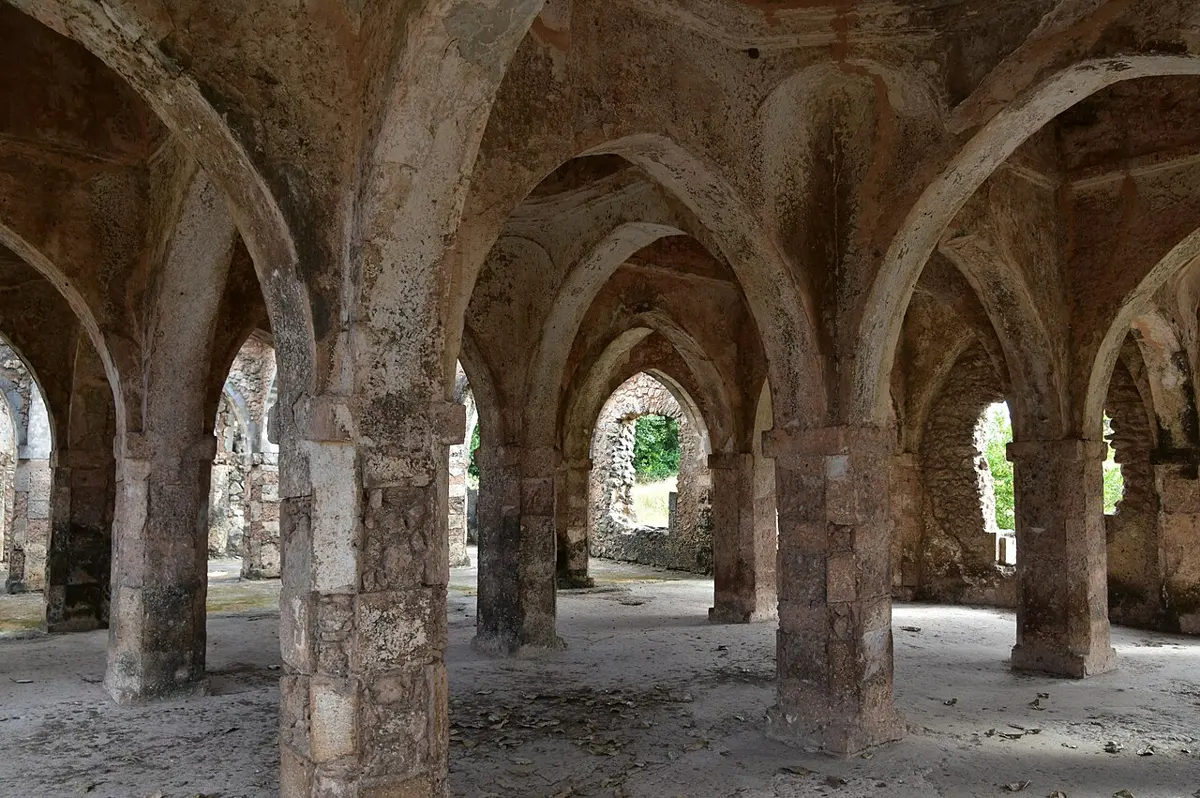
The Moroccan traveler Ibn Battuta landed there seven centuries ago and called Kilwa “a very fine and substantially built town”. He praised its sultan, who gave a fifth of what he took in war to the poor, and whom he saw give the clothes off his back to a beggar. He also noted, as a stranger would, that its people were very dark, with tattoo marks on their faces. The gold, he heard, came from a place far inland, a month’s journey away.
Who were the people of these towns? Archaeologists of the colonial years, seventy years ago, gave the credit to settlers from Persia and Arabia, and looked past the Africans who built and lived in them. In fact imported goods are only a small share of what is dug up there. A few years ago, a team of geneticists and archaeologists, African scholars among them, read the DNA of eighty people buried in six of these towns over five hundred years. More than half of their ancestry came from Africa, mainly from African women. A large share came from Asia, most of it from Persian men, and the mixing began about a thousand years ago, around the time Islam spread on the coast. The towns’ own oldest history, a chronicle of Kilwa’s sultans, tells of founders who came from Shiraz, in Persia, and the DNA fits that story. But the towns’ leading families were not foreign settlers: they grew out of these mixed families, on the coast. And the children of those marriages grew up speaking their mothers’ language. Swahili, the language of the coast today, is an African language, a Bantu language like those spoken deep in the continent, with many words borrowed from Arabic and Persian.
Salt for gold
On the other side of Africa, the trade crossed not water but sand. The desert had its own ships: camels. South of the desert, in the lands along the Niger River, there was gold. North of it, and in the desert itself, there was salt, which people in the hot lands to the south needed and did not have. The trade across the Sahara was, above all, salt for gold.
The first kingdom that grew rich on it was Ghana, in what is now the south of Mauritania and the west of Mali, far from the country called Ghana today. Ruins at Kumbi Saleh, in Mauritania, with a mosque counted among the oldest in West Africa, are thought to be its capital, though not every archaeologist agrees. A scholar in Muslim Spain, al-Bakri, who never went there but questioned the merchants who did, described its capital about nine hundred and fifty years ago as two towns. In one lived the Muslim merchants, with twelve mosques. In the other, about ten kilometers away, lived the king, who was not a Muslim, though his interpreters, his treasurer and most of his ministers were. The king took a tax on every load of salt that came in and twice as much on every load that went out, and he kept every nugget of gold for himself, leaving the people only the gold dust, so that gold would not become too common to be worth anything.
Ibn Battuta crossed the desert too. Starting from Morocco, he reached a place called Taghaza in twenty-five days. Its houses and its mosque were built of blocks of salt, roofed with camel skins, and no one lived there except the slaves who dug the salt for their masters. A camel carried two slabs. In the first town south of the desert, he says, a load sold for eight to ten mithqals, weights of gold, and in the capital of Mali for twenty to thirty. From Taghaza the caravan went on across waterless country, hiring a guide who rode ahead to the next town to send water back, and reached the edge of the grasslands two months after leaving Morocco.
Later the kingdom of Mali held the gold lands, and its most famous king was Mansa Musa. In 1324 he set off across the desert on the pilgrimage to Mecca, and he came through Cairo. Egyptian officials who met him told their stories to a writer named al-Umari, who wrote them down about a dozen years later. Musa, they said, would not kiss the ground before the sultan of Egypt, as visitors were expected to: he said he bowed only to the God who created him. He told them he had come for the pilgrimage and nothing else. He and his people gave away and spent so much gold that its value in Cairo fell, and twelve years later it still hadn’t recovered.
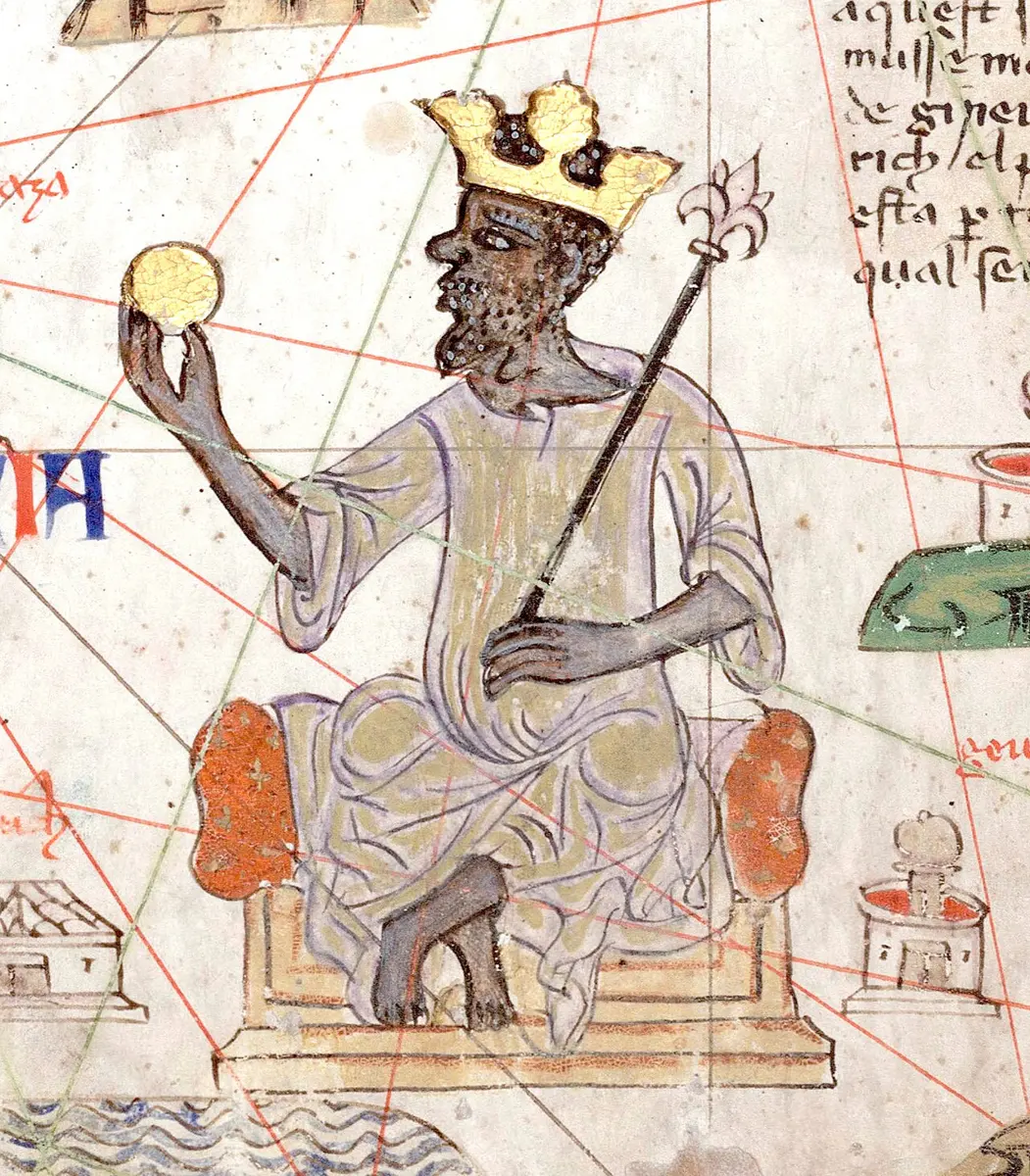
The story has grown in the telling ever since, and modern lists that call Musa the richest person who ever lived rest on guesses, not on any figure from his time. Africa’s own historians told it with more care. Three hundred years later a scholar of Timbuktu, al-Sa’di, wrote his country’s history. He calls Musa pious and just, and passes on the grand figures, sixty thousand men in the caravan and five hundred slaves walking ahead of him, each carrying a staff of gold. But he adds that the histories written in the East did not remember Musa as especially generous, and that he gave less in alms at the holy cities than a later king of his own land would give. He also tells, from Ibn Battuta, that Musa ran short of money on the way home and borrowed from a merchant of Alexandria.
At home, Musa is remembered for a building. On his way back from Mecca, al-Sa’di says, Musa took Timbuktu, the first king ever to rule it, and built its great mosque, the Djinguereber. Al-Sa’di’s Timbuktu began, he says, as a camp of desert herders by the river, where they left their goods in the care of an old woman, and the town took its name from her. He loved it: “my homeland,” he calls it, “and what is dearest to me in the world”. Scholars came there from Egypt, from the desert oases and from Morocco, and so did books.
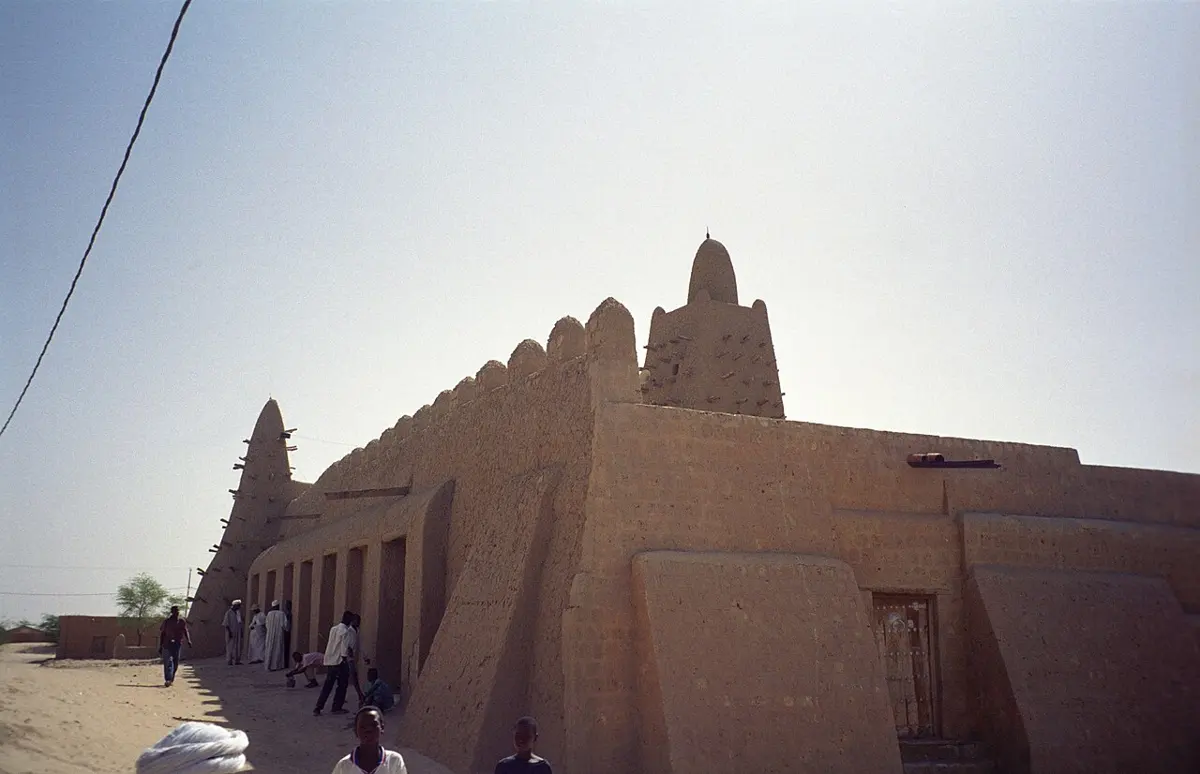
The books stayed. Families in Timbuktu kept libraries of handwritten books for centuries, the oldest of them about eight hundred years old. A little over a decade ago, armed groups linked to al-Qaeda took the town. Librarians and families carried the manuscripts out to Bamako, the capital, in chests and rice sacks, by donkey cart, boat and motorbike, some 285,000 of them by the count of scholars who worked with the libraries. More than four thousand that were left behind were burned or lost, but nearly all were saved. Since last year they have begun to go home, because Bamako’s damp air was harming them.
Memory with music
Ibn Battuta spent eight months in Mali’s capital, and its king, Sulayman, did not impress him. His welcome gift was three loaves of bread, a piece of fried beef and a gourd of sour milk, and Ibn Battuta laughed at it. But he admired the country’s safety: a traveler there, he wrote, had nothing to fear from thieves. And at the king’s audiences he saw something new to him.
The king’s interpreter, Dugha, played an instrument of reeds with small gourds underneath, and sang a poem in praise of the king, recalling his battles and brave deeds. On festival days poets came dressed as birds, in costumes of feathers with wooden heads and red beaks, stood before the king and recited. Their poems, he was told, said something like this: this platform you sit on is the one this king and that king sat on, and these were their good deeds; so do good deeds whose memory will live after you. It was a very old custom, Ibn Battuta was told, older than Islam in that country.
These singers were what West Africa still calls griots, or in Mali’s own languages jeli: women and men born into families whose work, passed from parent to child, is to remember. They keep the history of kings and families and sing it on great occasions, and they have served kings as advisers and go-betweens too. Ibn Battuta’s Dugha is the first griot anyone has found clearly described in writing. Griots often sing to the music of the balafon, the instrument of wooden slats and gourds that Dugha may have been playing. The best known of their songs is the epic of Sunjata, the man who built the empire of Mali. In a village in Guinea a family of griots, the Kouyaté, still keeps a balafon of twenty slats, about one and a half meters long, which they say belonged to Sumaoro Kanté, a king of about eight hundred years ago, and only the head of the family may play it.
The Kathmandu Valley kept its memory a different way: on palm leaf. One of the two oldest of its chronicles, the गोपालराजवंशावली (Gopālarājavaṃśāvalī), is a list of kings and what happened in their reigns, probably put together by someone close to the court. It is told in Nepal’s History, for the Curious, in What History Is. Song and script look like opposites, one changing a little at every telling, the other fixed on the page. But the two have a lot in common. Both were kept by specialists who served kings, and both remember what kings wanted remembered. Both mix legend with fact, more of it the further back they go. And historians check both in the same way: against what outsiders saw and wrote at the time. The Valley’s chronicle is tested against inscriptions on stone; Mali’s epic, against travelers like Ibn Battuta, who watched the griots sing and wrote down what he was told they said.
So Africa and Asia were never really separate. Across the Indian Ocean, a wind that turned round twice a year carried ships between Africa, Arabia, India and China, on a timetable everyone shared, and the towns along its shores, Kilwa, Srivijaya’s harbors and the ports of the Chola kings, grew rich by waiting for it. Across the Sahara, camels carried salt south and gold north, and Mali grew rich enough for its king’s pilgrimage to shake the price of gold in Cairo. Both trades carried enslaved people as well as goods. And both carried learning: monks to Sumatra and on to Tibet, through the Kathmandu Valley; books and scholars to Timbuktu. When Portuguese ships at last came round Africa into this ocean, they found it already full of traders (Chapter 19).
Meanwhile, in Nepal: in 1324, the year Mansa Musa passed through Cairo, the Sultan of Delhi took Simraungadh, in the Tarai, and its last king, Harisimha, died a refugee in the hills; the raids on the Valley from Simraungadh and from the western hills, and the city’s fall, are in Nepal Mandala and Simraungadh, in Nepal’s History, for the Curious.
Found a mistake? Please tell us.