
In the winter of 1898, an English scholar of Sanskrit named Cecil Bendall came to Kathmandu to make a list of old manuscripts. He worked in the library people then called the Durbar Library, and among its bundles of palm leaves he found a small chronicle of the Valley’s kings. Each leaf is a strip about 28 centimeters long and 5 wide, written in five lines on both sides, with a hole near the middle for the string that held the leaves together. Forty-eight leaves survive. The first sixteen are gone, so the book now opens in the middle.
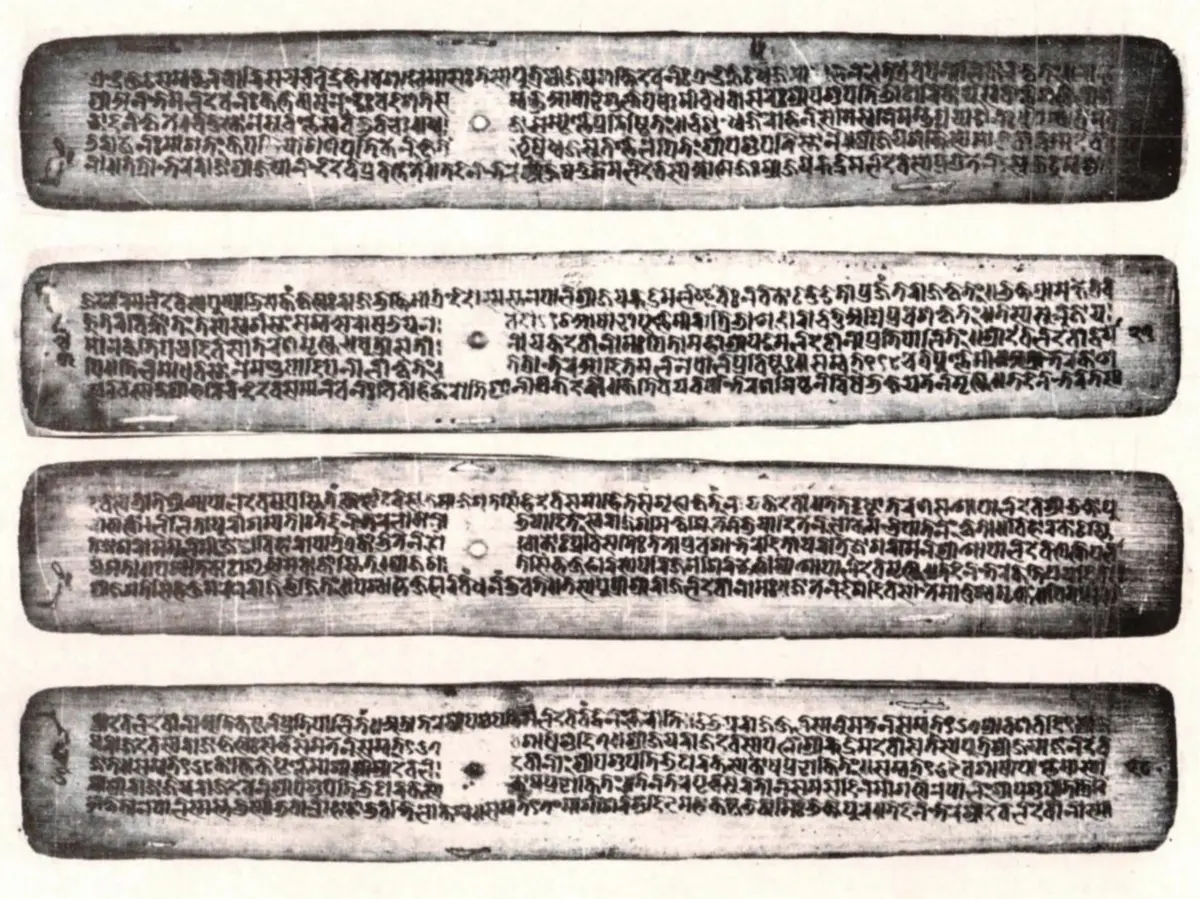
The first half is written in a rough, ungrammatical sort of Sanskrit. The rest is in old Newari, so far from the Newari of Bendall’s day that he wrote he could get “no adequate help in Nepal or in Europe” to read it. Half a century later another historian still called editing it “nearly hopeless”. A full edition, with every leaf photographed, read and translated into Nepali and English, came out only in 1985. Today it is called the गोपालराजवंशावली (Gopālarājavaṃśāvalī), the chronicle of the cowherd kings, after the first line of kings it names, and it is one of the two oldest chronicles of Nepal, and much the fuller of them.
What it says is a mixture. Where the surviving leaves begin, the Valley is a dense forest, and the chronicle tells the sacred story of how Pashupati was found: a cowherd named Nepa notices that his brown cow goes every day to the bank of the Bagmati and lets her milk flow into a hole in the ground, and when he digs there, the god appears. Then come the cowherd kings, one ruling for 86 years, the next for 73, the next for 91.
But in the two centuries before it was written, in the late 1300s, its voice changes. It starts to sound like someone keeping a careful diary. It records an earthquake that killed a third of the people, the king among them. It records a fire set on purpose in the town of Bode that killed 24 people, 46 buffaloes, 116 cows and calves and 58 sheep and goats, and chickens, dogs, sparrows and pigeons. It records a feast for the whole neighborhood when a new canal at Bhaktapur was finished in a fortnight, and lists what was eaten and drunk, down to the 220 jars of beer. Its last readable lines tell of a royal priest who had his own brother put in chains, and of a complaint to the king about it. Then the writing fades out.
So here is one old book with a sacred story, a king who rules for ninety-one years, and a fire counted down to the sparrows. How much of it is a record of what happened? The answer is different for different pages, and working that out is what history is.
Traces and questions
History is the story of the past, worked out from what the past left behind. Nobody can go back and look. All anyone has are traces: words cut in stone, coins, books, letters, royal orders, buildings, things buried in the ground, and what people remember and pass on. The word itself says so. It comes from the Greek historia, learning by asking around and looking into things. The Greek writer Herodotus, who lived about 2,500 years ago and wrote about the wars between the Greeks and the Persians, is often called the father of history. He wrote, he said, so that what people had done wouldn’t be wiped out by time.
Every trace was made by somebody, at some time, for some reason. A trace made by people who were there, at the time, is called a primary source: the king’s own stone, a letter, a photograph. A book written later from such traces, like this one, is a secondary source. The chronicle is both. For the cowherd kings it is copying old stories written down by others. For its last decades it is close to a diary: its writer seems to have lived near the court at Bhaktapur, through many of the things he set down.
So a historian asks the same few questions of every trace. Who made it, and when? Was the maker there? Whom was it made for, and what did they want that reader to think? And does anything made by somebody else agree with it, or disagree? None of these makes a source simply good or bad. They show what it is good for. The time before people wrote anything down has only the things they left in the ground, and it is usually called prehistory. Once there is writing, there is far more to work with, and far more to question.
A pillar that disagrees
The chronicle can be checked. In its list of the Licchavi kings, who ruled the Valley about 1,500 years ago, it gives the best known of them, मानदेव (Mānadeva), a father with a different name from his real one, and puts his grandfather and his father after him instead of before. It even tells how that father died: beheaded at night by his own son, who didn’t know whom he was killing, and who then wandered weeping and did penance on a hill where a stupa rose.
How does anyone know that the chronicle is wrong, and not the other way round? Walk up to the temple of Changu Narayan, on its ridge north of Bhaktapur. In front of it stands a stone pillar, and on the pillar, in Sanskrit, are words मानदेव had cut there himself. They give the date as the year 386, which most historians read as 464 CE. Exactly which year the Licchavis counted from is a puzzle of its own, for a later chapter. The words also name his family: his father was Dharmadeva, and his mother was the queen राज्यवती (Rājyavatī). Before them came his grandfather and great-grandfather.
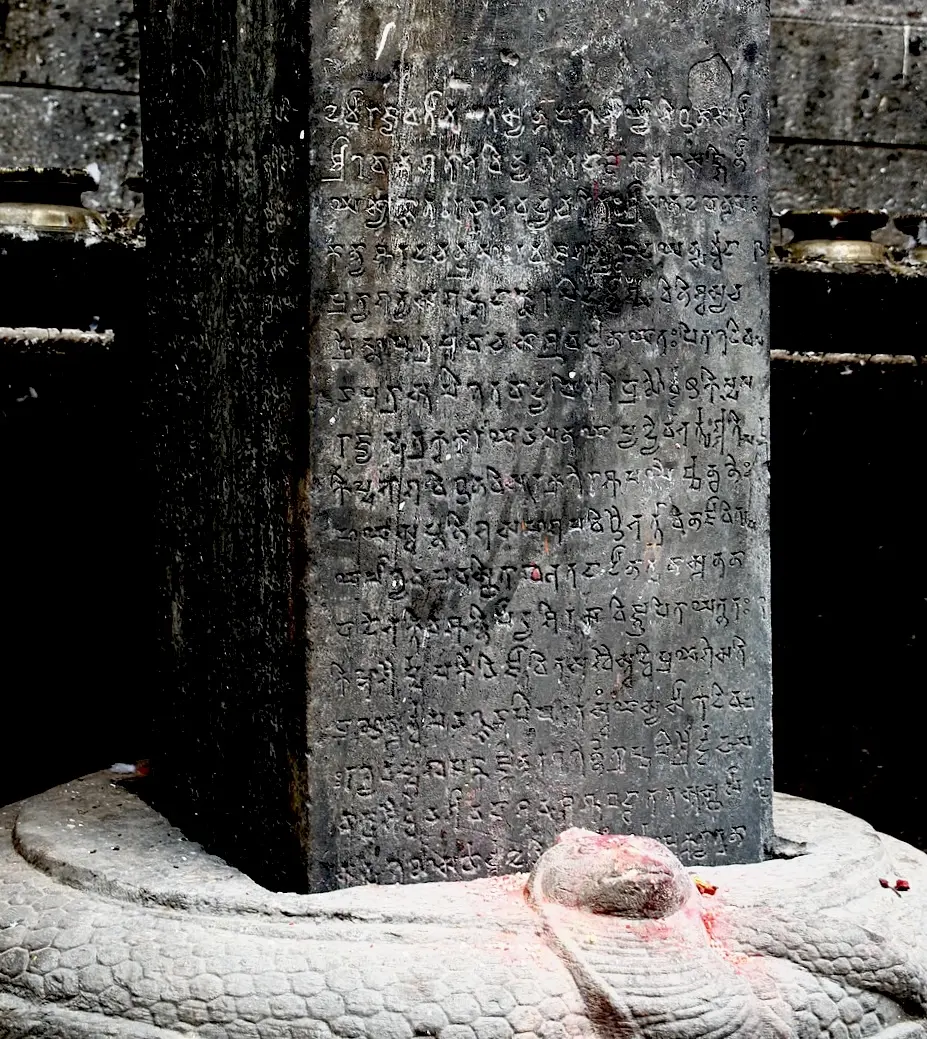
The stone wins. It was carved while he was alive, by people who knew his father. The chronicle was put together about nine hundred years later, from older lists that had been copied again and again. And the stone has company. A later king, Jayadeva, had his own ancestors carved on a stone nearly three hundred years after मानदेव, and his list agrees with the pillar, not with the chronicle. Two stones made centuries apart, by different kings for their own reasons, give the same order. That is very hard to get by chance.
Does that make the chronicle useless? Far from it. For the Licchavis it is muddled. For the 1200s and 1300s, the years its writer and his sources lived nearest to, historians trust it much more, and for some events it is all there is. A source is good for some things and poor for others.
The pillar has a weakness too, and it isn’t a wrong name. It is the king’s own voice. Read on, and the stone tells a story. Dharmadeva has died. राज्यवती tells her son that today she will follow his father’s path, meaning onto his funeral fire. मानदेव presses his head to her feet and says that if she goes, he will give up his life first. She stays. Then the son marches east, where the princes come under his orders, and west across the Gandaki, takes a town, and comes home to give his riches to Brahmins.
It is one of the oldest pieces of writing in the Valley, and already it is the story a king wanted told. The princes in the east may have told it differently, and nothing on the stone says what the war cost or who paid for it. Most old inscriptions are like this. They were cut to record a gift to a god, a grant of land or a ruler’s victories, so they show kings, priests and donors, and almost nobody else. The farmers who grew the Valley’s rice left no stones. A record shaped by who could pay to make it has gaps that can’t be seen by reading it, only by asking who is missing, which is what Stories and what’s missing, in Thinking Clearly, for the Curious, is about.
Things in the ground
For about a century, the pillar of मानदेव was the oldest inscription anyone knew of in the Valley. Then the ground gave up older ones. One turned up in May 1992, when workers digging the foundation of a house in Maligaon, in eastern Kathmandu, hit a stone figure lying face down about a meter under the ground. It was a man, life-size, carved in sandstone and broken into four pieces. On its base were a date, the year 107, and a name: the great king Jaya Varma. Most scholars read the date as 185 CE, nearly three hundred years before मानदेव. One trench for one house pushed the Valley’s written history back by centuries.
That is archaeology at its luckiest. Most of it is slower: digging carefully in layers, where what lies deeper is usually older, and dating what turns up by the style of its pots, by coins mixed in with it, or by the charcoal from old fires. Its great strength is that it finds things nobody meant to leave for us. A broken cooking pot wasn’t trying to impress anyone. Its weakness is that a pot can’t speak. It can show that people cooked here, not what they believed or what they called their king.
Coins sit halfway between the two. They are things, dug up by the thousand, and they carry words. The earliest Licchavi coins show a lion on one side with the name मानाङ्क (Mānāṅka), and on the other a goddess seated on a lotus. The name points to मानदेव, and the Grade 9 इतिहास book says he issued them. The specialists who have cataloged Nepal’s coins disagree. They find no Licchavi coins as early as मानदेव, and date this one to the late 500s, two or three generations after his death, when a later king and his powerful minister may have chosen to honor the dynasty’s great king. A coin can carry a name and still not come from that person’s time, the way a bank note with a famous face on it doesn’t come from that person’s life.
Paper and voices
Closer to our own time, the traces multiply, and most of them are paper. One of the most useful is the लालमोहर (lālmohar), a royal order stamped with the king’s red seal. Here is one, from 1807, in the name of the boy king Girvan Yuddha Bikram Shah. It gives land to a man named Badhuwa Nagarchi, so that he can look after two great banners and three long trumpets that had been offered to the goddess Degutaleju at the Hanuman Dhoka palace. It lists every field, in Dumkot, Bisankhu and other places, and the boundary of each: a stream on one side, a cliff on another. It says what the land must pay for each year, down to five rupees for a male buffalo at Dashain. It names the neighbors who walked the boundaries as witnesses, Thapas, Khadkas, Basnyats, Ranas, Mijhars and others. And it ends with an old Sanskrit curse: anyone who takes back land once given will be born a worm in dung for sixty thousand years.
No chronicle would mention Badhuwa. Yet here he is, with his fields, his duties and his neighbors, because a piece of paper mattered enough to someone to be kept for two hundred years. That is the strength of such papers, and their trap. They were kept because they proved a right to land, so they speak for those who held land. And they say what was ordered, not what happened. Whether the buffalo was bought every Dashain, the order can’t tell us.
The Newar cities of the Valley left another kind of paper, the ठ्यासफु (thyāsaphu), a “folded book”, its leaves joined so that a reader goes from one to the next without turning any over. From the 1500s to the 1700s, writers close to the courts kept them as diaries: births and deaths in the royal families, festivals, quarrels, omens. They are close in kind to the later pages of the chronicle Bendall found. Copyists of religious books often ended their work by naming the king who ruled while they wrote, and for some centuries after the Licchavis these few lines at the ends of manuscripts are almost the only names and dates there are.
Outsiders left their reports too. Envoys from China passed through the Licchavi kingdom, and China’s histories describe its king on a lion throne, hung with pearls and coral. Much later came Catholic priests and British officers. An outsider notices what local people take for granted, and misses what they would never say out loud. An Italian priest who lived in Patan while the Valley fell to Gorkha left one of the fullest accounts of it, and he also took one side in that war, which has to be kept in mind each time he is quoted.
Then there is memory. Much of Nepal’s past was never written down by the people who lived it. Among the Limbu, the मुन्धुम (Mundhum), their body of sacred oral tradition, is chanted by priests, and in one family line’s rite the priest must chant the names of all its clans: a family tree held in the voice. Historians make a useful difference here. Oral history is what people saw themselves and tell, like a grandmother’s account of the earthquake of 2015. Oral tradition is what was handed down through many generations, and it tends to change in the passing, as each teller fits it to their own time. Neither is worthless. Oral tradition often keeps what writing dropped, especially about people who weren’t kings. A historian treats it as one more trace, to be weighed like the rest.
Weighing it all
Weighing is most of the work. A trace made close to the event, by someone with no reason to bend it, counts for more. Two traces that agree count for more than one, but only if neither copied the other.
The earthquake in the chronicle shows how far that can go. On a Monday in June 1255, it says, there was a great earthquake. Very many temples fell. For a fortnight to a month people had to leave and live outside. A third of all the people died, and so did the king, Abhaya Malla. For centuries that entry was all anyone had. Then a team of geologists went looking for places where Nepal’s great earthquakes had broken the ground. In the valley of the Sir River, in eastern Nepal where the hills meet the plain, they dug trenches across the ground and studied the cliffs a river had cut, and in the layers they found where the earth had broken right up to the surface. Charcoal in those layers, dated by its radiocarbon, fits 1255. A palm-leaf chronicle and a trench full of mud, made some six hundred years apart by people who knew nothing of each other, tell the same story. Neither proves it alone. Together they’re very hard to doubt.
Sometimes the weighing goes the other way, and a document turns out to be a fake. The case every history book tells comes from Italy. For hundreds of years, popes pointed to a paper called the Donation of Constantine, in which the Roman emperor Constantine, cured of leprosy and baptized by Pope Sylvester, gave him Rome, all of Italy and the western half of the empire. From the 800s to the 1400s nearly everybody accepted it.
In 1440 a scholar named Lorenzo Valla read it the way a historian reads, by asking whether its words fit the time it claimed. They didn’t. The emperor in it speaks of his “satraps”, a Persian word for governors. “Whoever heard of satraps being mentioned in the councils of the Romans?” Valla asked, and he went on through the text phrase by phrase, finding Latin no Roman of Constantine’s day would have written. The Donation, scholars now agree, was written about four hundred years after Constantine. And the same questions apply to the critic. Valla worked for a king who was at war with the pope, so he had his own reason to want the Donation gone. He was still right, because his argument didn’t depend on whose side he was on: anyone could check it. A forgery from our own time, and how experts were fooled by it, is the story of Whom to believe.
None of this makes history a matter of opinion. Some things are settled as firmly as anything can be: मानदेव was Dharmadeva’s son, a great earthquake struck the Valley in 1255, Badhuwa Nagarchi held fields in Dumkot. Others are argued, and good history says which is which. Much of what follows in this book is known from a few traces, each made by someone for a reason of their own, and the honest thing is to say how well each thing is known. The Grade 9 सामाजिक book sorts these same sources of history into kinds. And the traces keep coming: a statue turns up in a house trench, a trench across a fault agrees with a chronicle, papers come out of family boxes to be photographed and read.
So history isn’t the past itself, which is gone, but the best account that can be built from what the past left behind. Each trace, a pillar, a coin, a palm-leaf chronicle, a royal order, a song, was made by someone, for someone, and shows what its maker saw and wanted said. Asking who made it, when, why and what else agrees is how a historian tells a reign of ninety-one years from a fire counted down to the sparrows. The next puzzle is one nobody has solved: where the name “Nepal” comes from.
Found a mistake? Please tell us.