
Around 1834 the British Resident in Kathmandu, Brian Hodgson, rode on an elephant into a patch of jungle in the Tarai, near today’s border with India. His elephants could hardly push through. The jungle was about twelve miles round, full of tigers, wild boar and deer, and nobody farmed it, though the land all around was plowed. Anyone who swung an axe or drove a plow in there, it was said, would feel the anger of the goddess Kali. Hodgson climbed a mound about 25 feet high, made of what was left of a palace, and looked around. He saw “nothing but a wilderness”.
Yet the mound was a palace, and the wilderness had been a city. A local Brahmin told him that in April and May, when the jungle was thinnest, you could see the whole plan of it: a long rectangle inside an outer wall of mud brick and an inner wall of fired brick, with ditches of water outside. Hodgson paced out a great tank, 333 paces by 210, lined with bricks a cubit square and so heavy that one weighed nearly a man’s load. Some twenty carved stone gods had been pulled from the rubble by a holy man, many of them broken. “It is barely 500 years,” Hodgson wrote in a letter printed in 1835, since this had been a walled city, “the pride and the defence of Mithila”.
The place was Simraungadh, in today’s Bara district, a little under a hundred kilometers south of Kathmandu in a straight line. For about two hundred and thirty years, from 1097 to the 1320s, it was the capital of a kingdom on the plains, and that kingdom shaped the Valley’s history more than any army ever did.
A king from the south
The kingdom was called Tirhut, another name for Mithila, the flat, rich plain between the Gandaki and the Kosi rivers that stretched from the foot of Nepal’s hills down to the Ganga. Its kings came from very far away. The founder, Nanyadeva, was from Karnataka, in the south of India, well over a thousand kilometers off. He was praised as “the ornament of the Karnata family”, and in his own book he called himself “chief of the great vassals”, the title of a nobleman who served a greater king, not of a king. The man who founded a new line of kings in Bengal at the same time came from Karnataka too. How a southerner came to rule here isn’t really known. In those years armies from the Deccan, in southern India, raided far into the north, and the likeliest story is that he came with one and stayed. He is often said to have been a general of Vikramaditya VI, the great Chalukya king of the Deccan, and he may have been, but no record of his time says so. His family is called the Karnat kings.
An old verse, remembered both in Mithila and in the Valley’s chronicles, gives the day he made himself king: a Saturday in the month of Shrawan that works out as 18 July 1097. He ruled for about fifty years from his new capital. He was also an author. He wrote a long commentary on the oldest Indian book on music and drama. It is a good start for a kingdom whose court would care about words and songs.
Mithila’s own memory counts six kings, from Nanyadeva to the last, Harisimha; the documents show at least two more whom that memory forgot, and the reigns can be dated only to within a decade or two.
In the Valley the people of Tirhut were known as the Doya. Their raids into the hills began early. One short line in the Valley’s old chronicle, the गोपालराजवंशावली (Gopālarājavaṃśāvalī), says that in August 1111 a man named Naramalla “cut to pieces” the Doya. Later chronicles, written centuries afterward, turned this into a conquest and had Nanyadeva rule the Valley from Bhaktapur. No record of his own time says so. What the evidence shows is a neighbor who came raiding and was thrown back.
Seven walls
The best look we have at Simraungadh while it stood comes from a Tibetan monk, Dharmasvamin, who walked through Tirhut on his way to the Buddhist holy places of India in 1234 and back again in 1236. His travels were written down by a pupil, from what he told him. He described a town called Pa-ta, with “some 600,000 houses”, which is surely far too many. It was surrounded by seven walls, each about as high as a Tibetan fort. Outside the town walls stood the king’s palace, with eleven large gates, ringed by twenty-one ditches of water and rows of trees. More than ten archers guarded each bridge over the ditches, because the Turkish armies of the Muslim sultans had marched on the town that very year and failed to reach it. Somewhere in Tirhut, off the road, grew a grove of dark green sugarcane, where the raw sugar came from.
On his way home Dharmasvamin fell ill in Tirhut for two months. When he could walk again, he was told that the king, Ramasimha, was coming to the town square. It happened once a year. The king rode a female elephant, seated on a jeweled throne behind a curtain, with drummers, dancers, banners and conch shells, and silk hung from every rooftop. A minister sent a sedan chair for the monk and told him plainly that the king would punish him if he stayed away. Dharmasvamin greeted Ramasimha with verses in Sanskrit. The king was pleased, gave him gold, cloth, medicines and rice, and asked him to become his own priest. Dharmasvamin said no: a Buddhist monk could not be guru to a Hindu king. The king took the refusal well and asked him to stay a few days.
Most historians think Pa-ta was Simraungadh, though the name is odd and a few place it elsewhere in the same plain. The ground backs them up. Italian and Nepali archaeologists surveyed and dug at Simraungadh in 1991, 1992 and 1994. They found an inner earth rampart, still six or seven meters high in places, with a wall of fired brick on top. It runs about seven and a half kilometers from north to south and four and a half from east to west, which makes Simraungadh one of the largest old city sites in all of South Asia. Outside it they could still trace lower rings of earth bank with small ditches between them, one after another. Water flowed through the whole system from the river: it was a defense, a guard against floods and a way to water the fields inside, all at once.
You may have read that King Ramasimha built a fort of seven walls and twenty-one moats. That description is Dharmasvamin’s, of what he saw in Ramasimha’s time, and in his account the seven walls go round the town and the twenty-one ditches round the palace. Who built them, and when, isn’t known for sure. The diggers found that the rampart was raised in two stages, on ground where people had already lived. In the middle of the city, the pottery runs from about the 800s to the 1300s. Their best guess was that both stages of the rampart belonged to the Karnat kings’ two centuries, but they were careful to call the city’s dates “a very open question”. They found the bones of very large catfish in the pits where people threw their waste, so the people here ate a lot of fish from these waters. They found that most of the brick wall had been carried off by later villagers for building. And in 1991 they found a broken piece of an inscription that seems to name King Ramasimha.
The end of Simraungadh
In 1324 the Sultan of Delhi, Ghiyasuddin Tughluq, was marching home from a war in Bengal when he turned north into Tirhut. A poet who wrote the sultans’ history about twenty-five years later, from what he had been told, describes what happened next. The jungle in front of the army was so thick that, the writer says, an ant could hardly get through it. The Sultan got off his horse, took an axe and cut down an old tree or two with his own hands, and his soldiers set to work after him. For two days they marched along the road they had cut. On the third they came to the fortress of Tirhut, ringed by seven ditches full of water. For two or three weeks after that, he says, the army attacked the country round the fort and carried off what it could. A later Muslim history says the ditches were filled and the wall broken in three weeks, and that the king and his family were taken.
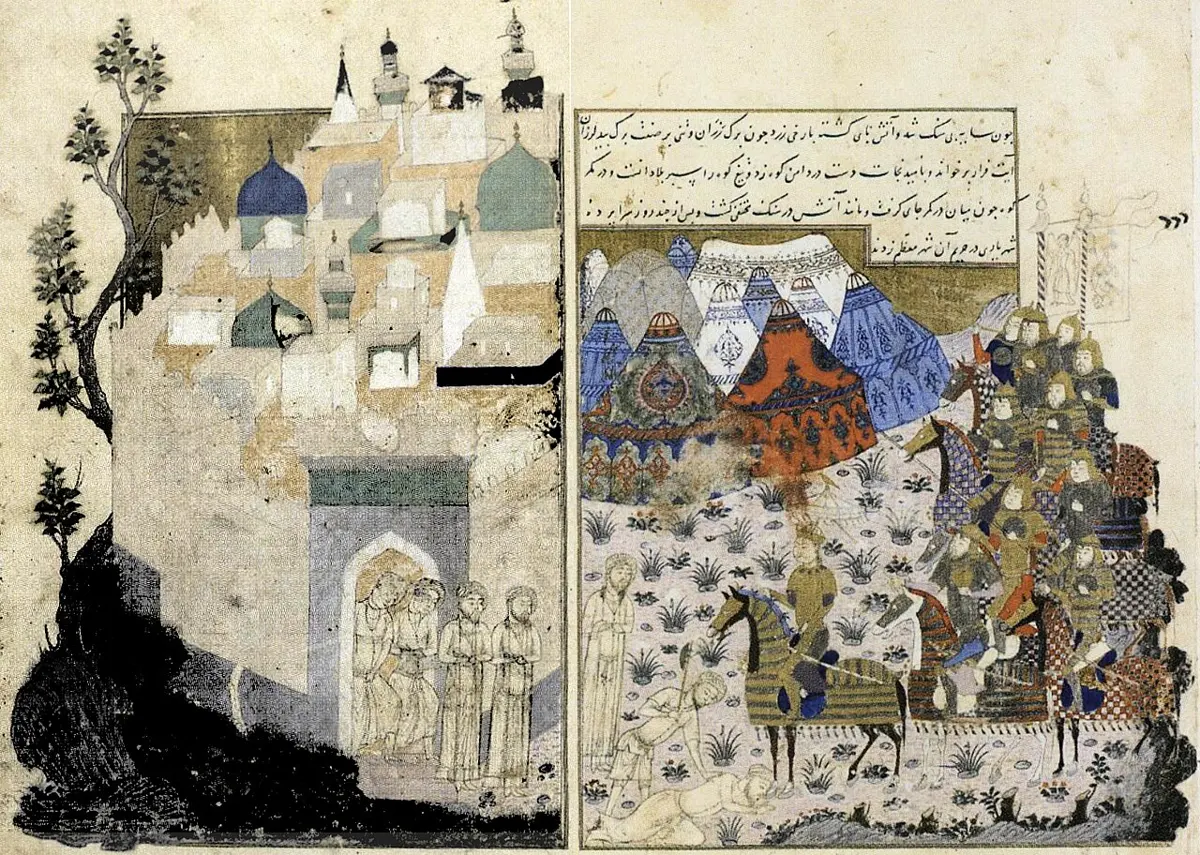
So the city fell. What happened to its king is less simple. Harisimha was carried off to Delhi, but early in 1325 Ghiyasuddin died, and the new sultan, his son Muhammad, sent the captive king home to rule Tirhut again in return for tribute. Before the year was out, Muhammad decided to take Tirhut for himself, and Harisimha fled north, into the hills. A reader may have learned all this as a single attack in a single year; the Muslim histories tell it as two steps, and the Valley’s chronicle agrees on the date of the second.
The Valley’s chronicle picks up the story on 7 January 1326. King Harisimha of Tirhut, it says, beaten by the Turks of Delhi, left Mithila with his people, and Simraungadh was destroyed. He and his minister escaped into the hills and went on toward Dolakha. The king died on the way, at a place called Jimpata, southeast of the Valley. His son and his minister, though they asked for shelter, were seized as prisoners, and a local lord took everything they had. A king who had ruled a great plain ended his life as a refugee in the hills.
Chronicles written centuries later make Harisimha a conqueror who took the Valley’s throne. The record of his own time has him die outside the Valley, a refugee.
What he left behind in Tirhut passed to the sultans. In the 1350s they handed the country to a Maithil Brahmin, Kameshvara Thakur, to govern under them, and his family, the Oinwars, held it for about two centuries. Accounts differ on which sultan chose him.
How Mithila came to the Valley
If Harisimha himself never arrived, people from his court did, slowly. A woman named Devaladevi appears in the chronicle at Bhaktapur from 1336, running one of the Valley’s two royal houses. Many historians think she was Harisimha’s widow, though no document calls her that; it is worked out from how her family is later linked to his. She is the one who married her granddaughter to Jayasthiti Malla, who went on to rule the whole Valley (Chapter 10). In the years after 1380, under Jayasthiti, the chronicle keeps mentioning Doya, people from Tirhut, living in the Valley. Learned men came too. Tirhut’s court had been one of the great centers of Sanskrit learning, famous for its logic and its law. One of Harisimha’s ministers, Chandeshvara, wrote books of law. He also boasted of beating the Valley’s king, of touching the image of Pashupati and, in 1314, of giving away his own weight in gold on the banks of the Bagmati: deeds often credited to Harisimha himself. Another of Harisimha’s courtiers, Jyotirishvara, wrote about 1324 the oldest book we have in the Maithili language, a long book of descriptions of cities, seasons, kings and battles, the kind a poet could borrow from. Old books on astronomy sit in the Valley’s libraries, one of them a commentary in the Maithili script, and one of the Valley’s own historians thinks the scholars who fled Simraungadh may have carried many of them there.
The goddess Taleju is often said to have come the same way. She was the family goddess of the Karnat kings, and tradition says she was brought from Simraungadh to Bhaktapur. Old documents show she was already known in the Valley before then. But the newcomers from Tirhut gave her worship new life, and her first great temple was built inside the palace at Bhaktapur. Kathmandu built her one in 1576 and Patan later still. To this day she is the goddess of the Valley’s old kings.
The biggest change took centuries. Under Jayasthiti and his heirs the court wrote in Sanskrit and Newari. Then, in the 1600s, the Malla kings, Jayasthiti’s descendants, grew proud of a southern ancestry. Kings such as Pratap Malla of Kathmandu and Siddhinarasimha Malla of Patan began to trace their line from Nanyadeva through Harisimha, and passed over Jayasthiti himself. The palace poets followed. The first plays at the Malla courts were in Bengali. Then Jagajjyotir Malla, who ruled Bhaktapur from 1614 to 1637, made Maithili the language of his court’s plays. Malla kings wrote songs in Maithili themselves, and copied them into their songbooks next to the love songs of Vidyapati, the great Maithili poet who had lived around 1400 at the Oinwar court. Many of the oldest and longest manuscripts of Vidyapati’s songs that survive anywhere come from the Malla palaces of the Valley. Among the kings whose Maithili songs fill those books is Ranajit Malla, the last king of Bhaktapur, whose road out of the Valley is in Chapter 17.
Maithil Brahmins served as priests and scholars at the Malla courts too. Until well after the Gorkha conquest, the languages of learning in the Valley were mainly Sanskrit, Maithili and Newari. Only then did Nepali, the language of the new rulers, take over the courts and offices, and Maithili and Newari were pushed out.
There is a strange echo of all this in the 1740s. An Italian priest, Cassiano, traveling up to the Valley in 1740, passed old ruins in the forest of the Tarai. Later, many people from Bhaktapur told him what they were: the ruins of the ancient city of “Scimangada”, the place their own kings had come from. They said it had been built inside a maze of high walls, so that an enemy had to circle it for a month to reach the center, and that it had fallen only because a minister let the enemy in. Its plan, he was told, was kept cut in stone in the royal palace at Bhaktapur, and he sketched it in his journal: a maze. No such stone is known today. The story is half true: the city did fall to a Muslim army, people from its court did end up in the Valley, and the rings of bank and ditch that the archaeologists found are just what a memory could turn into a maze.
The ruins today
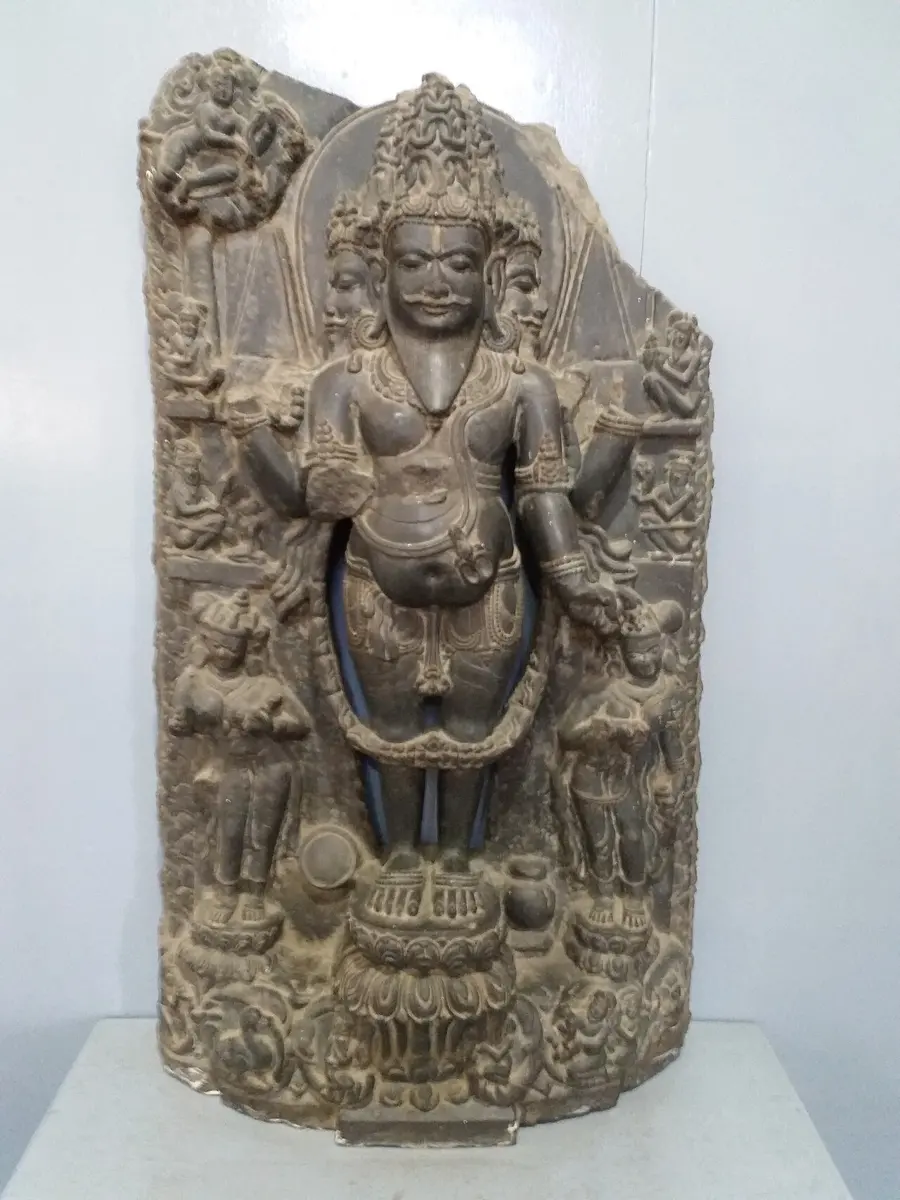
Simraungadh is a town again now, with fields and houses across the old city. Statues still come out of the ground when people dig, and some have been stolen; others wait in a house beside the temple of Kankali, or at the police station, since there is no museum. A few of the finest are in the National Museum in Kathmandu. In late 2024 the Department of Archaeology made a rushed three-week dig at a building site in Hariharpur, in the town, and found the remains of a medieval town: houses and temples, bricks of many sizes, pots, clay toys and iron nails. Eight sites in the town are protected, and nobody may dig there without leave.
So there is more to Simraungadh than a ruin in the Tarai. For more than two centuries it was the capital of the Karnat kings of Tirhut, a southern family who ruled the plain of Mithila from a city of walls, banks and ditches. Its armies raided the hills, but its kings never ruled the Valley. Their city fell to the sultans of Delhi in 1324, and its last king, Harisimha, died a refugee in the hills in 1326. But people from his court, perhaps his widow among them, and learned men from Tirhut found a place in the Valley, and over the next three centuries Maithili songs, plays, priests and pride in a southern ancestry became part of the Malla courts. Not everything in Nepal’s old culture came down from the hills to the plains. Some of it climbed up.
Found a mistake? Please tell us.