
In the Qur’an, the holy book of Islam, there is a chapter called “The Byzantines”. It opens with news of a war: “The Byzantines have been defeated in a nearby land. They will reverse their defeat with a victory in a few years’ time.” The Byzantines were the eastern Roman Empire, and the people who had beaten them were the Persians of the Sasanian Empire. For more than twenty years the two greatest powers of western Asia had been fighting the worst of all their wars. The Persians took Syria, Jerusalem and Egypt. Then the Byzantine emperor struck back, all the way into Persia, until both empires lay exhausted. Muslims have long read the verses as foretelling that turn. Whatever one makes of them, a desert town far to the south was following that war closely.
That town was Mecca, in western Arabia, and within a generation of the war’s end, armies from Arabia had taken most of what the two empires had fought over.
Around 610, a merchant of Mecca named Muhammad began to preach that there is one God, and that he was God’s messenger. Muslims believe the words that came to him over the rest of his life are the Qur’an. Opposed at home, he and his followers moved to Medina, where they became a community with its own leader, laws and army, and by his death in 632 most of Arabia had joined it. His followers then disagreed about who should lead them, and from that disagreement come the two great branches of Islam, Sunni and Shia. Arab armies conquered an empire from Spain to the Indus, and under its caliphs, the rulers who claimed to succeed the Prophet, Baghdad became the place where the science of Greece, Persia and India was put into Arabic. Today there are about two billion Muslims, one person in every four, and most of them live in Asia, far from Arabia.
Arabia, and the Prophet
Arabia was not a kingdom but a land of tribes. The two empires paid Arab tribes on their borders to guard them, and late in the 500s the Persians took over Yemen, in the far south-west. Mecca had little water. What it had was trade, and the Ka’ba, a cube-shaped shrine that Arabs came to on pilgrimage. The tribe that ran the town, the Quraysh, looked after the pilgrims, and its merchants sent out caravans. One short chapter of the Qur’an speaks of the Quraysh and “their winter and summer journeys”.
Muhammad was born into the Quraysh, in the clan of Hashim, around 570. (Muslims, when they say his name, add a blessing: peace be upon him.) His father died before he was born and his mother when he was about six, so he grew up with his grandfather and then with his uncle, Abu Talib, a merchant who took him along with the caravans. As a young man he managed the trading business of a rich widow named Khadija. She asked him to marry her, he agreed, and they were married for twenty-five years.
He liked to go alone to a cave on a mountain called Hira, outside Mecca, to think and pray. There, when he was about forty, in the month of Ramadan, came what Muslims believe was the first revelation. The angel Jibril, whom Christians and Jews call Gabriel, brought him words that begin: “Read! In the name of your Lord who created: He created man from a clinging form. Read! Your Lord is the Most Bountiful One who taught by [means of] the pen, who taught man what he did not know.” Frightened, he went home to Khadija, and she was the first to believe him.
What he preached was simple and, in Mecca, dangerous. There is one God. The idols in the Ka’ba were nothing. Everyone would be judged after death, so the rich must look after the poor, the orphan and the widow. For Muslims, Muhammad founded no new faith: he was the last in a line of prophets that includes Noah, Abraham, Moses and Jesus, sent to call people back to the one God, and the Qur’an is God’s own word, not his. Mecca’s leaders saw a threat to their gods, their pilgrims and their trade. His followers were mocked, beaten and boycotted. Some fled across the Red Sea to the Christian king of Aksum, in what is now Ethiopia, who took them in. After Khadija and Abu Talib died, Muhammad had no protector left.
Then men from Yathrib, an oasis town about 300 kilometers to the north, invited him to come and settle the feuds among their tribes. In 622 he and his followers moved there. The move is called the Hijra, the emigration, and Muslims count their years from it; the town came to be called Medina, the City of the Prophet. In Medina, Muhammad was a lawgiver and a ruler as well as a prophet. His house became the first mosque, and a freed African slave named Bilal was chosen to call the faithful to prayer. Medina fought Mecca for most of the next eight years, in battles and raids, and also fought some of the Jewish tribes of the oasis, which Muslim tradition says had broken faith with it; they were driven out or killed. Eight years after the move, Mecca surrendered, with little fighting. Muhammad pardoned most of his old enemies and cleared the idols from the Ka’ba. Two years later, after one last pilgrimage, he died in Medina.
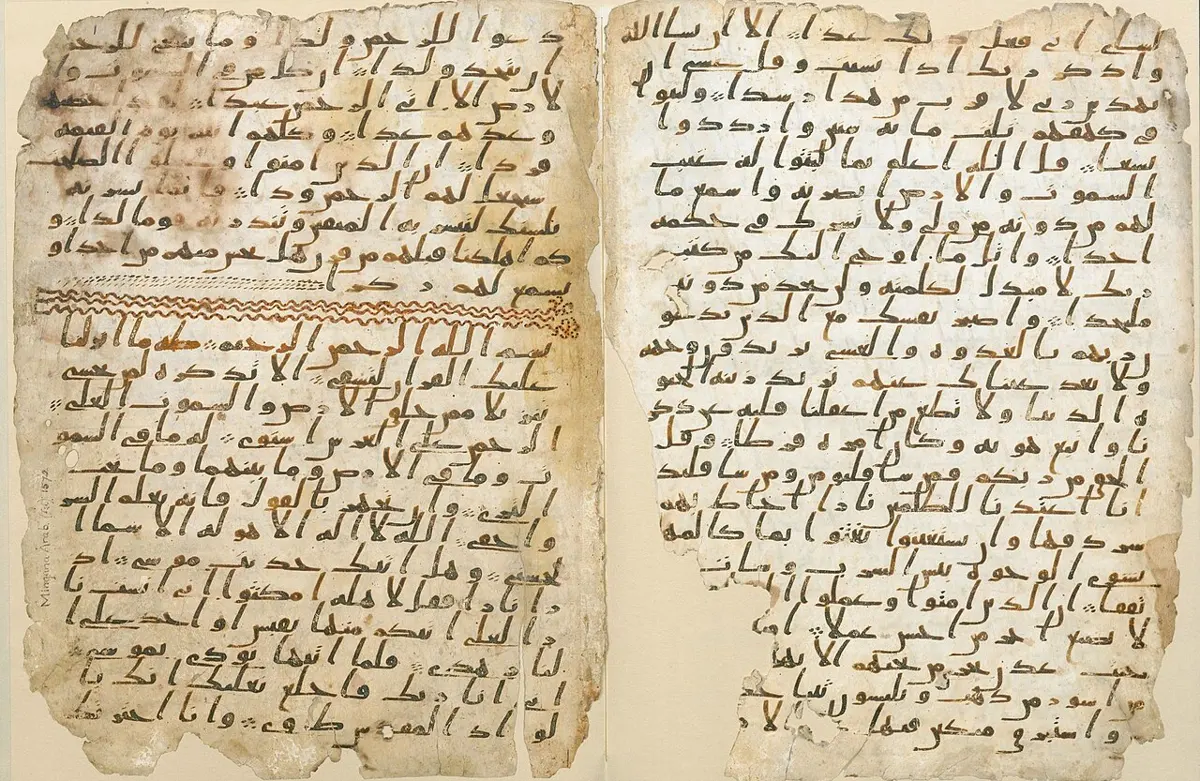
How do we know all this? The Qur’an was written down early: two leaves kept in Birmingham, in England, are on parchment dated to between 568 and 645, around his lifetime. But the Qur’an rarely tells the story of his life. That comes from the biographies, the earliest of which was written about 120 years after his death and survives only as later scholars copied and cut it, and from collections of his sayings gathered later still. Muslim scholars have sifted these reports with great care for over a thousand years. Historians agree on the outline above and argue over many of the details.
Sunni and Shia
Muhammad left no son, and the community had to decide at once who would lead it. A small meeting of the leading men chose Abu Bakr, his close companion and friend. That much is history. Why it happened is where Muslims part.
Most Muslims, the Sunnis, hold that the Prophet had named no successor, and that by his example the community was to choose one. Their name comes from sunna, the Prophet’s example. They honor the first four caliphs, Abu Bakr, Umar, Uthman and Ali, as the rightly guided ones. The Shia hold that the Prophet had chosen Ali, his cousin and the husband of his daughter Fatima. On the way home from his last pilgrimage, at a pool called Ghadir Khumm, he took Ali’s hand and said, in the words both sides report, “Whoever I am his mawla, Ali is his mawla.” For Shias, mawla here means master, and the words named Ali as the first imam, the rightful leader after the Prophet, to be followed by imams from the Prophet’s family. Sunnis accept that the words were spoken, and take mawla to mean friend and helper. The name Shia comes from shi’at Ali, the party of Ali.
Ali did become caliph, the fourth, but in a time of civil war after Uthman was murdered, and he too was killed. Power passed to Mu’awiya, the governor of Syria, whose family, the Umayyads, ruled from Damascus. About twenty years later, in 680, Ali’s son Husayn, the Prophet’s grandson, refused to accept Mu’awiya’s son as caliph and set out for Iraq with his family and about seventy men. At Karbala, by the Euphrates, an Umayyad army surrounded them and killed Husayn and nearly all the men with him, and the women and children were led away as captives. Shias mourn Husayn every year on the tenth day of the month of Muharram, Ashura, as the man who died standing against injustice. Some historians think that the split of belief, and not only of politics, grew from that day.
The two share the Qur’an, the one God, the Prophet, the daily prayers, the fast of Ramadan and the pilgrimage to Mecca. They differ over who should have led, over which sayings of the Prophet are reliable, and over some law and ritual. Today about nine Muslims in ten are Sunni, and about one in ten Shia.
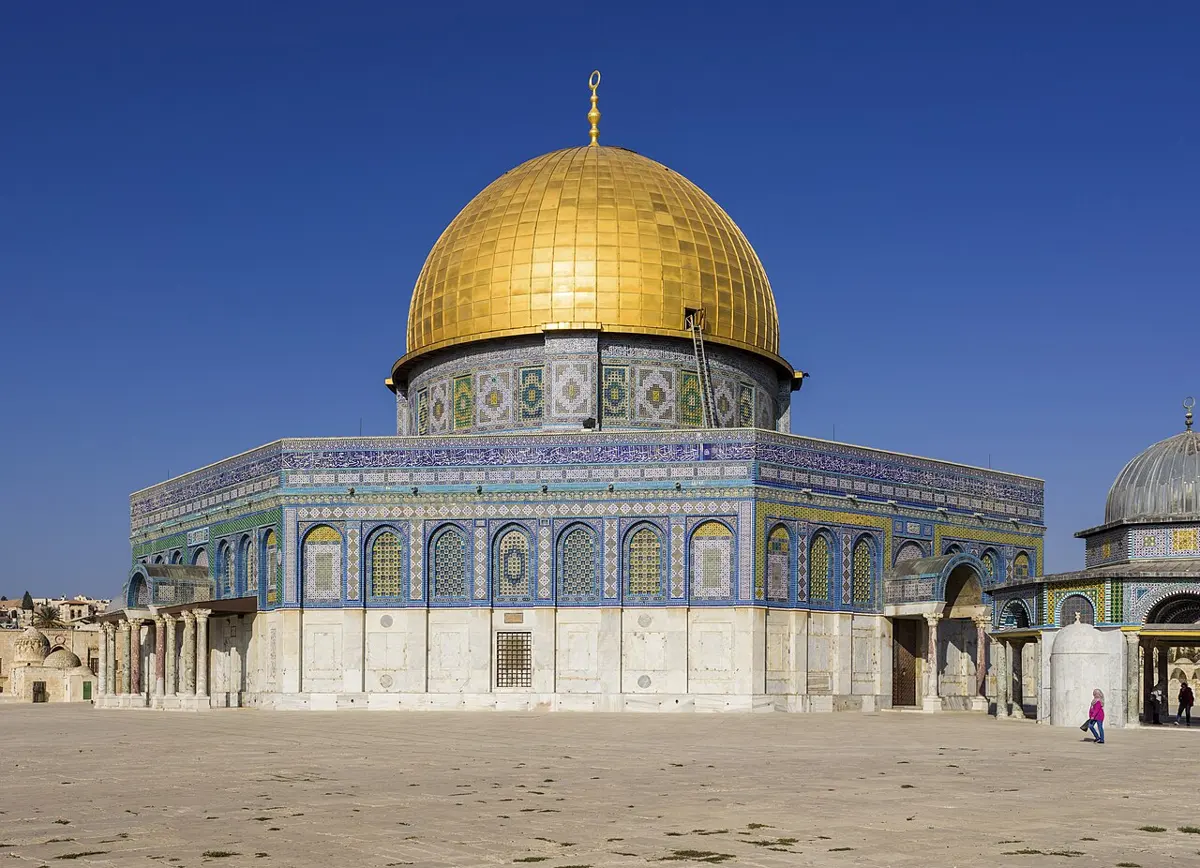
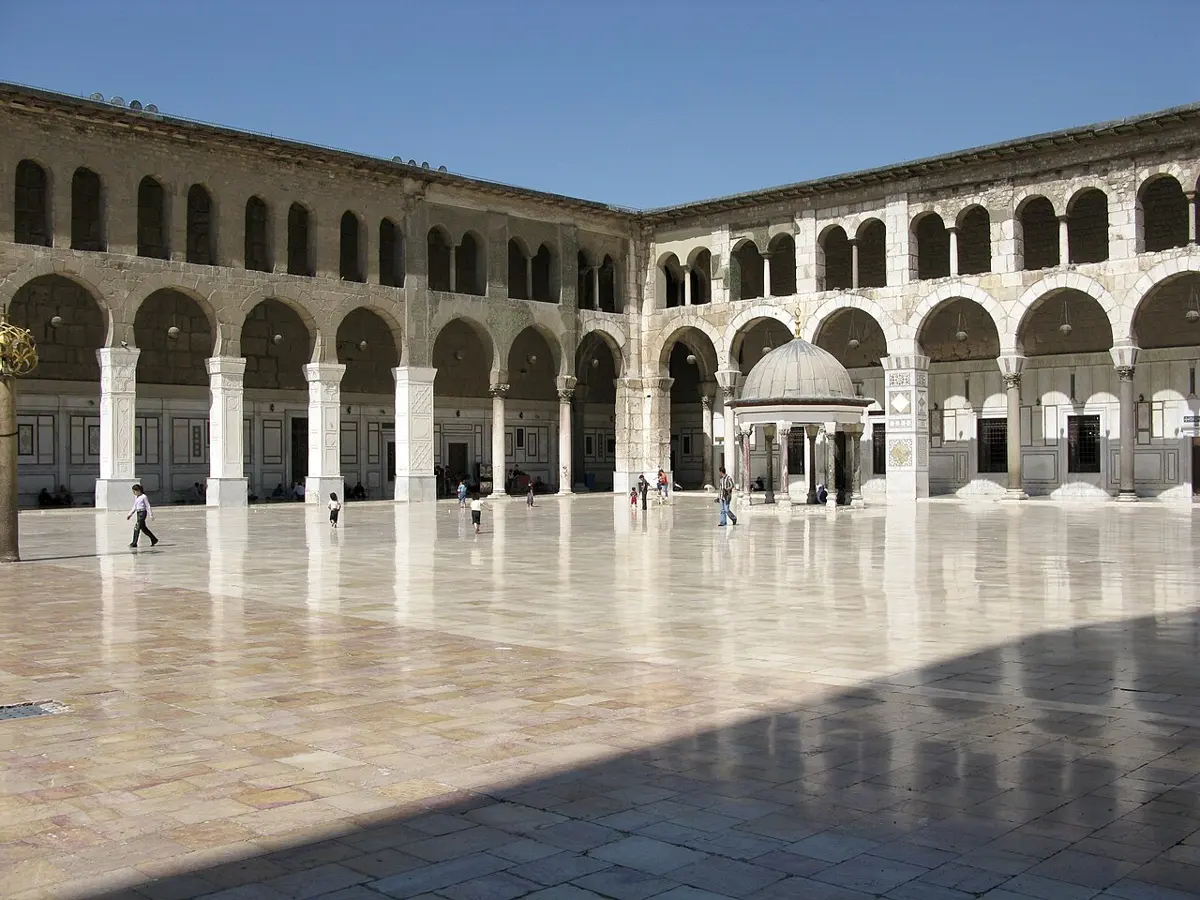
Meanwhile the armies of Medina had gone out. Within about twenty years of the Prophet’s death they had taken Syria, Iraq, Egypt and the whole of the Persian Empire, and within a century they reached Spain in the west and Sindh, on the Indus, in the east. The two old empires, worn out by their war, could not stop them. The conquered people were not made to become Muslims. Christians, Jews and Zoroastrians kept their faiths, paid a special tax and lived under Muslim rule, not as equals. Syria and Egypt stayed mostly Christian for centuries, and most of the conquered became Muslim only slowly, over generations. In Jerusalem the Umayyads built the Dome of the Rock, the oldest Islamic building still standing, on the hill where the Jewish temple had stood. In Damascus they built a great mosque on the site of a church.
Baghdad
A century after the Prophet, a new family of caliphs, the Abbasids, descended from the Prophet’s uncle Abbas, overthrew the Umayyads. They moved the capital east, and the caliph al-Mansur founded a new city on the Tigris, near the old Persian capital. It was round, with the palace and the great mosque at its center. He called it Madinat al-Salam, the City of Peace. Everyone else called it Baghdad. By the 900s, perhaps a million people or more lived there.
From al-Mansur’s time until the end of the 900s, almost every Greek book of science and philosophy that could be found was translated into Arabic: Aristotle’s philosophy and logic, the geometry and astronomy of the Greeks, Galen’s medicine, and books on everything down to falconry. Some survive today only in Arabic. Persian books were translated too, and an astronomer from India, who came to al-Mansur’s court with an embassy from Sindh, helped put a book of Indian astronomy into Arabic. Paper, a Chinese invention, made all this cheaper; the Abbasids took up papermaking in the 700s.
There is a famous picture of how it happened: a great academy, the House of Wisdom, where a caliph gathered scholars to translate. Historians now think this is too tidy. The House of Wisdom was the caliphs’ library, not a translation school. The work went on for more than two centuries and was paid for by almost everyone with money in Baghdad: caliphs and princes, officials and generals, merchants and bankers, and scholars and doctors who needed the books for their work. They wanted astronomy to cast horoscopes, medicine to stay alive, and logic to win arguments, including arguments about religion. Most of the translators were Christians who spoke Syriac, the language of the eastern churches. The most famous of them, a Christian doctor called Hunayn ibn Ishaq, and his pupils translated with a care for the exact words that scholars still admire.
Then the scholars of the Islamic world went past their books. Al-Khwarizmi in Baghdad wrote the book that gave us the word algebra and explained the Indian numerals, Ibn al-Haytham in Cairo showed by experiment how light travels, and Ibn Sina gathered the medicine of Greece, Persia and India into one huge book. Their stories are on the Science and Scientists timelines. Over the same centuries the caliphs lost their real power to their own generals and governors, and Baghdad’s great days ended when the Mongols took it, a story for Chapter 17.
The Franks, seen from Damascus
In 1099 an army from western Europe took Jerusalem. Europeans would later call such wars crusades. The Arabs called the invaders Franks, whatever country they came from. A chronicler of Damascus who lived through it wrote that the Franks stormed the walls, killed a great many people, and that when the Jews gathered in their synagogue, the Franks burned it over their heads. A historian of Mosul, writing about a century later, said the Franks killed more than 70,000 people in the mosque of al-Aqsa alone, and blamed the Muslim rulers of Syria, who had been too busy fighting each other to stop it. Jerusalem held far fewer people than that, and modern estimates of the dead run to some thousands. Whether the killing was worse than at the other towns the Franks took is still argued.
The Franks set up four small states along the coast and stayed for nearly two hundred years. For much of that time they were neighbors as well as enemies, and the best person to show what that was like is Usama ibn Munqidh. He was born into the family that ruled a castle town in northern Syria, a few years before the Franks came, and he lived to ninety-three. A soldier, hunter, diplomat and poet, he wrote a book of memories when he was old.
For some years Usama served the ruler of Damascus, at a time when Damascus and the Frankish kingdom of Jerusalem were allies against a stronger Muslim ruler in the north, and he visited Jerusalem often. The Knights Templar, an order of Frankish warrior monks, were living in the al-Aqsa mosque, and they were his friends. They let him pray in a small mosque beside it. One day, as he began to pray, a Frank rushed in, seized him, turned his face to the east and said, in effect, “This is how you pray!” The Templars pulled the man away and apologized: he was a stranger, they said, just arrived from the land of the Franks, who had never seen anyone pray facing any other way.
Usama thought the Franks brave fighters and nothing more. He tells how a Christian doctor his uncle had sent to a Frankish lord was healing a knight’s swollen leg with a poultice and a woman troubled in her mind with a diet, until a Frankish doctor took over. The Frank had the leg chopped off with an axe and cut a cross into the woman’s scalp to let out a devil, and both patients died. But Usama also tells of Frankish cures that worked, washing a wound with strong vinegar and healing a boy’s swollen neck, and he noticed that the Franks who had lived long in the East were far better company than the newcomers.
Alliances like Usama’s did not last. In 1148 a new army arrived from Europe, led by the king of the Germans, and with the Franks of Jerusalem it marched on Damascus, their ally of a few years before. The city’s soldiers and townspeople fought it in the orchards outside the walls for four days, and the Franks went home. After that, Damascus joined the Muslim rulers to the north. Their ruler, Nur al-Din, made Jerusalem his goal, and Saladin, a Kurdish general who rose after him, beat the army of the Frankish kingdom at the Horns of Hattin, near the Sea of Galilee, and took Jerusalem back in 1187. This time there was no massacre. Franks who could pay a ransom left in safety. Seven thousand of the poor were bought free with money from the city’s treasury, and some thousands more were let go by Saladin and his commanders, but the rest, about fifteen thousand by the count of Saladin’s own secretary, were sold as slaves. The Christians of the East stayed, and Jews were allowed back. The last Frankish city on the coast fell a century later.
Delhi, and the end of Nalanda
Islam had reached the far west of India long before, when an Arab army took Sindh in the 700s. North India’s turn came from Afghanistan. In 1192 a ruler from the mountains of Ghor beat the Rajput king Prithviraj Chauhan at Tarain, north of Delhi, and when he died in 1206, his general in India, Qutb ud-Din Aibak, became the first Sultan of Delhi. Aibak had been sold as a slave when he was a boy. For more than three centuries, under five families in turn, Delhi’s sultans ruled most of north India. They kept the Mongols out of most of India when the Mongols were taking nearly everyone else.
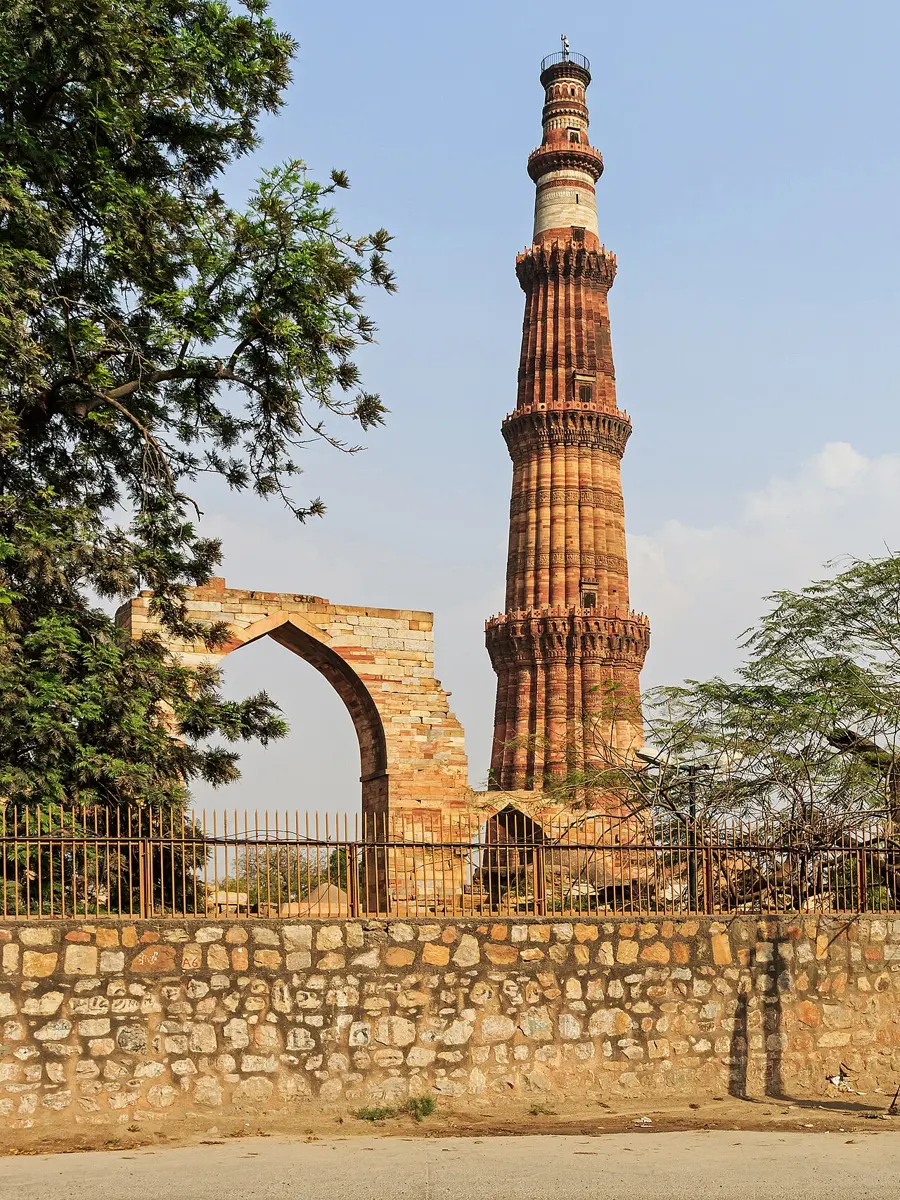
In Delhi, Aibak began a mosque, the Quwwat-ul-Islam, and beside it a tower of victory, the Qutb Minar. The mosque’s cloisters were built from the carved pillars and stones of twenty-seven Hindu and Jain temples, which Aibak had demolished, as his own inscription over its eastern gate records. One of the early sultans was a woman, Razia, who ruled for four years. The historian of her court praised her as a wise, just and warlike ruler who had every quality a king needs, and then asked what use they were to her, since she had not been born a man.
Around 1200 a Turkish commander, Bakhtiyar Khalji, raided Bihar. The court historian who praised Razia tells the story, from what a soldier who was there told him decades later. The raiders, he says, took a walled town, most of whose people were “Brahmans” with shaven heads, and killed them all. There were a great many books there. The raiders called for Hindus who could tell them what the books were, but all of them had been killed. Only then did they learn that the whole place had been a college, which the Hindus called a vihara. Historians read the shaven heads as Buddhist monks.
This story is often told as the end of Nalanda, the great monastery where Xuanzang had studied. The account does not name Nalanda, and most historians think the place was another monastery, Odantapuri, about a day’s march to the east, though even that is not certain. Nalanda had already been losing its royal patrons since the fall of the Pala kings, who had supported it. And we know it was still there in 1235, because a Tibetan monk named Dharmasvamin lived and studied there for months. He found many of its buildings damaged by the Turks, with no one to look after them, though many others stood undamaged; two of its monasteries were still in use. A teacher of more than ninety, Rahula Shribhadra, was still teaching about seventy monks. Then word came that soldiers from Odantapuri were coming to kill them. The other monks fled. The old teacher told Dharmasvamin to go too, but he refused, so the teacher let the Tibetan carry him on his shoulders to a nearby shrine, with some rice, a little sugar and their favorite books. Three hundred armed soldiers came, did not find them, and went away. Dharmasvamin later went home to Tibet. Nalanda faded out over the next century, through raids, the loss of its patrons and the slow decline of Buddhism in India, and how much weight each carried is still argued.
Islam began with one man in a trading town of Arabia, between two empires that had worn each other out, and within a century Muslim rulers held land from Spain to the Indus. The quarrel over who should lead after him made the Sunni and Shia branches that still exist. The Muslim world kept and built on the learning of Greece, Persia and India, much of which reached Europe through it. Its wars, and the wars fought against it, were fought as wars were everywhere, with killing and enslaving on both sides, and with moments of mercy and friendship too. And the stories most often told about it, a House of Wisdom full of translators or a single raid that ended Nalanda, are simpler than what happened.
Meanwhile, in Nepal: on his way home from Nalanda, the same Dharmasvamin stayed with the king of Tirhut, in Simraungadh; the Valley’s early silver coins copied the coins of the sultans of Delhi and Bengal, in Over the Passes; Prithvi Narayan Shah is said to have brought a Muslim gunsmith home from Banaras, in Prithvi Narayan Shah and Gorkha; and the law of 1854 placed Nepal’s Muslims among its castes, in The Law of 1854, all in Nepal’s History, for the Curious.
Found a mistake? Please tell us.