
On 14 December 1721 an Italian priest named Ippolito Desideri set out from the Tibetan town of Kuti for Kathmandu. He had lived five years in Tibet, learned Tibetan well enough to write books in it, and was now under orders to leave. The road down, he wrote, was breakneck. It ran along “frightful precipices” and up rock faces by holes “just large enough to put one’s toe into, cut out of the rock like a staircase”. At one place the path crossed a chasm on a plank “only the width of a man’s foot”. The rivers were crossed on bridges of iron chain, or on wooden ones that “swayed and oscillated most alarmingly”. Nobody could ride, so travelers were carried, sitting on a small board on a porter’s back with their arms round his neck. His companion, a Capuchin father of sixty, was so tall and heavy that it was hard to find men who would carry him. They reached Kathmandu on 27 December.
Desideri wasn’t exploring. He was walking down one of the busiest trade roads in the Himalaya, and almost everyone else on it was there for business. This chapter is about that business: what went up and down the passes north of the Valley in the 1600s and 1700s, who carried it, and why the kings of Kathmandu, Patan and Bhaktapur cared about it so much. The short answer is that the Valley stood between India and Tibet, and it made its living, and a good deal of its kings’ money, from being in the middle. It traded salt, wool and gold from the north for cloth and goods from the south, and it struck the silver coins that Tibet used. That made the Valley rich. In the end it also helped to bring an army to its gates.
Two roads north
From the Valley, two roads crossed the Himalaya into Tibet.
The first left the Valley at Sankhu, climbed over the hills to Chautara and then followed the Bhote Koshi up its gorge to a village called Listi and on to Kuti, which Tibetans call Nyalam. This was the road Desideri came down, and it was so steep and narrow that nothing went up it on four legs. Every load bound for Nepal from Kuti, Desideri said, had to be carried on men’s backs, and the porters were very well paid. On the Tibetan side the merchants of Kuti, Tibetan and Nepali, kept horses and mules and hired them out to traders.
The second road went west out of the Valley to Nuwakot, down to the Trishuli and up that river to Kerung, which Tibetans call Kyirong. On the Kerung road, Desideri wrote, horses could be used all the way down into Nepal, and from there on to India, which was “not possible by the Kutti road”.
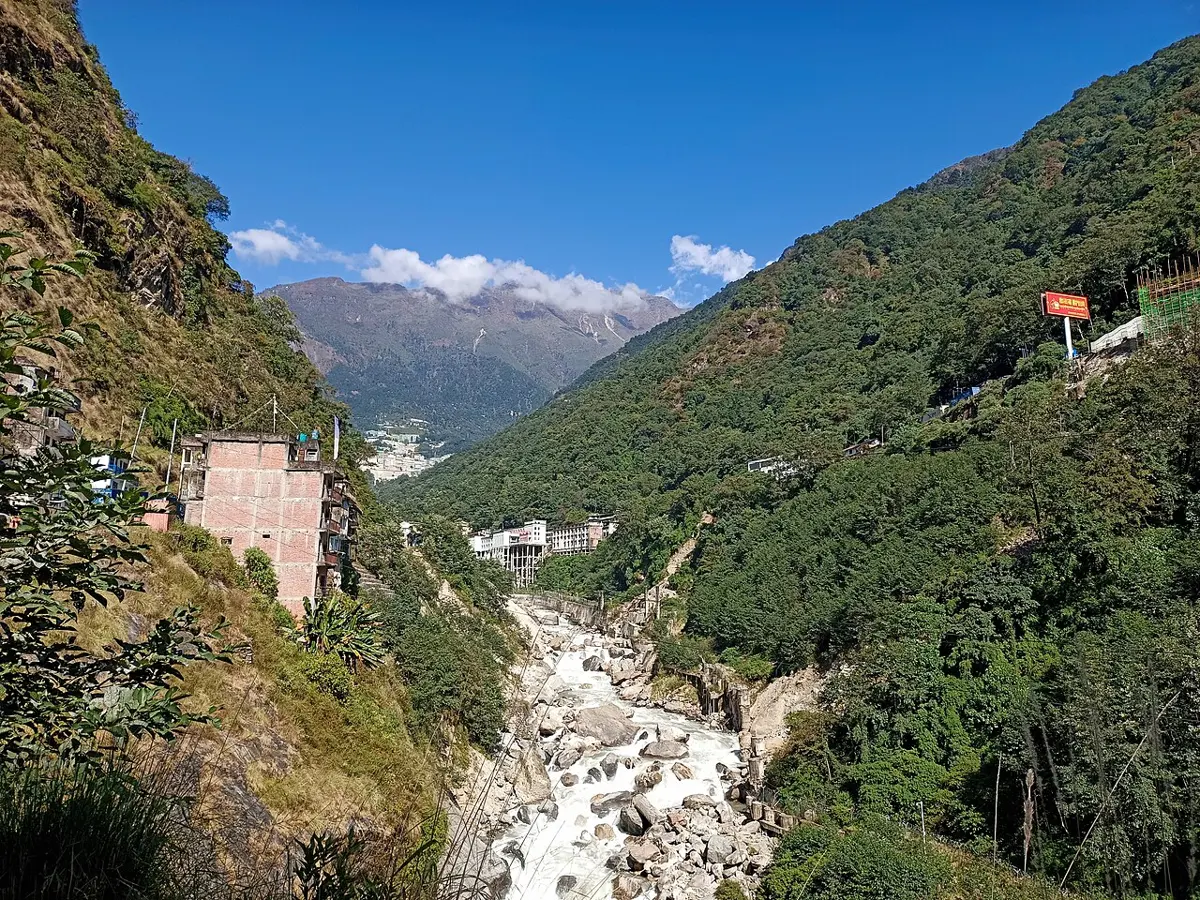
Beyond Kuti the road climbed to a pass the Tibetans called Langur, the hardest part of the whole journey. On the way up, Desideri wrote, “everyone suffers from violent headache, oppression in the chest and shortness of breath”, and there was deep snow even at the end of May. Shortly before he passed, an old Armenian merchant on his way to Lhasa had died there in a single night. Desideri blamed the thin air, not poisonous fumes from the rocks, as others thought, and he was right. From the Langur the road ran on across the plateau by Shigatse to Lhasa. Desideri, going the other way, took thirty-three days from Lhasa to Kuti, on horseback from dawn to dusk.
These were old roads: a Licchavi stone of 695 already sets aside porters “for trade to Bhoṭṭa”, which is Tibet. Nor were they the only ones. Palpa had its road up the Kali Gandaki, and an earlier king of Gorkha, Ram Shah, is said to have fought the Tibetans near Kerung. But the Valley’s two roads carried the most, and by the 1600s their trade was worth fighting over.
Salt, wool and gold
What made such a walk over the Himalaya worth it? Mostly, things that one side had and the other didn’t.
Tibet’s high plateau has salt lakes, wide pastures for sheep, goats and yaks, and gold in its rivers. Lists made by British visitors to Kathmandu in 1793 and 1802 show what came down from it: rock salt, borax, gold dust, musk, the long tails of yaks for fly-whisks, wool, woolen blankets and rugs, horses and medicinal herbs. Much of it didn’t stay in the Valley. Musk, borax and yak tails went on down to India, where they sold for high prices.
Going the other way were the things Tibet lacked: cotton and silk cloth from Banaras and Bengal, coarse cloth woven by the Newars themselves, and spices. From Nepal’s own northern hills came a red dye made from the root of madder, which Tibetans used to dye their cloth and which was bartered for their rock salt and borax. And all the iron used in Tibet, Desideri was told, came through the district of Kuti.
So the Valley’s merchants made money twice: once buying from Tibet and selling to India, and again buying from India and selling to Tibet. The kings made money from customs on the goods that passed through their lands, and so did Tibet. Desideri noticed that Kuti, a small town, had three governors at once, a Mongol, a Tibetan layman and a Tibetan monk, so that none of them could pocket the customs alone. Bales weren’t even opened. They were weighed, and taxed by weight. Nepali merchants, he was told, paid less than other foreigners, because a Grand Lama of long ago who had been born in Nepal had lowered their duty.
Caravans from Kashmir, India and Armenia came through Kuti too. But in Lhasa the Nepali merchants were, in Desideri’s word, “numerous”.
Much of what went north came up the road from the plains of Bihar. That road, as a British visitor walked it in 1793, left the Valley by Thankot, crossed the hills to Chitlang, dropped steeply to Bhimphedi and ran down through the forests to Hetauda and out onto the plains. From there the great market town was Patna, on the Ganga.
In the 1600s, the plains of northern India belonged to the Mughal emperors, at the height of their power. The Valley’s kings copied Mughal coins, Mughal rupees were used in the Valley for large deals, and the Valley’s merchants bought Indian cloth and spices to carry north. The road south was the Valley’s link to the whole of India, and through India to the wider world. In 1628 a Portuguese priest, João Cabral, came that way from Tibet, the first European known to cross the country, and by the 1700s Capuchin priests living in Kathmandu went back and forth to Patna.
So the Valley was a crossroads, and its kings knew it. That is why roads were the weapon they used against one another. Pratap is said to have tried to choke Patan’s trade by closing his roads, and Patan answered by sending its traders north through Gorkha’s lands instead.
Making money for Tibet
The most curious part of the trade was the money.
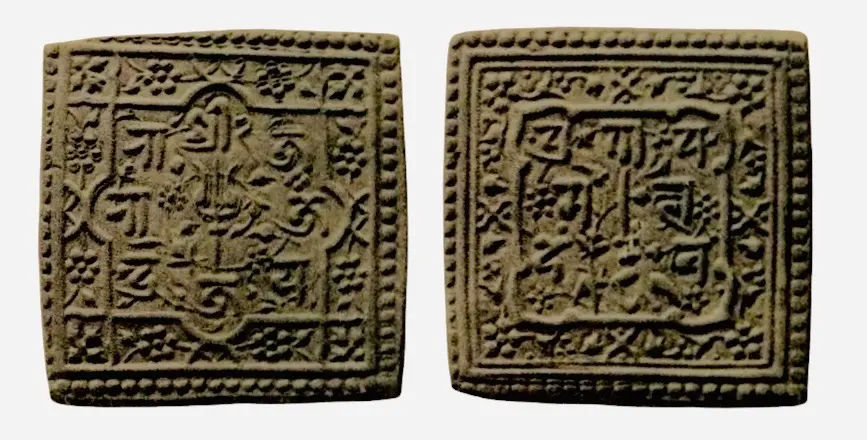
Tibet in those days struck no coins of its own. Big deals were paid in lumps of silver, most of it cast in China, and weighed out. For everyday buying, Tibetans used coins made in the Kathmandu Valley. The Licchavis had struck copper coins, but the Valley’s silver coins began in the 1500s. Thick pieces called tankas were struck at Dolakha, east of the Valley, a little before 1550, and in the 1560s by Mahendra Malla, king of Kathmandu. They imitated the coins of the Muslim sultans of Delhi and Bengal, with patterns taken from Arabic writing that most people who used them couldn’t read. Around 1640 the Valley’s kings changed over to a lighter coin, the mohar, about 5.4 grams of silver, and from then on each coin carried the name of the king who struck it and its date. Mahendra Malla’s name stayed with them. People called the mohar the “Mahendramalli”, and Desideri, in the 1720s, heard it as “mandermali”.
The Valley’s three kingdoms struck mohars for their own people and for Tibet, and where the silver came from changed over time. Tibet mined little silver of its own. For a long time the Valley’s silver came up from India, as Mughal rupees that merchants brought to pay for Tibet’s wool, salt and musk. The Valley’s mints turned them into mohars, and the mohars went north to pay for more. Then, in 1720, a Chinese army marched into Lhasa with silver enough to pay for everything it needed, and Tibet was suddenly full of it. Desideri, then living in Tibet, described what happened next. The Tibetans, at their own risk and expense, sent silver from Lhasa to Nepal to be turned into coins by the three kings. The kings “charged nothing, but gave an equal weight in coins for the silver and gained many millions, especially the King of Kattmandu”. By the time British visitors reached Kathmandu, seventy years later, the silver that the Valley turned into Tibet’s money came from Tibet, and one of them found that the oddest thing of all.
How do you make millions out of a deal in which you charge nothing? The answer was in the metal. A coin isn’t pure silver. It is silver with some copper mixed in, both to harden it and, if the mint wishes, to stretch the silver further. Here is a made-up example, with round numbers, to show how it worked. A merchant brings the mint 100 tolas of pure silver. The mint hands him back 100 tolas of coins, an equal weight, just as Desideri said. But if those coins are one part copper in every twelve, they hold only about 92 tolas of silver. The other 8 tolas stay with the king. Do that with every load that comes over the passes, year after year, and it adds up. In the 1790s the mint openly charged 12 in every 100, 4 for the work and 8 from the copper in the coins, and the silver coinage alone had once brought the king a lakh, a hundred thousand rupees, a year. In the worst coins of the 1700s, nearly a third or even half of the metal was copper.
The coins were made to suit the people who would use them. Pratap Malla, king of Kathmandu from 1641, struck a large square coin copied from a rupee of the Mughal emperor Jahangir, but added a trident for Shiva and a sword. And a design of eight petals arranged like a lotus, first struck in about 1689, became a favorite in Tibet, where people cut coins into pieces for small change. Cut with three petals on one side and five on the other, a coin split almost exactly into a third and two thirds, and the petals could simply be counted.
A treaty without a text
How did the Valley come to hold such a privilege? The story most Nepali books tell goes like this.
In the time of Pratap Malla, a Kathmandu noble named Bhim Malla led an army north. He took Kuti, and the lamas of Tibet, afraid he would reach Shigatse, asked for peace. In the treaty that followed, Kathmandu kept Kuti and Kerung, thirty-two Nepali merchants or trading houses were allowed to set up in Lhasa, and a Nepali official, the nayo, was to live there to look after them. Nepali merchants would pay no customs anywhere in Tibet, and Tibet would send a small yearly token: a tola of gold, a little silver and three pathis of salt. Nepal would mint Tibet’s coins in its own king’s name. Bhim Malla came home with gold and silver for his king, and was put to death soon after, because someone at court had persuaded the king that he wanted the throne for himself. His wife, it is said, cursed the court as she died on his funeral pyre: may there never be sound judgment in this durbar.
It’s a good story, and it is probably true in outline. But the treaty itself is another matter. None of the accounts quotes its words or says where a copy is kept, and they don’t agree on its details. The old chronicle of the Valley’s kings, in the version a British doctor in Kathmandu published in English, makes Bhim Malla a minister of Pratap’s father, Lakshminarasimha, not of Pratap. It says he set up thirty-two shops, “in the city” in one passage and “in Lhasa, Kuti, etc.” in another, brought Kuti under Nepal’s rule and made “a treaty with the ruler of Bhot”, but it gives no terms and says nothing of a battle. Most of the terms come from Nepali historians of the 1900s. The best evidence that something of the kind happened is a letter of August 1789 from Bahadur Shah, then ruling Nepal for his young nephew, which speaks of a boundary with Tibet “fixed along Kuti during the time of King Pratapa Malla and Kaji Bhima Malla”. By then that was well over a century in the past, and the name was being used as an argument, but it shows that people in Kathmandu remembered it.
When it happened is uncertain too. Those who follow the chronicle put it before 1641, under Pratap’s father; others put it in the late 1640s.
What is certain is that Kathmandu didn’t hold Kuti for long. When Desideri was there in 1721, he was told that the fort and district of Kuti had “not long ago” belonged to the king of Kathmandu, but now belonged to Lhasa. The border had moved back down the Bhote Koshi to Listi, where, he found, half the people were subjects of Tibet and half of Kathmandu. Seventy years later a British visitor still gave Listi as the border.
Whatever the treaty said, the merchants went. By Desideri’s time the Nepali merchants in Lhasa were many, and some of them had made large fortunes. They worshipped at the Jokhang, the great temple at the heart of Lhasa, which Tibetans told him had been built by the Nepali princess who married their king, Bhrikuti.
They were mostly Newars from the Valley, and most of them Buddhists. Desideri says little more about how they lived, and what we know of it comes from much later, from the 1900s, when the community was still there and visitors and the families themselves described it. Its trading houses, the kothi, stood around the Barkhor, the road that circles the Jokhang and is also Lhasa’s main market. Some observers thought most of the merchants by then had Tibetan wives, and the sons of those marriages grew up between the two countries. How far life was the same in Malla times, nobody can now say.
Newars were in Tibet as craftsmen too. Desideri thought the Tibetans themselves had few equals at casting statues, vases and gun barrels, but added that “the Nepalese are masters in these crafts, by which they make a very good business in Thibet”. This was an old tradition. In the 1260s a young Newar artist, Arniko, had gone north and ended up at the court of the Mongol emperor of China, where he oversaw the building of the great White Stupa in what is now Beijing.
Back home, not everyone was happy about people going to Tibet. Desideri was told that a Newar who came back from Tibet or India couldn’t go near his relatives until he had been purified. The chronicle says that when Patan’s merchants began going to Tibet too, Patan’s king, Siddhinarasimha, ordered that the ceremony be overseen by the senior monks of five Buddhist monasteries, and that the fees for it went to the king. Even here, it seems, there was money to be made.
Bad silver
The arrangement worked as long as Tibet trusted the coins. The temptation for a king short of money was obvious: put a little more copper in each coin, and keep a little more silver. In the 1700s the Valley’s kings gave in to it.
The worst offender was Jaya Prakash Malla, the last Malla king of Kathmandu. Most of the coins of his first reign, from 1735 to 1746, were so debased that the Dalai Lama wrote to complain about the coins being sent to Lhasa. In the next few years, while Jaya Prakash was off the throne, mohars were struck in the name of Jyoti Prakash that were only about half silver. Tibetans, who had to accept these coins at the same value as the good old ones, lost out, and the Valley’s good name went with them.
Meanwhile the Valley was being drawn into wider quarrels. The road to Kerung ran past Kathmandu’s hill fort of Nuwakot, and just west of Nuwakot lay the small kingdom of Gorkha. Its king, Prithvi Narayan Shah, took Nuwakot in 1744, as Chapter 17 tells, and with it the Valley’s western road to Tibet. Over the next twenty years he squeezed the Valley’s trade with blockades. When at last he ruled the Valley himself, he inherited both the mints and the quarrel over the bad coins. That quarrel, over whose coins Tibet should use and what they were worth, was one of the things that led Nepal into war with Tibet at the end of the 1780s, and that story belongs to a later part of this book.
So the passes give us a different way of looking at the Malla kingdoms. They were small states, quarreling over villages. But they were also rich, out of all proportion to their size, because of where they stood and what their people knew how to do: carry goods over the highest mountains in the world, keep shops weeks of walking from home, and cast metal and strike coins better than anyone around them. The same things that made them rich made them worth conquering.
Meanwhile, in the world: in 1631, about when the Valley’s kings were changing over to the mohar, the Mughal emperor Shah Jahan ordered the Taj Mahal built at Agra, and it was finished by about 1653. In 1639 the English East India Company was given land on the coast of south India, at Madras, and built a fort there, finished in 1644. It was one of the first footholds of a company that would, a century later, rule eastern India.
Found a mistake? Please tell us.