
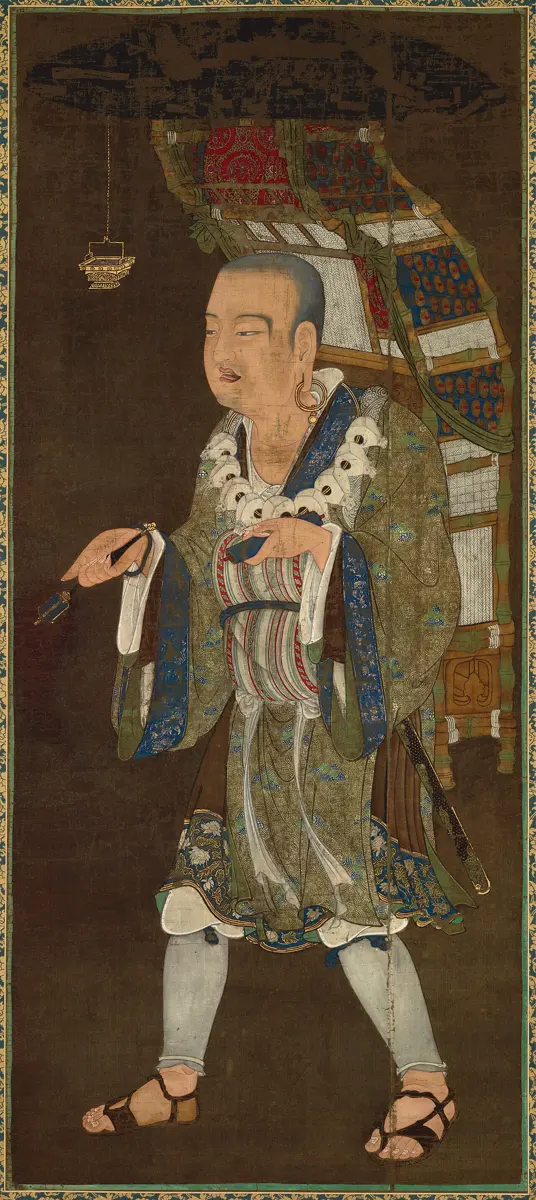
About fourteen hundred years ago, a young Chinese monk named Xuanzang decided to walk to India, and his own government told him he couldn’t. The Tang emperor had forbidden his subjects to leave the country. The friends who had planned to go with him gave up, so Xuanzang went alone. At Liangzhou, on China’s western edge, the governor ordered him back to the capital. Two monks led him on in secret instead, and from then on he hid by day and traveled by night. At the next town an order came for his arrest. The local governor, a religious man, showed it to him, asked him whether he was the monk it named, and when Xuanzang said yes, tore it up in front of him and told him to leave quickly.
What stood between him and the next oasis, Hami, was a desert with five watchtowers on its road and no water between them. An old man who had crossed it more than thirty times offered him a horse: lean, red and old, with a varnished saddle bound in iron, and it had been to Hami and back some fifteen times. Xuanzang took it. A fortune-teller in the capital, he remembered, had once told him he would ride a thin old red horse with exactly that saddle. His guide lost his nerve and turned back, and Xuanzang went on alone.
Then he dropped his water bag. It was heavy, it slipped from his hands as he went to drink, and the water ran into the sand. He turned back towards the last tower, stopped, and turned round again: he had vowed not to take one step east until he reached India. For four nights and five days he had nothing to drink. In the middle of the fifth night, lying on the sand, he felt a cool wind and found he could see again, and his horse could stand. He pushed on, and the horse suddenly turned off the track and would not be turned back. It led him to a patch of green grass, and ten paces beyond it, to a pool. His disciple Huili, who wrote his life, was sure a bodhisattva had sent the water. A horse that had walked that road fifteen times may also have known where to find it.
Not one road
Xuanzang was on what we now call the Silk Road. The name makes you picture a single great highway with camels carrying silk all the way from China to Rome. It was nothing like that, and nobody who used it called it that. The name was first put into print about 150 years ago by a German geographer, Ferdinand von Richthofen, and even he wrote of Silk Roads, plural, as well as one Silk Road.
Here is the real picture. Between China and the lands to its west lies the Taklamakan, a great desert of sand, walled in by mountains: the Tian Shan to the north, the Pamirs to the west, and to the south the ranges at the edge of the high plateau of Tibet. Snow melts off those mountains and runs down towards the desert, and where it comes out, there are oases, green islands of fields and orchards. The roads ran from oasis to oasis, along the northern edge of the desert or the southern one, and then over the passes into Central Asia, Iran and India. A map of them looks less like a road than a net.
Hardly anyone traveled the whole net. Goods went in short hops, sold at one oasis and carried on by someone else, so a bale might change hands many times between where it was made and where it was used. The caravans were small, often a dozen people or so with their camels and donkeys, and most people in the oases never traded at all. They farmed.
The people who did most of the carrying came from Sogdiana, the country around Samarkand and Bukhara, in today’s Uzbekistan. Sogdians settled in the oases and in China’s cities, and they wrote home. Early in the last century an explorer found a bag of their letters in the ruins of a watchtower west of Dunhuang, written about 1,700 years ago and never delivered: the mail had probably been seized. One letter reports that Luoyang, a Chinese capital, had burned, and that the Indians and Sogdians living there had starved. Another is from a woman named Miwnay to her husband. She had come to Dunhuang with their daughter because he told her to, against her mother’s and brothers’ advice, and he wasn’t there. Three years later she is still stuck, waiting for him. She has written again and again without an answer, and the community’s leaders won’t help her get home. “I would rather be a dog’s or a pig’s wife than yours!” Her daughter adds a few lines: because of a debt, mother and daughter have become servants of the Chinese. The letter never reached him, and nobody knows what became of them.
What really traveled
Most of what we know about the trade comes from paper that was meant to be thrown away. The people of Turfan, the oasis kingdom Xuanzang reached after the desert, dressed their dead in paper boots, hats and belts, and since paper was scarce there, they made them from old government files and contracts. Scholars have taken these grave clothes apart and read about two thousand documents from them.
One set is a year of tax receipts from Turfan’s market, from around the time Xuanzang was born. A tax was charged on anything weighed for sale, and the receipts list what was weighed: spices, gold, silver, silk thread, and ammonium chloride, a salt used as a medicine and for working metals and dyes. Of the forty-nine people named, forty-one had Sogdian names. Not one of them bought silk cloth. That isn’t because there was no silk. Cloth was sold by its length, not weighed, so it was never taxed, and the receipts don’t show it.
Silk was also money. Other papers from Turfan show a camel bought for fourteen bolts of silk, a horse for eighteen, and an eleven-year-old girl for forty. Animals and enslaved people were among the goods most often traded on these roads. The Tang government sent silk west in huge quantities to pay its soldiers and officials in the oases, and the trade grew busy around them. When a great rebellion in China in the 750s made the Tang pull its armies back, the subsidies stopped, and trade on the roads shrank to a trickle. Even in the busiest years, more people in Turfan earned their living from the land than from trade.
Some things did go a long way, slowly. The know-how for making paper, a Chinese invention, went west, and the know-how for making glass came east into China. Glass itself traveled too: a piece of a cut-glass bowl made in Persia has turned up at an island shrine off Japan, though nobody knows by what roads it got there.
What traveled farthest was something no tax collector weighed. Buddhism went north from India over the mountains, settled in the oasis kingdoms, from Khotan and Kucha to Turfan, and from there went east into China, and on to Korea and Japan. Monks walked these roads both ways, carrying books and statues, and some of the oasis people became the great translators of Buddhist books into Chinese. Goods went in small loads and short hops. People, and what was in their heads, went all the way.
To Nalanda
Xuanzang’s next trouble was a friendly king. The king of Turfan was so pleased with him that he refused to let him go, and offered him the choice of staying as his teacher or being sent home. Xuanzang stopped eating. On the fourth day the king gave in, made Xuanzang his brother, and had travel clothes and letters to the rulers along the way made for him.
North of the desert, the road crossed the Tian Shan. For seven days the party climbed among glaciers, cooking in hanging pots and sleeping on mats spread on the ice. Twelve or fourteen of them died of hunger and cold, and still more of the oxen and horses. Beyond the mountains, past a great lake, he met the khan of the Turks out hunting, in a robe of green satin, with about two hundred officers round him. Then he turned south, through Samarkand and over the Hindu Kush into what is now Afghanistan.
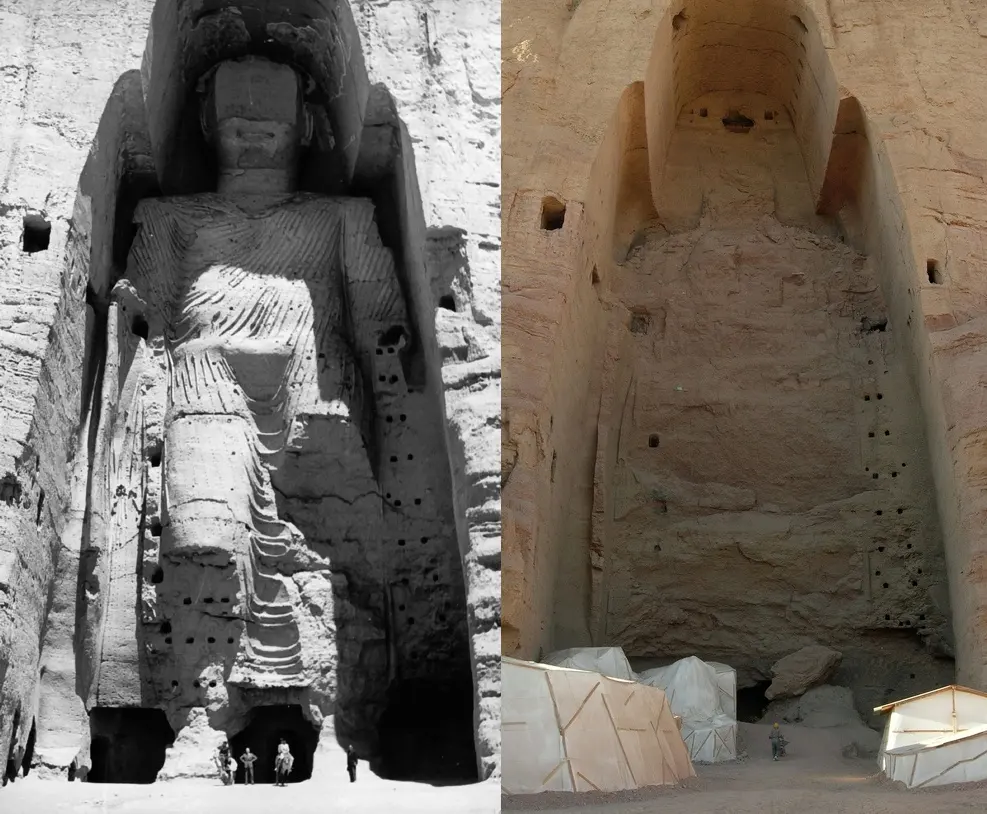
At Bamiyan he saw a Buddha cut into the cliff, standing, its gold glittering, which he guessed at 140 or 150 feet. It was fairly new: carbon dating of material from inside it puts its making within about forty years before his visit. It stood about 55 meters tall for nearly fourteen hundred years, until, a quarter of a century ago, the Taliban, who then ruled Afghanistan, blew it up, with the smaller Buddha beside it.
He spent two years in Kashmir studying, then went on into the plain of the Ganga. A traveler from China had been there before him. Two centuries earlier, the monk Faxian had walked to India too, in the days of the Gupta kings, who then ruled much of the north of India. Faxian found the country rich and mild: no tax on each person, kings who punished most crimes with fines rather than beatings, and in Pataliputra, today’s Patna, free hospitals where doctors treated the poor of every country. Late in the Guptas’ time, around the year 500, the mathematician Aryabhata wrote his book on astronomy. By Xuanzang’s time their empire had broken up into smaller kingdoms, worn down by attacks from the Huna, invaders from Central Asia, and the north’s great king was Harsha, at Kannauj.
Xuanzang went from one holy place to the next. At Kapilavastu, where the Buddha grew up, he found about ten towns in ruins and nobody in charge. At Lumbini, in today’s Nepal, where the Buddha was born, he saw a dead tree on the spot and Ashoka’s great stone pillar, with a horse on top, broken in the middle.
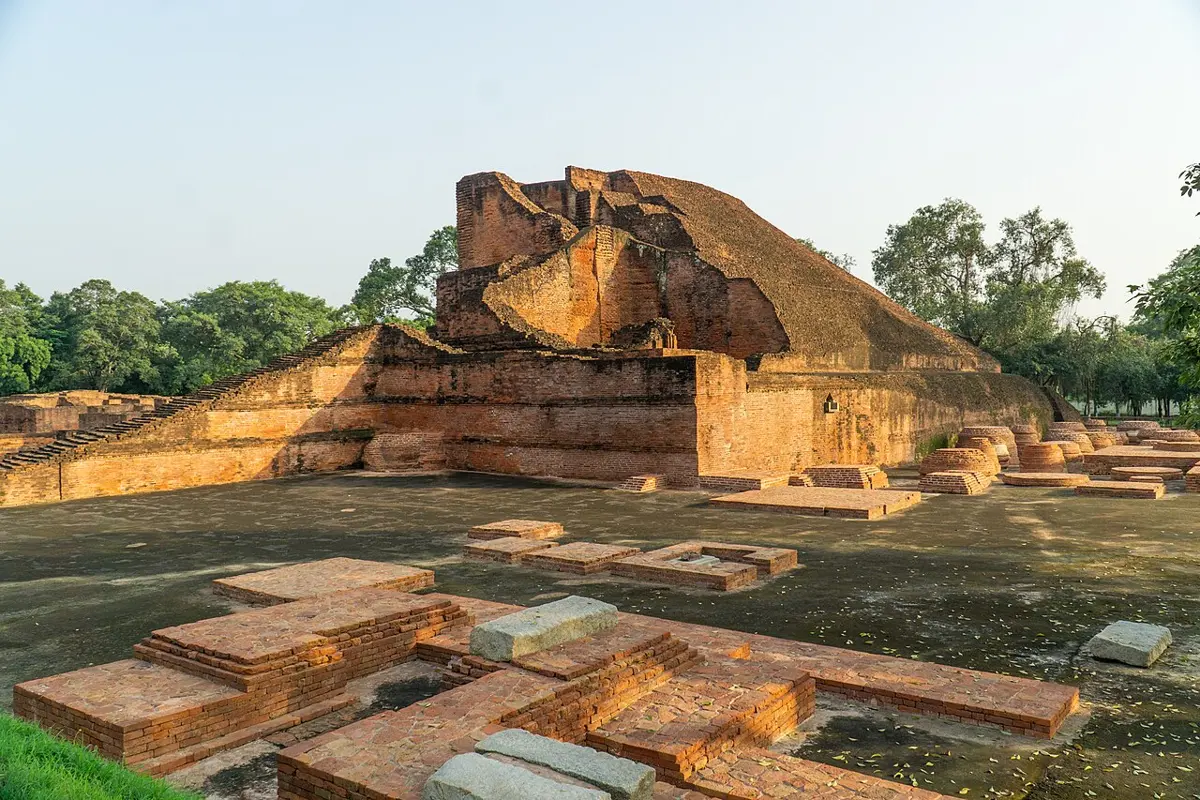
Then he came to Nalanda. Gupta kings had founded it about two centuries before, and by now it was a town of brick monasteries and temples given over to study. Huili says ten thousand monks lived there. Yijing, another Chinese monk, who studied there a generation later, counted more than three thousand, which is still a big university. They studied every school of Buddhism, and also the Vedas, grammar, logic and medicine. Its head was an old teacher, शीलभद्र (Śīlabhadra), and according to Huili he had been told in a dream, three years before, to wait for a monk who would come from China. Xuanzang stayed for years, learning Sanskrit and the books he had come for.
A side road through Nepal
Xuanzang seems never to have gone up into the Kathmandu Valley. From Vaishali, on the plain, he wrote down what he heard about it. Nepal, he was told, lay among the snowy mountains. It had copper and yaks, and copper coins, and a cold climate. Its people were skilled in the arts and crafts, though he also passed on some unkind gossip about their manners and their looks, as travelers will. About two thousand monks lived there, and their monasteries stood side by side with the temples of other gods. Its king was a Licchavi and a sincere Buddhist, and there had lately been a learned king, अंशुवर्मा (Aṃśuvarmā), who had written a book on the sounds of words.
That was Nepal from far away. Within a few years it was on a road. Up on the plateau, a king named Songtsen Gampo had made the peoples of Tibet into one strong kingdom, and it grew quickly. China and Tibet made peace, and for a while Chinese envoys took a new way to India: across Tibet, over the passes, through the Kathmandu Valley and down to the Ganga. One of them, Wang Xuance, arrived to find that Harsha had died, and that the man who had seized his throne sent soldiers against the Chinese party. Wang escaped, came back with 1,200 soldiers from Tibet and more than 7,000 horsemen from Nepal, and won. On a later journey his party cut an inscription into the rock in the valley of Gyirong, just north of today’s border at Rasuwa. It was found only about thirty-five years ago, and is the oldest Chinese inscription known in Tibet. Kerung, as Nepalis call Gyirong, stayed one of the two main roads between the Valley and Tibet for centuries after.
The two sides tell the start of the friendship differently. The Tang dynasty’s own history says Songtsen Gampo asked for a Chinese princess, was refused, attacked a border town, was beaten back, sent envoys to apologize, and asked again, and that the emperor then gave him the princess Wencheng. Tibetans remember him as the great king who brought Buddhism to Tibet, with two foreign queens to help: Wencheng from China, and a princess from Nepal, Bhrikuti. Tibet soon became an empire in its own right, a match for the Tang. A century later, the same Chinese history records, its army took Chang’an, the Tang capital, and held it for fifteen days. Later still the two made peace. Their treaty says “the west is Great Tibet, the east is Great Tang”, and it was carved in both their languages on a stone pillar outside the Jokhang temple in Lhasa.
How busy was the road through Nepal? Yijing, the monk who counted Nalanda’s three thousand, wrote short lives of more than fifty monks who went to India in his century. At least six of them went or came home through Nepal, among them a Korean monk who “took the Tibetan road, passed through Nepal, and reached central India”. A few stayed in Nepal and died there, and one, coming home, found the way through Nepal closed by the Tibetans. It was never more than a side road, short but high and hard. The great roads stayed in the north.
Home
Xuanzang came home by a different road. At the Indus he crossed on an elephant, while his books went by boat. In midstream a storm nearly swamped it, and the man guarding the books fell in. He was pulled out, but fifty books were lost, with the seeds of Indian flowers Xuanzang had collected. The local king, who came to meet him, told him that was what came of carrying flower seeds over that river. Xuanzang crossed the Pamirs, came down to Kashgar and Khotan, and from Khotan wrote to the emperor, confessing that he had left without permission and asking to come back. The emperor sent a warm welcome and ordered the towns on the way to give him guides and horses.
He reached Chang’an in 645, about sixteen years after he had slipped away. He brought relics, statues of the Buddha and 657 Buddhist books, in 520 bundles carried by twenty horses or more. For the rest of his life he translated them into Chinese, and seventy-five of his translations are still in the Chinese collection of Buddhist books. He wanted a stone tower to keep them safe from fire; the emperor thought stone too big a task and had it built of brick. That tower, the Big Wild Goose Pagoda, changed and rebuilt more than once, still stands in Xi’an. At the emperor’s request he also wrote an account of every country he had seen or heard of, which is how we have his page on Nepal. His journey, told and retold for centuries, became the great Chinese novel Journey to the West, in which a monk goes to India for the holy books.
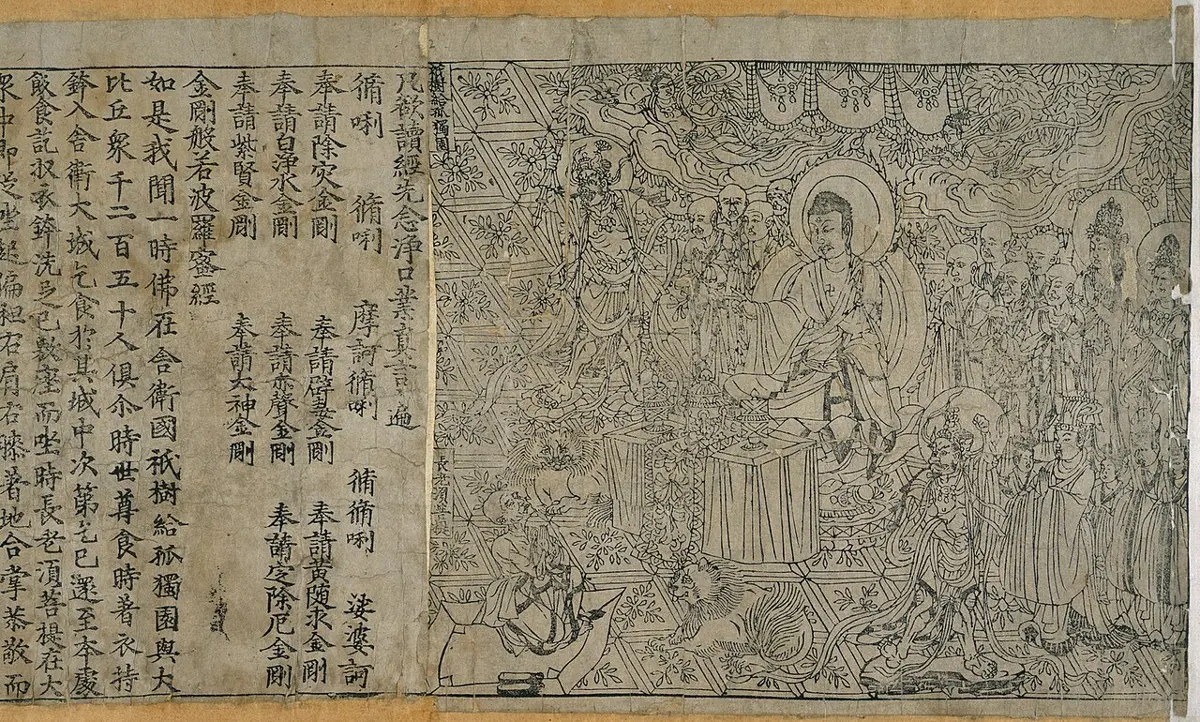
Another trove from these roads sat hidden for nine hundred years. At Dunhuang, the oasis where the roads from the west met China, monks had cut hundreds of caves into a cliff and painted them. About a thousand years ago, one small cave, full of old manuscripts, was bricked up. Nobody knows why. A little over a century ago a Daoist priest looking after the caves found it, and a few years later he sold thousands of its papers to explorers from Britain and France. Most were in Chinese or Tibetan, but the other languages of the roads were there too, Sogdian among them, and even a few lines in Hebrew: prayers, contracts, letters, schoolwork. Among them was a printed scroll of a Buddhist text, the Diamond Sutra, with a line at the end saying it was made in 868 by a man named Wang Jie, on behalf of his two parents, to be given out to all. It is the oldest printed book in the world that carries its own date.
So the Silk Roads were never one road, and silk was more often money than cargo. They were a net of tracks between oases, carried mostly by small caravans of Sogdians and others, in short hops, with farmers all around them who rarely traded at all. What crossed the whole of Asia on them was what people carried in their heads and their packs: a religion, books, and the know-how for making paper and glass. Nepal sat off to one side. For a few decades in the 600s, when Tibet and China were at peace, the road through the Kathmandu Valley joined the net, and Chinese envoys rode through the Valley on their way to India.
Meanwhile, in Nepal: the Licchavi kings, from मानदेव (Mānadeva), whose pillar starts the Valley’s written history, to अंशुवर्मा, and the princess Bhrikuti, whose story rests on Tibetan memory more than on any record of her time, are in The Licchavis and Amshuverma and Narendradeva, in Nepal’s History, for the Curious.
Found a mistake? Please tell us.