
Early in 1744, a young king came home to Gorkha from the plains of India with, it seems, a few new guns and a man who knew how to make them, and a deadly fight at a customs post behind him. He was Prithvi Narayan Shah, about twenty-one years old, king for less than a year of one of the poorest kingdoms in the hills. Within twenty-five years he would hold the richest valley in the Himalaya, and his family would rule from it for nearly two and a half centuries.
How did a small, poor kingdom come to do that? Part of the answer is in the Valley itself, and Chapter 17 tells it: three quarreling kings, a ring of forts, the roads shut. This chapter is about the other part, the place he started from. What Gorkha had and what it lacked, who stood with it and who against it, and how the world beyond the hills was changing while he grew up.
A small kingdom on a hill
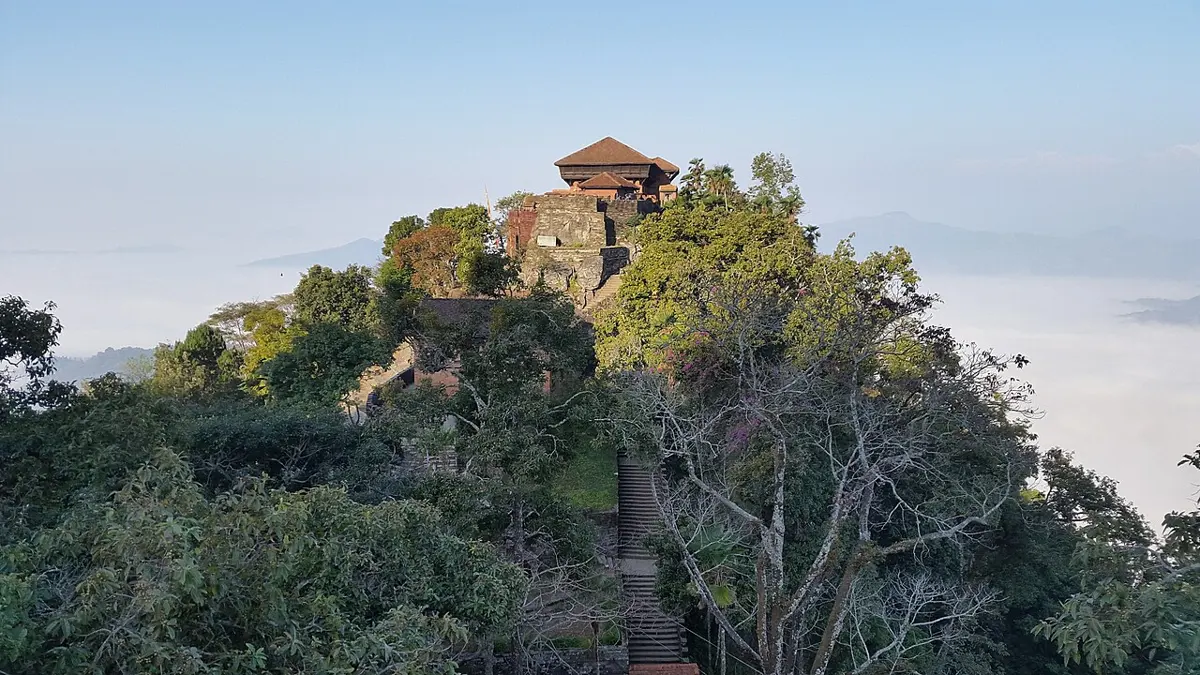
Gorkha had been a kingdom for less than two hundred years. A prince of Lamjung, the larger kingdom next door, took it in 1559, as Chapter 13 tells, and his family ruled it from a palace on a high ridge, beside the temple of Gorakhnath, one of the family’s guardian gods.
It wasn’t much of a kingdom to look at. Francis Buchanan Hamilton, a Scottish doctor who gathered everything he could about the hill states some sixty years later, was told that the town had about two thousand houses and was “the only place of note” in the whole territory. Its kings, he wrote, were “cut off from any direct communication with either the low country or Thibet”. With no mines and nothing much to trade, they “were considered as insignificant”. The land brought its king about 12,000 rupees a year for his household. Gorkha didn’t even make its own coins. It used the Valley’s silver and the Mughal rupees from Patna.
Most of its people farmed. The doctor’s informants counted Brahmins and Khas, or Chhetris, in about equal numbers, and rather fewer Magars, with the Brahmins mostly working the land and the Khas and Magars doing the fighting.
East of Gorkha, across the Trishuli river, lay Nuwakot, a hill fort that belonged to the king of Kathmandu. The road from the Valley to Tibet ran past it, north to the pass at Kerung. Along roads like that one, Newar merchants carried the trade between India and Tibet, and the Valley’s silver coins went north in large numbers. Chapter 15 follows that trade over the passes.
So a poor kingdom sat beside a road full of other people’s money. Some historians think that road was much of the point. Within about ten years of taking Nuwakot, Prithvi Narayan was striking silver coins of the Valley’s pattern and had an agreement with the Tibetan officials at Kuti, and they read this as a king out to win the Tibet trade for himself. That is a reading of what he did later. Nothing we have read from these early years says what he wanted. But the sayings that may be his own, gathered as the दिव्य उपदेश (divya upadeś), the “divine counsel”, said to have been spoken near the end of his life, return again and again to roads, merchants and cash. They tell his heirs to keep foreign merchants out of the hills, to have their people weave their own cloth instead of buying it from India, and to sell herbs abroad and bring the money home, because, as they put it, when the people are well off the palace is strong.
Growing up in Gorkha
Prithvi Narayan was born at the start of 1723, the eldest son of King Narabhupal Shah. His mother was a princess of Palpa, one of the strongest hill kingdoms to the west, and her family would matter to him all his life. But he was brought up by another of his father’s four wives, the senior queen, who had no children of her own. The family’s priests taught him the scriptures and the old books on how to rule.
He grew up watching Gorkha lose. In the 1720s its soldiers had gone to fight in the Valley’s own wars, first for one Malla king and then for another, and come home with a share of the payment, 8,000 rupees. In the 1730s his father sent an army against Nuwakot, and it was beaten. One of its commanders was dismissed, and later went to serve the king of Kathmandu, who put him in charge of Nuwakot. Narabhupal never recovered from the defeat. He withdrew from public life, and while still a teenager his son began to take over the kingdom’s defense and its dealings with its neighbors.
Friends and quarrels
A small kingdom without money had other things to offer: marriages and friendships. Prithvi Narayan tried both, and not every one went well.
His first bride was a daughter of Hemkarna Sen, the king of Makwanpur, a Sen kingdom that held the hills and forests south of the Valley and grew rich on Tarai rice land and on the elephants caught in its forests. The wedding took place at Makwanpur, but the bride, about twelve years old, stayed at home with her parents. When he came back in January 1739 to take her to Gorkha, he was told she was still too young, and at a fair by the Bagmati her brother, the crown prince, treated the Gorkhalis with contempt. In the दिव्य उपदेश the quarrel turns on wedding gifts, a one-tusked elephant and a necklace said to be worth nine lakh rupees: the young prince demands them with the bride, and swears he will take her by the sword if they are refused. He left without her. His road home crossed Chandragiri, the ridge above the Valley, and what he is said to have seen and thought there belongs to Chapter 17. A year later he married again, a Rajput lady from the plains.
To the west, his mother’s family gave him advice. The same sayings tell of an uncle from Palpa who visited Gorkha and put the young prince’s position in a picture. Lamjung is the गरुड (garuḍ), the great bird that eats snakes, the uncle said; Gorkha is the snake, and Nepal, meaning the Valley, is a frog. Only once the snake has slipped past the bird’s eyes can it eat the frog.
In other words, before going east, make sure you won’t be attacked from behind. Lamjung was the old family home, and with Kaski and Tanahun it belonged to a league of kingdoms, while Gorkha “entered into none of the leagues formed by their neighbours”. So in 1740 the prince met the king of Lamjung at Chepe Ghat, on the river between their kingdoms, and the two swore to treat each other’s friends as friends and enemies as enemies. Gorkha would help Lamjung against Kaski, and Lamjung would leave Gorkha free to move east. We know the terms only from a short summary in an old list of palace papers, and that list survives only in a historian’s notes, since the copy he made of it was lost. The oath itself has never been found.
Then, around 1741 or 1742, he went to the Valley. A family history written decades later says turbans were exchanged with the kings of Bhaktapur and Kathmandu, the custom that made two men ritual kin. Bhaktapur’s king, Ranajit Malla, became Prithvi Narayan’s मितबा (mitbā), his ritual father, and Ranajit’s son, the crown prince, became his friend. The young man stayed with the family as a guest: for a few days in one telling, for three years in a chronicle written much later. The record of these visits is thin, and their dates were worked out much later. But if they happened, the prince saw the Valley’s cities and its kings at close range, as a friend.
At home, a king of Gorkha didn’t rule alone. A circle of old families, the थरघर (tharghar), had served his ancestors and expected a share of the kingdom’s offices. William Kirkpatrick, a British officer who visited Nepal in 1793, was told there were thirty-six such families, led by six, and that the kingdom’s ministers were usually chosen from them. They used to dress simply, he heard, saying it was “with their swords, and not with the aid of fine garments, that their ancestors had raised the Goorkhali house”.
Prithvi Narayan needed the थरघर, and he needed a chief minister, a काजी (kājī), whom they would follow. The sayings tell how he chose one. He had meant to give the post to another man, but he asked his people whom they wanted, and found that they wanted Kalu Pande, an older man of one of the leading families. So Kalu Pande became काजी, and the king tied two of the great families together by arranging a marriage between the Pandes and the Basnyats. Whether it happened just that way, nobody can say. It shows at least how the court liked to remember him: a king who listened before he chose.
Those were the people who stood with Gorkha. Against it, or at least not with it, stood almost everyone else. Kathmandu held Nuwakot. Makwanpur’s crown prince was an enemy. Lamjung, Kaski and Tanahun were friends by oath and rivals by habit. And the Valley’s three kings, divided as they were, were each far richer than the king of Gorkha.
A journey south
Narabhupal Shah died early in 1743, and in April Prithvi Narayan became king at about twenty. Within months he set out for Banaras, the holy city on the Ganges in India, on what was called a pilgrimage.
The India he walked into was coming apart. In 1739 the Persian king Nader Shah had marched into Delhi, sacked it and carried off the Mughal emperors’ Peacock Throne. The emperor kept his throne, but little else. His governors ran their provinces as they pleased: Bihar, with its city of Patna, answered to the Nawab of Bengal, and Banaras to the Nawab of Oudh, whose man there was a local landlord with the title of raja. For a traveler from the hills, the empire now meant local lords and their tax collectors.
What Prithvi Narayan wanted most in India were guns. Muskets had come into the Valley perhaps fifty years before, bought from Indian traders, but by his biographer’s guess there were still fewer than 150 there, and Gorkha’s soldiers fought with bows, swords and the curved knife, the khukuri. His biographer remembered reading, in a Christian priest’s account he could no longer find, that the young king brought home from Banaras a Muslim who knew how to make guns. From that he reasoned that the king must have bought some guns too, flintlock muskets at about sixty rupees each, since a gunsmith is no use without guns to mend. He certainly bought tents. It may not have worked at first: he thought the gunsmith went home again, because the guns couldn’t yet be put to use.
On the way back, a customs post stopped the party and its officers wanted to search the king’s baggage. The Gorkhalis refused, there was a fight, and the officers were killed. Two separate records tell this: the Scottish doctor was told the young king “instantly put the officers to death”, and a Sanskrit stone at the palace in Nuwakot, dated 1762, praises him for it. The doctor also heard that a wandering holy man, a vairagi, hid the king from the police and led him safely to Palpa, where his cousin, the king of Palpa, welcomed him and helped him on his way. By the end of March 1744 he was home in Gorkha.
Some readers will have learned that Prithvi Narayan attacked Nuwakot in 1743, just after he became king, and lost, and that the defeat is what sent him to Banaras for guns. That story is in an old chronicle, and some historians accept it. His most careful biographer thought it imagined, partly because it names a commander who had already been sent away from Gorkha. Whichever is right, the attack that won Nuwakot came in 1744, and that is where Chapter 17 begins.
The world beyond the hills
The world around Gorkha was changing on both sides.
To the north, Tibet had come under the eye of China’s Qing emperors. A Qing army helped drive invaders out of Lhasa in 1720, and from 1728 two of the emperor’s officers, the ambans, lived in Lhasa with soldiers. Tibet still ran its own affairs, but anyone who dealt with Lhasa now dealt, in the end, with Beijing.
To the south, the Mughal empire was breaking into pieces, and a newcomer was waiting for them. The English East India Company was, in the 1740s, a trading company with a fort at Calcutta and a few other ports. Thirteen years after Prithvi Narayan came home from Banaras, it took Bengal. It is often said that he set out to join the hills together before the British could take them one by one. When he started, the Company was still a company of traders, and nothing we have read from those years mentions it. He did come to see the danger. In old age, the दिव्य उपदेश says, he called his kingdom “a yam between two stones”, China to the north and the emperor of the southern seas to the south, and told his heirs to keep friends with both, but to beware of the second, who was “very clever” and had already pressed India under him.
Historians have never agreed about Prithvi Narayan Shah, and they still don’t. The Scottish doctor, who never met him but talked to many who had, gave praise and blame in a single breath: a man “of insatiable ambition, sound judgment, great courage, and unceasing activity”, “kind and liberal” to his friends, but “regardless of faith to strangers, and of humanity to his enemies”. Nepal’s school books have long called him the maker of modern Nepal, and many historians agree. Others see in his wars the conquest of other peoples’ lands, the Valley’s Newars, the Kirat east, the Tarai, by a small group of hill families who then held power for centuries. Most of what is said for and against him concerns what he did after 1744, which the next chapters tell, and Chapter 21 sets out the arguments.
What can be said about the years in this chapter is plainer. By March 1744, the king of a poor hill kingdom had an oath at his back, friends and a rival inside the Valley, old families who expected to share in whatever he won, a first try at a new kind of weapon, and a fresh look at a great empire falling apart. His father had lost at Nuwakot, and the road to Tibet still ran past it in Kathmandu’s hands. Nobody could have known what would come of it. But the pieces were in place.
Meanwhile, in the world: in 1757, while Prithvi Narayan was closing his ring of forts around the Valley, an East India Company army defeated the Nawab of Bengal at Plassey, and in 1765 the Mughal emperor gave the Company the right to collect the taxes of Bengal, Bihar and Orissa. A company of traders had become the government of eastern India, just across the hills from Nepal.
Found a mistake? Please tell us.