
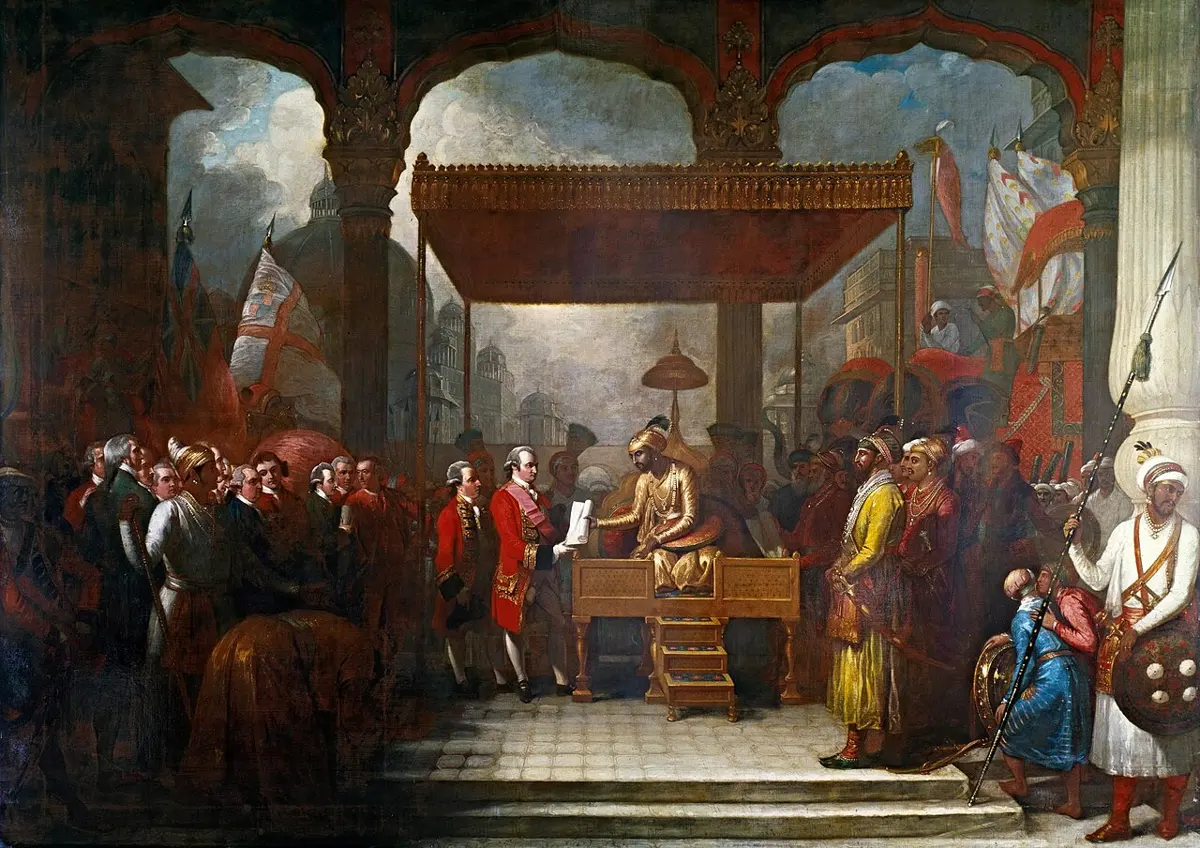
In August 1765, in a camp at Allahabad on the Ganga, the Mughal emperor Shah Alam signed away the richest province in India. He could not go home to his own capital, Delhi, and the autumn before, he and his allies had lost a battle to the Company at Buxar. He sat for the occasion, one account of the day says, on a silk-covered armchair set on top of the dining table of Robert Clive, the British commander. The paper he handed over made a London trading company the दिवान (diwan), the official who collected the taxes, of Bengal, Bihar and Orissa. In return the company promised the emperor 26 lakh rupees a year. It took very little time to agree.
So a company of merchants, run by shareholders who met in a London office, now collected the land tax of tens of millions of farmers. Within a century the same company ruled most of South Asia. In the century after that, a handful of European countries took nearly all of Africa, and nearly every coast of Asia felt their guns.
How did a few small countries come to rule most of the world? Not mostly by sending their own people. The pattern repeats from India to Africa. Traders built a fort to guard their goods. They hired local soldiers and drilled them in the European way. They found local allies who had quarrels of their own, and they took a side. Then they took the right to collect taxes, and the taxes paid for the soldiers who took the next place. Each conquest paid for the one after it. This chapter follows that machine from Bengal to China and across Africa, and ends with the few countries it never quite swallowed. Nepal is one of them.
A company with an army
The East India Company was given its charter, its permission from the English queen to trade with Asia, on the last day of 1600. For a century and a half it was what its name said: a trading company. In the 1610s the Mughal emperor Jahangir let it set up a trading post at Surat, on the coast of Gujarat. Its ships brought home pepper, silk and, above all, Indian cotton cloth, and paid for most of it in silver. Its posts at Madras, Bombay and Calcutta grew into forts.
The Company had soldiers to guard those forts, and in the 1740s and 1750s, as Mughal power broke apart into rival kingdoms, it found out how much they could do. It fought the French company for influence in the south, and then, in Bengal, it fought the Nawab himself.
The fight came at Plassey, a village about 150 kilometers north of Calcutta, in June 1757. Clive had about 3,000 men, more than two-thirds of them Indian. The Nawab, Siraj ud-Daulah, had about 50,000. But Clive had already made a secret deal with the Nawab’s own general, Mir Jafar, who was promised the throne, and with Bengal’s great banking family, the Jagat Seths, who were tired of the Nawab. When the fighting began, much of the Nawab’s army never moved. A sudden rainstorm soaked his gunpowder; the British had covered theirs. By evening the battle was over, and Mir Jafar became Nawab, a ruler who owed everything to the Company.
What followed was a scramble for money. Bengal’s new rulers paid the Company and its officers huge “presents”, and Clive himself came home one of the richest men in Britain. One of the first Hindustani words to settle into English in those years was loot. Eight years and another war later came the diwani, the camp at Allahabad, and the armchair on the dining table.
Collecting taxes was the turning point. Up to then the Company had to send silver to India to buy cloth. Now it could pay for the cloth, and for its army, out of Bengal’s own taxes.
The worst of it came quickly. The rains failed in 1769, and in 1770 Bengal starved. By the end of 1769 rice cost twice what it had, and in 1770 the price tripled again. The Company had bought rice for its army, and some of its own men cornered the grain trade. It did not cut its taxes; its officers raised the land tax that year, and the tax it collected in 1771 was a little more than it had been before the famine. How many died nobody counted. The Company’s own directors in London were told that about a third of the people had died, which made it about ten million. Historians who have gone back through the district records think that figure much too high, and some put the deaths nearer one million. Either way, it was one of the great disasters of the century, and Bengal still remembers it as छियात्तरको मन्वन्तर, the famine of ’76, after the year in the Bengali calendar.
The famine and the Company’s debts that followed brought a rescue loan from the British government, and Parliament began to watch how the Company governed. But the machine kept running. Taxes paid for soldiers, soldiers won more land, more land paid more taxes. By the 1800s the Company’s three armies together had about a quarter of a million soldiers, most of them Indian, more than Britain’s own army at home.
In the same years, on the hills just north of the plains, Prithvi Narayan Shah was building the kingdom of Gorkha into Nepal, and watching the Company closely. In 1814 its army came into the hills.
Opium for tea
The Company’s other great trade was with China, and it had a problem. Britain was falling in love with tea, and tea came only from China. China wanted almost nothing Britain made. So silver flowed out of Britain to Canton, the one port where foreign merchants were allowed to trade.
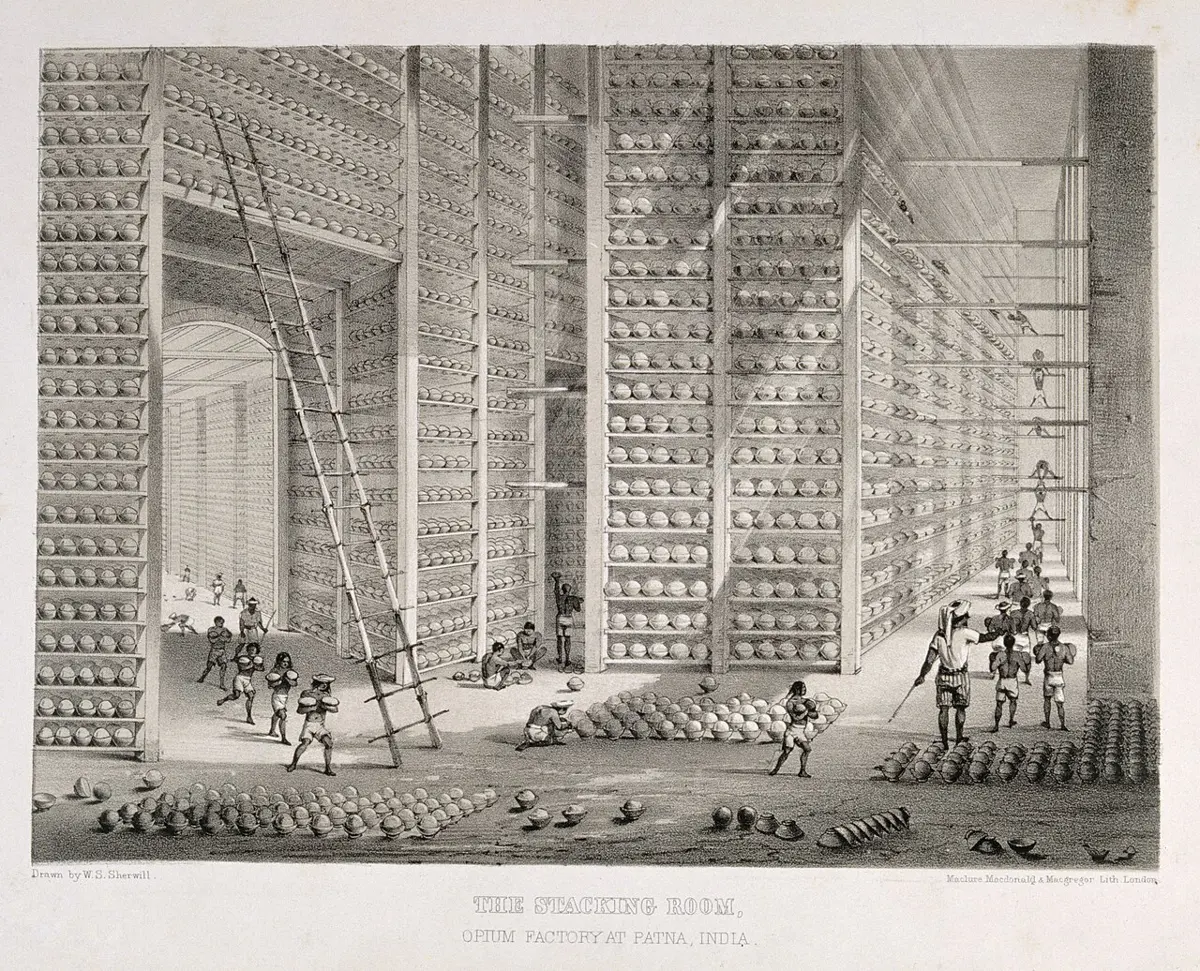
The Company found something China would buy. Its farmers in Bihar and Bengal were ordered to grow opium poppies, and the Company had the only right to buy the crop. Its factory at Patna dried the sticky drug into balls, packed them in wooden chests, and sold them at auction in Calcutta. The Company did not carry the opium to China itself, since the Qing emperors had banned it. Private merchants did, smuggling it in at the coast. Around 1800 about 4,000 chests a year reached China; by 1831 it was nearly 20,000, each chest holding about 60 kilograms. The silver now flowed the other way, out of China, and millions of people there were addicted.
In 1839 the Qing emperor sent an honest and stubborn official, Lin Zexu, to Canton to end it. Lin surrounded the foreign merchants’ quarter until they handed over their opium, more than 20,000 chests. Then he had it destroyed in trenches by the sea, mixed with lime and salt and washed out with the tide. It took about 500 workers twenty-three days. Lin even wrote a short piece to the spirits of the sea, apologizing for what was being poured into it.
He also wrote to Queen Victoria. Britain, he had heard, did not let its own people smoke opium. If it would not harm its own country with the drug, he asked, how could it send it to harm another? He was wrong about the ban, which Britain did not have, but his point was hard to answer. The queen never answered it.
Britain answered with warships. The merchants wanted payment for their lost opium, and their government sent a fleet. In Parliament a young William Gladstone, later prime minister, said he knew of no war “more unjust in its origin”, but the war went ahead. Chinese junks and forts were no match for British guns and a new iron steamship called the Nemesis. In 1842 China signed the Treaty of Nanking. It gave Britain the island of Hong Kong “in perpetuity”, which means forever, opened five ports to British trade, and made China pay 21 million dollars, six million of them for the destroyed opium.
The treaty didn’t mention the opium trade at all, but the smuggling went on. A second war, fought by Britain and France from 1856 to 1860, made China allow it outright, and ended with British and French troops burning the emperor’s Summer Palace outside Beijing. China kept its emperor and its government, but foreigners in its ports now lived under their own laws, not China’s. Chinese historians later named these the unequal treaties, and the years from the first Opium War to 1949 China’s “century of humiliation”.
The rising of 1857
Back in India, the Company kept growing. It took the Punjab in 1849, and in 1856 it took the kingdom of Awadh, around Lucknow, saying it was badly ruled. When rulers died without a son of their own, it took their lands too, as it did at Jhansi. Many of the Company’s Indian soldiers, the sepoys, came from Awadh, and their own villages were changing hands.
Then came a new rifle. Its paper cartridges were greased, and a soldier tore them open with his teeth. A rumor spread that the grease was made from the fat of cows and pigs, which would break the faith of Hindus and Muslims alike. Whether any cartridge really had such grease is still argued; what mattered was that many soldiers believed it.
In May 1857 the soldiers at Meerut, near Delhi, rose against their British officers, killed many of them, and marched to Delhi. There they proclaimed the old Mughal emperor, Bahadur Shah Zafar, aged 81, their leader. Within weeks much of northern India had risen: soldiers, landlords, peasants, and rulers like Rani Lakshmibai of Jhansi and Begum Hazrat Mahal of Lucknow. Both sides killed prisoners, women and children among them. British reprisals burned whole villages, and Delhi and Lucknow were wrecked. Much of the south and east stayed quiet, and the Sikh princes of the Punjab sided with the British. By the end of 1858 the rising was crushed. Zafar was sent to Rangoon in Burma, where he died in 1862, and the Mughal line ended with him.
What to call it is still argued, because each name tells a different story. In Britain it was long called the Indian Mutiny, a soldiers’ revolt. In India it is often the First War of Independence: India marked its 150th year with a coin that says so. Many historians now say the rebellion or the uprising, or simply the rising, since soldiers started it but villagers and rulers carried it on.
Nepal was in it too. Jung Bahadur, Nepal’s prime minister, sent about 3,000 soldiers, then marched down himself with about 9,000 more, and they helped the British take Lucknow back. Britain gave Nepal back a strip of the western plains for it.
When it was over, the British government took India away from the Company. From 1858 India was ruled in the queen’s name, and the Company faded away. The army was rebuilt, and recruiters now preferred peoples they called “martial races”, said to be born fighters, Sikhs and Punjabi Muslims and, from Nepal’s hills, the men they called Gurkhas, after the old kingdom of Gorkha. In the hills a man who went to serve abroad was called a लाहुरे (lāhure), after Lahore, where an earlier generation had gone to serve the Sikh king Ranjit Singh. Their courage and pride in the regiments were real, and so was the fact that they were recruited cheaply by a foreign power for wars that were not Nepal’s. Both are true.
The “martial races” were part of a bigger mistake of the age: race science. Scientists measured skulls and noses and claimed to rank humanity. The British official in charge of India’s census of 1901 claimed that its castes fell into rank by the shape of their noses, measured on a few dozen to a hundred people each. It is wrong. People vary, but not in neat groups; the idea of fixed races was never accurate, and grew up to explain and excuse colonial rule. Every human population is mixed, and no group has ever been pure.
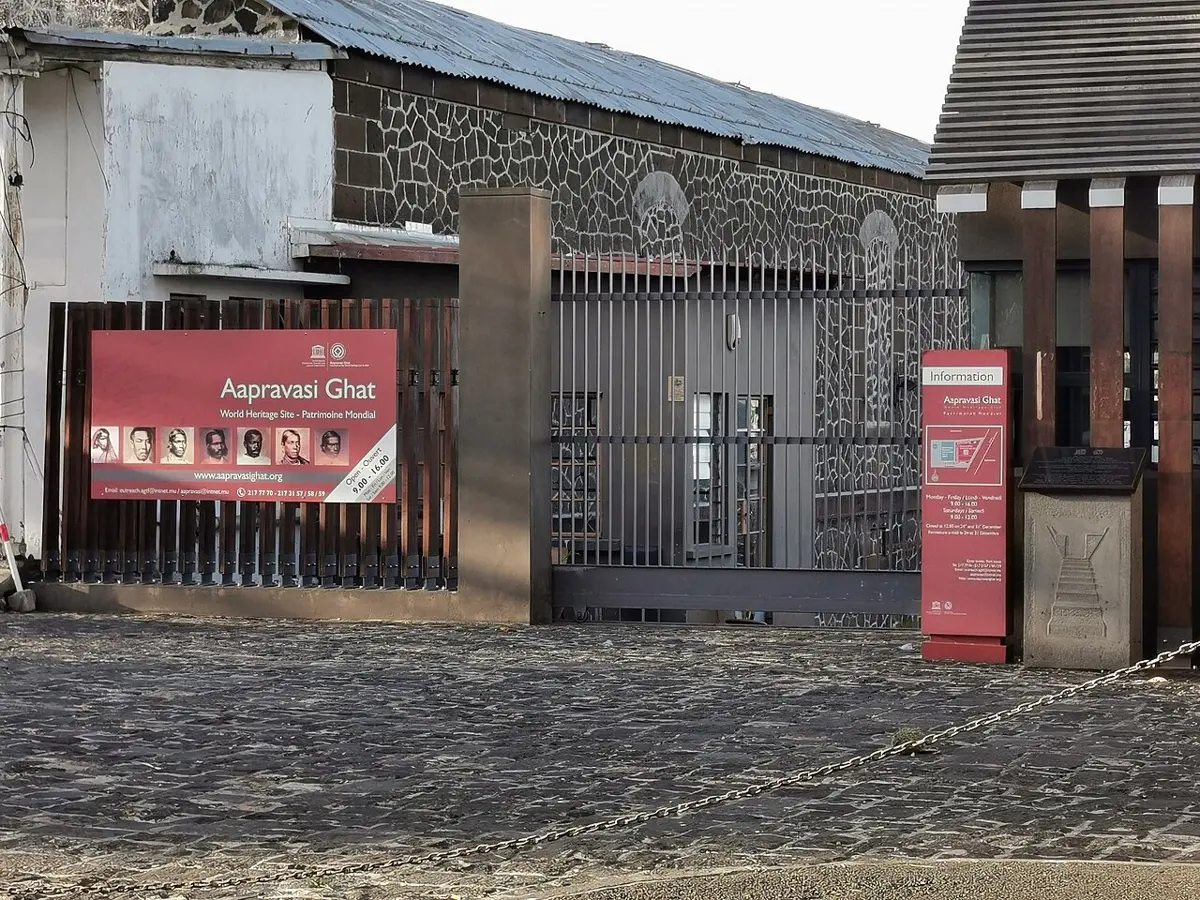
India’s people also crossed the oceans. When Britain ended slavery in its colonies in 1834, sugar planters needed new hands, and they turned to India. Workers signed contracts, usually for five years, and sailed to Mauritius, the Caribbean, South Africa and Fiji. They called the contract girmit, from the English “agreement”, and themselves girmitiya. More than 1.6 million went before the system ended in 1917. The pay was low, the work was hard, and many who signed did not know where they were going. Some have called it a new system of slavery; it was not slavery, but it was not freedom either. A few came from Nepal. In Fiji they were admired for their enterprise until Nepal’s government discouraged them from going after 1894, perhaps to keep the young men for the army.
Africa divided
In the 1870s Europeans held only about a tenth of Africa, mostly near the coasts. Then new medicines against tropical fevers, steamships, railways, the telegraph and new rifles let them push inland. By 1914 only two African countries were not ruled by Europeans: Liberia and Ethiopia.
The race was given its rules at a conference in Berlin in the winter of 1884–85, called by Germany’s chancellor, Otto von Bismarck. Fourteen countries came. No African country was invited. The meeting did not draw a map of Africa with a ruler, as people often say. It set rules for claiming: a country taking a stretch of coast had to tell the others, and had to show it really controlled it. It also promised to protect “the native tribes” and end the slave trade. The only lines it drew were around the basin of the Congo River, where every country was to be free to trade.
The Congo shows what those promises were worth. In the same months the powers recognized the Congo Free State, the private property of one man, King Leopold II of Belgium, who never once went there. In the 1890s the Congo’s forests had something the world would pay for, wild rubber, and Leopold’s state made every village bring it in. Its soldiers took women and children as hostages until the men brought their quota. Villages that fell short were burned and people were shot, and soldiers cut off hands. In 1904 the British consul Roger Casement reported what he had seen and heard. One man told him, of the rubber, “we were always in the forest and then when we were late we were killed.”
How many people died in the Congo is not known, and is fiercely argued. No one counted the people before 1924. Disease, especially sleeping sickness, killed huge numbers in the same years. So estimates of the fall in population run from about one million to ten million. Whatever the number, the outcry led Belgium to take the Congo from its king in 1908.
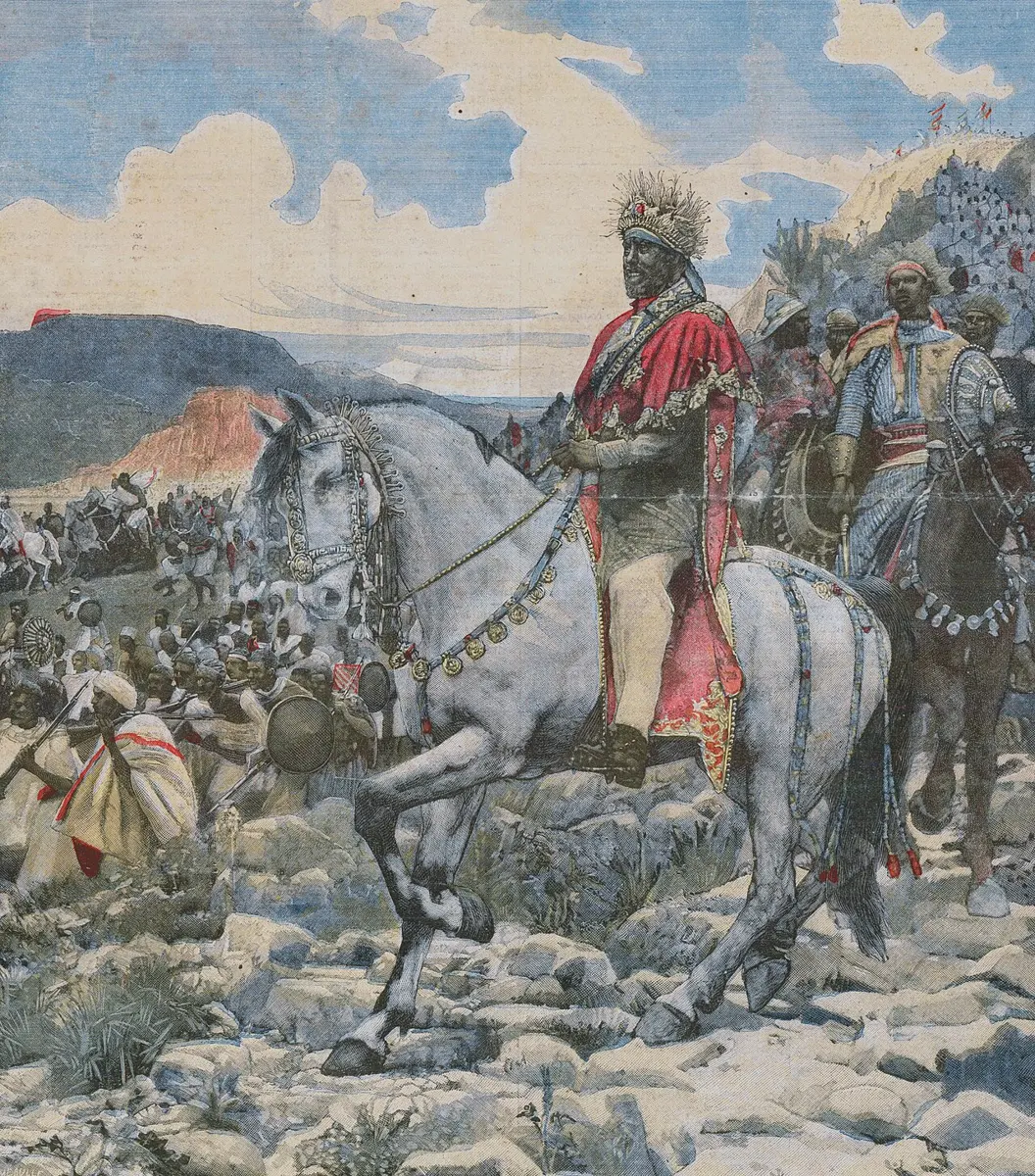
Ethiopia went another way. In 1889 Italy and Ethiopia’s emperor, Menelik II, signed a treaty. Its Italian text made Ethiopia an Italian protectorate, a country whose dealings with the world went through Italy. Its Amharic text said only that Ethiopia could use Italy’s help if it wished. When Menelik found out, he rejected the treaty. Meanwhile he had been buying modern rifles and cannons from France and Russia.
Italy invaded, and on 1 March 1896, at Adwa in the northern hills, Menelik and Empress Taytu met its army with somewhere between 70,000 and over 100,000 men. Italy’s army was beaten in a single day, and thousands died on both sides. Italy had to recognize Ethiopia’s independence. For Ethiopians Adwa is a national holiday; for Italians it was a long-remembered humiliation; and for many Africans and Black Americans it became a symbol that Europe could be beaten.
Who stayed free
Only a few countries in Asia and Africa were never colonies. Scholars who have compared every country find that places far inland, and places with long histories of farming and of states of their own, were taken late or not at all. The cases show more: some countries reformed in a hurry when the danger came, and rival empires sometimes found it handier to leave a country standing between them than to fight over it. Even where a colony ends is argued: Persia, never ruled by Europeans, has been called half-colonized. None stayed free for nothing.
Japan answered by becoming like the countries that threatened it. American warships forced it to open its ports in 1853, and it signed unequal treaties like China’s. In 1868 a group of young samurai took power in the emperor’s name and set out to remake the country under the slogan “rich country, strong army”. They sent officials around the world to study, built industry on the Western model, and conscripted an army. By 1899 the foreigners in Japan were under Japanese law again. Then Japan became an empire itself. It beat China in 1895 and took Taiwan, and beat Russia in 1905, the first great victory of an Asian power over a European one in modern times. In 1910 it took Korea. Koreans and Taiwanese lived under Japanese rule until 1945.
Siam, now Thailand, sat between British Burma and Malaya and French Indochina, and each side found it handy to keep Siam between them. Its kings reformed the government and the army, signed unequal treaties, and gave up land: France took the lands east of the Mekong in 1893, now part of Laos. Afghanistan was the buffer, a country kept as a cushion between rivals, between British India and the Russian Empire, and from 1879 to 1919 Britain controlled its dealings with other countries. Persia, now Iran, was split by Britain and Russia in 1907 into zones of influence, though no one took it. Ethiopia had Adwa.
Nepal fought the Company and lost a third of its land at Sugauli in 1816. After that it kept its rulers, its laws and its hills, a buffer between British India and Tibet, and sent its young men to fight for the British. Each of these countries kept its independence, but each paid for it in land, in soldiers, or in letting others decide its foreign affairs.
Empire, in the end, was a machine that paid for itself out of the people it ruled: a trading company that taxed Bengal, opium that paid for tea, rubber that paid a king, workers sent across oceans to replace the enslaved. It was carried out mostly by local soldiers and allies, and justified by ideas about race that science has shown to be false. It is remembered differently in London, in Delhi, in Beijing and in Addis Ababa, and the memories don’t have to agree. The few countries that stayed free did it by reforming, by fighting, or by being useful as cushions between empires, and they paid a price too.
Meanwhile, in Nepal: the battle of Plassey was fought in 1757 while Prithvi Narayan Shah was closing in on the Valley, in Prithvi Narayan Shah and Gorkha; the Company’s war with Nepal and the treaty of Sugauli are in Bhimsen Thapa and the war with the Company; Jung Bahadur’s march to Lucknow in 1858 is in The Kot and Jung Bahadur; and the लाहुरे who served in the British army are in Lahures and the First World War, all in Nepal’s History, for the Curious.
Found a mistake? Please tell us.