
In April 1814 the king’s council in Kathmandu was asked a question, and its members gave their answers in writing. The East India Company, which by then ruled most of India’s plains, had ordered Nepal to leave Butwal and Sheoraj, strips of rich lowland at the foot of the hills that both sides said were theirs, and had warned that its soldiers would come if Nepal didn’t. Should Nepal give way, or fight? The question itself, sent in the young king’s name, already leaned toward fighting.
The chief minister, Bhimsen Thapa, wanted to fight. No one had ever got the better of Nepal, he wrote; even the Chinese had been glad to make peace. The English had once failed before the small fort of Bharatpur, in the plains, and that had been built by men. Nepal’s hills, he said, “are formed by the hand of God, and are impregnable.” They could make peace afterwards, on whatever terms suited them. Three of the commanders who governed the western hills, Bam Shah, Amar Singh Thapa and Hastidal Shah, wrote back together with less confidence: “We have hitherto but hunted deer; if we engage in this war, we must prepare to fight tigers.” They added, pointedly, that the man urging war had grown up at court and had never known the hardships of a soldier’s life.
Bhimsen won the argument. Within two years Nepal had lost about a third of the land it held, and the country’s borders were drawn, more or less, where they lie today. This chapter is the story of how Bhimsen came to power, how the war was fought, and what it cost.
A king who would not stay away
Ran Bahadur Shah, who had taken power from his uncle in 1794, did not rule for long. In 1799 he gave up the throne to Girvan Yuddha Bikram Shah, a boy of a year and a half, the son of his favorite queen, Kantavati, who was gravely ill. When she died later that year he was wild with grief, and before long he left for Banaras, in India, as a swami, a holy man. With him went a young bodyguard named Bhimsen Thapa, born in 1775, whose father was an officer in the army.
The court he left behind split into quarreling parties. One of them made a treaty with the Company in 1801 and let a British envoy, Captain Knox, live in Kathmandu; the senior queen, Rajrajeshwari, came back to power, sent Knox away and let the treaty die. Meanwhile, in Banaras, Bhimsen and Ran Bahadur’s priest were borrowing money and planning his return. In 1804 the former king came back over the pass at Thankot. The soldiers sent to bring him in under guard went over to his side, and the leading minister, Damodar Pande, who had come out to Thankot to receive him, was arrested there. Some days later Damodar Pande was beheaded, with his son and several others.
Ran Bahadur was not king again, but he was in charge. Two years later, in April 1806, at a meeting of the court one night, his half-brother Sher Bahadur Shah drew a sword and killed him.
Bhimsen Thapa took charge that same night and ordered the arrests. By the account of Baburam Acharya, the historian who pieced it together from the records, 93 people died in the days that followed: 77 nobles, officials and guards were beheaded, the king of Palpa, Prithvipal Sen, among them, and 16 women died as satis on the funeral pyres, among them the senior queen Rajrajeshwari, whom Bhimsen sent horsemen to Sankhu to make a sati. When the fortnight was over, the boy king Girvan had a regent, Ran Bahadur’s young widow Tripurasundari, and Bhimsen was the government. For the next thirty years he ran Nepal.
Bhimsen’s Nepal
The new government kept the army moving. Palpa, the old ally to the west, had already been taken: its king had been called to Kathmandu on the pretext of a marriage between his sister and Ran Bahadur and held there, while Bhimsen’s father, Amar Singh Thapa (not the general of the same name in the far west), marched in with troops. Garhwal, beyond Kumaon, had been shaken by an earthquake and torn by quarrels in its royal family; the Gorkhali army took it in 1804, and its king, Pradyumna Shah, was killed fighting in the valley of Dehradun. Then the army pushed on across the Yamuna, into the small hill kingdoms around today’s Shimla, and as far as the Sutlej. It crossed the Sutlej too, toward the Beas, and laid siege to the great fort of Kangra, but Kangra was never taken.
By 1814 the kingdom stretched more than a thousand kilometers along the Himalaya, Sutlej to Teesta, with Kathmandu near the middle and the far ends many weeks’ march away. Measured roughly on the map, it was about half as large again as Nepal is now. The new lands were hard to hold. The general who governed the far west, the elder Amar Singh Thapa, was a strict and able soldier, but British officers who reached Garhwal in 1815 found its people bitter about their rulers’ heavy demands, and the princes the Gorkhalis had driven out were waiting in the plains for their chance. That chance came from the Company.
The war, 1814 to 1816
The quarrel began over land in the plains. For years the Gorkhalis and the Company’s officials had argued about villages along the border, and above all about Butwal and Sheoraj, lowlands that had belonged to Palpa and so, Kathmandu said, now to Nepal. When no answer came to its demand, the Company sent soldiers in, in April 1814, and left police posts there. At the end of May Nepali troops attacked the posts, and eighteen of the Company’s men were killed. The Governor-General, Lord Moira (later the Marquess of Hastings), decided that the Gorkhalis had to be beaten, and the Company declared war on 1 November 1814.
The two sides tell this beginning differently. The Company’s records say that Nepal had been taking border villages for years, that its officers left Butwal without a fight, and that the attack in May, in which a police officer was killed after he had surrendered, began the war. To Nepal, Butwal was its own land, taken by force: its Grade 9 history book says sixteen Nepali soldiers died resisting the Company’s troops, and a Nepali historian has argued that the Company wanted the hills anyway and had only been waiting until Napoleon was beaten in Europe, as he was, for the first time, in 1814.
The Company sent more than thirty thousand men against Nepal’s army of perhaps twelve thousand, in four columns along the whole length of the hills, while a fifth stood guard in the east. Two great columns in the middle were meant to climb from the plains to Palpa and to Kathmandu itself. They hardly got going: on New Year’s morning of 1815 the Gorkhalis surprised two of the forward camps in the Tarai, at Parsa and Samanpur, and in February the general commanding the Kathmandu column left his camp before daylight, without a word to his troops, and was removed from his command. The real war was fought in the far west, in the newly won hills that the Company could reach from its own territory.
Kathmandu had expected the first blow to fall in the Dun, the valley of Dehradun. In May 1814 a letter sent in the king’s name, though the thinking was Bhimsen’s, called the valley “the heart of the kingdom”, said that if fighting came it would certainly come there, and complained that the new fort at Nalapani was still not ready.
The first fight was at Nalapani, that small hill fort at Khalanga above Dehradun, held by about six hundred people under Captain Balbhadra Kunwar. On 31 October 1814, the day before war was formally declared, General Rollo Gillespie led an assault on it. The walls were low and unfinished, but the defenders fought hard, and Gillespie himself was shot through the heart a few yards from the gate, waving his hat to urge his men on. From Srinagar in Garhwal, two officers wrote to Bhimsen that the fort had beaten off this attack and a smaller one six days before, “we were victorious on both occasions”, and asked his pardon: they had been so busy sending ammunition to Nalapani that their Dashain offerings would reach him some days late. A second assault, a month later, after heavy guns had been dragged up from Delhi, failed too. A British historian of the war, writing a few years later, noted that “this petty fortress had already cost us considerably more than the entire number of its garrison.”
The guns could not take Nalapani, but thirst could. The British cut off the spring below the fort, and on the night of 30 November Balbhadra led the seventy or so who could still walk out through the British lines and away. Inside, the British found the dead and the badly wounded, among them women and children. Women had been on the walls in the first assault, throwing stones at the attackers. James Baillie Fraser, a Scot who traveled with the Company’s army, wrote of the garrison that there had been no cruelty to the wounded or to prisoners: “they fought us in fair conflict, like men.” He told of a Gorkhali soldier whose lower jaw had been shattered by a cannon shot, who walked into the British battery to ask for help; when he had recovered, he asked to go back to his own side and fight again.
West of the Yamuna the war was a long, slow siege. At Jaithak, a ridge-top fort above Nahan, Amar Singh’s son Ranajor Singh Thapa beat back the attacks of December 1814 and held out until the war in the west was over. Farther west still, the British general David Ochterlony gave up costly assaults and moved patiently from ridge to ridge, building roads for his guns, to pen Amar Singh into his forts around Malaun, above the Sutlej. On 16 April 1815, at Deothal, close to Malaun, the old commander Bhakti Thapa, over seventy by the Nepali account, led some two thousand of the best Gorkhali soldiers against a British position. He was killed, and his men driven back. Ochterlony sent his body back to the Gorkhali lines wrapped in shawls, as a mark of respect.
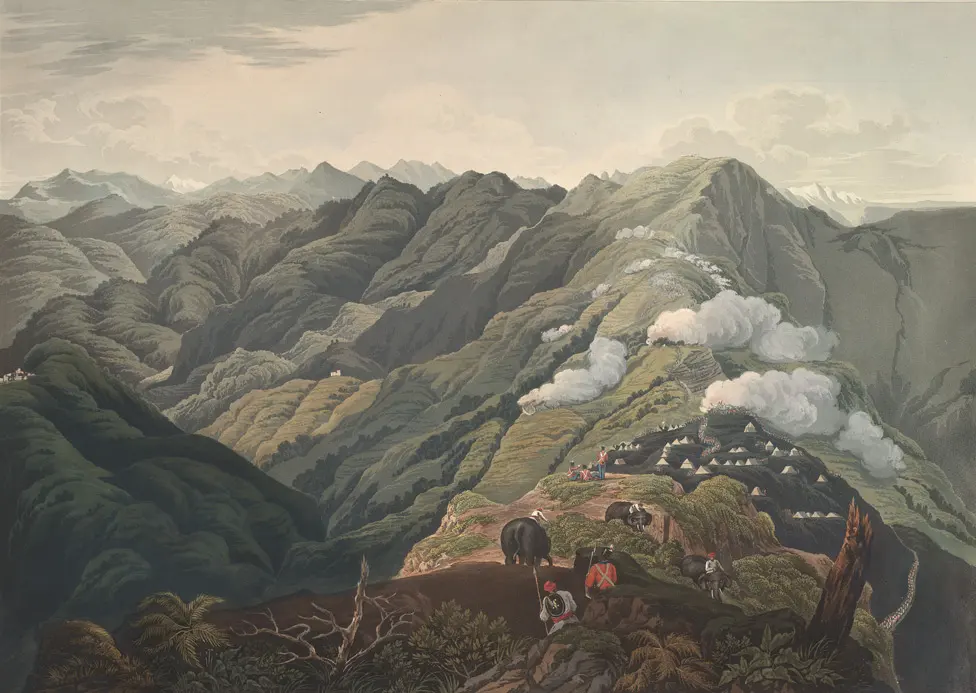
That spring the Company also sent a force into Kumaon, from its own plains. On 23 April Hastidal Shah, one of the three who had warned against the war, was killed in a fight near Almora. Within days Almora was besieged, and on 27 April Bam Shah, governor of Kumaon, signed away the province and marched his men back east of the Kali.
Amar Singh Thapa was still fighting. In March 1815 he had written to the king from his fort, in a letter the British intercepted and translated. The king had told him to make terms, even to give up the plains, the Dun and the hills as far as the Sutlej. Amar Singh begged him not to. Give up land, he warned, and the English would only come back for more, as they had with Tipu Sultan of Mysore, whom they first fined and then destroyed. The whole quarrel, he said, had been “a war for trifles,” started by the killing at Butwal. “Let me intreat you, therefore, never to make peace,” he wrote. “I am old, and only desire once more to kiss your feet.” He also admitted that “all the inhabitants and chiefs of the country have joined the enemy.” But his chiefs began to leave him, and on 15 May 1815, surrounded at Malaun, he signed a surrender. He and his soldiers were allowed to march home with their arms, back east of the Kali. Everything west of it was lost.
Many of the men who had fought for him did not go home. The Company had been impressed by them, and before the war was over it began enlisting them. Three battalions of Gorkhali soldiers were raised in 1815 and called the Nasiri battalions, and others in the Sirmur and Kumaon hills; some of these later became the 1st, 2nd and 3rd Gurkha Rifles. That was the start of the Gurkha regiments, which still recruit young men from Nepal two centuries later. Amar Singh’s surrender at Malaun left the soldiers in Nepal’s service free to join the Company’s; the peace treaty said nothing about it.
The Sugauli treaty
Peace took almost a year to make. Nepal’s envoy, the royal priest Gajraj Mishra, and the Company’s Lieutenant-Colonel Paris Bradshaw talked through the summer of 1815, and the talks broke down over the Tarai. The lowlands were where Nepal’s nobles and officers held the land that paid their salaries, and the court would not give them up. In the end the Governor-General offered two lakh rupees a year in pensions for the nobles who would lose their land, and on 2 December 1815, at Sugauli, a village just south of today’s border, Gajraj Mishra and Chandrashekhar Upadhyaya signed.
In Kathmandu the war party won the argument again, and the treaty was not ratified. So in February 1816 Ochterlony marched into the hills from the plains, went round the fortified main pass over the Chure hills by a smaller one, and beat the Nepali army before the fort of Makwanpur, in the hills south of Kathmandu. On 4 March 1816, in his camp in the Makwanpur valley, Chandrashekhar Upadhyaya handed him the treaty, now with the king’s seal, together with a written promise that Nepal accepted it.
The treaty had nine articles. Nepal gave up its claims to the disputed lands and to everything west of the Kali river, and ceded the lowlands from the Kali to the Rapti, from the Rapti to the Gandak (except Butwal itself), the lowlands between the Gandak and the Koshi where the Company had already taken charge, the plains between the Mechi and the Teesta, and the hills east of the Mechi. It promised not to trouble the king of Sikkim, and to let the Company settle any quarrel with him. It promised not to employ any British, European or American subject without the Company’s consent. And each side would keep a minister at the other’s court; the first British Resident, Edward Gardner, arrived in Kathmandu in 1816. Shortly after he arrived, King Girvan, not yet twenty, died of smallpox, and his son Rajendra, aged two, came to the throne.
The Company soon decided that it didn’t need all the lowlands, only enough for a straight, easily marked border. In December 1816 it gave back most of the Tarai between the Rapti and the Koshi, in place of the pensions, and a line of masonry pillars was built along the new border. The far western plains it gave to the Nawab of Oudh, to cancel a loan; they came back to Nepal in 1860, as Chapter 22 tells. The lowlands between the Mechi and the Teesta went to Sikkim. A reader who has learned that Nepal lost all the Tarai except Butwal may be surprised: the eastern plains beyond the Koshi were never ceded, and most of the central plains came back within the year. Even so, Nepal lost about a third of the land it had held, and the far west and the east were gone for good.
One line of the treaty is still argued over. It made the Kali the western border, but did not say which stream at the river’s head is the Kali. Nepal’s position is that the Kali is the stream that rises near Limpiyadhura, so the land around Kalapani and the Lipulekh pass lies inside Nepal, as Nepal’s official map draws it; India’s position is that the river begins at the springs of Kalapani, and India governs the land between the two streams. The argument started soon after the treaty, when Nepal claimed two villages there, Kuti and Nabhi, and the Company kept them. Geography, for the Curious tells it in full.
Bhimsen’s long rule, and how a defeat was remembered
Bhimsen Thapa stayed in power for twenty more years; the British record of treaties calls his power, until 1832, “complete and uninterrupted.” In 1832 Tripurasundari, the queen mother, died, and the young king Rajendra and his senior queen, Samrajya Laxmi, began to turn against him, with the Pande family, Damodar Pande’s, on their side. In 1837 the king’s infant son died, and Bhimsen was accused of having him poisoned. He was arrested, released after some months and sent to his home in Gorkha, then brought back to Kathmandu and charged again, this time with a forged document as evidence. In July 1839, by Baburam Acharya’s account, he heard a rumor that his wife was to be publicly disgraced, and took his own life with a khukuri. The king and queen had him carried, still alive, to the bank of the Bishnumati and left there, and he died nine days later; the court refused his body a funeral. Acharya tells it as suicide, out of despair at that rumor. Nepal’s Grade 9 history book says only that he died a prisoner, in a mysterious way.
How the war came to be remembered as Nepal’s proudest hour is a story of its own. In the 1930s, Nepali writers in Darjeeling, among Nepalis living under British rule in India, began writing the lives of brave men from Nepal’s past. Surya Bikram Gyawali’s Bir Balbhadra, about the defense of Nalapani, appeared in 1940, and his Amarsingh a few years later. Later Nepal’s own school books took these stories up, and Balbhadra and Bhakti Thapa became national heroes. The school versions do say that women and children fought at Nalapani, though the heroes are always Balbhadra and his men. What they usually leave out is that Balbhadra himself, after the war, went to the Punjab to fight for Ranjit Singh and was killed there fighting the Afghans, and that Bhimsen, the hero of resistance, was also the man who led the country into a war his own generals warned him against. How the different memories of the Gorkha campaign sit together is the subject of the next chapter.
The war with the Company ended Nepal’s growth and fixed its shape: a long strip of hills and plains between the Mahakali and the Mechi, with the Company’s India on three sides and Tibet on the fourth. It also left Nepal one of the very few countries of South Asia that the British never ruled. The treaty that took away a third of the kingdom left the rest independent, with a British Resident watching from his house in Kathmandu and Nepal’s young men walking south to join the Company’s army.
Meanwhile, in the world: Napoleon’s empire was falling. A month after Amar Singh Thapa gave up Malaun, Napoleon, back from exile, was beaten for good at Waterloo, in June 1815, while diplomats at the Congress of Vienna redrew the map of Europe.
Found a mistake? Please tell us.