
In August 1788 a four-pound loaf of bread cost 9 sous in Paris. By February 1789 it cost 14 and a half, and it would have cost more if the government had not been paying bakers to keep it down. A factory laborer earned about 25 sous a day, a builder’s laborer about 30. Bread was most of what poor Parisians ate, and in an ordinary year it took about half of a working family’s budget. In the worst months of 1789, by one careful reckoning, it took nearly nine-tenths. Floods in 1787, then spring rain and hail in 1788, had ruined the harvest.
Here is the whole story in a few lines. The king of France, Louis XVI, was out of money, partly from helping the Americans win their war. To raise taxes he called an old assembly that had not met since 1614. It met in May 1789, in that year of hunger, and its commoners declared that they were the nation. Paris rose, the countryside rose, and by the end of August the assembly had ended the lords’ old rights over peasants and declared that “Men are born and remain free and equal in rights.” War with the kings of Europe followed, then a republic, the king’s execution and the Terror, when the new government killed thousands of its own people as traitors. In 1799 a general, Napoleon Bonaparte, took power, and he made himself emperor. Across the ocean, in France’s richest colony, Saint-Domingue, enslaved people rose in 1791, won their freedom, beat the army Napoleon sent to bring the colony back under France, and in 1804 made a country of their own, Haiti. And Napoleon’s wars broke Spain’s hold on its American empire, where Simón Bolívar led the wars that freed much of South America.
Bread and debt
France was a large and wealthy kingdom, with about 28 million people. Its government was poor all the same. It had fought Britain again and again, and the American war alone cost it more than twice what the crown took in a year. By 1788 half of what the government took in went on its debts.
The odd thing is that France’s debt was not especially large. Measured against everything the country produced in a year, Britain owed about twice as much. The difference was that Britain could tax its people and France could not, or not fairly. Taxes changed from province to province, and the nobles and the Church were let off many of them, though the Church alone owned nearly a tenth of the land. So the weight fell on everyone else. Every attempt to change this was blocked by the people who gained from it. In 1786 the finance minister proposed new taxes that everyone would pay. An assembly of hand-picked notables, most of them nobles, turned them down, and so did the high courts, which had to approve new taxes, saying that only the Estates-General, the ancient assembly of the kingdom, could agree to them.
So in May 1789 the Estates-General met at Versailles, the king’s palace outside Paris. It had three parts, or estates: the clergy, the nobles, and everyone else. If each estate voted as one, the clergy and the nobles could always outvote the commoners, who were nearly the whole nation. A popular pamphlet of that winter, What Is the Third Estate?, said that the commoners were the nation. In June the commoners’ deputies called themselves the National Assembly and swore not to part until France had a constitution.
When the king sacked his popular finance minister in July and brought soldiers toward Paris, the city rose. On 14 July a crowd, joined by many of the soldiers, attacked the Bastille, an old royal fortress and prison, to get its gunpowder. It held only seven prisoners. Its governor was killed and his head carried through the streets on a pike. In the countryside wild rumors spread that the lords were hiring bandits to burn the crops, and peasants armed themselves and attacked manor houses. In early August the assembly answered them. It abolished the dues that peasants had paid their lords for centuries, along with the Church’s tenth of the harvest. A quarter of France’s farmland had owed such dues.
The rights of man, and of woman
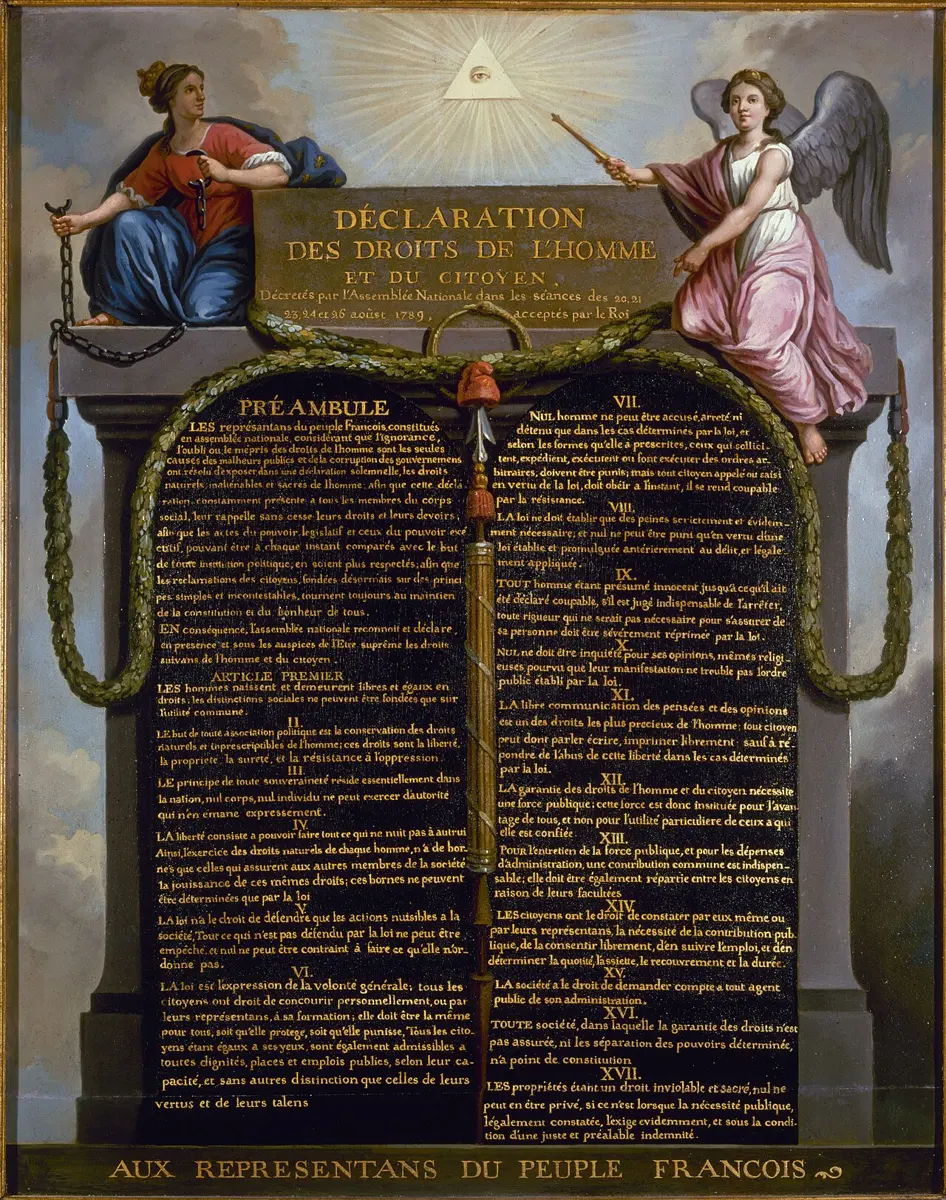
On 26 August the assembly adopted the Declaration of the Rights of Man and of the Citizen. Its first article is the one the world remembers:
Men are born and remain free and equal in rights. Social distinctions may be founded only upon the general good.
The rest follows from it. The natural rights of man are “liberty, property, security, and resistance to oppression”. Power belongs to the nation, not to a king. “Law is the expression of the general will”, and it “must be the same for all, whether it protects or punishes”. Every citizen may “speak, write, and print with freedom”. Much of this was the American argument of Chapter 25, but France wrote it as rights belonging to everyone, everywhere, and it has been copied ever since.
Words did not fill bellies. In October the market women of Paris, angry at the price and the shortage of bread, marched to Versailles and brought the king and his family back to live in Paris, where the crowds could watch him. In November the assembly took over all the Church’s land and began selling it to pay the debts, with a new paper money backed by it.
Who were the citizens the Declaration spoke of? Not everyone. Under the constitution of 1791 a man voted only if he paid a certain amount of tax, which left out many poor men. No woman voted at all. In September 1791 a playwright and pamphleteer named Olympe de Gouges published her own Declaration of the Rights of Woman, which copied the men’s article by article. Its first article reads: “Woman is born free and remains equal to man in rights.” Her tenth is the one people quote: “woman has the right to mount the scaffold, so she should have the right equally to mount the rostrum”. If a woman could be put to death for her opinions, she should be allowed to speak them in public too. Her afterword began, “Women, wake up; the tocsin of reason sounds throughout the universe; recognize your rights.” (A tocsin is an alarm bell.)
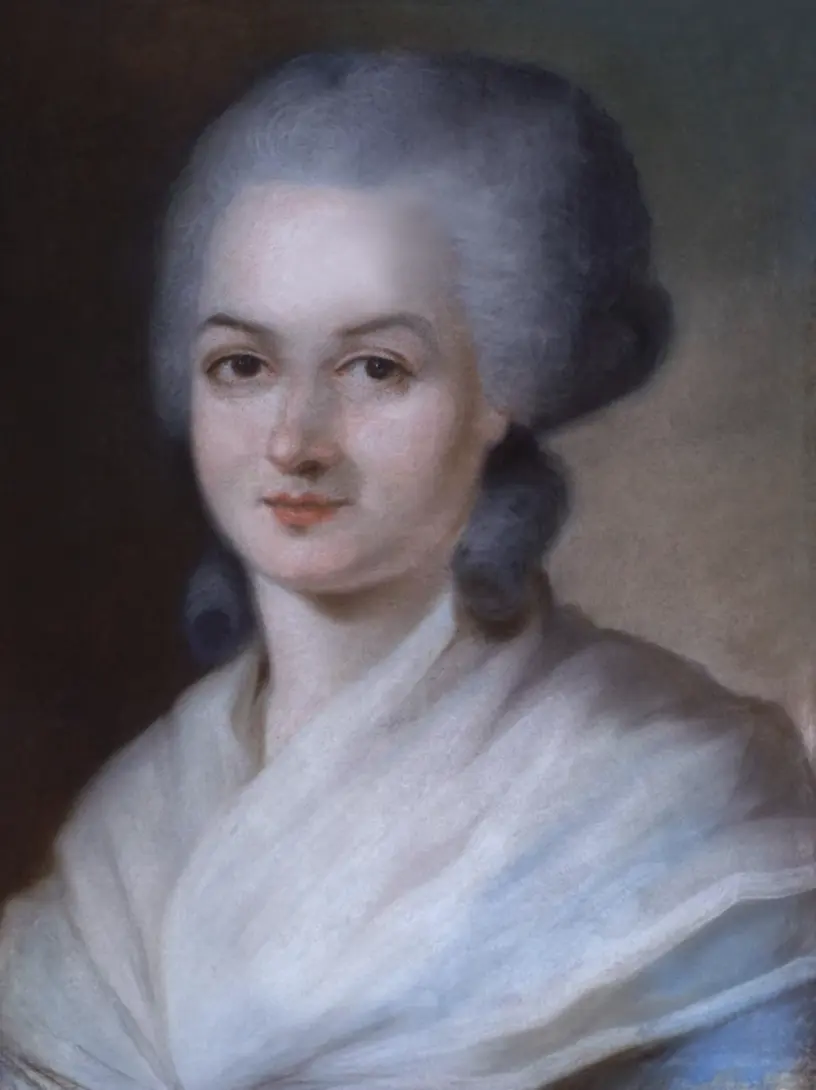
She was guillotined in November 1793, for posters attacking the men then in power. The women of France first voted in 1945.
The rights stopped at the sea, too. France’s colonies in the Caribbean held about 700,000 enslaved people, and what they grew, sugar and coffee above all, made up about a third of France’s exports. The colonists’ delegates in Paris argued that the Declaration could not apply there, and the assembly agreed. Free men of color from the colonies, many of them planters themselves, came to Paris to ask for equal rights and were turned away.
The Terror, and Napoleon
In April 1792 France went to war with Austria and Prussia, and the war went badly. The king was suspected of siding with the enemy, and in August crowds and armed volunteers stormed his palace in Paris. In September, with an enemy army marching on the city, mobs broke into the prisons and killed between 1,100 and 1,600 prisoners, most of them ordinary criminals. France became a republic, and in January 1793 Louis XVI was tried and guillotined, his head cut off by the guillotine, the machine the revolution used for its executions.
Then everything happened at once. Britain, Spain and the Dutch joined the war. In the Vendée, in the west, peasants who refused to be drafted into the army rose for the Church and the king. The government in Paris handed its powers to a small Committee of Public Safety, whose best-known member was a lawyer named Maximilien Robespierre. It raised a mass army, set the highest prices allowed for food, and arrested “suspects”: at least 300,000 of them.
What followed is called the Terror. Between the spring of 1793 and the summer of 1794 the revolutionary courts passed about 16,600 death sentences. Most of those killed were not nobles or priests. By one historian’s count of the records, more than eight in every ten were commoners, carters and day laborers among them. Many more, perhaps ten to twenty thousand, were shot or drowned without trial or died in prison. The war in the Vendée was far worse: estimates of the dead there, on both sides, run from over a hundred thousand to several hundred thousand.
How did people who had written the Declaration come to this? Historians argue over it. One answer is in the revolutionaries’ ideas, which made anyone who disagreed an enemy of the people. Another is fear: of invasion, of plots and of each other, at a time when generals had gone over to the enemy. Leaders who felt fear went on to impose it. In July 1794 Robespierre’s colleagues turned on him, and he was guillotined.
In November 1799 a young general, Napoleon Bonaparte, took power. He kept some of what the revolution had done and undid the rest. His Civil Code of 1804, which is still the law of France in much changed form, made men equal before the law and kept the peasants’ freedom from their lords. It also put wives firmly under their husbands. In 1804 he crowned himself emperor. In 1808 he made the king of Spain give up his throne and put his own brother on it. In 1812 he marched about 450,000 men into Russia, and only about 75,000 of them came back across the border. He was beaten for good at Waterloo in 1815 and died a prisoner of the British on a small island in the Atlantic.
To some French people Napoleon is the man who gave them their laws and their glory, to others the man who ended a republic and filled Europe with graves. To Haitians he is something else.
Saint-Domingue becomes Haiti
Saint-Domingue, the western third of the island of Hispaniola, was the most profitable colony in the world. In 1789 it grew more than half the world’s coffee and much of Europe’s sugar. About 40,000 white people lived there and about 28,000 free people of color. The rest, about 450,000 people, were enslaved, and many of them had been born in Africa: in 1787 alone some 20,000 more Africans were brought in.
On the night of 22 August 1791 the enslaved people of the northern plain rose. Haitian tradition says the rising was sealed at a ceremony in the forest at Bois Caïman a few nights before, but no one who was there wrote it down, and the first written account is a colonist’s, from 1814. Within weeks tens of thousands had joined the rising and hundreds of plantations were burning. Spain, which held the rest of the island, and Britain, at war with France, both sent armies to take the colony. The French commissioner there needed soldiers, and in 1793 he did what Paris had refused to do. He declared the enslaved people free. In February 1794 three deputies from the colony, a white colonist, a free man of color and a Black officer, came before the assembly in Paris to ask it to approve the freedom, and it abolished slavery in every French colony. The revolution in Paris had gone that far only because the revolution in Saint-Domingue had pushed it.
The leader who rose highest was Toussaint Louverture. He had been born enslaved on the Bréda plantation in the north, was freed before the revolution, and became a free man who owned land and, for a time, slaves himself. He joined the rising, fought for Spain, then went over to the French republic once it had ended slavery. By 1800 he had beaten the British and the Spanish and his rivals, and ruled the colony, still in France’s name.
The historian C. L. R. James, writing in 1938, put the wonder of it in one sentence:
The transformation of slaves, trembling in hundreds before a single white man, into a people able to organize themselves and defeat the most powerful European nations of their day, is one of the great epics of revolutionary struggle and achievement.
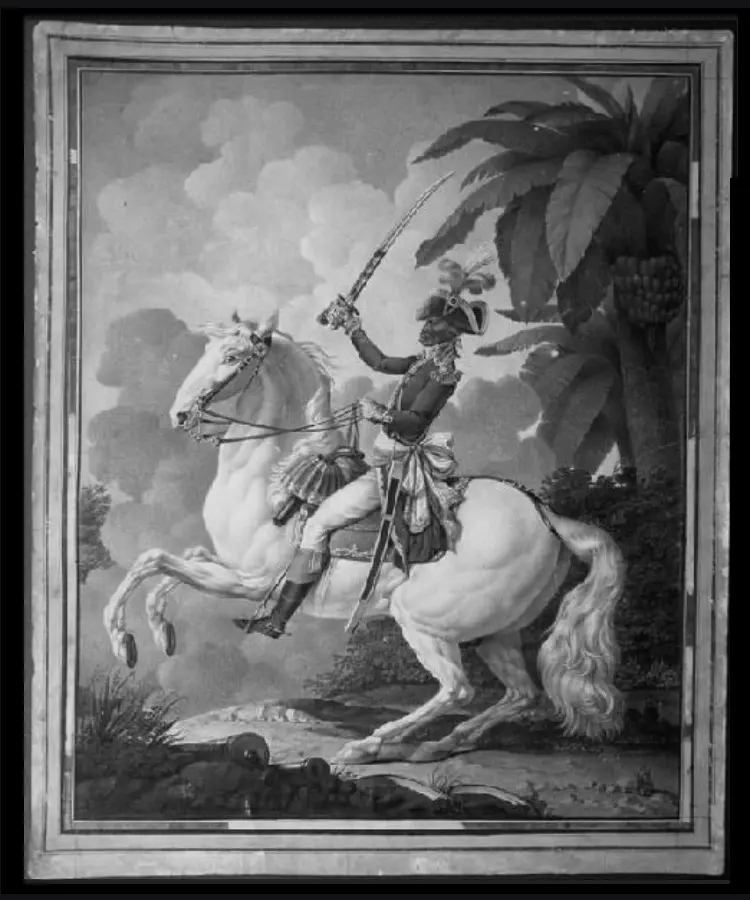
Toussaint’s constitution of 1801 said it in law: “There can be no slaves on this territory; servitude has been forever abolished. All men are born, live and die there free and French.” It also made him governor for life. And it kept the plantations going by force. The colony, it said, “cannot allow the least interruption in its labor and cultivation”, and the freed workers were tied to their estates. His rule was that without work there could be no freedom. To many of the people who had just won their freedom, being made to go back to the cane fields looked a lot like what they had escaped.
Napoleon wanted the colony firmly back under France, and he did not trust Toussaint, who, he feared, would never allow slavery back. In 1802 he sent his brother-in-law, General Leclerc, with an army that grew to about 31,000 men. In May his government kept slavery, and the slave trade, in the islands France was getting back from Britain, where it had never ended. That summer it restored slavery in Guadeloupe, another French island. Toussaint was tricked into a meeting, arrested and shipped to France, and died in a cold prison in the mountains in April 1803. When the news from Guadeloupe reached Saint-Domingue, the people who had been freed rose again, and the officers who had gone over to the French, among them Jean-Jacques Dessalines, came back to lead them.
The war that followed was savage on both sides. The French drowned a Black general who had come over to them, with his family, in the harbor, and later brought in dogs trained to hunt people. Yellow fever, a disease the newcomers from Europe had no defense against, killed far more French soldiers than the fighting did, and Leclerc himself died of it. Only about 7,000 or 8,000 of the soldiers France sent came home. In November 1803 the last French army surrendered.
On 1 January 1804, at Gonaïves, Dessalines declared independence and named the country Haiti. The declaration, written overnight by his secretary, is fierce:
We have dared to be free, let us be thus by ourselves and for ourselves.
It promised “Peace to our neighbors”, and no attack on the islands nearby, which were still slave colonies. It promised none to the French. In the months that followed, on Dessalines’ orders, between 3,000 and 5,000 of the French who were left, men, women and children, were killed. Haitians remember 1804 as the year of their freedom; in France it was long remembered for the killings. Both happened.
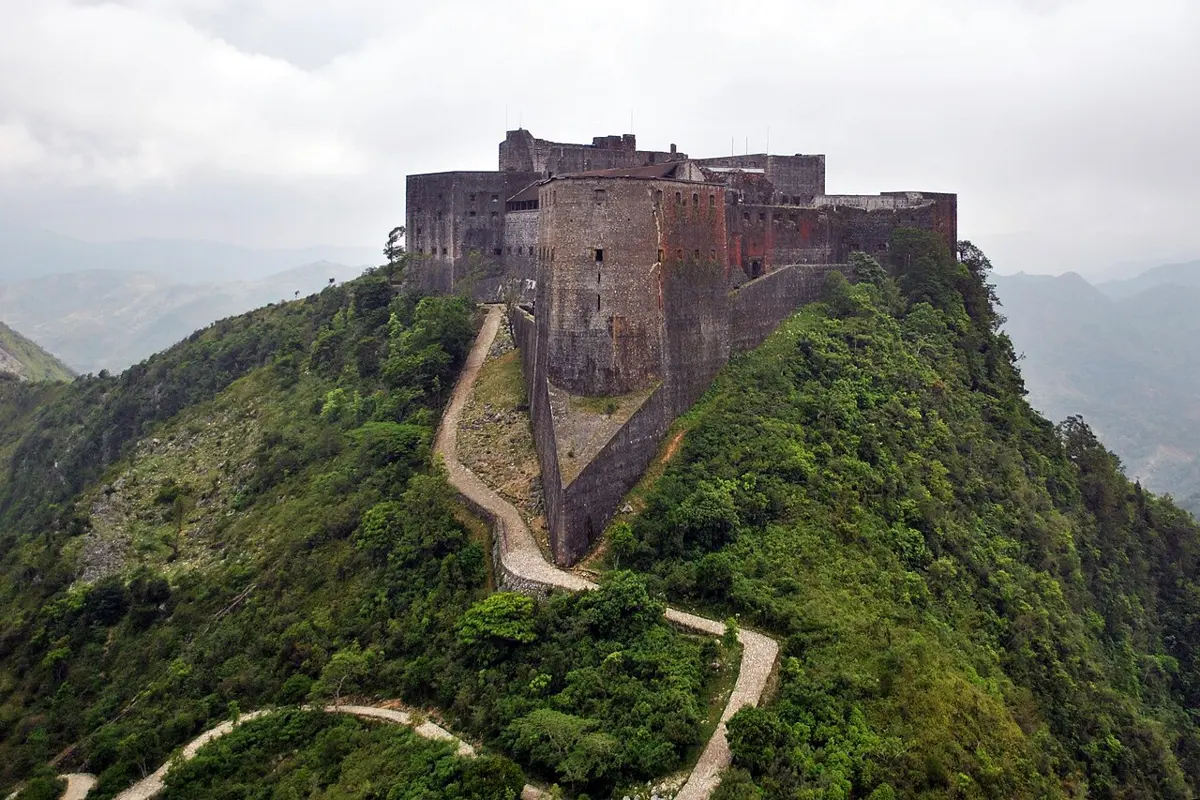
Haiti was a country made by people who had freed themselves from slavery. Its constitution of 1805 called every Haitian citizen Black, even the few white people it let become citizens. In 1825 fourteen French warships with more than five hundred guns came to Haiti with a demand from the king of France: 150 million francs, to repay the former colonists for what they had lost, in return for France’s recognition. Haiti agreed. It had to borrow from French banks to pay, and the sum was cut to 90 million in 1838. A 2022 New York Times investigation reckoned that Haiti paid about 112 million francs in all, some $560 million in today’s money, and that the loans taken to pay it were not cleared until 1947. In 2025, two hundred years on, France and Haiti set up a joint commission to study what the debt did.
Bolívar’s wars
When Napoleon took Spain’s throne in 1808, Spain’s American empire, from Mexico to Argentina, suddenly had no king it recognized. Its towns set up councils of their own, at first in the captive king’s name, and soon some asked why they needed Spain at all. The leaders were mostly criollos, people of Spanish descent born in the Americas, who had long been kept out of the top posts by men sent from Spain.
The best known was Simón Bolívar, the son of a rich family of Caracas, in Venezuela. His first republic fell, and so did his second, and by 1815 he was a refugee in Jamaica, a British island. There he wrote a long letter explaining what his people were. They were, he said, “not Indians nor Europeans, but a mixture of the legitimate owners of the country and the usurping Spaniards”, caught between the two.
From Jamaica he went to Haiti. Its president, Alexandre Pétion, gave him money, guns and ships, and asked one thing in return: that Bolívar free the enslaved people in the lands he won. Bolívar promised, and in 1816 he declared the slaves of Venezuela free. In 1819 he led an army over the Andes to beat the Spanish at Boyacá, in New Granada, now Colombia, and by 1824 his armies and their allies had freed most of South America. The promise to Pétion was kept only in part. The new republics ended slavery step by step, most of them only in the 1850s. Bolívar himself, tired and ill and pushed out of power, died in 1830.
So the French Revolution began with an empty treasury and expensive bread, and made words that are still quoted all over the world: that people are born free and equal in rights, and that power belongs to the nation. It also led to the Terror, to a dictator and to twenty-three years of war. The people of Saint-Domingue took the same words further than France was willing to, and made them true for themselves: freedom for everyone, whatever their color. France made them pay heavily for it. Read from Paris, the story is about rights won and then betrayed; read from Port-au-Prince, it is about rights the French wrote down and Haitians made real.
Meanwhile, in Nepal: in July 1789, as the Bastille fell, the Gorkhalis were marching on Jumla, in Ran Bahadur Shah and the campaign east and west. And while Britain fought Napoleon, the East India Company fought Nepal, from 1814 to 1816; a Nepali historian has argued that the Company waited until Napoleon was beaten in Europe before it struck. That war is in Bhimsen Thapa and the war with the Company, in Nepal’s History, for the Curious.
Found a mistake? Please tell us.