
At about ten o’clock on the night of 14 September 1846, General Gagan Singh was saying his prayers in a room of his house in Kathmandu when someone fired through an open window from a roof nearby and killed him. He was the most powerful man at court and the closest adviser of the queen, Rajya Laxmi Devi. When the news reached her, one account says, she set out on foot with four maids to see his body, and then went straight to the Kot, the courtyard and hall of the army beside the Hanuman Dhoka palace. She had the bugles blown and messengers sent to call every officer and noble of the kingdom.
They came in the dark, in a hurry, many of them unarmed. Before the sun was up, dozens of them lay dead in the courtyard, and a young general of twenty-nine, Jung Bahadur Kunwar, had been made prime minister and commander of the army. He kept the post, with one short break, until he died thirty years later. His brothers and then his nephews kept it after him, and the family he founded, the Ranas, ruled Nepal until 1951, more than a hundred years.
A court at war with itself
The king in 1846 was Rajendra Bikram Shah. He had come to the throne in 1816 at the age of two, and for most of his life the kingdom had been run for him by Bhimsen Thapa, the minister who led Nepal through the war with the East India Company. When Bhimsen fell in 1837, and died two years later after wounding himself in prison (Chapter 20), nobody took his place. Instead the court split into parties, each trying to steer the king.
The old noble families were the Thapas, Bhimsen’s family; the Pandes, who had been their enemies for forty years; the Chautariyas, cousins of the royal family; and the Basnyats. Each had soldiers who were loyal to their own commander, so a quarrel at court could quickly become a fight. The royal family was divided too. The senior queen, mother of the crown prince Surendra, died in 1841, and the junior queen, Rajya Laxmi, wanted her own elder son, Ranendra, to be king instead. In January 1843 the nobles made the king hand his powers to the junior queen. From then on she was the real ruler of the court.
Into this came Mathabar Singh Thapa, Bhimsen’s nephew, back from years in exile in India. He was made prime minister at the end of 1843. On the night of 17 May 1845 he was called to the palace, on the excuse that the queen had had an accident. As he walked into the room where the king and queen sat, he was shot from behind a screen and then cut down. The king wrote to the British in India that he had killed his minister with his own hands, for treason. Years later the man who fired the first shot said openly that it had been him, under the king’s and queen’s orders, and showed a British doctor the gun. He was Mathabar Singh’s own nephew, Jung Bahadur.
Jung Bahadur, born in 1817, the son of an officer, had been a soldier since his teens and was known for his nerve. Over the summer of 1845 the court shared out the army among four generals: Fateh Jung Shah, a Chautariya, who was made prime minister, Abhiman Singh Rana Magar and Jung Bahadur, with three regiments each, and Gagan Singh, the queen’s man, with seven. British writers of the time said Gagan Singh was the queen’s lover. Whether that was true or palace gossip, he was the most powerful man in the government, and Jung Bahadur, the youngest general, had no office in it at all. A year later Gagan Singh was dead.
The night at the Kot
What happened at the Kot is told in very different ways, but the bones of it are agreed.
The queen came to the Kot with the sword of state and demanded the name of Gagan Singh’s killer. She suspected a noble named Bir Kishor Pande, had him put in irons, and ordered Abhiman Singh to cut off his head on the spot. Abhiman Singh turned to the king, who was there, and the king refused to allow an execution without a trial. So Abhiman Singh refused too. The king then left, saying the prime minister had to be present, and rode off to fetch him. Fateh Jung came to the Kot with his son and his brothers. Jung Bahadur and his brothers were already there, with his regiments around the building.
Then the fighting started. Soon Fateh Jung, his son, Abhiman Singh, the Pande leader Dalbhanjan Pande and many others were dead. Jung Bahadur’s soldiers held the courtyard and its gates, so that those inside could not get out, and they shot or cut down those who tried. A few escaped over walls and roofs or through the drains, and one man survived by lying still among the dead, covered in blood. By morning the queen had made Jung Bahadur prime minister and commander-in-chief. When the king came back towards the palace, the gutter in the street was red.
Everything else is argued, and each account comes from someone with a reason to tell it their own way.
The first account is Jung Bahadur’s own, sent to the British Resident two days later. In it the queen accused all the ministers of the murder, and the first blood was drawn by Fateh Jung’s son, who wounded one of Jung Bahadur’s brothers. The ministers, in this telling, were killed in the fighting that followed, and the queen, who had supreme power that night, was to blame for it all.
A British doctor at the Residency, the Company’s mission in Kathmandu, who knew Jung Bahadur well, wrote the fullest account in English, from what the crown prince told the Resident a year later. He says the murder of Gagan Singh was planned by the king himself, with Fateh Jung and Abhiman Singh, to get rid of his wife’s favorite, and that Jung Bahadur knew nothing of it. In his telling, shots were fired in a dark passage at the foot of the stairs as the queen went up, nobody knows by whom, and the killing grew out of panic, not a plan. He also says the queen stood at the window of the upper floor through it all, calling to the soldiers to kill her enemies.
Jung Bahadur’s son, writing his father’s life in 1909, has a third story. Abhiman Singh tried to leave to join his men outside, was stopped at the gate, and was stabbed with a bayonet on the queen’s order. As he died he pressed his bloody hand on the wall and cried out that Jung Bahadur was Gagan Singh’s murderer. A soldier of Jung Bahadur’s then shot Fateh Jung on the stairs, he says, while Jung Bahadur stood silent. Many Nepalis know this version, the handprint on the wall above all, because it is the one the school books tell.
The queen gave her own account the next spring, in a letter answering the king, who had asked her to explain herself. Gagan Singh, she wrote, had been killed by a हुकुम (hukum), an order, and whoever ordered his death had ordered the killing of the nobles too. She had gone to rest in a room of the Kot and the king to the palace, and while they were away Jung Bahadur and his men had killed them. Whom she meant is argued, but only the king or queen gave a हुकुम. A Nepali chronicle, written down under the Ranas, tells it another way again: the queen handed Jung Bahadur her sword to find the killer, and he called the nobles in unarmed, with his regiments posted around the Kot.
Others put the blame squarely on Jung Bahadur. An English traveler who met him in 1850 heard that he had shot Fateh Jung and then the nobles, one after another, as his men handed him loaded rifles. Another Residency doctor was sure the night had been arranged beforehand, on the queen’s written orders. And in 1856 the old king himself said he had sent Jung Bahadur written orders for the massacre.
No account survives from the Chautariyas, the Pandes or the Basnyats, the families who lost their men that night. Under Jung Bahadur, speaking against him could cost a man his land, his home or his life.
Even the number of dead isn’t settled: 31 nobles and officers in Jung Bahadur’s report, 55 names in his son’s book, with many more never written down, and up to 150 in other accounts. Who killed Gagan Singh, who struck first, and whether Jung Bahadur rode a storm or made one: the sources don’t agree, and nobody can settle it now. What every account agrees on is who came out of it with the power.
The queen sent away, and the king
Jung Bahadur had been the queen’s choice, but he wasn’t her tool. She wanted the crown prince Surendra and his brother out of the way so that her own son could be king, and Jung Bahadur refused to do it. Within weeks a new plot was made against him, led by a noble named Bir Dhwaj Basnyat, with Gagan Singh’s son. On 31 October 1846 Jung Bahadur was summoned to meet the queen. Warned of a trap, he came with his men armed. Meeting Bir Dhwaj in the street, he had him shot on the spot, and the plotters were hunted down. This is remembered as the Bhandarkhal massacre, after the palace garden where the gathering was to be. Somewhere between thirteen and twenty-three men were killed, most of them Basnyats.
Now the queen’s powers were taken away and she was ordered out of the country. On 23 November 1846 she left for Banaras, in India, with her two sons. The king, saying he needed to make a pilgrimage for all the blood that had been spilled, went with her, leaving Surendra in charge. He didn’t come back as king. From the border he plotted with the exiles to get rid of the minister, and in May 1847 two men were caught carrying a letter under his seal that called on the army to kill Jung Bahadur. On 12 May 1847 the letter was read to the assembled troops, and they hailed Surendra as king. The proclamation said his father had shown signs of madness and was to be treated as having given up the throne.
In July 1847 the old king crossed into the Tarai with a band of followers, and on 28 July a regiment from Kathmandu caught him at Alau, near today’s Birgunj. He was lodged in the old palace at Bhaktapur, where he was watched for the rest of his life. He died in 1881.
In under a year the parties that had pulled the court apart were gone, their leaders dead or in exile. The new king was Jung Bahadur’s king, and every important post in the army and the government went to Jung Bahadur’s brothers, cousins and friends.
To London and back
In January 1850 Jung Bahadur set off for Britain. Nobody from Nepal’s court had gone so far, and for a Hindu of his rank crossing the sea risked his caste. He went to carry the king’s friendship to Queen Victoria, but he also wanted to see how strong Britain really was, and he hoped to deal with London directly instead of through the Company’s men in India.
He went by Calcutta and sailed in April with two of his brothers, officers, cooks and a Newar painter, Bhajuman, who had painted his portrait the year before. They reached Southampton at the end of May. London made a great fuss of the Nepali minister with his jeweled headdress. He met the Duke of Wellington, went to the opera night after night, and on 19 June 1850 was received by Queen Victoria. He toured arsenals, factories and dockyards, then spent some weeks in France. He was back in Kathmandu on 6 February 1851.
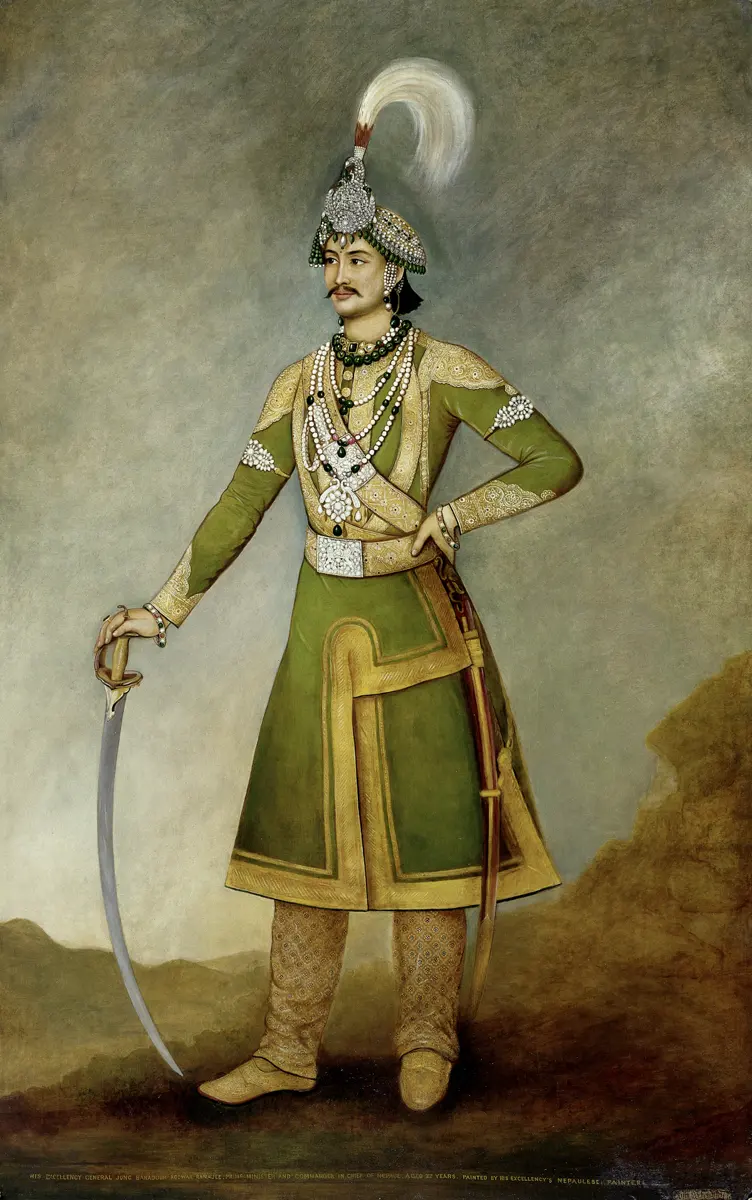
What did the trip buy? Not the direct link with London: Britain’s government said politely that Nepal’s dealings would still go through India. But he had seen the factories, the guns and the ships, and he came home sure that Nepal could not beat Britain and must keep its friendship. And it nearly cost him his life. Ten days after he came home, his brother Bam Bahadur woke him in the night to warn him of a plot to shoot him on the road. The plotters, another brother, a cousin and the king’s younger brother, had been told that Jung Bahadur had lost his caste in England by eating with Europeans. He refused to have them killed or blinded, as the council wanted, and sent them instead to a British prison at Allahabad. Soon afterwards he began revising the kingdom’s harsh laws, work that led to the great law of 1854, the story of Chapter 23.
A family’s charter
In March 1856 a short war with Tibet ended with Tibet agreeing to pay Nepal 10,000 rupees a year. Then, on 1 August, Jung Bahadur suddenly resigned as prime minister and handed the post to his brother Bam Bahadur. Nobody has ever been sure why.
Five days later, on 6 August, the king made him Maharaja of Kaski and Lamjung, two old hill kingdoms, with the title and their land to pass down in his family. The same royal grant gave him powers over the whole country, from the Mahakali to the Mechi, whether he was prime minister or not: the power of life and death, to appoint and dismiss every servant of the state, to make war and peace and sign treaties, and to make and repeal laws. He could even overrule the king if the king went wrong in the affairs of state. And it settled who would be prime minister: Jung Bahadur’s brothers, one after another by age, and then his sons. This list of who comes next became the रोलक्रम (rolkram), the roll of succession.
That was the system. The king stayed on the throne and was honored as king, but the real ruler was the Rana prime minister, and the post passed inside one family by its own rule, like a crown. The family had taken a grander name too: by royal order the Kunwars became the Ranas, a name that traced their line to the Rana princes of Mewar in Rajasthan, and Jung Bahadur’s children married into the royal family itself. When Bam Bahadur died in May 1857, Jung Bahadur took the post back, and he kept it until his death in 1877.
1857, and the plains returned
That same May, soldiers of the Company’s army in northern India rose against their British officers. The British called it the Mutiny. To many Indians it was the first war of independence. Within weeks the rising had spread across the plains just south of Nepal, and the British were fighting for their lives at Delhi, Kanpur and Lucknow.
Jung Bahadur offered troops at once, and after some hesitation the British accepted. In July 1857 about 3,000 Nepali soldiers went down to Gorakhpur. In December Jung Bahadur marched himself, with about 9,000 more. They fought their way west through Gorakhpur and Oudh, and on 11 March 1858 joined the British army in the siege of Lucknow, which fell within days. When the city was taken, Jung Bahadur’s son wrote, there followed a plunder such as the world’s wars had never seen, and Nepal’s soldiers had their share.
When the rising was crushed, thousands of its last fighters fled north into Nepal’s Tarai, among them Begum Hazrat Mahal, the queen of Oudh, who had led the rebels at Lucknow, and her young son. Jung Bahadur disarmed the fighters, but he refused to hand the begum and her son over to the British, saying it was against the laws of hospitality, and gave them a house near his own palace in Kathmandu.
Then came the payment. After the war with the Company, Nepal had lost the far western plains, from the Mahakali to beyond the Rapti river. On 1 November 1860, in Kathmandu, Jung Bahadur and the British Resident signed a treaty that gave those lowlands back “in full sovereignty”, “in recognition of the eminent services” of Nepal in 1857. Surveyors set up masonry pillars along the new border. In Nepal the land was called the नयाँ मुलुक (Nayā Muluk), the new country. It is today’s Banke, Bardiya, Kailali and Kanchanpur.
How Nepal should remember all this is still argued. Seen one way, Jung Bahadur was a hard-headed ruler who read the strength of the British correctly, kept Nepal independent when the rest of the subcontinent fell to them, and got back land that a war had lost. Seen another, he fought for a foreign company against people rising for their freedom, as Nepal’s soldiers would fight for Britain again and again, a story that belongs to Chapter 25. Both can be true at once.
Jung Bahadur came to power in a night of killing that nobody has ever fully explained, and he made it last: his charter put the kingdom’s real power in his family’s hands while the king reigned without ruling. The system outlived him, though not as he planned. His roll put his brothers before his sons, and in 1885 his youngest brother’s sons, the Shumshers, killed the prime minister, his brother Ranodip Singh, and his eldest son, and took the roll for their own branch of the family. Ranas ruled Nepal until 1951.
Meanwhile, in the world: the rising of 1857 began at Meerut, and when it was over the British government took India from the East India Company and ruled it directly from 1858.
Found a mistake? Please tell us.