
On a Sunday morning in June 1914, in Sarajevo, the capital of Bosnia, a student not yet twenty, Gavrilo Princip, stepped up to an open car and fired at close range. In the car were Archduke Franz Ferdinand, the man who would one day rule the empire of Austria-Hungary, and his wife Sophie. Both died. The car should not have been there at all. Earlier that morning another of the plotters had thrown a bomb at it and missed, and later the driver took a wrong turn, which brought the car a few steps from where Princip was standing.
Five weeks later, on 3 August, a letter went from Kathmandu to the British Resident, Britain’s representative in Nepal. Chandra Shumsher, Nepal’s Rana prime minister, offered “the whole military resources of Nepal” to the British king. Britain was not even at war yet. Within a year young men from hill villages that no road reached were in trenches in France, on the beaches of Turkey and in the marshes of Iraq.
How did two shots in a Balkan city reach the hills of Gorkha? The short answer is that Europe’s great powers were tied to each other by promises, and Europe’s empires were tied to half the world.
How it started
In 1914 Europe’s biggest countries stood in two camps. Germany and Austria-Hungary were allies in the middle of the continent, the Central Powers. France and Russia, on either side of them, were allies too, and Britain had settled its old quarrels with both. Each camp feared the other was growing stronger, and each had spent years building bigger armies and navies. Each had a plan for war, worked out by its generals years before and timed by railway timetables.
The plotters in Sarajevo were Bosnian Serbs. They wanted Bosnia, which Austria-Hungary had taken over, to join the Serbs’ own kingdom next door, and they had been given their pistols and bombs, and some training, by officers of a secret society inside Serbia’s army. So Austria-Hungary blamed Serbia. Its leaders wanted a war that would crush Serbia, and first they asked Germany whether it would stand behind them. Germany said yes, whatever happened. Austria-Hungary then sent Serbia a list of demands, with 48 hours to accept them all, written so that Serbia would refuse. Serbia accepted most of them, but not all, and Austria-Hungary declared war.
Then the promises went off one after another, like a line of falling bricks. Russia, Serbia’s friend, began to gather its huge army. Germany declared war on Russia, and then on France, Russia’s ally. Germany’s plan was to beat France first, quickly, before Russia’s slow army was ready, and the quickest road to Paris ran through Belgium, a small country every great power had promised to leave alone. On 4 August German soldiers crossed into Belgium, and Britain declared war on Germany.
Britain’s declaration took its empire with it. India, Canada, Australia, New Zealand, South Africa and the colonies in Africa were at war without being asked. Japan joined Britain’s side within weeks. That autumn the Ottoman Empire, which ruled Turkey and most of the Arab lands, came in on Germany’s side; its sultan, who was also the caliph, the leader most Sunni Muslims looked to, called on Muslims everywhere to fight Britain, France and Russia. By the end of 1914 the fighting ran from the English Channel to the Persian Gulf.
Why it happened is one of the most argued questions in history. The usual list of causes runs: the alliances, the race to build armies, the empires’ rivalry for colonies, the angry pride of nations, the newspapers. Few historians doubt any of those. The quarrel is over who chose war. In the 1960s the German historian Fritz Fischer, reading his own country’s government papers, argued that Germany’s leaders had wanted a great war and used the crisis to start one, so that Germany could become the master of Europe. His books shocked Germany, and his critics answered that France and Russia had aims of their own. In 2012 the British historian Christopher Clark argued instead that every capital took risks, Vienna, Berlin, St Petersburg, Paris, London and Belgrade alike, that none of them sought the war they got, and that they walked into it like sleepwalkers, “watchful but unseeing”. His critics answer that this spreads the blame too evenly, when Berlin and Vienna made the first and biggest decisions. The argument goes on.
Mud, wire and guns
Everyone expected a short war. It wasn’t. In September 1914, at the river Marne, only a few days’ march from Paris, the French and British stopped the German advance. Both sides then dug in, and by the end of the year a line of trenches ran across Belgium and France from the sea to Switzerland. It barely moved for more than three years.
A trench was a ditch deeper than a man, with walls of sandbags. In front of it ran belts of barbed wire, and between the two sides lay a strip of torn ground called no man’s land, sometimes only a few hundred meters wide. Nineteenth-century generals had won battles by charging. Now a few machine guns could stop a whole charge, and the big guns behind the lines could fire for days, churning the ground to mud. Men lived for weeks among rats and water. When an attack came, soldiers climbed out of their trench and walked toward the enemy’s wire. On the first day of the battle of the Somme, in July 1916, the British army lost more than 57,000 men killed, wounded or captured, about 19,000 of them dead, and gained a few kilometers at most.
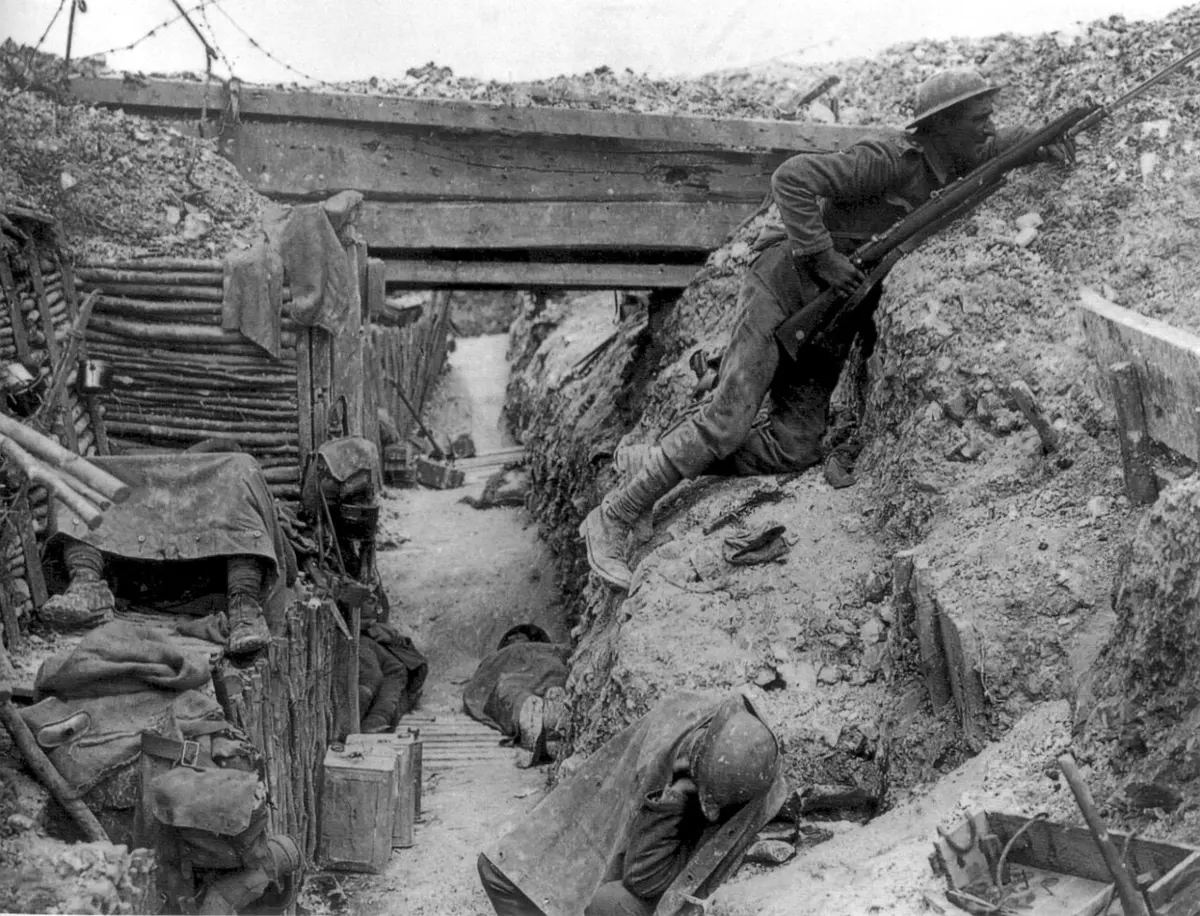
The first soldiers from outside Europe to reach those trenches came from India. Two infantry divisions and two of cavalry sailed from India and landed at Marseille, in the south of France, from the end of September 1914, and were in the line before the winter. Among them were battalions of Gurkhas from Nepal. In October, in Belgium, a Muslim soldier from the Punjab named Khudadad Khan kept his machine gun firing after the other five men of its crew had been killed, and became the first Indian to win the Victoria Cross, Britain’s highest medal for bravery.
The Indian soldiers wrote home, and the British censors, who read their letters for signs of trouble, copied out passages in English. That is how we have them. A wounded Punjabi Rajput, writing from a hospital in England in January 1915, told a relative not to think that this was war: “This is not war. It is the ending of the world.” He reached for his people’s great epic. This, he wrote, was just such a war as the Mahabharata told of.
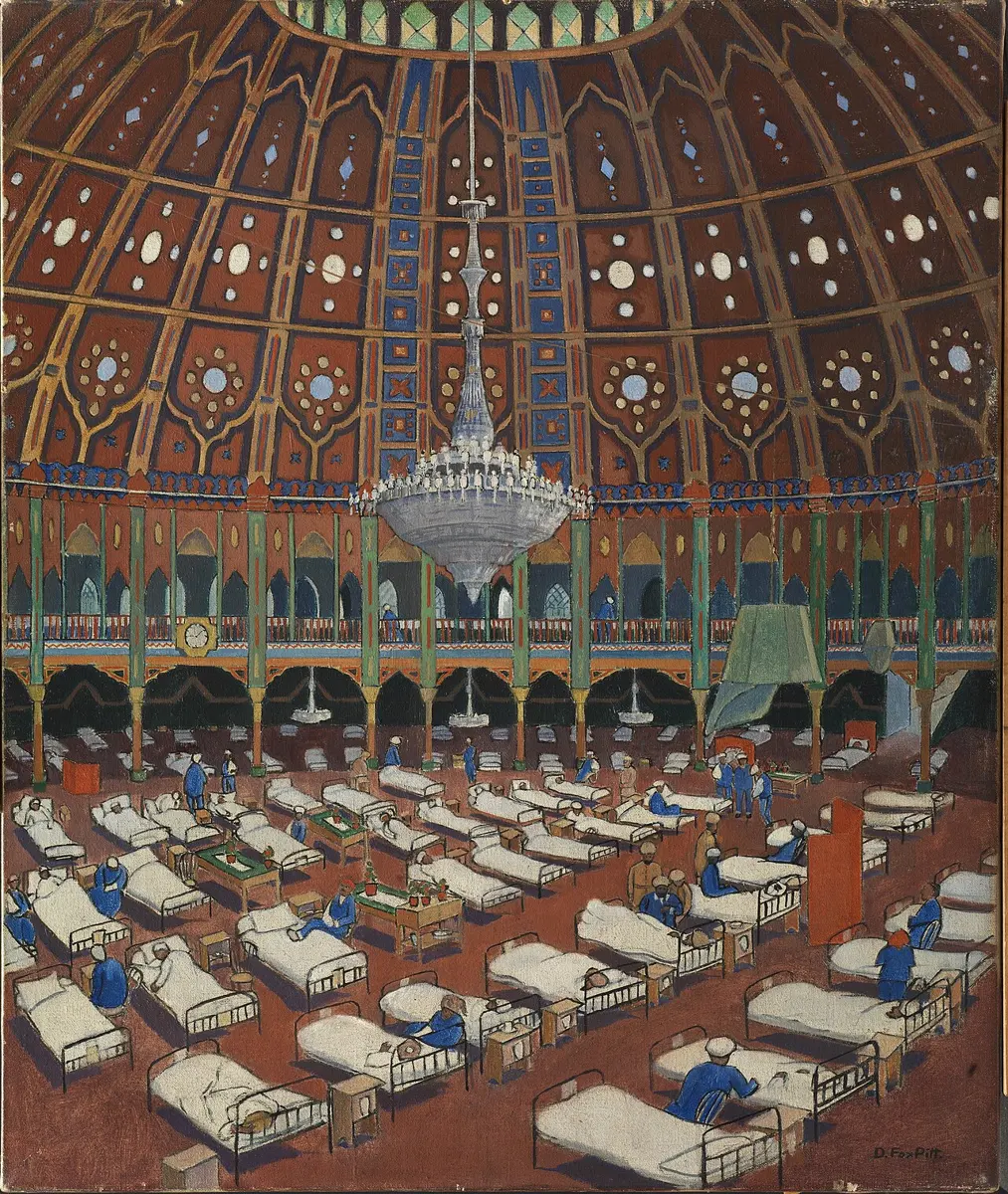
By the end of 1915 most of the Indian infantry had left France for the war against the Ottomans, where most Indian soldiers would fight. All told, nearly 1.4 million men from India served in the war, as soldiers and as laborers, porters and cooks, and about 74,000 of them died. India’s army was one of the largest armies of volunteers in the world.
A world at war
The war against the Ottoman Empire was fought far from the trenches, and it was there that Nepal’s soldiers saw most of the world.
In 1915 Britain and France tried to knock the Ottomans out of the war by seizing the narrow straits that lead from the Mediterranean to Istanbul. Their troops landed on the Gallipoli peninsula, in Turkey, and were pinned to the cliffs for eight months by Ottoman soldiers who fought just as hard, defending their own country. One of their commanders, a lieutenant colonel named Mustafa Kemal, would later found modern Turkey. The Allies gave up and left at the start of 1916. In Mesopotamia, now Iraq, an army of British and Indian soldiers that had landed near Basra to guard Britain’s oil pushed up the river Tigris toward Baghdad. It was surrounded at the town of Kut, and after five months of siege, with its men starving, about 13,000 of them surrendered in April 1916. Many died afterward as prisoners. Later British and Indian armies took Baghdad, and others marched from Egypt, past the Suez Canal, into Palestine, and reached Damascus in 1918.
Gurkha battalions were in almost every one of these places, from France and Flanders to Gallipoli, Egypt, Palestine, Mesopotamia and Persia, and in Salonika in northern Greece. By the war’s end more than 90,000 Gurkhas had served, and more than 20,000 had been killed or wounded. How Nepal’s rulers raised them, what the villages paid, and what Nepal got in return belong to Nepal’s own story, told in Nepal’s History, for the Curious.
The war against the Ottomans also saw one of its worst crimes. From the spring of 1915 the Ottoman government, which accused its Armenian Christian subjects of siding with Russia, deported almost the whole Armenian people of Anatolia. Hundreds of community leaders in Istanbul were arrested and most were killed. Families were driven on foot toward the Syrian desert, robbed, starved and massacred on the way. Somewhere between 600,000 and 1.5 million Armenians died, about a million by many historians’ count, and Assyrian and Greek Christians were killed in the same years. Almost all historians outside Turkey, and the world’s main association of genocide scholars, call it the Armenian genocide, an attempt to destroy a people. Turkey’s government rejects that word. Its position is that Armenians were moved away from the war zone, that many died in a war of revolts, famine and disease in which still more Muslims died, and that there was no plan to destroy them; it has proposed that Turkish and Armenian historians study the events together. Armenians remember it on 24 April, the day of the arrests.
The war had come to Africa too, where British, Indian and African soldiers chased a small German army around East Africa until after the fighting in Europe had stopped, and porters, carrying everything on their heads, died in huge numbers. Russia, worn out and starving, collapsed into revolution in 1917, and its new rulers made peace with Germany in March 1918; that story is the next chapter’s. But in April 1917 the United States came in. Germany had started sinking ships at sight again, American ones included, and had secretly offered Mexico an alliance against the United States. With fresh American armies arriving, Germany’s last great attack in France failed in the summer of 1918. Its allies gave up one by one, and on 11 November 1918 the guns stopped.
Between nine and eleven million soldiers died, and somewhere between six and thirteen million civilians, from fighting, hunger, disease and massacre. No one can count them better than that.
The flu
Then came something worse. In 1918 a new kind of influenza spread around the world in waves, carried along the war’s own roads, in troopships, trains and camps. It killed in a way flu usually doesn’t: many of its dead were young adults, healthy one day and dead within days. Nobody yet knew that a virus caused it, and there was no vaccine or medicine that could stop it.
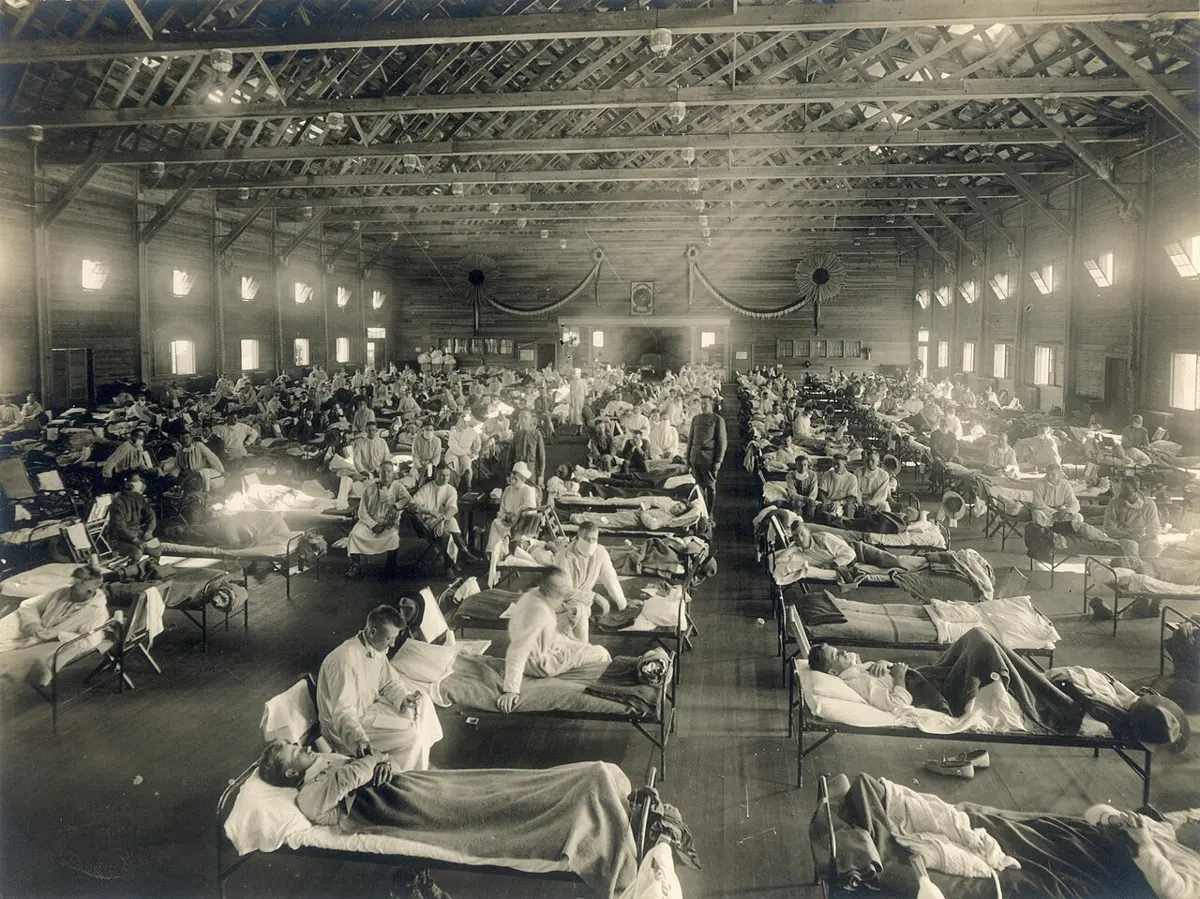
How many died depends on who is counting. One study, working from death records in countries that kept them, puts it at about 17 million. Other estimates run from about 25 million to 50 million, and some to 100 million. Either way it killed more people than the war. India was hit worst of all: at least twelve million people died there, more than in any other country. No one counted the dead in Nepal’s hills.
The peace
In January 1918, before the war was even over, the American president Woodrow Wilson set out fourteen points for the peace. There should be no secret treaties, and seas open to everyone’s ships. Europe’s nations should be free to govern themselves. Even colonies were mentioned: in deciding their future, the point said, “the interests of the populations concerned must have equal weight” with the claims of the governments that ruled them. And there should be a league of nations to keep the peace.
People all over the colonized world read that and took heart. In 1919, as the victors met in Paris, a delegation from Egypt tried to put its case; Britain arrested its leader and deported him to Malta, and Egypt rose up. Indians hoped for self-rule after so many had fought; that April, in Amritsar, British troops fired on an unarmed crowd and killed hundreds. A young Vietnamese man living in Paris, later known as Ho Chi Minh, sent the peacemakers a petition for his people, and never got an answer. In China students marched when the peacemakers gave Germany’s old rights in Shandong, a Chinese province, to Japan. Wilson’s words, it turned out, were meant for Europe.
Japan, which had fought on the winning side, asked for one line in the League’s rules: that nations would treat each other’s people equally, whatever their race. Eleven of the seventeen delegates on the committee voted for it, and none against. Australia’s prime minister, who feared it would end his country’s whites-only immigration, fought it hard. Wilson, in the chair, ruled that a change this important needed everyone’s agreement, and the line was dropped.
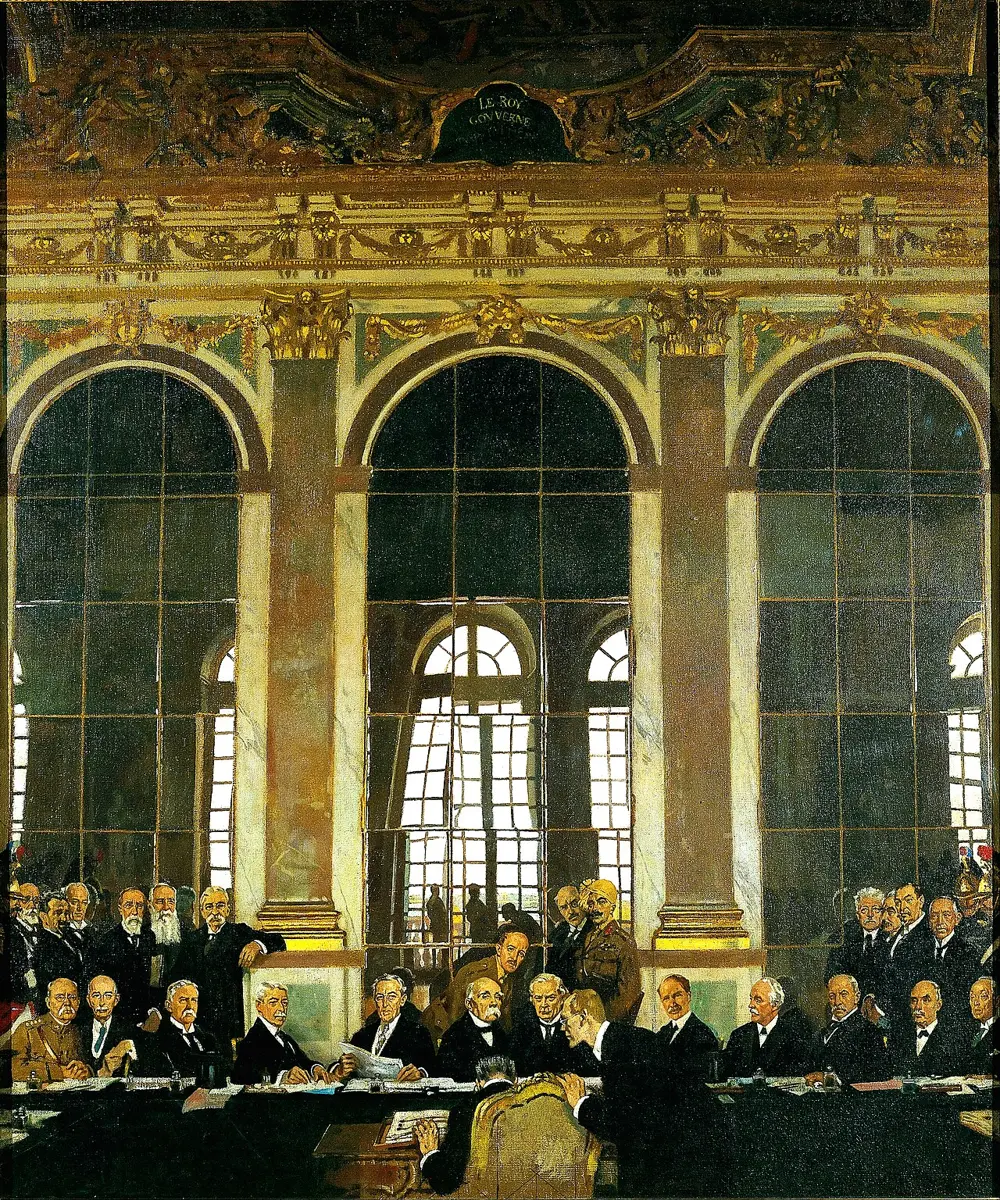
The treaty with Germany was signed in June 1919 in the Hall of Mirrors at the palace of Versailles, outside Paris. Germany lost about an eighth of its land and a tenth of its people, all its colonies, most of its army and all its air force. One article made it accept the responsibility of Germany and its allies for all the war’s loss and damage, and reparations, payments for that damage, were later set at 132 billion gold marks. Germans hated it. The British economist John Maynard Keynes called it a “Carthaginian peace”, the kind Rome forced on a beaten Carthage; others have said it was milder than the peace Germany itself had forced on Russia, and that the trouble lay in how it was enforced. Whether it led to the next war is the subject of Chapter 30. The empires of Austria-Hungary and Russia were gone too, and new countries, Poland, Czechoslovakia, Yugoslavia and others, took their place.
The biggest change of all was in West Asia, where the Ottoman Empire was taken apart. During the war Britain had made three different sets of promises about the same lands. In letters to Hussein, the Sharif of Mecca, the guardian of Islam’s holy city, Britain’s man in Egypt, Sir Henry McMahon, wrote that Britain was “prepared to recognise and support the independence of the Arabs” in a great stretch of land, leaving out the parts of Syria to the west of Damascus, Homs, Hama and Aleppo. Trusting that, Hussein’s sons led an Arab revolt against the Ottomans in 1916. In the same months, in secret, two diplomats, Mark Sykes for Britain and François Georges-Picot for France, agreed how their countries would divide the same region between them, France taking the north, Britain the south and east, and Palestine to be run by the powers together. And in November 1917 Britain’s foreign secretary, Arthur Balfour, wrote that his government viewed “with favour the establishment in Palestine of a national home for the Jewish people”, provided that nothing was done to harm “the civil and religious rights of existing non-Jewish communities in Palestine”. Whether Palestine was one of the lands promised to Hussein is still disputed. Arab writers have said it was. The British government said in 1922 that it never was, though in 1939 Britain’s Lord Chancellor, its senior law minister, found the promise’s wording “exceedingly ambiguous”.
What came after looked much like the secret plan. At San Remo, in Italy, in 1920, the victors gave the Arab lands to Britain and France as mandates, a kind of trusteeship under the new League of Nations, meant to last until they were “able to stand alone”, with “the wishes of these communities” to count in choosing who ran them: Syria and Lebanon to France, Iraq and Palestine to Britain. Hussein and other Arab leaders saw the Balfour Declaration as a breach of McMahon’s promises, and Hussein never accepted it or the mandates. Zionists, Jews who hoped for a homeland in Palestine, the Land of Israel of their scriptures, welcomed it as the first public backing a great power had given them, and Jews in Palestine kept its anniversary as a holiday. Palestine’s Muslims and Christians, nearly nine in ten of its people, opposed it from the start; a British inquiry in 1920 found among them “a sense of betrayal and intense anxiety for their future”. Even a British foreign secretary, Lord Curzon, later called the declaration “a striking contradiction” of Britain’s own declared principles.
For the Turks, the victors’ plan, the Treaty of Sèvres of 1920, would have left them only part of Anatolia, with an Armenian state in the east, Greece at Smyrna, zones for Italy and France in the south, and the straits run by the powers. They fought it. Mustafa Kemal’s army drove out the Greek army in a bitter war, and in 1923, at Lausanne in Switzerland, the powers signed a new treaty that gave Turkey borders much like today’s, and that October Turkey became a republic. In an exchange of peoples agreed between the two countries, about 1.2 million Greek Orthodox Christians were moved out of Turkey and 350,000 to 400,000 Muslims out of Greece.
So a murder in the Balkans became a world war because Europe’s powers were bound by promises and plans, and because their empires brought in men and money from everywhere else: who most chose war is still argued. The trenches made a war of machine guns and shells, killing millions for little ground, and soldiers from India and Nepal fought in France, Gallipoli, Iraq and Palestine for an empire that ruled them. The war brought a genocide, and the flu that followed killed more than the war itself. The peace remade the map. It punished Germany, refused the equality of races, gave the colonies words but not freedom, and divided the Arab lands among Britain and France, after promises to Arabs and to Jews about the same ground. Much of West Asia’s map, and many of its quarrels, date from those years.
Meanwhile, in Nepal: Chandra Shumsher sent Nepal’s own army to guard India, opened the hills to British recruiters and gave money, and won ten lakh rupees a year and, in 1923, a treaty in which Britain recognized Nepal’s independence in writing. Whether Nepal should have joined at all is in Lahures and the First World War, in Nepal’s History, for the Curious.
Found a mistake? Please tell us.