
Schist and gneiss: rocks from deep in the mountains
The Himalaya’s deep, changed rocks
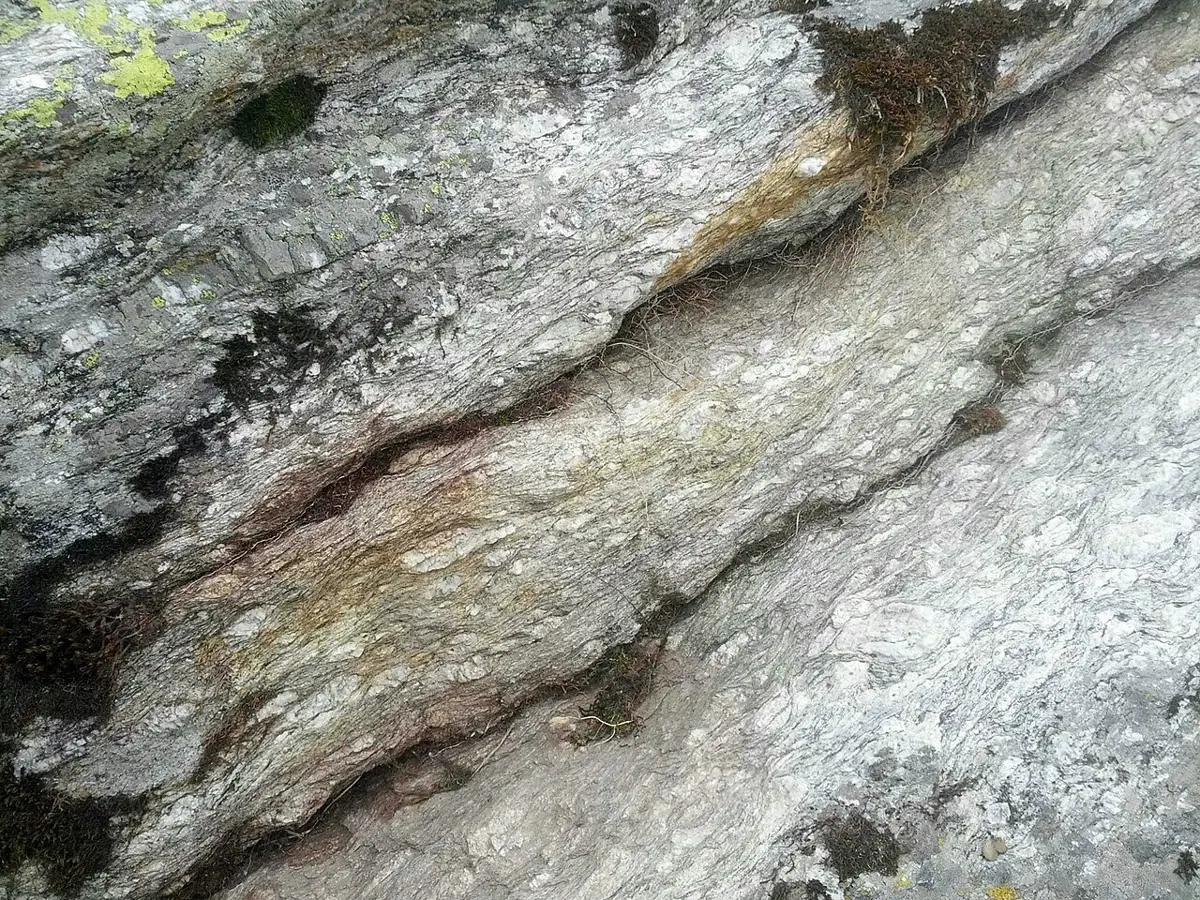
Some rocks glitter, their flat faces covered in shiny flakes; others are striped light and dark like a shawl. These are schist and gneiss (said “nice”). Much of Nepal’s high mountains, the Higher Himalaya, is made of them, and they formed deep inside the Earth.
The ladder of change
Rocks changed by heat and pressure are metamorphic rocks. Mudstone climbs a ladder as the heat and pressure rise, its minerals growing larger at each step:
| Step | Rock | What you see |
|---|---|---|
| low | slate | no grains; splits into thin, dull sheets |
| low to moderate | phyllite | a silky sheen; grains still too small to see |
| moderate | schist | flat flakes of mica large enough to see, all lined up; glitters |
| high | gneiss | bands of light and dark minerals; coarse grains |
Schist is named for its main visible minerals: mica schist, garnet schist, kyanite schist, graphite schist. It splits along its lined-up mica.
Gneiss is defined by its bands: light bands of feldspar and quartz, interlocked like granite, alternating with dark bands of mica or other platy minerals. Granite itself, cooked and squeezed, becomes granite gneiss. In augen gneiss (German Augen, “eyes”), large crystals of feldspar sit like eyes among the bands.
Nepal’s schist and gneiss
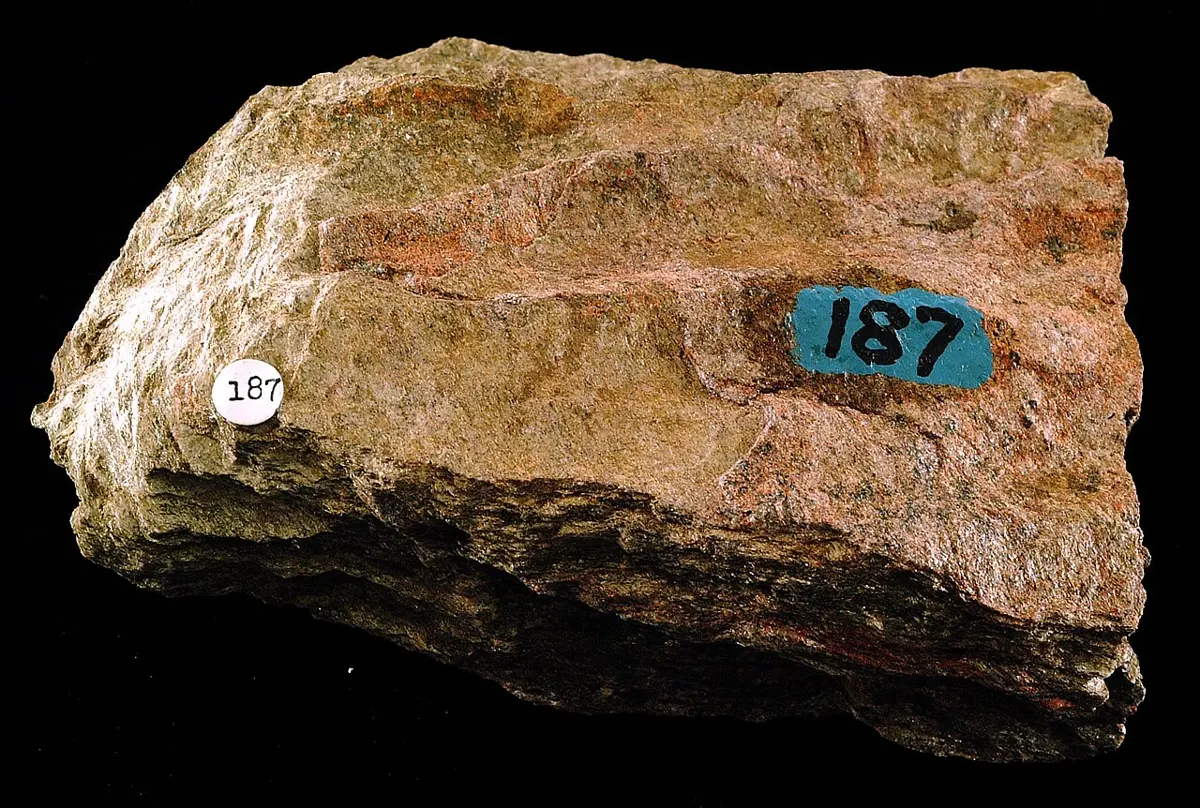
The Higher Himalaya, north of the Main Central Thrust, is made of high-grade metamorphic rocks, schist and gneiss, cut by young granites. A report by the Department of Mines and Geology, summing up recent research, gives their peak temperatures: about 700 °C for the upper part, 32 to 25 million years ago, and about 600 °C for the lower part, 20 to 16 million years ago. These rocks were deep inside the crust when the collision of India and Asia pushed them up.
Schist and gneiss occur south of the Main Central Thrust too: the Department’s geologists have mapped feldspathic schist and augen gneiss in parts of Achham, Dailekh and Surkhet and augen gneiss in Baitadi, and the Shivapuri gneiss lies just north of Kathmandu Valley.
Where the gems grow
Nepal’s metamorphic gems grow in these rocks:
- garnet in chlorite–biotite–garnet schist of the Higher Himalaya (Garnet);
- kyanite in kyanite schist and gneiss (Kyanite);
- tourmaline: dark brown dravite generally occurs in schist and gneiss (Tourmaline).
The Department says Nepal’s gem minerals are found in pegmatite, mica schist, gneiss and granite near the Main Central Thrust and the Mahabharat Thrust, from Taplejung in the east to Darchula in the west.
What they are used for
Schist that splits well is used for roofing slabs in the hills, like slate and phyllite. Their greatest value in Nepal is as the home of garnet, kyanite and other minerals.
In short
Where these facts come from
- Khadka D.R., Status of uranium and thorium prospects in Nepal; geological mapping for mineral exploration in parts of Achham, Dailekh and Surkhet; and Phosphorite exploration in Bajhang and Baitadi; all in Annual Report No. 11, Department of Mines and Geology, 2019.
- Ghimire J.R., An overview of precious and semi-precious stones in Nepal, and Ghimire R.P., Mineral resources, mining and investment opportunities in Nepal, in the same report.
- Kaphle K.P., Mineral resources of Nepal and their present status, Nepal Geological Society, 2020.
- King H.M., Schist and Gneiss, Geology.com.