
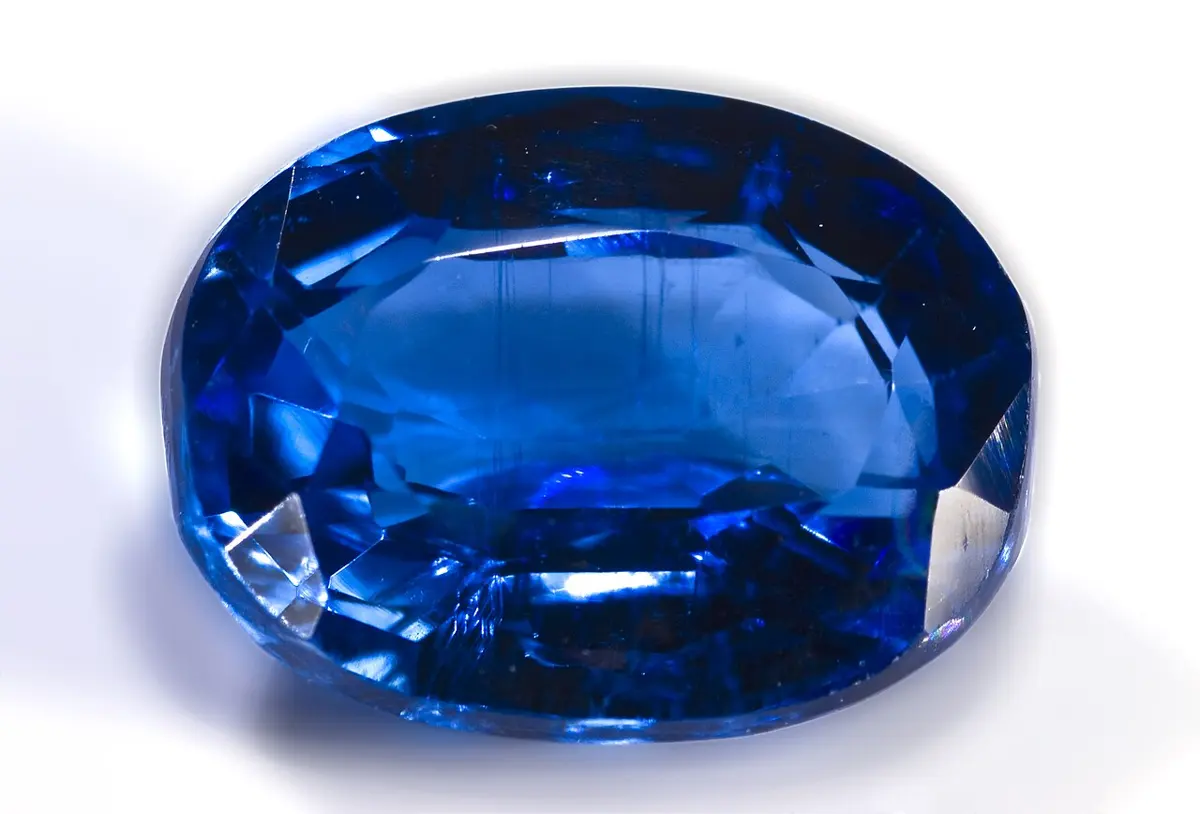
Most minerals have one hardness. Kyanite has two. Scratch a blade of it lengthwise and a knife cuts it; scratch across the blade and the knife slides off. Its blue blades are cut as gems in Jajarkot and Achham, and to a geologist they carry a message: this rock was once buried very deep.
What kyanite is
| Property | Kyanite |
|---|---|
| Formula | Al₂SiO₅ |
| Hardness (Mohs) | 5.5 along the blade, 7 across it |
| Density | 3.53 to 3.65 times as heavy as water |
| Crystals | long, flat blades, often bent or twisted |
| Color | usually blue, often in zones of lighter and darker blue; also white, gray, green |
| Cleavage | perfect along the blade |
Its hardness depends on which way you scratch.
A pressure gauge in a rock
Kyanite, andalusite and sillimanite all have the same formula, Al₂SiO₅, with their atoms arranged in three different ways. Which one grows depends on the conditions: kyanite forms under high pressure, sillimanite at high temperature, and andalusite at low pressure. Kyanite usually forms when clay-rich sedimentary rocks are changed under high pressure. So finding kyanite in a schist tells a geologist that the rock was squeezed deep inside the Earth.
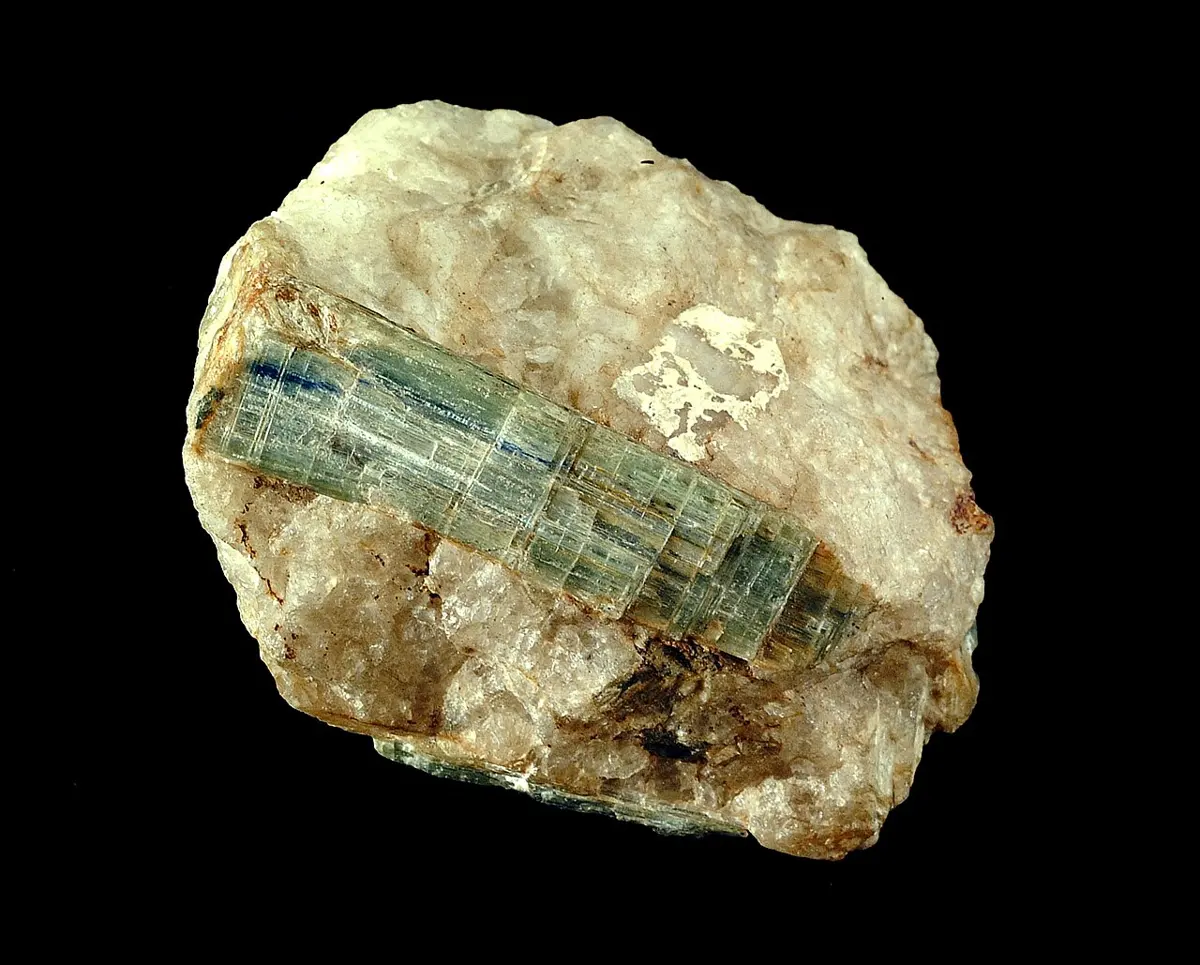
Kyanite in Nepal
Kyanite is known from kyanite schist and other high-grade metamorphic rocks in Dolakha, Sankhuwasabha, Taplejung, Rasuwa, Dhading, Jajarkot and Achham, and the Department of Mines and Geology lists prospects in Kalikot (Bharta, Bhairabi) and Dailekh too.
Most kyanite and tourmaline mining is in western Nepal, in Jajarkot, Achham and Kalikot. Small mines work at Daha and Suneri in Jajarkot and Barah in Achham; by 2018 the Department had issued 8 mining licenses and 9 prospecting licenses, though only 4 mines were working. Miners dig by hand along the veins. Gem-grade kyanite comes from pegmatite, industrial grade from mica schist; kyanite counts as gem grade above a 10% threshold.
The output has fallen sharply:
| Fiscal year (BS) | Gem-grade kyanite |
|---|---|
| 2067/68 | 3,085.6 kg |
| 2070/71 | 1,187 kg |
| 2072/73 | 105 kg |
| 2074/75 | 2 kg |
Most raw kyanite from Achham and Jajarkot used to be sent to India for cutting and polishing. Since the start of 2072/73 BS, raw gem minerals may not be exported.
What kyanite is used for
- Gems: inky blue to sapphire blue blades are cut as an inexpensive gemstone.
- Heat-proof products: kyanite goes into refractory bricks, mortars and kiln furniture for high-temperature furnaces, and into porcelain, such as sanitary fixtures and the insulators of spark plugs.
Which of these is true of kyanite?
Pick an answer to see why.
In short
Where these facts come from
- Kaphle K.P., Mineral resources of Nepal and their present status, Nepal Geological Society, 2020.
- Ghimire J.R., An overview of precious and semi-precious stones in Nepal: opportunity and challenges, in Annual Report No. 11, Department of Mines and Geology, 2019.
- Anthony J.W. et al., Kyanite and Sillimanite, Handbook of Mineralogy, Mineralogical Society of America.
- King H.M., Kyanite, Geology.com.