
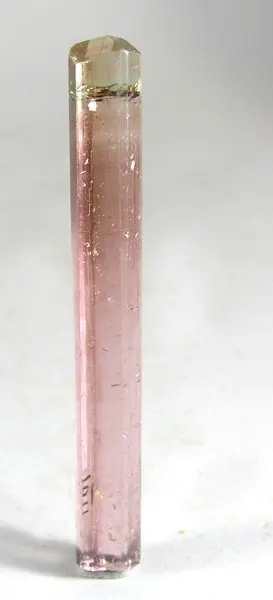
In 1934, at Hyakule in Sankhuwasabha, people found gem crystals of tourmaline and aquamarine. It was the start of Nepal’s gem mining. Tourmaline is still the gem Nepal mines most: in western Nepal there are tourmaline mines in Jajarkot, and pink and green crystals from the east are prized by collectors abroad.
What tourmaline is
Tourmaline is not one mineral but a group of boron silicates, with many other elements that can swap in and out of the crystal. That is why it comes in more colors and color combinations than any other mineral group. Two members matter most in Nepal:
| Property | Schorl | Elbaite |
|---|---|---|
| Formula | NaFe₃Al₆(BO₃)₃Si₆O₁₈(OH)₄ | Na(Al,Li)₃Al₆(BO₃)₃Si₆O₁₈(OH)₄ |
| Color | black | pink, green, blue, yellow, often several in one crystal |
| Hardness (Mohs) | 7 | 7 |
| Density (× water) | 3.18 to 3.22 | 2.90 to 3.10 |
| Streak | white | white |
Every tourmaline has the same shape: a long column whose cross-section is a rounded triangle, with fine lengthwise stripes, and no cleavage to speak of. One crystal may change color along its length, or be pink inside and green outside.
Tourmaline crystals are also pyroelectric and piezoelectric: warm one, or squeeze it, and electric charges appear at its two ends.
How tourmaline forms
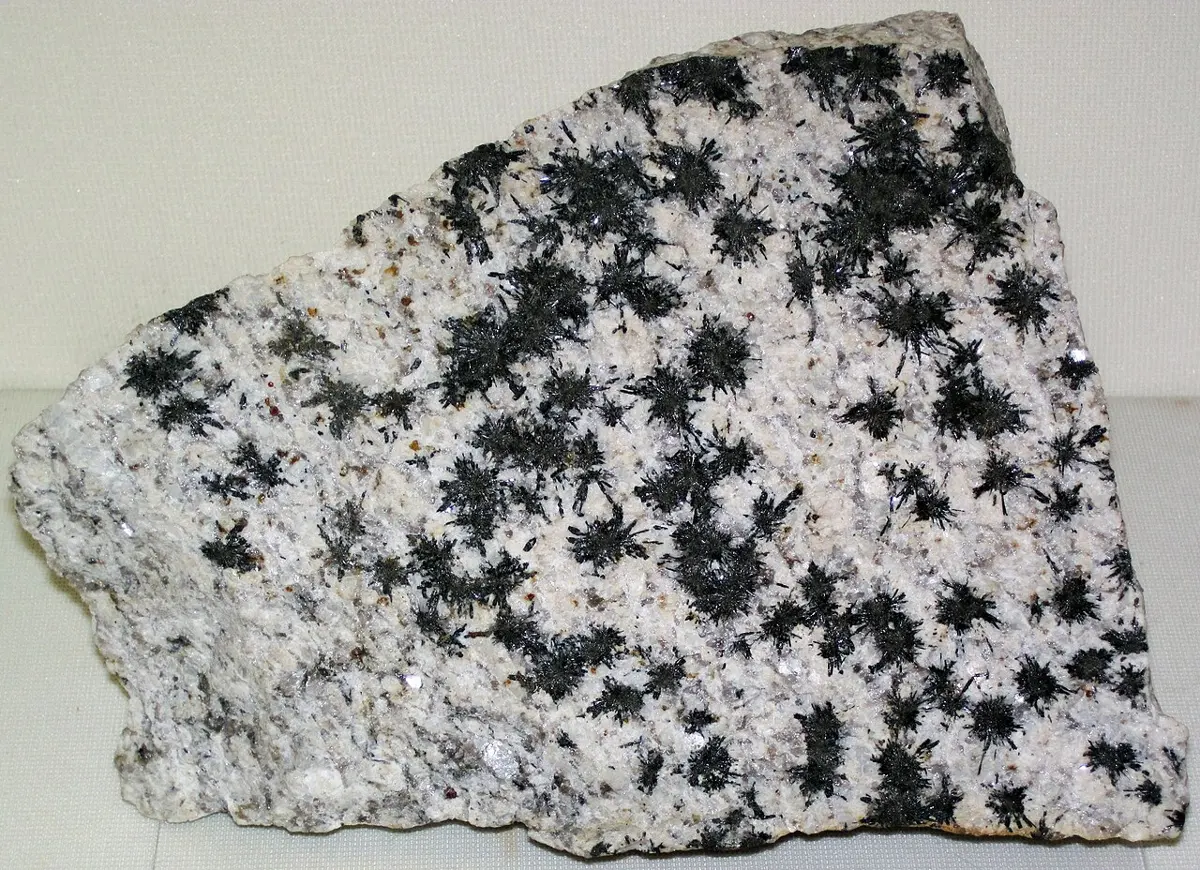
Tourmaline grows in granite and in metamorphic rocks, usually as a minor mineral. The biggest and finest crystals grow from hot, watery fluids in pegmatites and in cracks, where they have room. In Nepal, the Department of Mines and Geology says, gem tourmaline is found in pegmatites, while lower, industrial grade tourmaline occurs in mica schist.
Tourmaline in Nepal
The Department lists the kinds found in Nepal:
- Schorl, black, the commonest, in the granites of the Higher Himalaya;
- Elbaite, multicolored gem tourmaline, in Sankhuwasabha and Taplejung;
- pink tourmaline in the Langtang Valley;
- green tourmaline in Jajarkot;
- dravite, dark brown, in schist and gneiss in Taplejung;
- uvite, yellow-brown to amber, in sericite schist in Jajarkot.
The best-known places are Hyakule and Phakuwa in Sankhuwasabha, with pink, bright green and light orange crystals, some banded or with an amber core; Phaktanglung in Taplejung; Naje in Manang; and many places in Jajarkot, including Daha, Garkhakot, Tikachaur and Lekhpatan. The Langtang Valley and Naje pegmatites are also promising.
Mining is done by hand, with pick, shovel, chisel and hammer, following the vein in narrow tunnels called rat holes. Most of the output is industrial grade; tourmaline counts as gem grade only above a 1% threshold. The Department’s figures show how much production swings:
| Fiscal year (BS) | Gem-grade tourmaline |
|---|---|
| 2069/70 | 147.5 kg |
| 2070/71 | 696 kg |
| 2071/72 | 16.53 kg |
| 2073/74 | 0 kg |
Until 2072/73 most of it went raw to India at low prices and was cut and sold on at many times the value. Since the start of 2072/73 BS, exporting raw gem minerals has been banned. Kaphle reported in 2020 that two tourmaline mines were working at Daha in Jajarkot and six were being developed.
What tourmaline is used for
Mainly as a gemstone in jewelry, and as mineral specimens: well-formed, colorful crystals are sought by collectors and can sell for thousands of dollars.
In short
Where these facts come from
- Ghimire J.R., An overview of precious and semi-precious stones in Nepal: opportunity and challenges, in Annual Report No. 11, Department of Mines and Geology, 2019.
- Kaphle K.P., Mineral resources of Nepal and their present status, Nepal Geological Society, 2020.
- Anthony J.W. et al., Schorl and Elbaite, Handbook of Mineralogy, Mineralogical Society of America.
- King H.M., Tourmaline, Geology.com.