
Shaligram: fossils from a vanished ocean
शालिग्राम · A fossil and a sacred stone
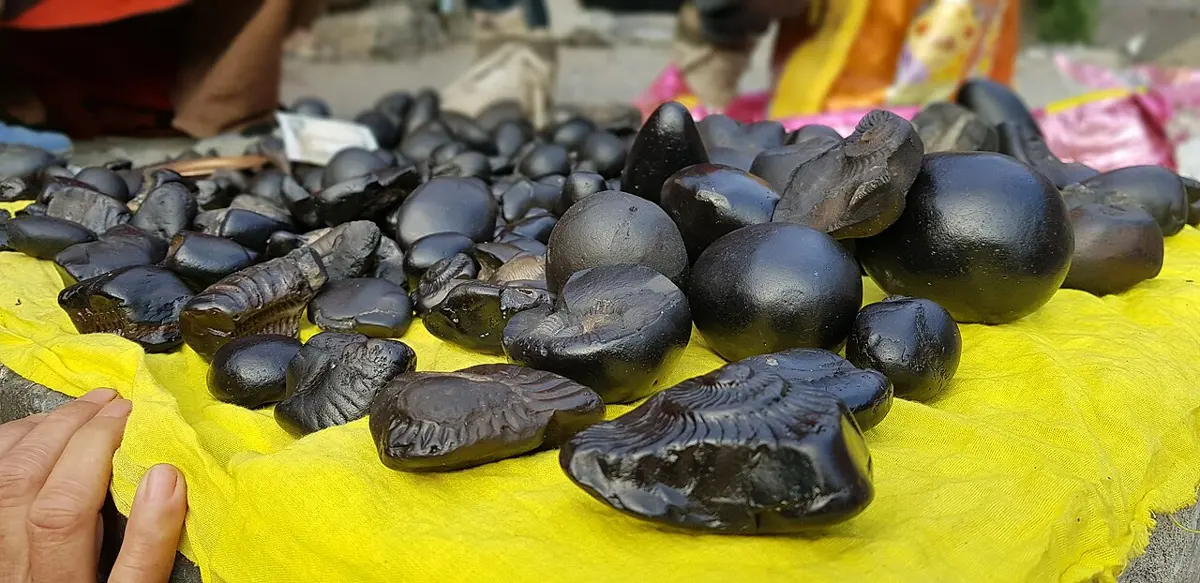
In the gravel of the Kali Gandaki and on the hillsides near Muktinath, pilgrims look for smooth black stones. Some are whole; some have broken open to show a perfect spiral inside, ribbed like a coiled rope. To Hindus a shaligram (शालिग्राम) is not a picture of Vishnu but Vishnu himself, present in stone. To a geologist it is also a fossil: the shell of a sea creature that lived in an ocean which no longer exists.
What is inside
The spiral is an ammonite: an extinct sea animal with a coiled shell, a relative of today’s squid, octopus and cuttlefish. Ammonites lived in the oceans for more than 300 million years and died out about 66 million years ago, in the mass extinction at the end of the Cretaceous. Shaligrams can also hold fossil clams and belemnites, but ammonites are by far the commonest.
The fossils in shaligrams date from the Jurassic to the earliest Cretaceous, roughly 166 to 140 million years ago.
How a sea creature reached the Himalaya
- The seafloor. The ammonites lived on the outer shelf at the southern edge of an ocean called Tethys (more exactly, Neotethys). When they died, their shells sank into black mud on a seafloor with very little oxygen, so they were not eaten or rotted away.
- The nodule. Around many shells, a hard lump of stone, a nodule, formed inside the soft mud. The nodules are mostly limestone. The mud around them hardened into black shale, called the Spiti Shale, or the Saligram Formation.
- The collision. As India pushed into Asia and the Himalaya rose, the old seafloor was lifted thousands of meters, into today’s Tethys Himalaya of Mustang.
- The river. The soft shale crumbles easily, but the hard nodules survive. The Kali Gandaki washes them out and rounds them into smooth pebbles. Stones freshly eroded from the hillsides near Muktinath are rougher.
Stone and scripture
Hindu scriptures tell that Vishnu was cursed to become stone on the banks of the Gandaki. Texts from as early as the 12th century already tell smooth river stones from rough hillside ones. Devotees read the marks on each stone, wheels and flowers, to know which form of Vishnu it is. Tradition says a shaligram must not be given a price.
Europeans first wrote about shaligrams in 1743, in a report by a French Jesuit missionary, Father Calmette. By 1782 a writer named Sonnerat had recognized them as ammonites.
The river’s upper course is called Kali Gandaki; kali means black, perhaps for the dark rocks it cuts through.
Collecting
There is a commercial demand for shaligrams, and fakes are sold too. A news report in 2025 said that collecting shaligrams in large amounts is prohibited in Nepal, without naming the law. In April 2025, according to that report, Nepal Police seized 894 kg of shaligrams in 34 sacks at a check in Mustang and handed them to the Annapurna Conservation Area Project in Pokhara for investigation.
In short
Where these facts come from
- Hagn H., Saligrame: Gerölle von Malm-Kalken mit Ammoniten als Kultgegenstände Indiens, Mitteilungen der Bayerischen Staatssammlung für Paläontologie und historische Geologie 17, 1977 (with an English abstract).
- Ormiston J., Sacred ammonites: the shaligram stones of Nepal, Bristol Dinosaur Project blog, University of Bristol, 20 January 2023.
- Nepal: 34 sacks of illegally obtained shaligram stones confiscated in Mustang, The Indian Awaaz, 17 April 2025.
- Ammonoidea, Wikipedia.
- शालिग्राम in the Nepali Brihat Shabdakosh (Nepal Academy).