
Garnet: crystals from deep in the Himalaya
गार्नेट · Red crystals that grew under pressure
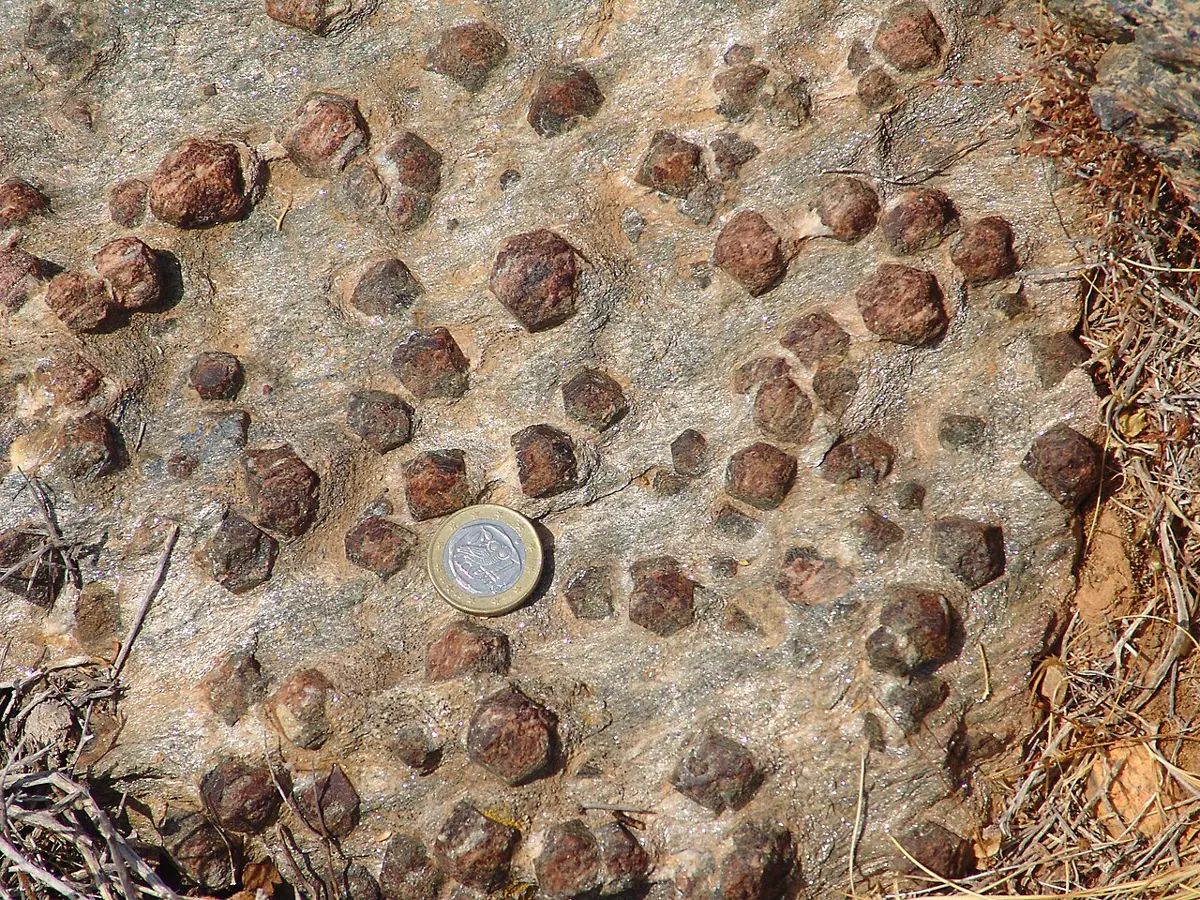
Look at the photo above. The rock is gray and flaky, and dotted all over with round, dark red crystals, as if someone had pressed seeds into it. Those seeds are garnets, and nobody put them there: they grew inside the solid rock, kilometers underground, while it was being heated and squeezed.
Garnet tells a story about where a rock has been. And the rocks of Nepal’s Higher Himalaya have been very deep indeed.
What garnet is
Garnet is not one mineral but a family. All garnets share the formula
X₃Y₂(SiO₄)₃
where X and Y are metal atoms that can change. Each garnet gets its name from its metals:
| Garnet | Formula | Hardness (Mohs) | Density (× water) |
|---|---|---|---|
| almandine | Fe₃Al₂(SiO₄)₃ | 7 to 7.5 | 4.32 |
| pyrope | Mg₃Al₂(SiO₄)₃ | 7 to 7.5 | 3.56 |
| spessartine | Mn₃Al₂(SiO₄)₃ | 7 to 7.5 | 4.19 |
| grossular | Ca₃Al₂(SiO₄)₃ | 6.5 to 7 | 3.59 |
Many real garnets are a mixture of these. The deep red almandine (with iron) is the commonest garnet in rocks like schist. Hessonite, an orange-brown kind of grossular, is another garnet found in Nepal.
Twelve faces
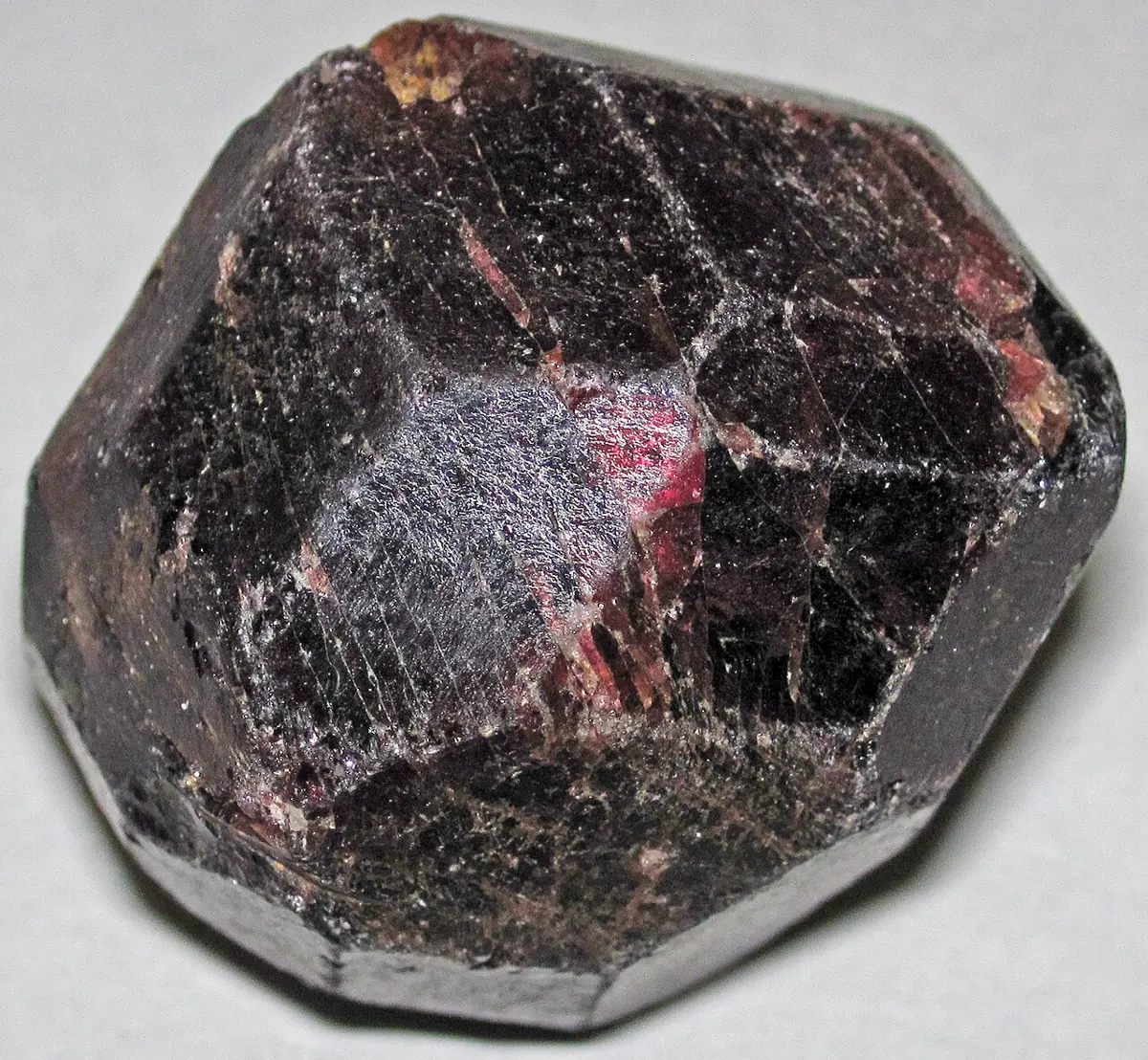
Garnet crystals belong to the cubic (isometric) system, but they rarely grow as cubes. Their commonest shape is a ball-like solid with twelve faces, each a rhombus: the rhombic dodecahedron.
Hard and tough
Garnet scores 6.5 to 7.5 on the Mohs scale, about as hard as quartz. It has no cleavage: unlike mica, it doesn’t split along flat planes, so when crushed it breaks into sharp, angular grains.
How the Himalaya grew garnets
About 40 to 50 million years ago, India ran into Asia. The rocks caught between them were folded, stacked and pushed deep under the growing mountains, where it is hot and the pressure is enormous.
Garnet grows when rock that began as mud (shale, rich in aluminium) is cooked and squeezed like this. The minerals in the rock slowly change, atom by atom, without melting, and new ones grow, garnet among them. The shale becomes schist or gneiss, shiny with mica and dotted with garnets.
Garnet in Nepal
In Nepal, garnets are found in schist made of chlorite, biotite and garnet, within the high-grade metamorphic rocks (rocks changed by great heat and pressure) of the Higher Himalaya. Deep red almandine, hessonite and pyrope have been mined in Sankhuwasabha, Taplejung, Sindhupalchok, Dolakha and Rasuwa.
Small garnet mines worked in Sankhuwasabha at Budhekhani, Bhote Khola, Hanglaung, Khining, Sunamla and Swachi Khani. They have closed: digging deeper was hard, and the miners lacked the right mining methods. The Department of Mines and Geology once gave three prospecting licenses for garnet; by 2020 there were none.
What garnet is used for
- Gems: the colorful, clear garnets are cut as gems. Garnet is an inexpensive gemstone, and the birthstone of January.
- Abrasives: most garnet is not a gem at all. Crushed garnet’s hard, sharp grains are used to blast-clean metal and stone, in water-jet cutting (garnet grit carried in a thin jet of water at very high pressure), as a filter for cleaning water, and on sandpaper, especially for wood.
The world mined about 730,000 tonnes of garnet for industry in 2025. Used grit can be cleaned and recycled several times without losing much of its quality.
Why is garnet better than ordinary sand for sandpaper that must smooth hard wood?
Pick an answer to see why.
In short
Where these facts come from
- Kaphle K.P., Mineral resources of Nepal and their present status, Nepal Geological Society, 2020.
- Anthony J.W. et al., Almandine, Spessartine and Grossular, Handbook of Mineralogy, Mineralogical Society of America.
- King H.M., Garnet: mineral, January birthstone, abrasive, filter media, Geology.com.
- King H.M., Mohs hardness scale, Geology.com.
- Grossular, Wikipedia.
- Olson D.W., Garnet (industrial), Mineral Commodity Summaries 2026, US Geological Survey, 2026.
- The Himalayas: two continents collide, This Dynamic Earth, US Geological Survey.