
Granite: a rock that cooled slowly underground
ग्रेनाइट · Big crystals from slow-cooled magma
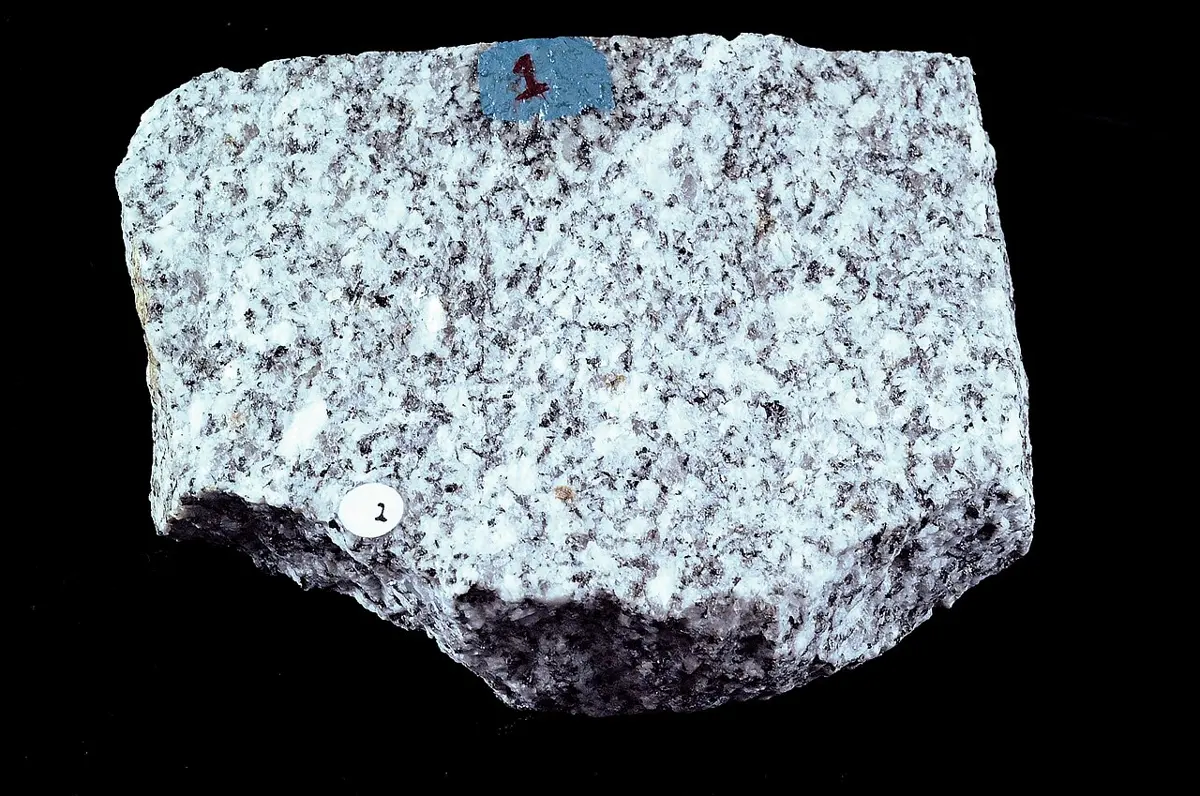
Look closely at a granite step or a polished granite tabletop. It is a jigsaw of grains you can see without a lens: milky white or pink ones, glassy gray ones and small black or silvery flakes. Each grain is a crystal of a mineral, and they grew into one another as the rock slowly turned from liquid to solid, deep underground.
What granite is
Granite is an igneous rock: a rock that formed from molten rock, magma. It is made mainly of three minerals:
| Mineral | Looks like in granite | Its page |
|---|---|---|
| feldspar | white, cream or pink blocks that flash in light | Feldspar |
| quartz | glassy gray grains | Quartz |
| mica | black (biotite) or silvery (muscovite) flakes | Mica |
Some granites also hold black tourmaline or red garnet.
Big crystals mean slow cooling
When magma of the same makeup crystallizes quickly, near or at the surface, its crystals stay too small to see: that rock is called rhyolite. Granite’s grains are large enough to see, which tells us it cooled slowly, over a long time, deep below the surface where the rocks around it kept it warm. We see granite today only because the rocks that once covered it have been worn away.
Granite in Nepal
Nepal has granites of two very different ages:
- Old granites in the Lesser Himalaya, of the Cambrian to Ordovician periods, long before the Himalaya existed: at Palung, Ipa and Narayanthan in Makwanpur, and in Sindhuli, Udayapur and Dadeldhura.
- Young tourmaline granites of the Miocene, formed while the Himalaya were rising, in the Higher Himalaya and the Tethys zone. The Department of Mines and Geology describes the Higher Himalaya as high-grade metamorphic rocks with these young granites. The black tourmaline schorl grows in them.
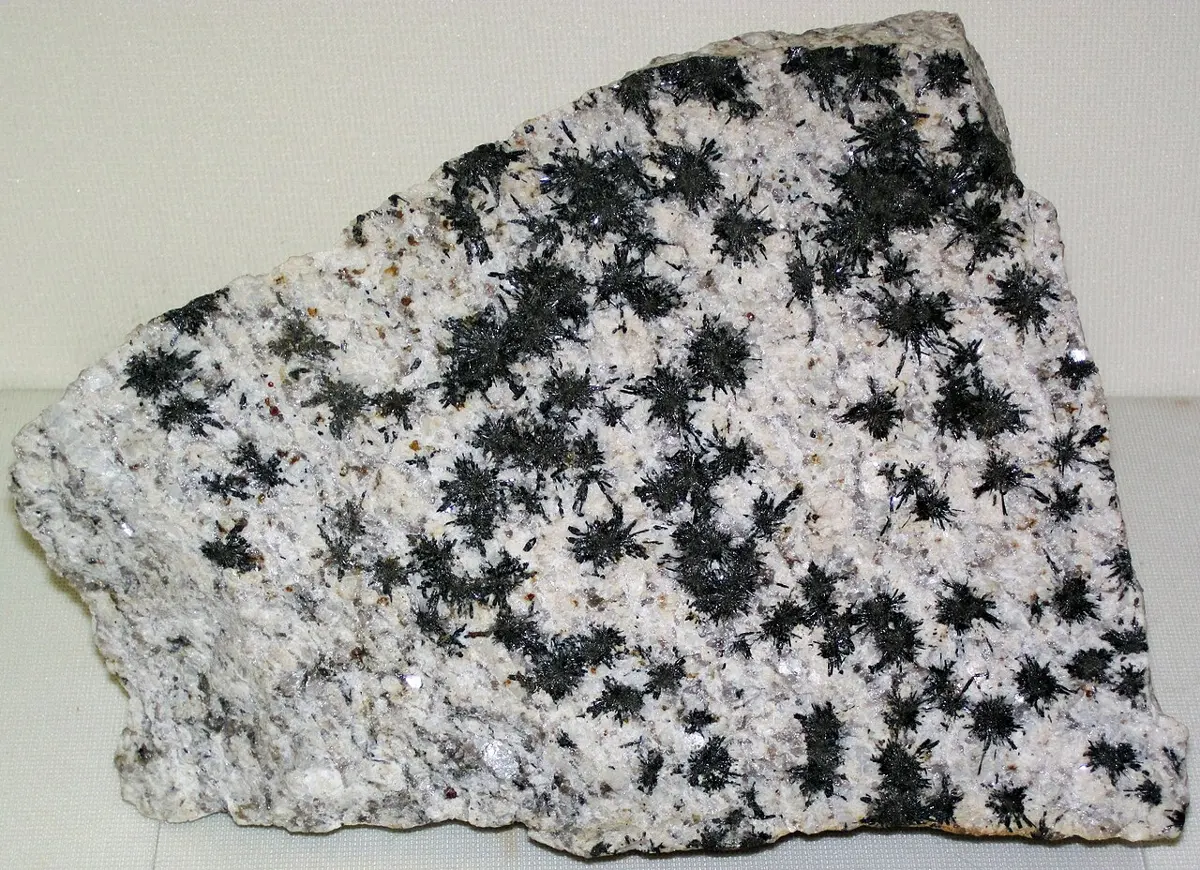
Coarse, massive granite makes good decorative and dimension stone, cut into slabs for tabletops, floors and walls. In 2018 the Department had issued three prospecting licenses for granite, but no granite quarry in Nepal was producing.
What granite is used for
Countertops, floor tiles, paving, steps, building facing and monuments: granite is hard, takes a polish and lasts.
Granite has large crystals you can see without a lens. What does that tell us?
Pick an answer to see why.
In short
Where these facts come from
- Kaphle K.P., Mineral resources of Nepal and their present status, Nepal Geological Society, 2020.
- Ghimire R.P., Mineral resources, mining and investment opportunities in Nepal, in Annual Report No. 11, Department of Mines and Geology, 2019.
- King H.M., Granite, Geology.com.