
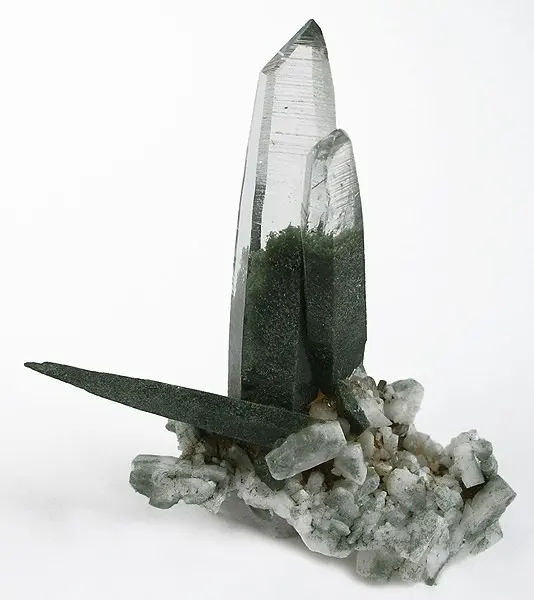
Pick up a white pebble from a riverbed: there is a good chance it is quartz. Look at sand under a hand lens: most of the glassy grains are quartz. Break open a piece of granite: the gray, glassy specks are quartz too. In Nepali a clear crystal of it is स्फटिक (sphatik) or बिल्लौर (billaur).
What quartz is
Quartz is silicon dioxide, SiO₂: silicon and oxygen, joined in a framework that is equally strong in every direction, so it has no weak planes to split along.
| Property | Quartz |
|---|---|
| Formula | SiO₂ |
| Hardness (Mohs) | 7 |
| Density | 2.65 times as heavy as water |
| Cleavage | none to speak of; it breaks with curved, shell-like surfaces |
| Luster | glassy |
| Crystals | six-sided columns with pointed tips |
| Color | colorless or white; pink, purple, yellow, brown or smoky from traces of other substances |
The colored kinds have their own names: purple amethyst, pink rose quartz, yellow citrine and brown-gray smoky quartz. Amethyst, citrine and smoky quartz are among Nepal’s semiprecious stones.
How quartz forms
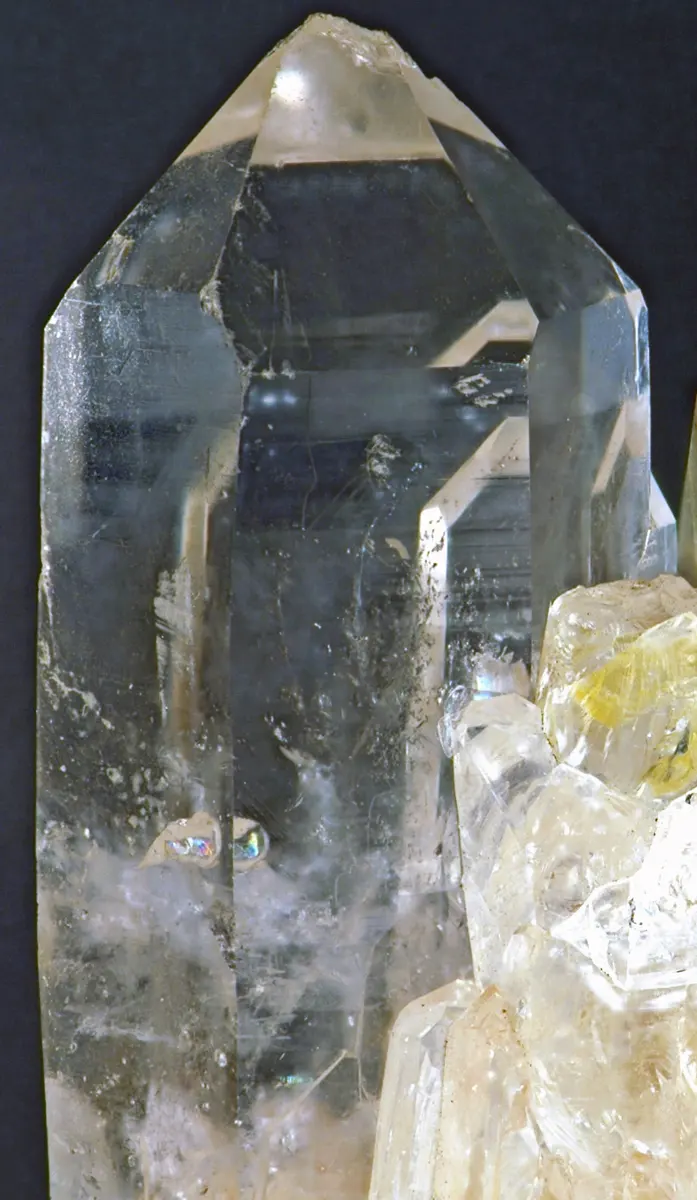
Quartz grows from hot magma as granite cools, and from hot water carrying dissolved silica that seeps along cracks: the white veins you see crossing rocks in the hills. The biggest, clearest crystals grow in pegmatites: bodies of rock that form from the last part of a magma to crystallize. That last melt is rich in water, which lets atoms move about freely, so crystals grow very large.
Quartz hardly dissolves and hardly wears down, so when other minerals in a rock rot away, the quartz grains are left: it is common in sandstone and as a leftover mineral in soils and sediments. That is why river sand is mostly quartz, and why a white pebble survives a long tumble down the Trishuli.
Quartz in Nepal
Rock crystal is known from Jajarkot, Dailekh, Dhading, Rasuwa, Nuwakot, Sankhuwasabha, Ilam and Taplejung. In 2020 two small mines were working crystals out of pegmatites: at Khejemi/Sirku in Taplejung and at Raluka in Nuwakot. The Department of Mines and Geology lists quartz mining leases in Sankhuwasabha, Humla and Bajhang, where miners follow the crystal veins by hand in narrow “rat holes”.
The Department’s figures show how much the trade rises and falls: gem-grade quartz production was 4,256 kg in 2070/71 BS and 0 in 2074/75. Since the start of 2072/73 BS, Nepal has banned exporting raw gem minerals, quartz among them; only cut and polished stones may go abroad.
Quartz also comes as sand. Geologists of the Department have proved about 11.9 million tonnes of silica sand good enough for glass at Karra Khola near Hetauda, Makwanpur.
A student finds a clear, six-sided crystal in a stream in Taplejung. A steel nail will not scratch it. Which is it most likely to be?
Pick an answer to see why.
What quartz is used for
- Glass and sand: pure quartz sand is used to make glass, and as an abrasive and a molding sand in foundries.
- Gems and decoration: amethyst, rose quartz, citrine and smoky quartz are cut as gems; rock crystal is carved and polished.
- Electronics: quartz is piezoelectric: squeeze a crystal and a tiny voltage appears across it. A thin slice of quartz vibrates at a very steady rate, which is used to hold radios on a fixed frequency and to keep time in quartz watches.
- Lenses and windows: clear quartz makes special lenses, windows and filters for lasers, microscopes and scientific instruments.
In short
Where these facts come from
- Kaphle K.P., Mineral resources of Nepal and their present status, Nepal Geological Society, 2020.
- Ghimire J.R., An overview of precious and semi-precious stones in Nepal, in Annual Report No. 11, Department of Mines and Geology, 2019.
- Anthony J.W. et al., Quartz, Handbook of Mineralogy, Mineralogical Society of America.
- King H.M., Quartz, Geology.com.
- King H.M., Feldspar, Geology.com.
- King H.M., Pegmatite and Mohs hardness scale, Geology.com.
- स्फटिक and बिल्लौर in the Nepali Brihat Shabdakosh (Nepal Academy).