
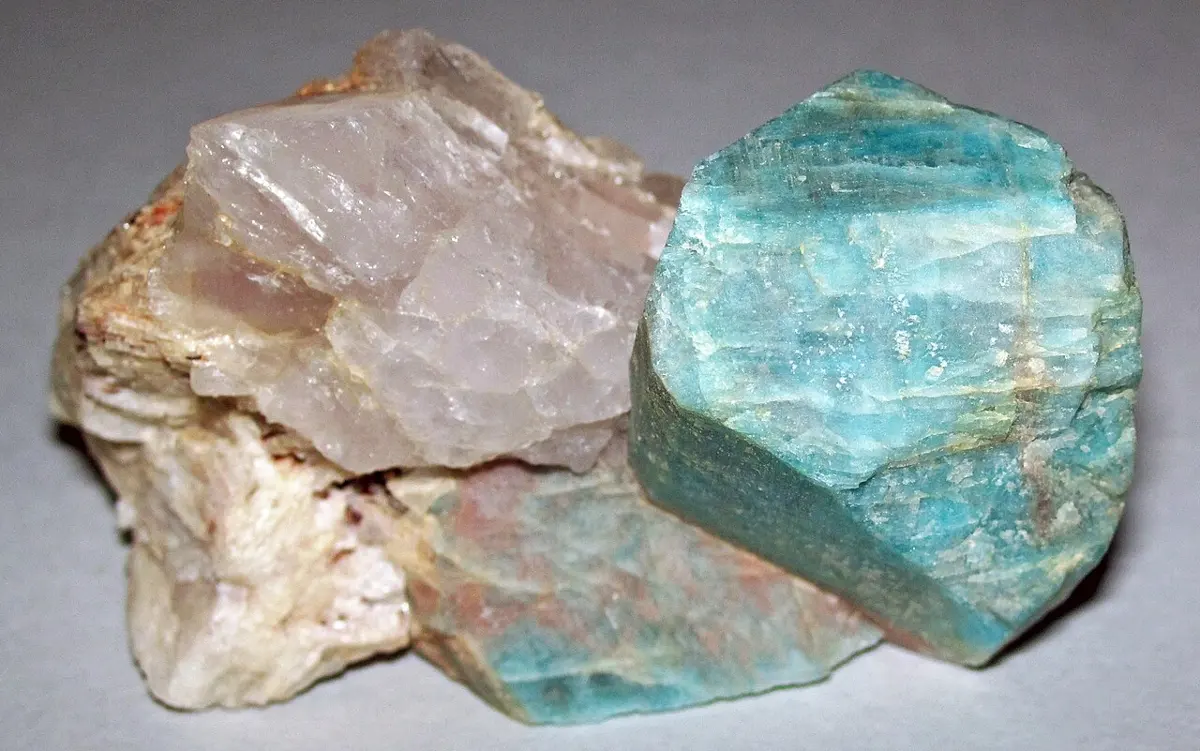
Look at a polished granite counter in a shop in Kathmandu. Among the glassy gray specks of quartz and the black flecks of mica, most of the stone is made of pale white, cream or pink blocks. Those blocks are feldspar, and they are the commonest minerals there are: feldspars make up over half of Earth’s crust.
What feldspar is
Feldspar is not one mineral but a group of silicates built from aluminium, silicon and oxygen, with potassium, sodium or calcium. Three common ones:
| Feldspar | Formula | Hardness (Mohs) | Density (× water) |
|---|---|---|---|
| orthoclase | KAlSi₃O₈ | 6 to 6.5 | 2.55 to 2.63 |
| microcline | KAlSi₃O₈ | 6 to 6.5 | 2.54 to 2.57 |
| albite | NaAlSi₃O₈ | 6 to 6.5 | 2.60 to 2.65 |
Orthoclase and microcline have the same formula but their atoms are arranged a little differently. Amazonite is green microcline.
Two flat faces at right angles
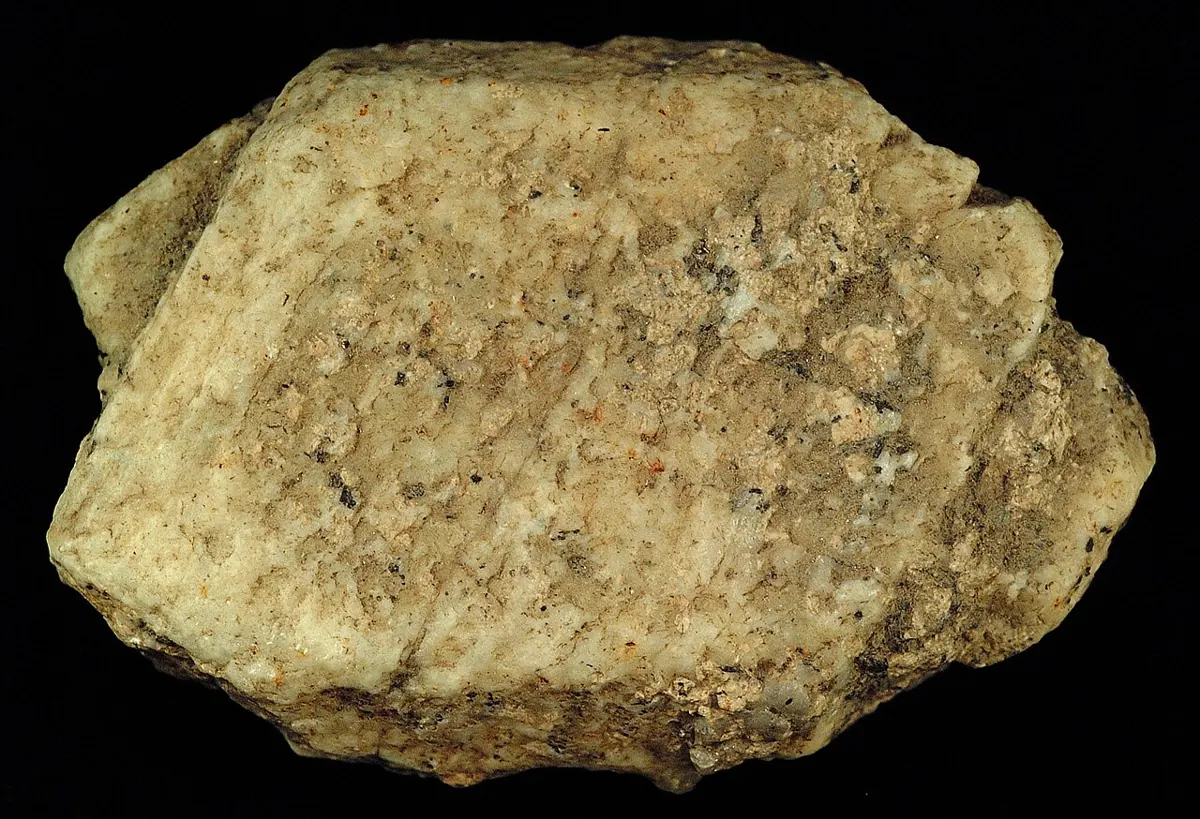
The best way to tell feldspar from quartz is its cleavage. Feldspar breaks along two directions, giving flat, shiny faces that meet at or close to a right angle, so broken pieces look blocky. Quartz has no cleavage and breaks with curved surfaces.
How feldspar forms, and what it becomes
Feldspars crystallize from magma, so they fill granite and its relatives, and they grow large in pegmatites. Heat and pressure also grow them in metamorphic rocks: geologists of the Department of Mines and Geology, mapping parts of Achham, Dailekh and Surkhet, describe feldspathic schist with white feldspar grains, which in places has become banded gneiss.
Feldspar does not last at the surface. Its cleavages let it break into small pieces, and water slowly turns it into clay minerals. The farther sand travels from the hills, the less feldspar is left in it.
Feldspar in Nepal
The Department of Mines and Geology lists feldspar among Nepal’s industrial minerals, and its studies show that the pegmatites so far reported in the country matter mainly for quartz, feldspar and mica, with a few gem minerals such as beryl and tourmaline. In 2018 it had issued one prospecting license for feldspar.
The prettiest Nepali feldspar is amazonite, light green microcline. It is found in the pegmatites of Hyakule and Phakuwa in Sankhuwasabha, at Naje in Manang and in parts of Taplejung, together with tourmaline and quartz crystals, so it can be mined at the same time as tourmaline.
What feldspar is used for
- Glass and ceramics: crushed and powdered feldspar goes into plate and bottle glass, ceramic tiles, pottery, fiberglass, paints and plastics.
- Gems: amazonite is cut and polished as a semiprecious stone.
- Clay: weathered feldspar gives kaolin, the white clay of porcelain.
In short
Where these facts come from
- Kaphle K.P., Mineral resources of Nepal and their present status, Nepal Geological Society, 2020.
- Department of Mines and Geology, खनिज स्रोतहरु (Mineral resources).
- Ghimire J.R., An overview of precious and semi-precious stones in Nepal; Ghimire R.P., Mineral resources, mining and investment opportunities in Nepal; and the geological mapping of Achham, Dailekh and Surkhet; all in Annual Report No. 11, Department of Mines and Geology, 2019.
- Anthony J.W. et al., Orthoclase, Microcline and Albite, Handbook of Mineralogy, Mineralogical Society of America.
- King H.M., Feldspar, Geology.com.