
बेल: the temple fruit with a wooden shell
बेल · Aegle marmelos · A thorny tree of the citrus family, Rutaceae
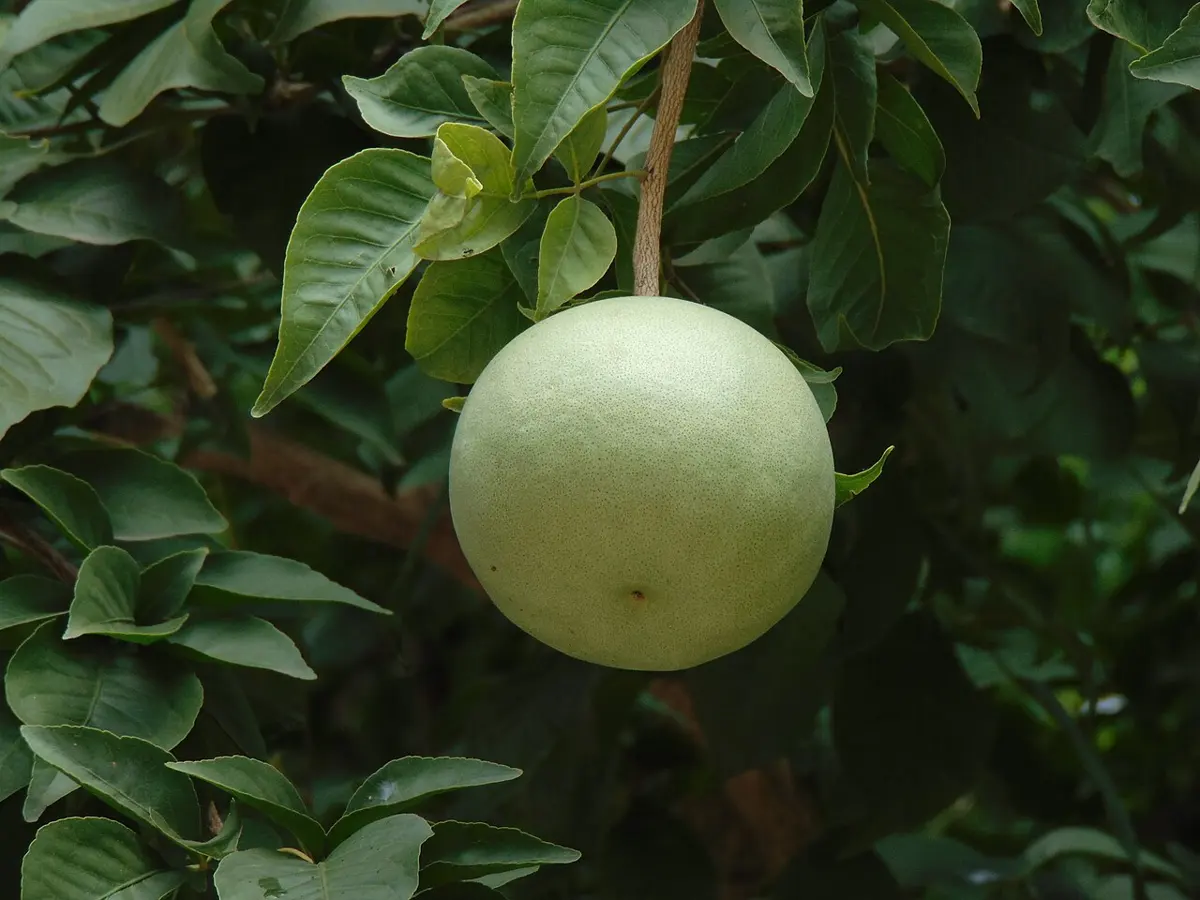
In the Kathmandu valley, a Newar girl, most often at the age of seven, goes through a ceremony called इही (ihi). It is a wedding, with the rites of a real one, and her groom is a fruit: a बेल (bel). The fruit stands for the god Shiva. Because the बेल is believed to never rot, staying fresh forever, a woman married to it is never thought of as a widow, whatever happens later in her life. For the ceremony, the fruit must look ripe and perfect, with no damage at all.
Fruits do rot, of course. But the बेल does have something unusual about it: a shell so hard it is more like wood than skin. This page is about the tree, its fruit, and what is known about both.
How to know it
बेल is a slow-growing, medium-sized tree, about 12 to 15 meters tall, with a short trunk and soft, flaking bark. Look for:
- thorns: its branches are sometimes spiny, and young shoots that spring up from the roots carry many stiff, straight thorns (careful when you touch it);
- the leaves: usually in three leaflets, oval and pointed, the middle one on a longer stalk; new leaves are glossy and pinkish-maroon, and mature leaves smell unpleasant when crushed;
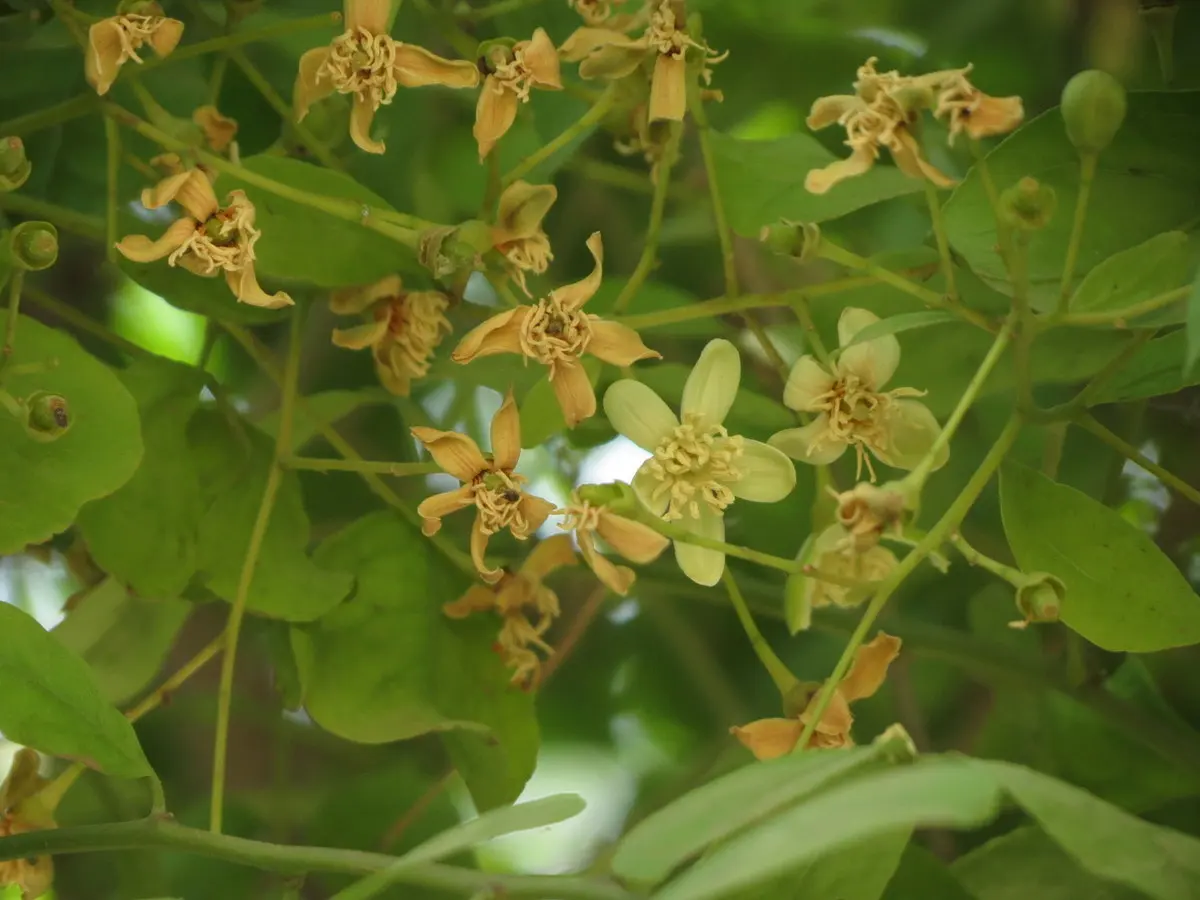
- the flowers: fragrant, with four thick, curled-back petals, green outside and yellowish inside, and 50 or more stamens; in India they come in April and May, just after the new leaves;
- the fruit: round to oval, about 5 to 12 cm across in Nepal (bigger elsewhere), gray-green until fully ripe, then yellowish, dotted with tiny scented oil glands. Inside the shell are 8 to 20 faint segments of pale orange, sweet, sticky pulp, and 10 to 15 woolly seeds, each in a sac of clear, gluey mucilage. The fruit takes 10 to 11 months to ripen after flowering.
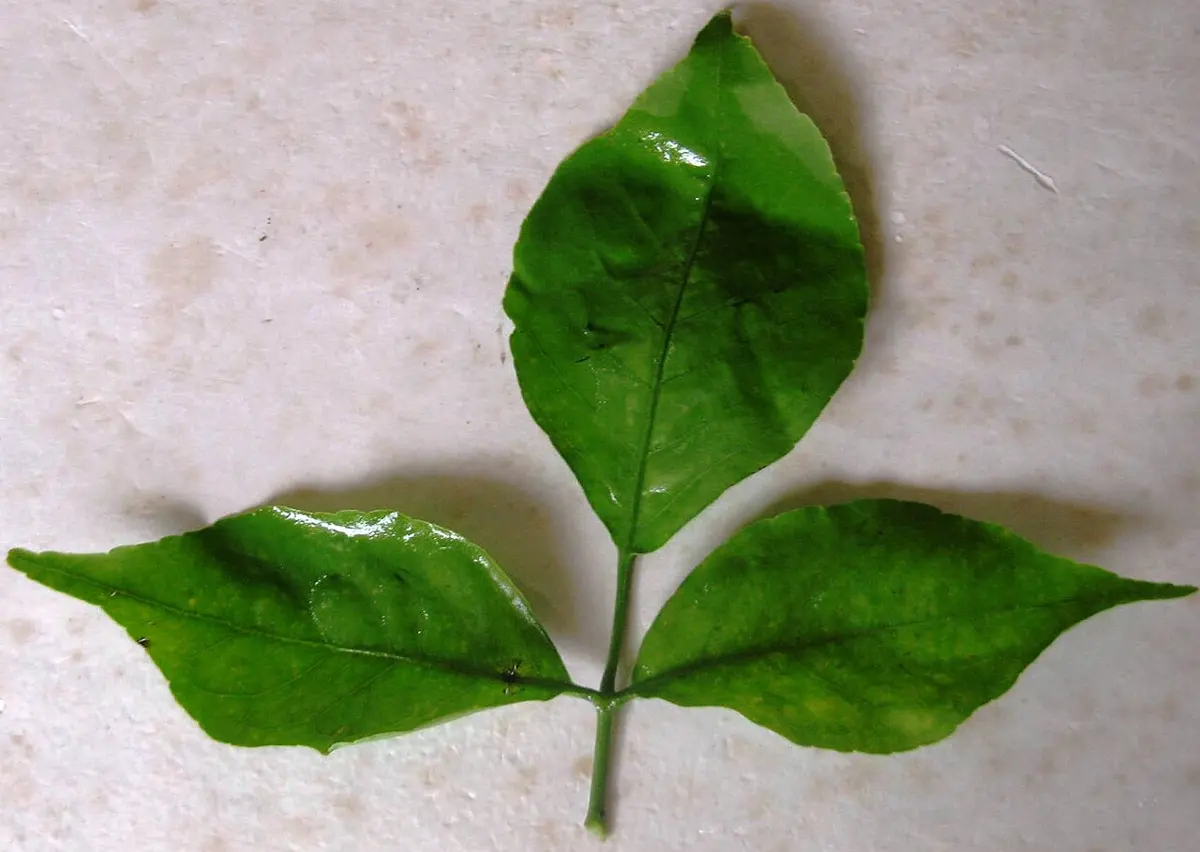
The Nepali Brihat Shabdakosh describes बेल as a famous thorny tree with three leaves to a stalk and white flowers, whose leaves are mostly offered to Shiva, or its round, hard fruit. Careful with the word: बेल also means any climbing vine (a लहरो).
Where it grows
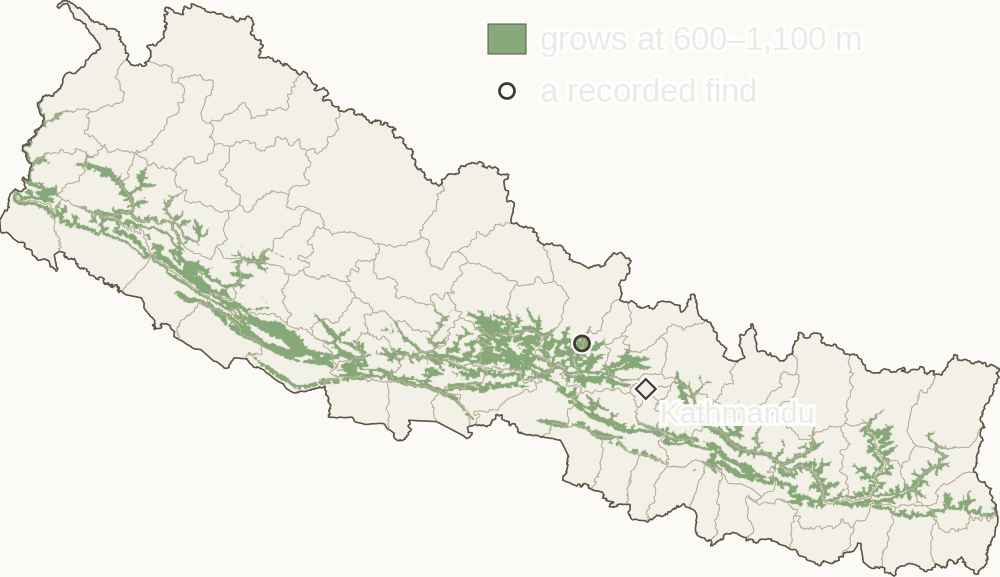
Nepal’s national register of medicinal plants records बेल from about 600 to 1,100 meters, in the west, center and east, but it is also planted lower down: in Rupandehi in the Terai it is a cultivated tree. And a study of इही notes बेल trees growing at about 1,200 to 1,300 meters in the Himalayan region, especially near Shiva temples, where they are planted. In India it grows wild in dry forests on hills and plains, and it is famous for thriving where other fruit trees can’t: in swampy, alkaline or stony soil. It needs a long dry season to fruit; where there is none, it won’t.
Ripe or unripe: one fruit, opposite uses
Here is the surprise. Tradition uses the same fruit for two opposite problems:
- the ripe fruit as a laxative, for constipation and indigestion;
- the unripe fruit, which is astringent, to stop diarrhea and dysentery.
Why would a fruit do both? Part of the answer is tannins, the chemicals that dry the mouth (see हर्रो for how they work). The pulp of wild fruits holds up to 9% tannin, and the rind up to 20%. Unripe and wild fruits, the most astringent, are the ones prized against diarrhea. The pulp also holds a substance called marmelosin, which is given as a laxative.
The pulp also holds sugar and water: 100 g of fresh fruit has about 55 to 62 g of water and 28 to 32 g of carbohydrates, with some vitamin C (8 to 60 mg) and carotene.
Traditional uses
बेल is food, medicine and worship at once. Studies of the herbs people use in Nepal record:
- ripe fruits eaten, or mixed with cold water into a cool drink, सर्बत (sarbat), in Kavrepalanchok, and ripe fruit eaten for diarrhea and fever;
- fruit juice for diarrhea and dysentery, leaves for stomach troubles, and root juice for fever and vomiting (a use first recorded in that study), in Rupandehi;
- in the national register: ripe fruit for constipation and indigestion, unripe fruit for dysentery, root bark for fever.
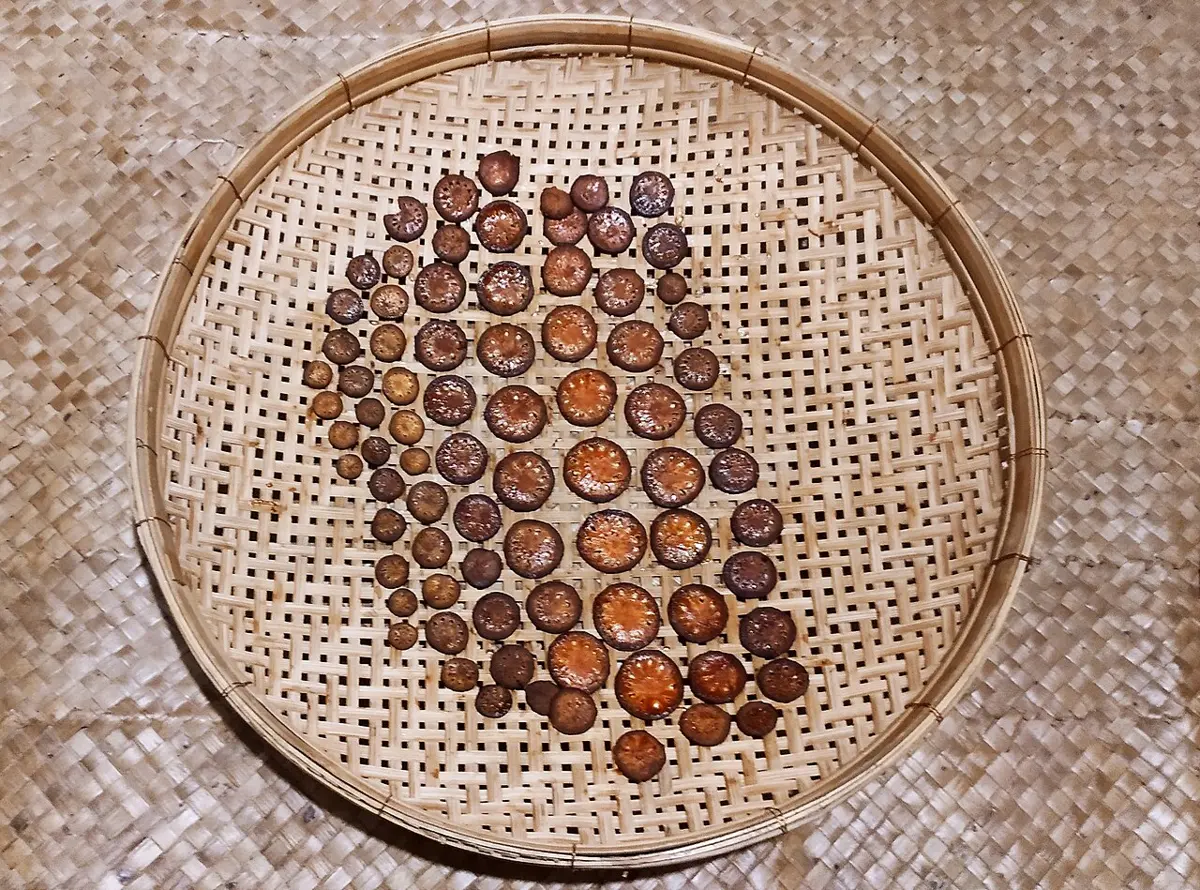
In India the young fruits are sliced and sun-dried, and sold in markets for medicine. The Sanskrit name is बिल्व (bilva). In Hindu worship its three-part leaves are indispensable offerings to Shiva.
What science has tested
Extracts of the fruit, leaves and roots have been tested in the laboratory and in animals, for diarrhea, blood sugar, inflammation and more, and many showed effects. A 2023 review of that laboratory and animal research (it left tests in people out on purpose) ends by saying it is now essential to do clinical research, tests in people.
- How strong the evidence is: not properly tested in people. The cool drink of ripe pulp is a food; as a medicine, बेल is unproven.
Protection
The IUCN Red List rates बेल Near Threatened: not yet threatened, but close to it. Planting it is one small way to keep it common.
See it at the Science Playground
बेल isn’t in our garden yet, but its cousin टिमुर grows in One Family: Citrus. Our exhibit Medicinal and Culinary Herbs of Nepal shows dried herbs and spices used in Nepal. More plants in Herbs of Nepal.
Where these facts come from
- Mangar R., Bel Bibaha among the Newars and its social significance, Social Trends (University of North Bengal), vol. 6, 2019.
- Orwa C. et al., Aegle marmelos, Agroforestree Database 4.0, World Agroforestry Centre, 2009.
- IUCN Nepal, National Register of Medicinal and Aromatic Plants (revised and updated), 2004: Bel, page 32.
- Ambu G. et al., Traditional uses of medicinal plants by ethnic people in the Kavrepalanchok District, Central Nepal, Plants, 2020.
- Singh A.G., Kumar A. and Tewari D.D., An ethnobotanical survey of medicinal plants used in Terai forest of western Nepal, Journal of Ethnobiology and Ethnomedicine, 2012.
- Monika S., Thirumal M. and Kumar P.R., Phytochemical and biological review of Aegle marmelos Linn, Future Science OA, 2023.
- World Health Organization, Diarrhoeal disease, fact sheet, 2024.
- Aegle marmelos: IUCN Red List category, GBIF (from the IUCN Red List), checked November 2026.
- बेल in the Nepali Brihat Shabdakosh (Nepal Academy).