
सिस्नो: the nettle that injects its sting
सिस्नो · Urtica dioica · A stinging herb of the nettle family
You are late for school, so you take the short way, along the edge of a field and past a heap of rubble. Something brushes your ankle. For a second nothing happens. Then the skin starts to burn and itch, and soon small white bumps rise where it touched. You look back and see it: a plain green plant with toothed leaves. Everyone in Nepal knows it, usually the hard way. It is सिस्नो (sisno, the stinging nettle).
This page is about that plant: how it stings (it really does inject something), and how it ends up as soup and as cloth.
How to know it
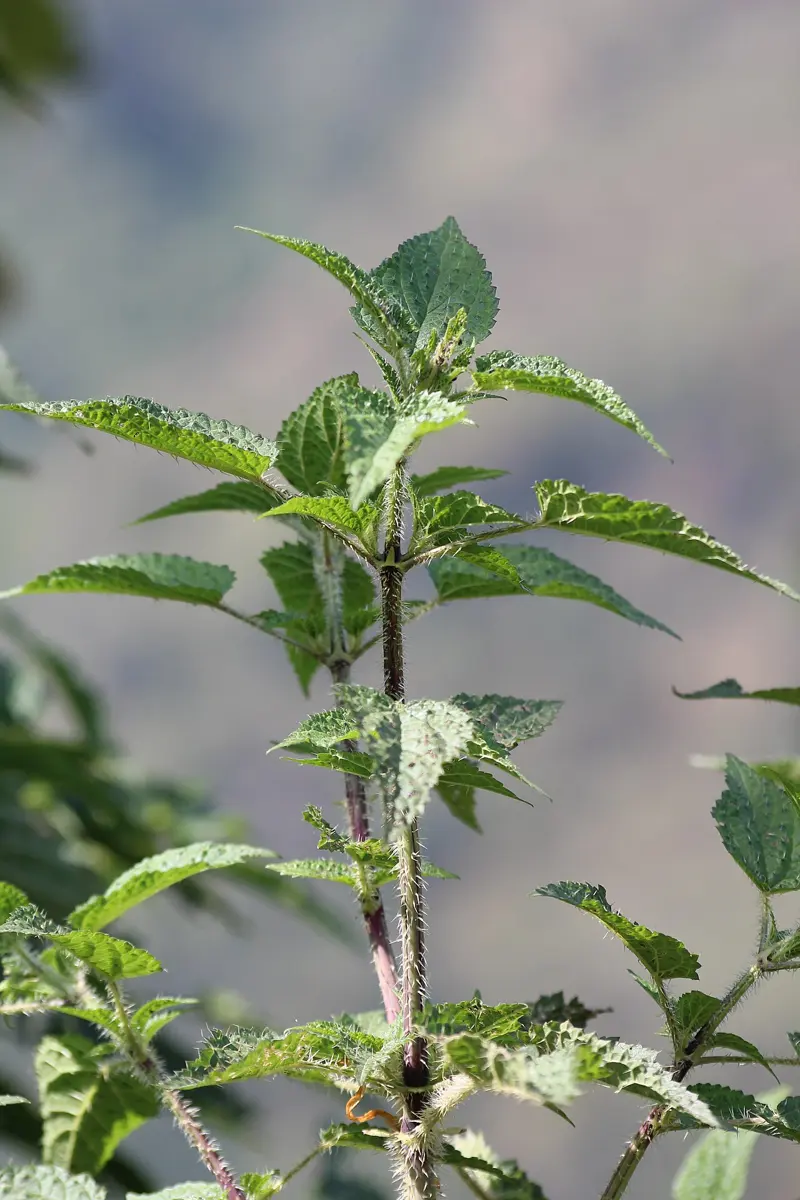
सिस्नो is a herb about half a meter to 2 meters tall. The Nepali dictionary describes it as a bush with sharp, white, soft “thorns” that prick and burn. Look for:
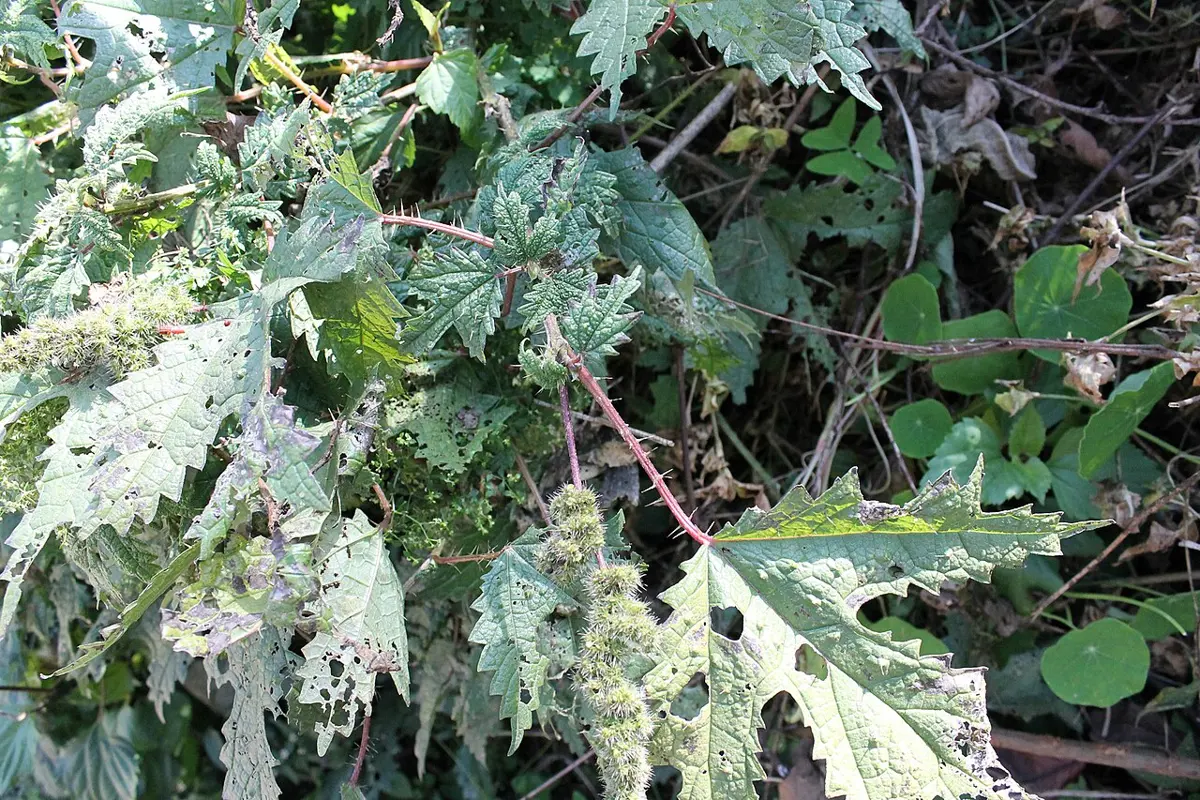
- the hairs: fine, stiff, white bristles all over the stem and both sides of the leaves; these are the stinging hairs;
- the stem: upright and square;
- the leaves: in opposite pairs up the stem, egg-shaped and pointed, with saw-toothed edges;
- the flowers: tiny, greenish, with no petals, in clusters where the leaves join the stem;
- the fruits: tiny flat seeds, each held inside the dry old flower.
Sources differ on when it flowers: March to July in one, June to November in a study in Lalitpur.
Which plant is सिस्नो?
सिस्नो is a name for several stinging plants of the same family (Urticaceae, the nettle family), not for one species:
- Urtica dioica, the common stinging nettle, found across Europe and Asia. This page is mostly about it.
- Urtica parviflora, another sisno of the hills; a food study in Dhankuta calls it the sisno most often eaten as a vegetable in Nepal.
- अल्लो (allo), also called पुवा (puwa) in the west of Nepal: Girardinia diversifolia, the Himalayan giant nettle, 1.5 to 3 meters tall. The dictionary calls it “a large kind of sisno” and लेकाली सिस्नो (lekali sisno, the sisno of the high hills).
There are more names, such as भाङ्ग्रे (bhangre), a sisno with big three- or four-cornered leaves in the dictionary. Which name goes with which species changes from place to place.
Where it grows
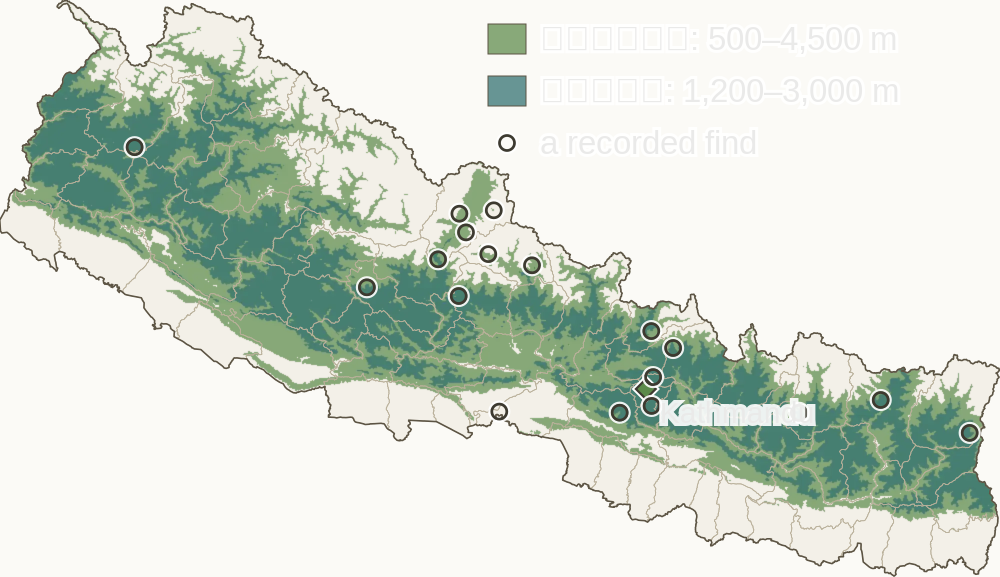
A study in Lalitpur gives the common सिस्नो as found throughout Nepal from about 500 to 4,500 meters, on waste and uncultivated land. It grows on wasteland, walls and hedges, by streams and in moist, disturbed ground. It even grows wild on the Institute of Forestry’s campus in Pokhara, at 750 to 915 meters. अल्लो grows in open forests and moist places by rivers, from about 1,200 to 3,000 meters.
How a hair injects a sting
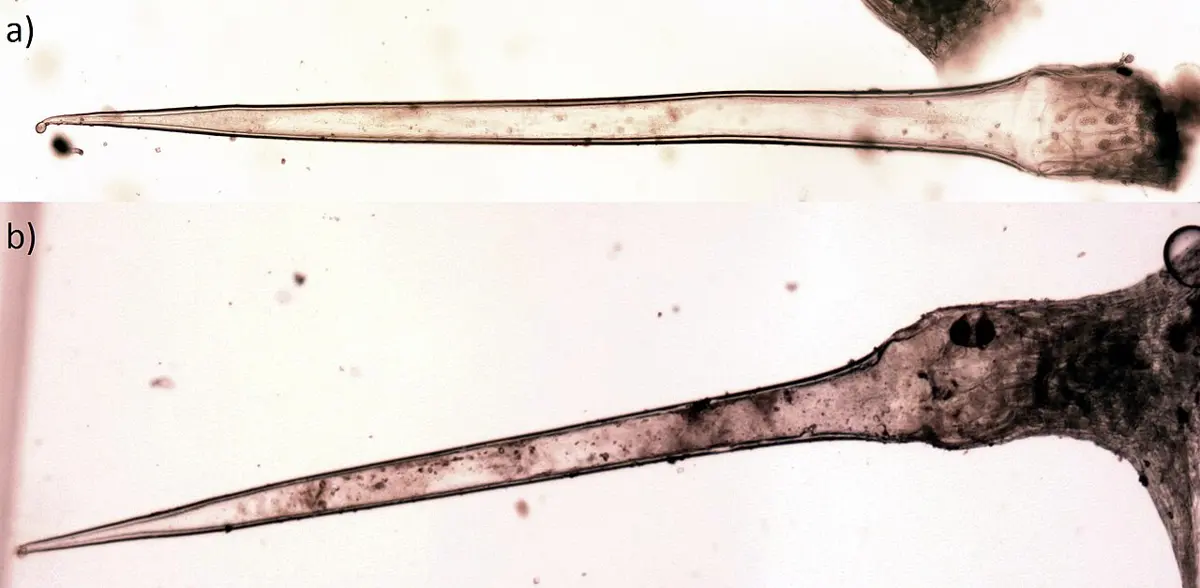
Under a microscope, each stinging hair turns out to be a single, very long cell, about 1.4 millimeters long in the common सिस्नो, filled with liquid. It works like a tiny injection needle:
- The needle: the hair’s wall is hardened with minerals. One study describes the hair as glass-like silica at its upper end and hardened with calcium lower down. The very tip is a small round knob.
- The snap: the tip has a weak place where it is made to break. When skin touches it, the knob snaps off, leaving a sharp, open point, like the end of a doctor’s needle.
- The push: the hair’s soft, swollen base sits in a cushion of cells. Pressing on the hair squeezes the base, and the liquid is pushed out through the needle into your skin.
Each hair holds about 4 nanoliters (4 billionths of a liter).
What is in the sting?
For a long time, books said the sting was formic acid, the acid of ant stings. That idea dates from 1849, and it was already shown wrong in 1886: there is far too little of it in the hairs. Yet it is still repeated.
What scientists have found instead:
- Histamine, acetylcholine and serotonin, found in nettle hairs in the 1940s and 1950s. These are chemicals our own bodies use as signals; histamine makes skin itch and swell into bumps.
- Oxalic acid and tartaric acid. In 2006, a team in Taiwan measured the liquid in the hairs of a nettle there (Urtica thunbergiana): each hair held about 21 nanograms of histamine, 5 of oxalic acid and 57 of tartaric acid. When they injected these into rats’ paws, the oxalic and tartaric acids caused pain that lasted, while histamine and acetylcholine on their own did not cause much pain. The team suggested that these acids, not histamine, cause the long-lasting burn.
- Potassium salts, found more recently in the common सिस्नो, which may add to the pain.
But a 2021 review of all stinging plants doubts the acid idea: in the authors’ own tests, no stinging-hair liquid was acidic enough for acids to be the main cause. It concludes that the story is still not complete: histamine explains some of the itch and swelling, but the known chemicals don’t explain everything a sting does.
From the field to the kitchen
In many parts of Nepal, सिस्नो is food. People pick only the tender top shoots and upper leaves, never the old leaves lower down, and cook them as a green, सिस्नोको साग (sisnoko saag), or as a soup. In the hills, people collect the shoots with bamboo or iron pincers so as not to touch them, and boil the plant with maize, millet or wheat flour, salt and chili into a kind of porridge. Newar families in the Kathmandu valley cook it as a vegetable too.
Why doesn’t the soup sting? Cooking destroys the hairs. A guide from Oregon State University’s extension service says that dipping nettles in boiling water for about two minutes, or drying them fully, makes them safe to eat. In Dhankuta, food scientists even turned sisno shoots into a dried, sour, fermented food like गुन्द्रुक (gundruk), so it can be eaten out of season.
From the forest to the loom
The stem of अल्लो holds long, strong, white fibers, and people of Nepal’s hills have spun and woven them for generations. A 2012 study in Sikles, a Gurung village in Kaski, described how:
- the plant is cut in the wild, and the green bark peeled off by hand; in the past villagers wrapped their hands in allo cloth, but 85% of households now use thick gloves or plastic;
- the bark is boiled to soften it, then spun on a wooden spinning wheel (100% of households used one);
- drying the plant for two or three days first weakens its sting;
- the yarn is woven into grain sacks, bags, mats, ropes, porters’ headbands and the भाङ्ग्रो (bhangro), a traditional Gurung garment; such products sold for about 8 to 19 US dollars.
The same study found a problem. All the fiber still comes from wild plants, and the patches near the village were being used up so fast that for more fiber people had to walk 3 to 4 hours to farther patches. None of the people asked knew whether the wild plants would last. (The common sisno is not threatened: the IUCN Red List rates Urtica dioica Least Concern; allo has not been assessed.)
Traditional uses
Studies of the herbs people use in Nepal record सिस्नो as:
- strips of the stem wound round a broken limb, together with another plant, in Kavrepalanchok;
- a remedy for fractures, in the far west;
- young twigs cooked and eaten as a tonic, and a paste for bone and muscle fractures, in Bhardew, Lalitpur;
- the root, for headache and jaundice, among Newars in Sindhupalchowk.
What science has tested
- Prostate trouble in older men (in herbal medicine nettle root is used for it, and the leaves for arthritis and allergies): nettle root, usually mixed with other herbs, has given some positive results in clinical trials. Some evidence, mostly for mixtures.
- Arthritis: trials of nettle put on the skin support it, but larger studies are needed. Some evidence, weak.
- Allergies and blood sugar: evidence is lacking or only preliminary.
- Fractures: no tests of sisno for healing bones were found.
See it at the Science Playground
Our exhibit Medicinal and Culinary Herbs of Nepal shows dried herbs and spices used in Nepal. More plants in Herbs of Nepal.
Where these facts come from
- Ensikat H.-J., Wessely H., Engeser M. and Weigend M., Distribution, ecology, chemistry and toxicology of plant stinging hairs, Toxins, 2021.
- Fu H.Y. et al., Identification of oxalic acid and tartaric acid as major persistent pain-inducing toxins in the stinging hairs of the nettle, Urtica thunbergiana, Annals of Botany, 2006.
- Gurung A. et al., Traditional knowledge of processing and use of the Himalayan giant nettle (Girardinia diversifolia) among the Gurungs of Sikles, Nepal, Ethnobotany Research & Applications, 2012.
- Joshi N., Ethnobotanical study of traditional food in Newar community of Kathmandu Valley, Central Nepal, Journal of Plant Resources (Department of Plant Resources), 2022.
- Silwal Gautam R., Joshi Shrestha S. and Shrestha I., Some ethnomedicinal plants of Bhardew village, Lalitpur District, Nepal, Patan Prospective Journal, 2022.
- Miya M.S. and Gautam D., Checklist of floral species at the Institute of Forestry, Pokhara Campus, Pokhara, Nepal, Forestry: Journal of Institute of Forestry, Nepal, 2021.
- Mishra A. and Kharel G.P., Preservation and quality evaluation of sisnu (Urtica parviflora) by making gundruk-like fermented product, Journal of Food Science and Technology Nepal, 2010.
- Bhusal K.K. et al., Nutritional and pharmacological importance of stinging nettle (Urtica dioica L.): a review, Heliyon, 2022.
- ICIMOD, Stinging nettle (Urtica dioica), Local Medicinal and Livelihood plants database, checked November 2026.
- Ambu G. et al., Traditional uses of medicinal plants by ethnic people in the Kavrepalanchok District, Central Nepal, Plants, 2020.
- Kunwar R.M. et al., Medicinal plants, traditional medicine, markets and management in far-west Nepal, Journal of Ethnobiology and Ethnomedicine, 2013.
- Gurung M., Ethnomedicinal study of plants used by Newar community in Sindhupalchowk District, Nepal, Journal of Plant Resources, 2023.
- Macy D. et al., Wild edibles: stinging nettle, Oregon State University Extension Service, 2022.
- Memorial Sloan Kettering Cancer Center, Nettle, About Herbs, updated 2023.
- NHS, Hives, checked November 2026.
- Urtica dioica: IUCN Red List category and Girardinia diversifolia, GBIF (from the IUCN Red List), checked November 2026.
- सिस्नो, अल्लो, पुवा and भाङ्ग्रे in the Nepali Brihat Shabdakosh (Nepal Academy).