
अदुवा: the hot root that isn’t a root
अदुवा · Zingiber officinale · A leafy herb of the ginger family, Zingiberaceae
On a cold morning, someone at home grates a thumb of अदुवा (aduwa, ginger) into the tea. In the evening it goes, crushed with garlic, into the tarkari. Bite a raw slice and your mouth burns.
That knobbly piece looks like a root, but it isn’t one. This page is about what it really is, how it grows, why dried ginger tastes different from fresh, what science has found, and why Nepal grows so much of it.
How to know it
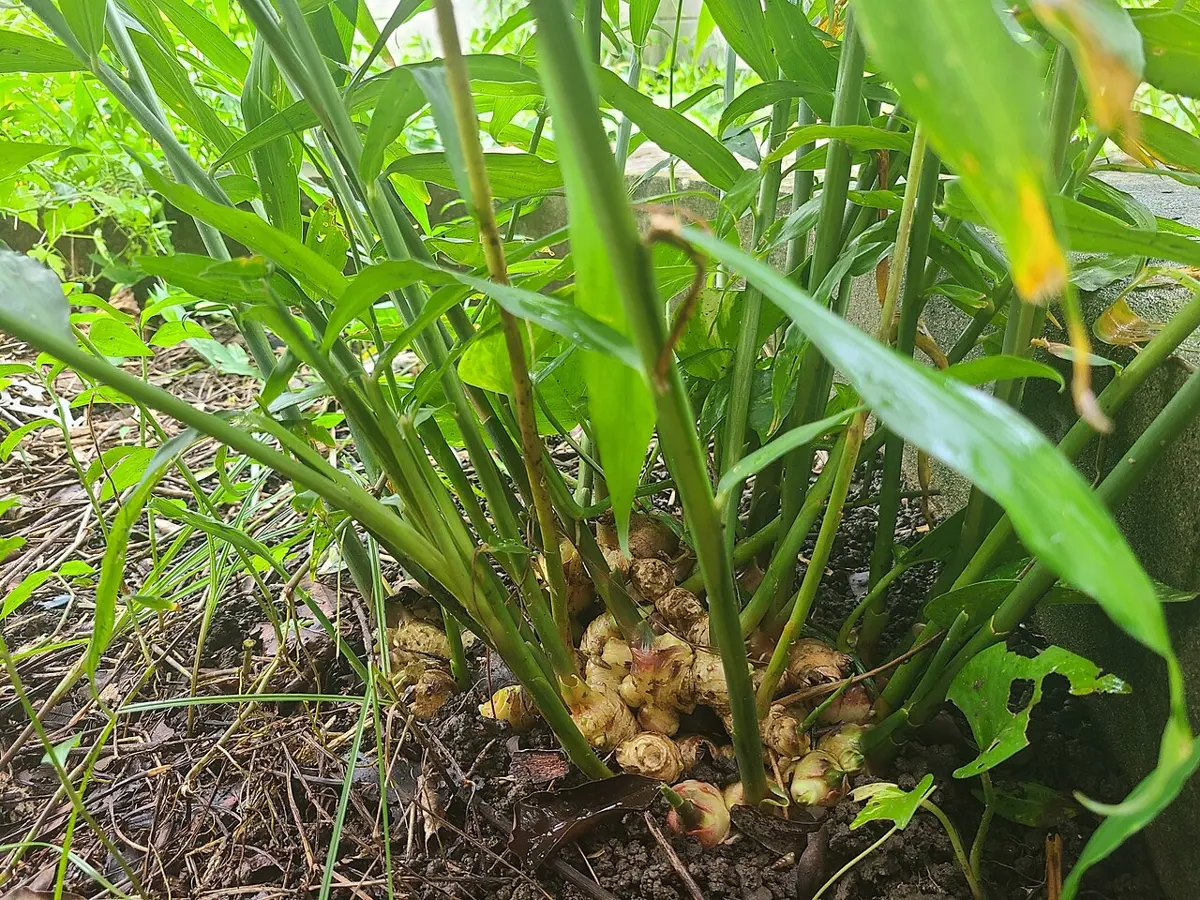
अदुवा is a leafy herb that grows in a clump of upright shoots. In a trial at Nepal’s Ginger Research Program at Kapurkot, Salyan, the plants grew to about 80 cm tall, with about ten shoots to a clump. Look for:
- the shoots: each looks like a stem, but botanists call it a pseudostem (“false stem”): the true stem is underground;
- the leaves: long, narrow and pointed;
- the part we eat: the pale, knobbly, branching piece in the soil, called a rhizome.
A ginger year
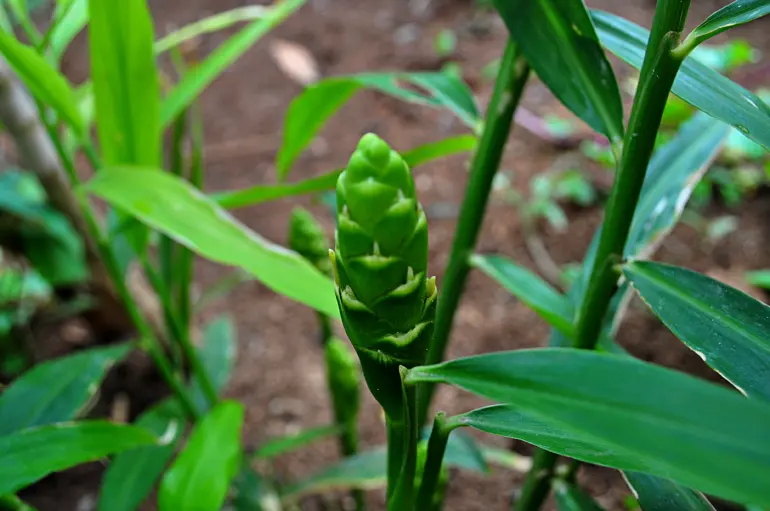
Farmers plant pieces of rhizome, called seed rhizomes, in spring. At Kapurkot, ginger was planted in the last week of March and dug up in the first week of December, nine months later, once the leaves and pseudostems had dried and fallen. Bigger seed pieces (60 to 80 grams) gave more ginger and fewer pests than small ones.
Ginger likes a warm, humid climate, about 21 to 32 °C and 1,500 to 2,000 mm of rain a year. But warm, humid weather with wet soil also suits its pests: the rhizome fly, and Pythium, a water mold that causes soft rot. In 2020, when the monsoon rain at Kapurkot topped 400 mm a month, more rhizomes were damaged and rotten.
Which plant is “aduwa”?
This page is about Zingiber officinale, the ginger of the kitchen, in the ginger family (Zingiberaceae), the same family as बेसार (turmeric). Fresh ginger is अदुवा; dried ginger is सुठो (sutho). In the Terai, Tharu speakers call ginger suntho.
Where it grows
In Nepal, the Ministry of Agriculture’s figures for 2078/79 (2021/22) give 22,441 hectares of ginger, producing 287,813 tonnes. Nepal’s Ginger Research Program, at Kapurkot in Salyan, has released two varieties for farmers, Kapurkot Aduwa-1 and Kapurkot Aduwa-2.
Fresh, dried, cooked: three tastes
Fresh अदुवा, dried सुठो and ginger cooked in a dish don’t taste quite the same. The reason is chemistry.
Ginger’s bite comes from chemicals of the kind called phenolic compounds. In fresh ginger, the main ones are the gingerols. When chemists measured fresh ginger, they found about 6 milligrams of 6-gingerol in every gram of dried-out ginger material, but less than a tenth of a milligram of a related chemical, 6-shogaol.
Heat and drying change that. A gingerol molecule can lose a molecule of water and become a shogaol: chemists call this a dehydration.
- Drying ginger raises the shogaols and lowers the gingerols.
- Moist heat made much more shogaol than dry heat in one experiment: most of all after six hours at 120 °C.
- Cooking also turns some gingerol into a third chemical, zingerone: after ginger was heated at 100 °C for ten minutes, its zingerone more than doubled.
So fresh ginger, सुठो and ginger cooked in a dish are, in chemistry, three slightly different spices.
Traditional uses
In Nepal, ginger is first a spice. In tradition it is also a home medicine. Studies of plant use record:
- in the Terai of Rupandehi, ginger juice given for cough, cold, fever, indigestion and constipation;
- across Bagmati Province, ginger eaten raw or in tea for cough, colds, sore throat, dysentery, indigestion and body pain, and to warm the body.
What science has tested
The United States’ National Center for Complementary and Integrative Health (NCCIH) sums up the trials of ginger (2025):
| Use | What the studies found |
|---|---|
| Nausea and vomiting in pregnancy | some evidence: research shows it may help |
| Nausea from cancer treatment | uncertain whether it adds anything to the usual medicines |
| Motion sickness (bus or car sickness) | most studies found it didn’t help |
| Nausea after surgery | unclear |
| Period pain | some research suggests it may reduce it |
So the best-tested use is nausea in pregnancy, and even there the evidence is “may help”, not a cure.
Nepal’s ginger trade
A 2025 study of the Kapurkot trials, citing the UN’s Food and Agriculture Organization (FAO), counts Nepal fourth among the world’s ginger growers, after India, Nigeria and China. About 40% of Nepal’s ginger is sold abroad, mainly to India, the same study says.
| Figure | Who gave it | |
|---|---|---|
| Ginger grown, 2078/79 (2021/22) | 287,813 tonnes | Ministry of Agriculture and Livestock Development |
| Ginger exported, 2078/79 (2021/22) | 11,958 tonnes, worth Rs 64 crore (641 million) | Ministry of Agriculture’s export table; the Kathmandu Post reported the same from the Trade and Export Promotion Centre |
| of which fresh ginger | 10,996 tonnes, worth Rs 36 crore | Ministry of Agriculture |
| of which सुठो | 423 tonnes, worth Rs 7.3 crore | Ministry of Agriculture |
| of which other ground ginger | 540 tonnes, worth Rs 20.6 crore | Ministry of Agriculture |
| Ginger exported, first 11 months of 2079/80 (2022/23) | 21,098 tonnes, worth Rs 99.8 crore | the Trade and Export Promotion Centre, as reported by the Kathmandu Post |
Prices swing wildly, the Kathmandu Post reported in 2023. In 2016/17 ginger fell to Rs 10 to 15 a kilogram, and some farmers dumped their harvest. In 2023 India’s harvest was poor: a farmer in Dhankuta who had sold at Rs 40 a kilogram the year before saw the price soar to Rs 250.
Ginger prices in Nepal often crash in a good year. Which would help a farmer most when fresh ginger is selling for Rs 15 a kilogram?
Pick an answer to see why.
See it at the Science Playground
Our exhibit Medicinal and Culinary Herbs of Nepal shows dried herbs and spices used in Nepal. Look for the buds on a piece of ginger at home: they show it is a stem. More plants in Herbs of Nepal.
Where these facts come from
- Ministry of Agriculture and Livestock Development, Statistical Information on Nepalese Agriculture 2078/79 (2021/22), Government of Nepal, 2023 (Tables 1.4, 2.13 and 11.1).
- Menyangbo P., Ginger prices soar on low output in India, The Kathmandu Post, 3 July 2023 (export figures from the Trade and Export Promotion Centre).
- Gautam J., Ginger rhizome fly management by planting appropriate seed rhizome size and suitable variety, Journal of Agriculture and Forestry University, 2025.
- Zagórska J. et al., Impact of thermal processing on the composition of secondary metabolites of ginger rhizome: a review, Foods, 2022.
- Jung M.Y. et al., Heat-induced conversion of gingerols to shogaols in ginger as affected by heat type, sample type, temperature and time, Food Science and Biotechnology, 2017.
- National Center for Complementary and Integrative Health, Ginger, updated February 2025.
- Singh A.G., Kumar A. and Tewari D.D., An ethnobotanical survey of medicinal plants used in Terai forest of western Nepal, Journal of Ethnobiology and Ethnomedicine, 2012.
- Subedi D. et al., Current outlook of ethnobotany in Bagmati Province, central Nepal, Journal of Plant Resources (Department of Plant Resources), 2025.
- अदुवा and सुठो in the Nepali Brihat Shabdakosh (Nepal Academy).