
हर्रो: the fruit that names a taste
हर्रो · Terminalia chebula · A deciduous tree of the Combretaceae family
Ayurveda counts six tastes, छ रस (chha ras). For one of them, English has no everyday word, but Nepali does: टर्रो (tarro). Open the Nepali Brihat Shabdakosh and it explains टर्रो as the taste found in हर्रो, in an unripe हलुवाबेद (haluwabed, persimmon) and in similar fruits: the taste Sanskrit calls कषाय (kashaya). English calls it astringent: the dry, rough, puckering feeling that makes your tongue stick to the roof of your mouth.
So हर्रो (harro) is the fruit a whole taste is measured by. This page is about the tree it grows on, what that taste is, and why the Tibetan doctors of the Himalaya call it a king.
How to know it
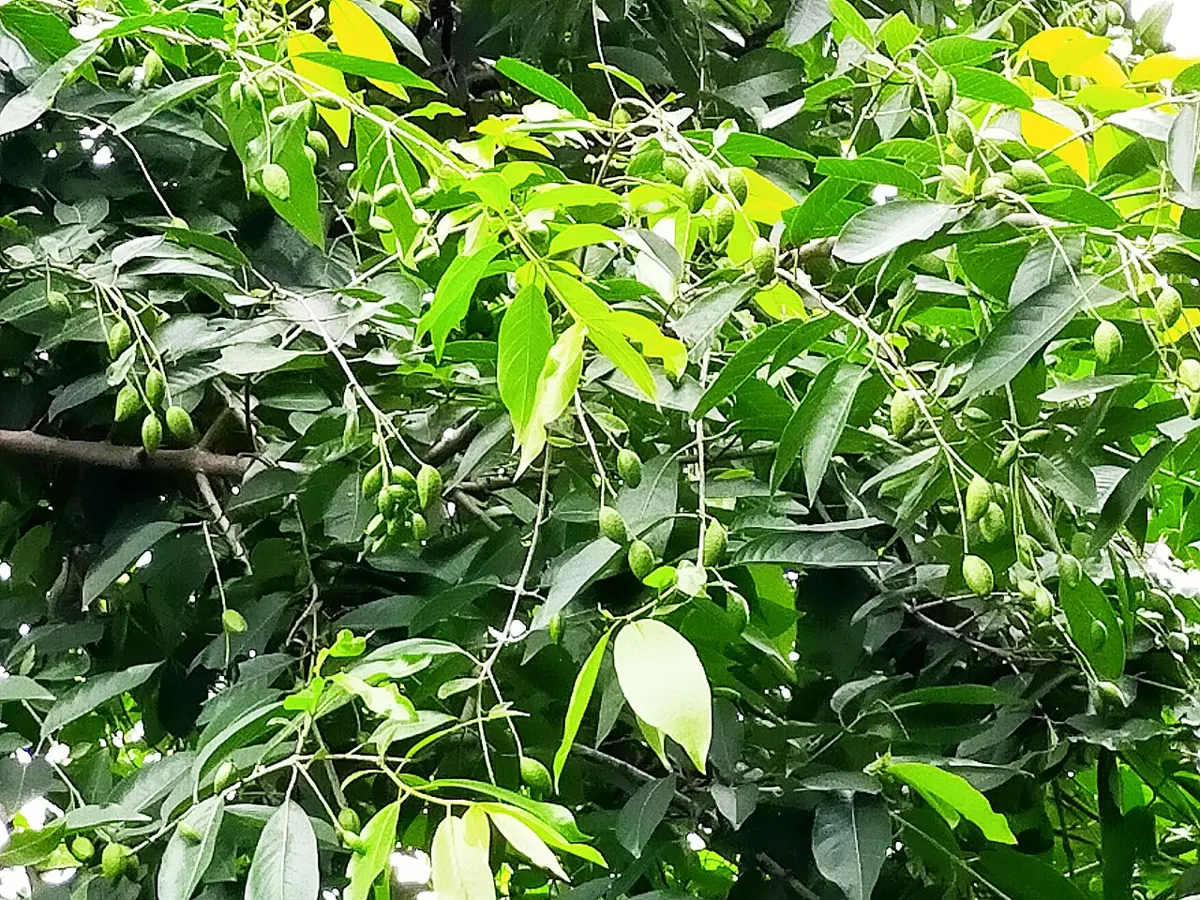
हर्रो is a tall or medium-sized deciduous tree, about 15 to 25 meters (50 to 80 feet) tall. Look for:
- the bark: dark brown, with cracks running up and down it;
- young branches covered in rusty brown hairs;
- the leaves: oblong to oval, with two large glands at the top of the leaf stalk;
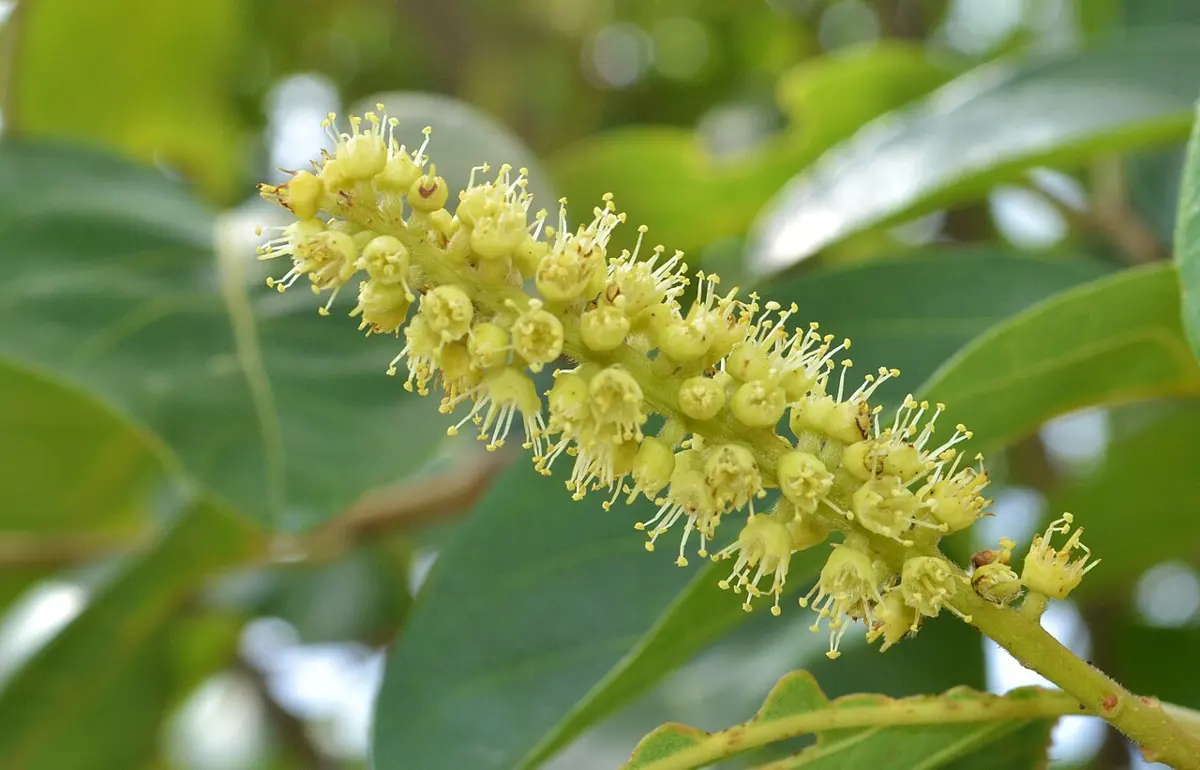
- the flowers: small, dull white to yellowish, without stalks, in spikes at the ends of the twigs, with an unpleasant smell; they come in May and June;
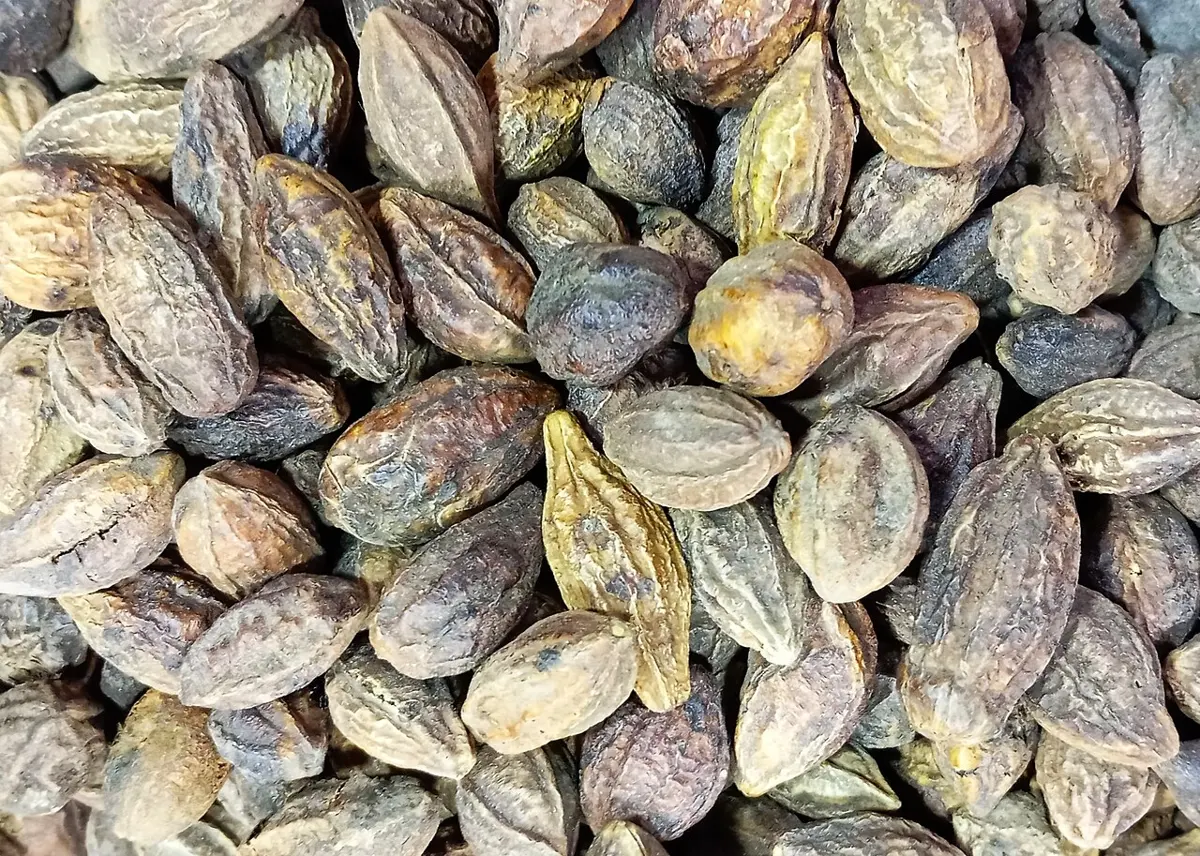
- the fruit: about 2.5 to 5 cm long, green when unripe and yellowish gray when ripe, thick and hard, with five ribs along it. The dictionary describes it as shaped like a dried date, a छोहोरा (chhohara). Fruits form from July to December.
Where it grows
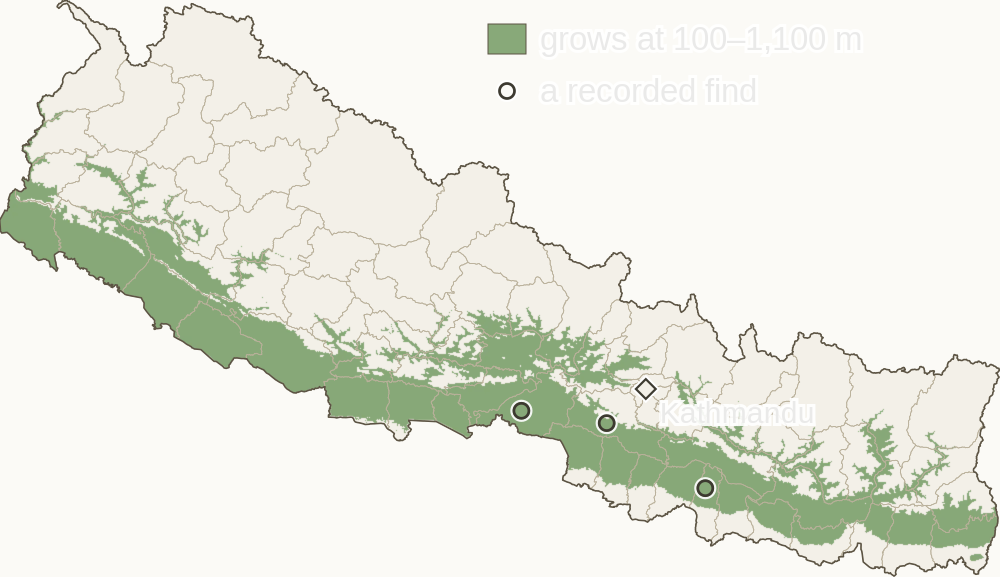
Nepal’s national register of medicinal plants records हर्रो from about 100 to 1,100 meters, in the west, center and east. Across the Himalaya it grows along the foothills, from the Ravi river in Punjab east to Assam, and up to about 1,500 meters. In Rupandehi, in the Terai, it is a cultivated tree.
Why your mouth puckers
The fruit is rich in tannins: about 32 to 34% of it, depending on where it grew. They belong to a group called hydrolysable tannins, and include gallic acid, chebulagic acid, punicalagin and ellagic acid.
Tannins are what you taste as astringency. Scientists define it as a drying and puckering feeling in the mouth, and they have worked out where it comes from:
- Your saliva contains special proteins, the proline-rich proteins, long and floppy, with many places tannins can grab.
- Tannins bind to these proteins and clump them together.
- The clumps take away saliva’s slipperiness: friction in the mouth goes up, and the tongue feels rough and dry.
So astringency is a feeling of friction: your mouth notices its own saliva stop working as a lubricant.
Tannins also tan leather, turning animal skin into leather. The bark of अमला has long been used for tanning together with the “myrobalans”, the fruits of Terminalia trees such as हर्रो and बर्रो.
The king of medicines
In Tibet, हर्रो is called the ”King of Medicine”, and in Ayurveda’s lists of medicines it always comes first. In Tibetan Buddhist art you can see why.
Traditional uses
Studies of the herbs people use in Nepal record हर्रो as:
- fruits for cough, colds, breathing troubles, fever, indigestion and stomach problems, and the bark chewed for urinary problems, in Rupandehi (a use first recorded in that study);
- in the national register, fruits that are astringent, laxative and good for coughs, a fine powder for decayed teeth and bleeding gums, and bark used on ulcers, wounds and burns.
The Ayurvedic name is हरीतकी (haritaki). Its best-known use is in त्रिफला.
त्रिफला: three fruits
त्रिफला (triphala) means “three fruits” (त्रि, three; फल, fruit). It is a powder of the dried fruits of हर्रो, बर्रो and अमला, usually in equal parts. In Ayurveda it is a laxative, and a purgative (strongly emptying the bowels) at high doses. It is also made into mouthwashes.
What science has tested:
- As a mouthwash: a 2020 systematic review collected seven trials with 1,270 people that compared a त्रिफला mouth rinse with chlorhexidine, a standard medical mouthwash, for plaque and gum inflammation. In all seven, त्रिफला did as well as chlorhexidine. But none of the trials was at low risk of bias, most lasted four weeks or less, and they measured things differently. Some evidence, from short and imperfect trials.
- For constipation: reviews report a few short trials in people with constipation, which found more frequent, easier stools; they give few details of how the trials were done. Some evidence, but thin.
- Everything else (blood sugar, weight, infections, the liver): mostly laboratory and animal studies, with a few small human ones. Not enough to know.
Trade and protection
Herb traders in Nepal buy the dried fruit: the March 2026 buyers’ prices for all three fruits of त्रिफला are on the बर्रो page. The IUCN Red List rates हर्रो Least Concern: not threatened.
See it at the Science Playground
हर्रो doesn’t grow in our garden yet, but its two partners do: अमला and बर्रो, in the healing plants. Our exhibit Medicinal and Culinary Herbs of Nepal shows dried herbs and spices used in Nepal. More plants in Herbs of Nepal.
Where these facts come from
- IUCN Nepal, National Register of Medicinal and Aromatic Plants (revised and updated), 2004: Harro, page 86.
- Bag A., Bhattacharyya S.K. and Chattopadhyay R.R., The development of Terminalia chebula Retz. (Combretaceae) in clinical research, Asian Pacific Journal of Tropical Biomedicine, 2013.
- McRae J.M. and Kennedy J.A., Wine and grape tannin interactions with salivary proteins and their impact on astringency: a review of current research, Molecules, 2011.
- Orwa C. et al., Emblica officinalis, Agroforestree Database 4.0, World Agroforestry Centre, 2009.
- Singh S., Bhatia A.K., Sharma K. and Sharma D., A review on Terminalia chebula Retz. (Harar): an important multipurpose tree, International Journal of Economic Plants, 2020.
- Rubin Museum of Art, Medicine Buddha, Project Himalayan Art.
- Watt J., Buddhist deity: Medicine Buddha iconography, Himalayan Art Resources, 2007, updated 2019.
- Singh A.G., Kumar A. and Tewari D.D., An ethnobotanical survey of medicinal plants used in Terai forest of western Nepal, Journal of Ethnobiology and Ethnomedicine, 2012.
- Peterson C.T., Denniston K. and Chopra D., Therapeutic uses of Triphala in Ayurvedic medicine, Journal of Alternative and Complementary Medicine, 2017.
- Richards D., Triphala mouthwash for plaque-induced gingivitis, The Dental Elf, 2020, on AlJameel A.H. and Almalki S.A., International Journal of Dental Hygiene, 2020.
- Terminalia chebula: IUCN Red List category, GBIF (from the IUCN Red List), checked November 2026.
- हर्रो and टर्रो in the Nepali Brihat Shabdakosh (Nepal Academy).