
टिमुर: the spice that makes your lips buzz
टिमुर · Zanthoxylum armatum · A thorny shrub of the citrus family
Bite into a piece of टिमुरको अचार, or a potato fried with टिमुर, and a few seconds later something strange happens: your lips and tongue start to tingle and buzz, almost as if a tiny phone were vibrating in your mouth. Chili burns; black pepper bites; टिमुर (timur) buzzes.
This page is about the shrub behind that buzz: how to know it, where it grows, what the tingle is, what tradition uses it for, and why its little red fruits are worth so much to farmers in Nepal’s hills.
How to know it
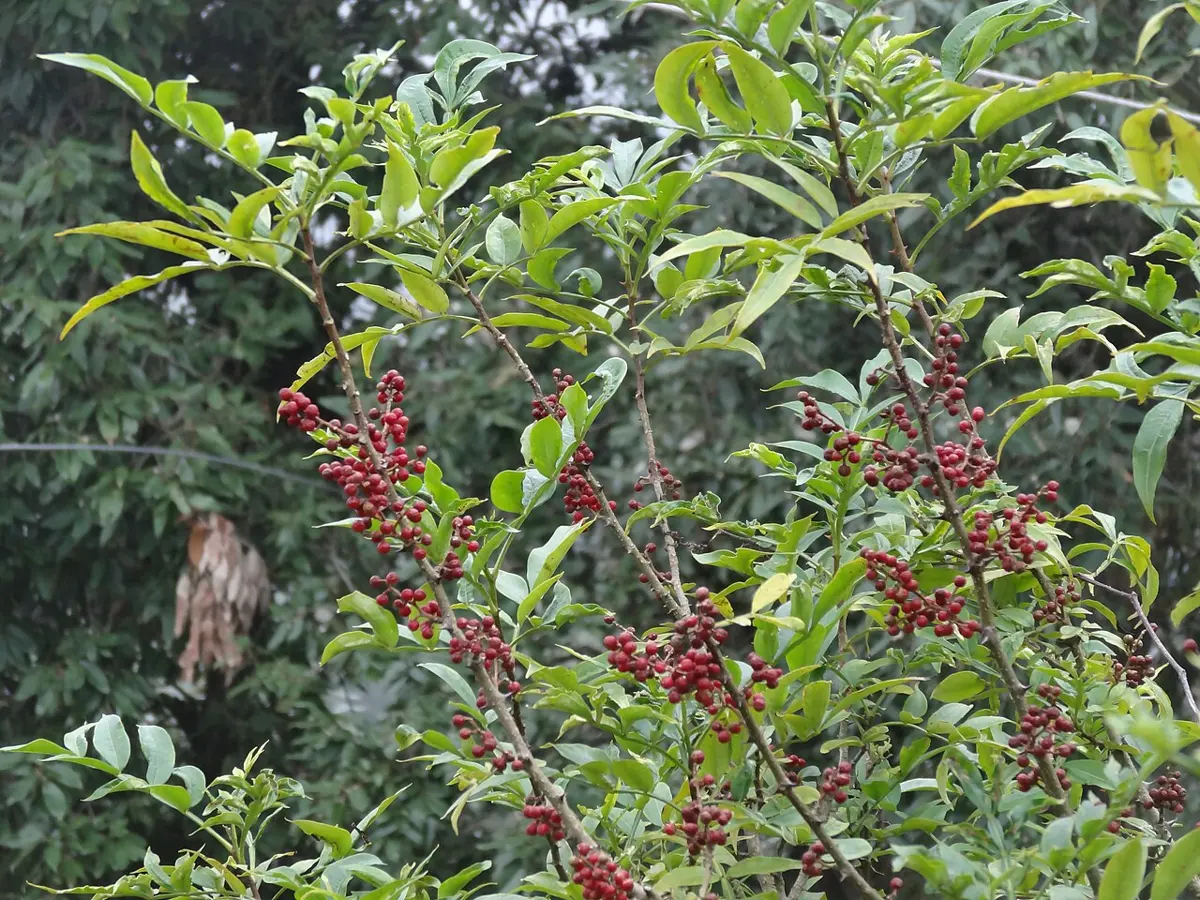
टिमुर is a shrub or small tree, up to about 5 meters tall. Look for:
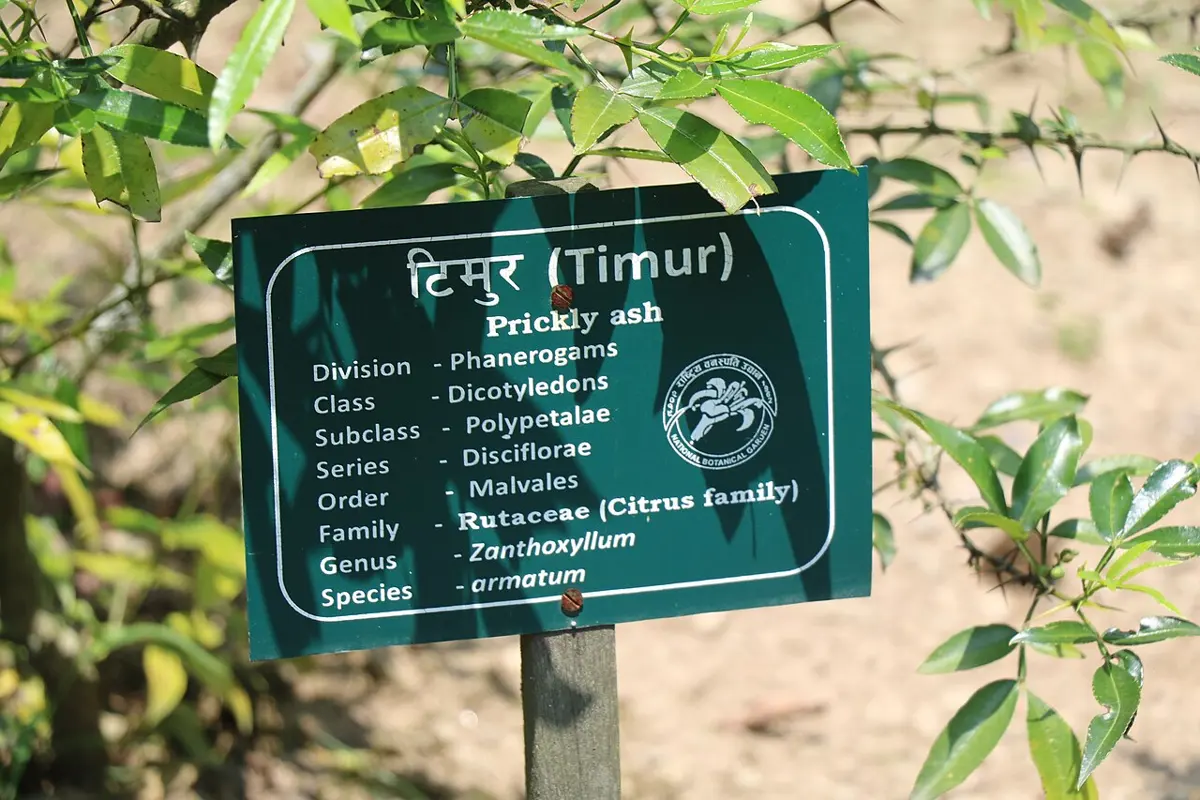
- thorns: many long, straight spines on the young branches and even on the leaf stalks (careful when you pick!);
- the leaves: each leaf is made of 2 to 6 pairs of leaflets on a stalk with a narrow “wing” along each side; the leaflets are narrow, about 8 cm long, finely toothed and dotted with tiny oil glands;
- the flowers: very small, about 1 mm, greenish or yellow, in short clusters, in April and May;
- the fruits: tiny round capsules 3 to 4 mm across, red and wrinkled when ripe, from July to November; each opens to show a shiny black seed.
The branches, leaves, fruits and seeds all smell strongly when crushed.
Where it grows
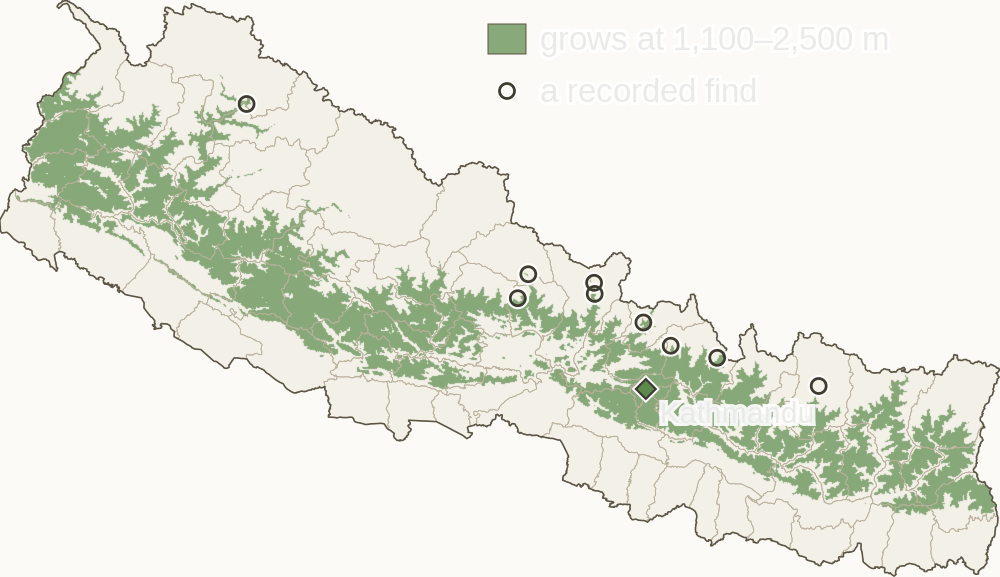
Nepal has eight species of Zanthoxylum, and टिमुर is the one most used and traded. It grows wild in more than 30 districts, from about 1,100 to 2,500 meters. Rolpa, Rukum, Salyan, Pyuthan, Dang, Surkhet, Gulmi, Baglung and Jajarkot are its heartland.
It likes cleared forest, worn-out slopes and the edges of fields, in light shade. It copes with poor and acid soil, and in fact grows better on farmland and waste ground than in thick forest. Its weak point is hail and storms while it flowers.
Why it tingles
The buzz comes from a group of chemicals in the fruit called sanshools. Tests of how people feel them point to one above all: hydroxy-alpha-sanshool.
In 2008, a team of scientists found how it works. Our skin and tongue have nerve cells that sense touch and nerve cells that sense pain and heat. Hydroxy-alpha-sanshool switches both kinds on, in an unusual way: it blocks some of the tiny “potassium channels” that normally keep these nerve cells calm, so they start firing by themselves.
In 2013, another team asked a simple question: if the tingle feels like a vibration, how fast is it? Volunteers put Sichuan pepper (from timur’s genus, Zanthoxylum) on their lower lip, then compared the tingle with a vibrating rod touched to a finger, turning its speed up and down until the two matched. The answer, again and again, was about 50 vibrations a second (50 Hz): just the speed that one kind of touch nerve in the skin is tuned to. When those touch nerves were first tired out by a long vibration, the pepper’s tingle felt slower. So the spice “talks” to the same nerves as real shaking.
Traditional uses
In Nepal the fruits are first of all a spice and a pickle. Studies of the herbs people use in different districts record टिमुर as:
- a remedy for toothache, the most common use in the far west;
- crushed or pickled fruits for stomach ache and indigestion, in Rasuwa;
- a home medicine for coughs and colds, tonsillitis, headache, fever, altitude sickness, dizziness and diarrhea.
The same idea appears far from Nepal. In the folk medicine of several countries, Zanthoxylum shrubs are called ”toothache trees”, because they numb the mouth.
The oil from the dried fruits, sold as Zanthoxylum oil, goes into medicines, flavors and perfumes; in Nepal it is used in toothpastes and a well-known balm.
What science has tested
- The tingle and numbness: well studied. Scientists know which chemical causes it and which nerves it acts on (above). That explains why people used टिमुर for toothache, but numbing the pain is not the same as treating the tooth.
- Health effects of the plant: extracts of the leaves, bark and fruit have been tested in the laboratory and in animals: for example, a bark extract lowered blood sugar in diabetic rats, and leaf and fruit extracts protected rats’ livers from damage. A review of the Zanthoxylum research found no trials in people.
- How strong the evidence is: not tested in people as a medicine. Enjoy it as a spice.
Trade: from the hills to India
Much of the timur trade starts with families who pick the fruit from wild shrubs and from their own fields. A government study of the timur trade (2013) described the chain:
- collectors and farmers sell to village traders, who sell to district and then regional traders in places like Nepalgunj;
- some of the fruit is exported raw to India; some is distilled into oil, near where it grows;
- more than 90% of Nepal’s timur is exported, and about 90% of the oil goes to India.
Prices, from the same study:
| Price | |
|---|---|
| Timur with seed, average for the year, 2007 | Rs 44 a kilogram |
| Timur with seed, September 2013 | Rs 210 a kilogram |
| What collectors were paid, December 2013 | about Rs 150 a kilogram |
| Zanthoxylum oil, 2013 | about Rs 6,500 a kilogram |
The dried fruit gives up to 6% of its weight as oil, usually 4 to 5% in a factory.
Picking it well
टिमुर is not a threatened plant worldwide (the IUCN Red List rates it Least Concern), but over-harvesting has been seen as a threat to it in the far west, and the way it is picked matters for the next year’s crop:
- some collectors cut off whole branches to strip the fruit, which means fewer fruits in later years;
- fruit picked too early grows mold as it dries and loses weight;
- twigs, thorns, stalks and dust mixed into the fruit lower its price.
Because it grows well on farmland, it is also planted, on private land and in community forests, and the government royalty on wild timur is waived for planted timur.
A family wants the best price for their timur this year and a good crop next year. What should they do?
Pick an answer to see why.
See it at the Science Playground
टिमुर grows in our garden, in One Family: Citrus: look for the thorns, crush a leaf and smell it. Our exhibit Medicinal and Culinary Herbs of Nepal shows dried herbs and spices used in Nepal. More plants in Herbs of Nepal.
Where these facts come from
- Department of Forests (Ministry of Forests and Soil Conservation), Timur value chain study, Panchase area, Ecosystem based Adaptation in Mountain Ecosystems in Nepal project, 2013.
- Bautista D.M. et al., Pungent agents from Szechuan peppers excite sensory neurons by inhibiting two-pore potassium channels, Nature Neuroscience, 2008.
- Hagura N., Barber H. and Haggard P., Food vibrations: Asian spice sets lips trembling, Proceedings of the Royal Society B, 2013.
- Okagu I.U. et al., Zanthoxylum species: a comprehensive review of traditional uses, phytochemistry, pharmacological and nutraceutical applications, Molecules, 2021.
- Kunwar R.M. et al., Medicinal plants, traditional medicine, markets and management in far-west Nepal, Journal of Ethnobiology and Ethnomedicine, 2013.
- Uprety Y. et al., Indigenous use and bio-efficacy of medicinal plants in the Rasuwa District, Central Nepal, Journal of Ethnobiology and Ethnomedicine, 2010.
- Zanthoxylum armatum: IUCN Red List category, GBIF (from the IUCN Red List), checked October 2026.
- टिमुर in the Nepali Brihat Shabdakosh (Nepal Academy).