
Think about your morning. The sun’s light lets you see the path to school, and its heat dries the clothes on the line. Your mother cooks dal bhat on an LP gas stove or a fire. A drum at a festival fills the street with sound. A light bulb, a phone charger and a television all run on electricity. Your own legs carry you up the hill because of the food you ate.
All of these use energy. Energy makes things move, warm up, light up and make sounds. Without it, nothing at all would happen.
In this unit you will find out where our energy comes from and how to save it (7.1), what heat and temperature are and how a thermometer works (7.2), how waves carry energy without carrying water or air along (7.3), and how light bounces off a mirror (7.4).
7.1 Energy
Look at people digging a field, carrying a heavy doko up a slope, or running a race. What does their body need for this? It needs energy. And what runs a bus, a plane or a factory machine? Energy again, from diesel, petrol, kerosene, coal or electricity.
Energy is the capacity (ability) to do work. Anything that can push, pull, lift, heat, light up or make a sound has energy. We measure energy in joules (J).
We get our energy from the food we eat. Food comes from plants and animals, and plants make food using sunlight. So the energy in your dal bhat first came from the sun.
A porter carries a 30 kg load from Lukla up to Namche. Where does the energy for his climb come from?
Pick an answer to see why.
Renewable and non-renewable sources of energy
What is used to cook food in your home? Most homes in Nepal use one of these: firewood, biogas (gobar gas), LP gas (liquefied petroleum gas, the gas in the red or blue cylinder), or an electric heater or induction stove. Where do they come from?
- Firewood comes from trees in forests.
- Electricity in Nepal comes mostly from the energy of flowing water: this is hydroelectricity (“hydro” means water).
- LP gas is separated out when crude oil from deep under the ground is refined (cleaned and split into parts). Nepal buys all of its LP gas, petrol, diesel and kerosene from other countries.
- Biogas is made from cow dung that rots in a closed tank.
We also need energy to run vehicles, to keep warm in winter, to dry grain, and to run tools and machines at a building site.
A substance or thing from which we get energy is called a source of energy. Firewood, biogas, coal, LP gas, petrol and diesel, flowing water, wind and the sun are all sources of energy.
Some sources are made again by nature in a short time after we use them. These are renewable sources of energy. Sunlight comes back every morning; rivers keep flowing because rain and snow keep filling them; cattle make fresh dung every day; new trees can grow in place of the ones we cut. Solar energy, wind energy, hydroelectricity, biogas (gobar gas) and firewood are renewable. Because they don’t run out, we should use them as much as we can.
Other sources take millions of years to form. Once we use them up, nature can’t make more in our lifetime. These are non-renewable sources of energy. The more we use them, the less is left, and one day they may run out. Coal, petrol, diesel, kerosene, LP gas and natural gas are non-renewable. So is nuclear energy, which comes from a rare metal called uranium, dug from mines.
Try sorting some sources yourself.
Which of these is a renewable source of energy?
Pick an answer to see why.
Fossil fuel
Most vehicles today run on diesel or petrol. Trains and factory machines can be run by the heat from burning coal. Have you ever wondered how petrol, diesel, kerosene and coal were made?
Long, long ago, great swampy forests grew on the land, and the seas were full of tiny living things (plankton, smaller than a grain of sand). When they died, they were buried under thick layers of mud and sand. Changes in the Earth’s surface pushed these layers deeper and deeper. Over millions of years, the great pressure (squeezing) and heat deep underground slowly changed them:
- the buried plants of the swamp forests became coal;
- the buried tiny sea creatures and plants became crude oil (mineral oil, also called petroleum) and natural gas.
The remains of living things from long ago are called fossils. So fuels made from them, coal, crude oil and natural gas, are called fossil fuels. Petrol, diesel, kerosene and LP gas are all made from crude oil, so they are fossil fuels too.
Advantages of fossil fuels
- Fossil fuels are easy to get compared with many other sources: there are petrol pumps and gas depots everywhere.
- They can be carried easily from one place to another, in tankers, pipes and cylinders.
- They have many uses. They run vehicles, generators and factories, and cook food.
- They give a very large amount of heat when burnt, so industries and factories use them a lot.
Disadvantages of fossil fuels
- We are using them up fast, and nature can’t make more in time. One day they may run out.
- Burning them pollutes the environment. The smoke has harmful gases and soot that make the air dirty and cause breathing diseases, and the carbon dioxide they give off traps heat and warms the whole Earth.
Why are coal and petroleum called fossil fuels?
Pick an answer to see why.
Alternative energy
A source of energy that we use instead of non-renewable fuels, to use less of them, is called alternative energy. In Nepal, the main alternative sources are hydroelectricity, solar energy and gobar gas (biogas).
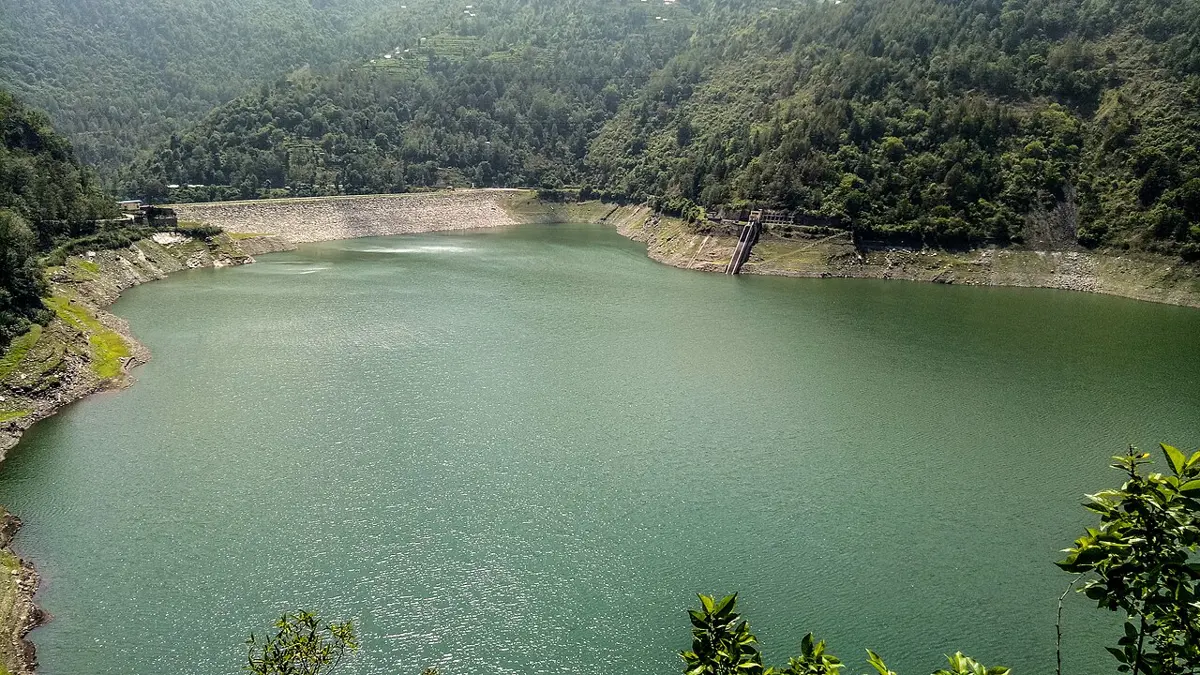
- Hydroelectricity. Nepal’s rivers rush down from the Himalaya. Their water turns turbines, which turn generators that make electricity. Almost all of Nepal’s electricity is hydroelectricity, and in the rainy season Nepal even sells some to India.
- Gobar gas (biogas). Nepal is an agricultural country. Many families keep cattle for farming, milk and ghee. Their dung (gobar) is mixed with water in a closed underground tank. Without air, tiny living things (bacteria) break it down and give off a gas that burns with a clean blue flame: biogas, used for cooking. What is left is good manure for the fields.
- Solar energy. In remote, hilly places where power lines are hard to bring, a solar panel can give a home electricity for lights, a radio and a phone charger. Solar water heaters on roofs in towns heat water for bathing.
For Nepal’s land and way of life, solar energy and gobar gas are some of the best alternative sources for villages, and hydroelectricity for the whole country. To help people use them, the Government of Nepal gives a subsidy (pays part of the cost) for building biogas plants and putting up solar panels.
Biofuel and geothermal energy
Fuels made from things that were alive recently, not millions of years ago, are called biofuels. Firewood, dried dung cakes, biogas and oil pressed from plant seeds are biofuels. They are renewable, because new plants grow and animals make new dung.
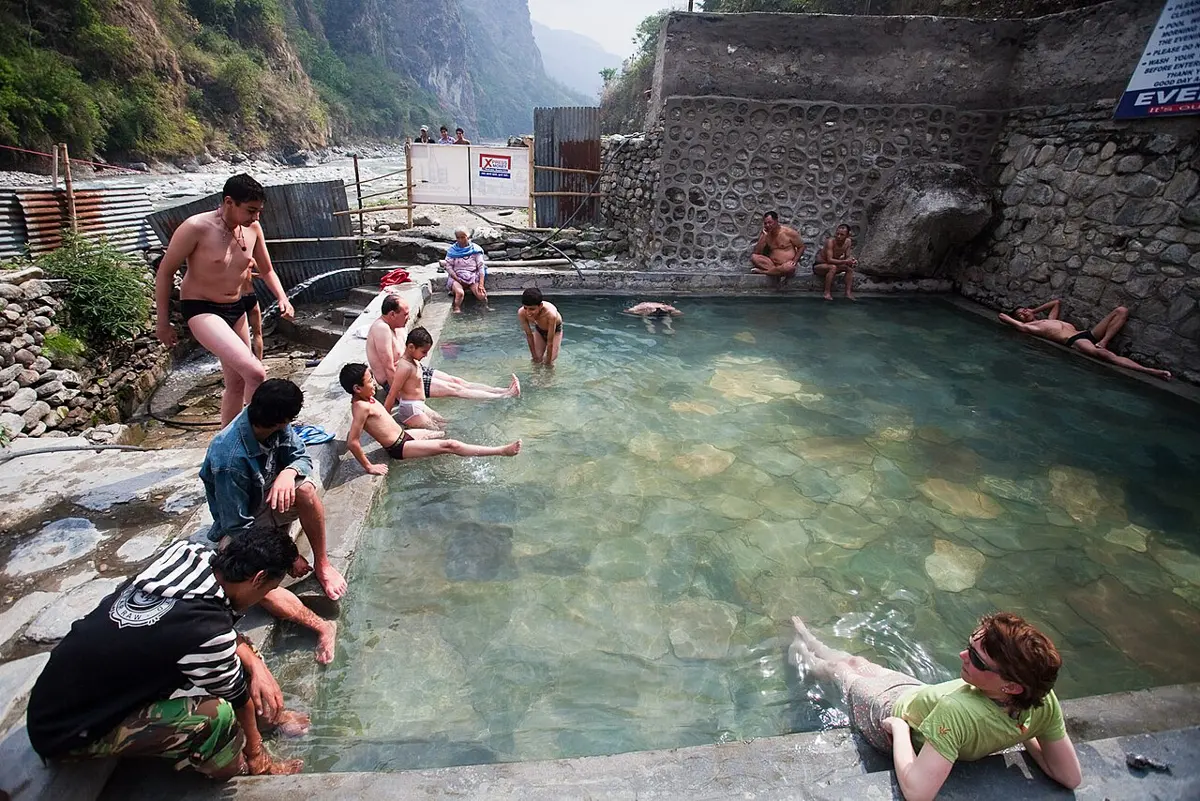
Deep inside the Earth it is very hot. In some places this heat comes up to the surface and warms the underground water. The heat energy from inside the Earth is called geothermal energy (“geo” means Earth, “thermal” means heat). Nepal has many hot springs, called tatopani, for example in Myagdi and Sindhupalchok, where people bathe in naturally hot water. Countries such as Iceland use geothermal heat to make electricity and to warm their houses. It is a renewable source.
Why is hydroelectricity called an alternative source of energy?
Pick an answer to see why.
Ways of saving energy
All over the world, people use more and more fossil fuel every year. If we keep using non-renewable sources this fast, there will not be enough energy for everyone in the near future. A shortage of energy, caused by using too much non-renewable energy, is called an energy crisis.
To avoid an energy crisis, we must conserve (save) energy. Using energy carefully and wisely, without wasting it, is called conservation of energy.
These steps can reduce the energy crisis in Nepal:
- Avoid using energy when it isn’t needed: switch off lights, fans and the TV when you leave a room.
- Nepal is an agricultural country: build more gobar gas plants, especially in remote villages.
- Make more hydroelectricity, and use it to cook food, run electric vehicles and do other work.
- Use electricity from solar panels for many purposes.
- Use alternative sources of energy instead of crude oil, coal and natural gas.
- Run public awareness programs so that people learn the ways to save energy.
Which of these saves energy?
Pick an answer to see why.
7.2 Heat and temperature
What do we need to dry grain and clothes, and to cook food? We need heat. Where does it come from?
The sun is our main source of heat. Its heat dries clothes, firewood and grain spread on a mat; it warms us in winter; and it dries sea water to leave behind salt. We also get heat from burning firewood and fossil fuels, and from electric heaters.
Heat is a form of energy that gives us the feeling of warmth. Like all energy, heat is measured in joules (J), the SI unit of heat. When we give heat to an object, its temperature rises.
Temperature
Three glasses stand on a table. One has lukewarm water, one has tap water, and one has very cold water. Can you tell which is which just by touching them? Easily.
Now try three glasses of lukewarm water, warmer water, and water that was boiled a little while ago. All three feel hot. It is hard to put them in order by touch, but their degree of hotness is different.
The degree of hotness or coldness of an object is called its temperature. Water with a higher degree of hotness has a higher temperature.
What makes hot water hot? Water, like everything, is made of tiny molecules, far too small to see. They are never still: they jiggle and move about all the time. In hot water they move faster; in cold water they move more slowly. The temperature tells us how fast, on average, the molecules are moving.
Thermometer
Have you had your temperature taken when you had a fever? The instrument used to measure the degree of hotness or coldness of an object is called a thermometer. There are different kinds:
- A clinical thermometer measures the temperature of the human body. It reads only from about 35 °C to 42 °C, because a living person’s body is never much hotter or colder than that. A thin kink just above its bulb stops the liquid from falling back, so the doctor can read it after taking it out of your mouth.
- A digital thermometer shows the temperature as numbers on a small screen. Today people use it instead of the glass clinical thermometer, because it is safer (no glass to break, no poisonous mercury) and quicker and easier to read accurately.
- A laboratory thermometer measures the temperature of other substances, such as water, ice or a solution, in a laboratory. It usually reads from −10 °C to 110 °C.
Laboratory thermometer
A laboratory thermometer is a long, thin cylinder of glass.
- At one end is a bulb with a thin glass wall, so that heat passes into it quickly.
- The bulb is joined to the stem. Through the middle of the stem runs a very narrow hole, finer than a hair, called the capillary tube. It goes from the bulb right to the other end of the stem.
- Around the capillary tube is thick glass, which makes the thermometer strong and acts like a magnifying glass, so the thin thread of liquid looks wider.
- The bulb is filled with mercury (a silvery liquid metal) or alcohol (colored red or blue).
- A scale in degrees Celsius is marked on the stem.
How does it work? To measure the temperature of a substance, we put the bulb in it, or touch the bulb to it. If the substance is hotter than the thermometer, heat flows into the bulb and the liquid expands (takes up more space). It has nowhere to go except up the capillary tube, so the level rises. If the substance is colder, the liquid contracts (takes up less space) and the level falls. Where the level stops, against the scale, gives the temperature.
Because the tube is so narrow, a tiny change in the volume of the liquid makes a big change in its height. That is what makes a thermometer able to show small changes in temperature.
Why is the capillary tube of a thermometer made so narrow?
Pick an answer to see why.
Units of temperature
What is the temperature around you right now? Guess, then check it on a thermometer or a weather app.
When you have a fever, your temperature is measured to see how high it is. In Nepal, body temperature is usually measured in degrees Fahrenheit (°F). The normal body temperature of a healthy person is about 98.6 °F. During a fever, it rises above this.
Temperature is also measured in degrees Celsius (°C), the unit used in weather reports and in science classes. Although °C and °F are both widely used, the SI unit of temperature is the kelvin (K).
Relationship between different scales of temperature
Heat can change the state of a substance: it turns a solid into a liquid, and a liquid into a gas.
- The fixed temperature at which a solid turns into a liquid is its melting point. At sea level, ice melts at 0 °C: the melting point of ice is 0 °C.
- The fixed temperature at which a liquid turns into a gas (boils) is its boiling point. At sea level, water boils at 100 °C: the boiling point of water is 100 °C.
These two temperatures are easy to make anywhere, so they are used to mark every thermometer. They are called the fixed points. Here they are on the three scales, Celsius, Fahrenheit and Kelvin:
| Scale | Celsius | Fahrenheit | Kelvin |
|---|---|---|---|
| Melting point of ice (lower fixed point) | 0 °C | 32 °F | 273 K |
| Boiling point of water (upper fixed point) | 100 °C | 212 °F | 373 K |
Between the two fixed points, the Celsius scale has 100 equal steps (100 − 0), the Fahrenheit scale has 180 (212 − 32), and the Kelvin scale has 100 (373 − 273). So a temperature that is, say, halfway between melting ice and boiling water is halfway along every scale. This gives the formula that changes a temperature from one scale to another:
which is the same as
Here C, F and K are the same temperature written on the three scales. To change Celsius into Fahrenheit, use the first two parts: . To change between Celsius and kelvin, use the first and the last.
Mathematical problems
The Celsius and Kelvin scales both have 100 steps between the fixed points, so one kelvin is the same size as one degree Celsius. That gives two handy shortcuts:
- kelvin = Celsius + 273, and Celsius = kelvin − 273;
- Fahrenheit = Celsius × 9 ÷ 5 + 32 (because 180 ÷ 100 = 9 ÷ 5).
Rita’s fever thermometer reads 102 °F. What does this tell us?
Pick an answer to see why.
Relationship between heat and temperature
Why does a cup of hot tea get cold after a while? Why does tap water feel so cold in winter?
Hot tea is at a higher temperature than the air around it. While it was boiling on the stove, it took in heat. On the table, it gives heat away to the cooler air and the cup, so the heat in the tea goes down and its temperature falls. It keeps cooling until it reaches the temperature of the room.
This shows the most important rule about heat:
Heat always flows from a hotter object (higher temperature) to a colder object (lower temperature), never the other way by itself. An object’s temperature rises when it gains heat and falls when it loses heat.
In winter, the air is cold, and the water in the pipes and wells cools down to that low temperature. Your body stays at about 37 °C. When you touch the cold water, heat flows from your hand into the water, and your skin loses heat quickly. That loss of heat is what you feel as “cold”.
| Heat | Temperature |
|---|---|
| A form of energy | The degree of hotness or coldness |
| Flows from a hotter object to a colder one | Tells us which way heat will flow |
| SI unit: joule (J) | SI unit: kelvin (K) |
| Measured with a calorimeter (as you will learn in higher classes) | Measured with a thermometer |
| Depends on the amount of the substance (more water holds more heat) | Does not depend on the amount: a cup and a bucket of boiling water are both at 100 °C |
You hold an ice cube. Why does your hand feel cold?
Pick an answer to see why.
7.3 Wave
Energy can get from one place to another in two ways.
- Something moves and carries the energy with it. A bullet fired from a gun, or a stone thrown at a mango tree, carries its energy all the way.
- The energy travels, but the substance stays where it is. This happens in a wave.
Throw a stone into the middle of a still pond. The water where the stone falls is set moving up and down, by the energy of the stone. This disturbance spreads out in circles, a wave, towards the edge of the pond. A leaf floating on the water just bobs up and down: it does not travel to the edge. The water does not flow to the edge either. Only the energy travels outwards: you can see it when the ripples make the grass at the edge move.
So a wave is a disturbance that carries energy from one place to another, without carrying the substance along.
Types of wave
Some waves need a substance to travel through; some don’t. The substance a wave travels through (air, water, a rope, the ground) is called its medium. Based on whether they need a medium, waves are of two types.
- A wave that needs a medium to travel is a mechanical wave. Water waves, a wave on a rope, and sound are mechanical waves. Sound can’t travel through empty space, where there is nothing to vibrate.
- A wave that can travel without any medium, even through empty space, is an electromagnetic wave. Light, X-rays and radio waves are electromagnetic waves. That is how the sun’s light reaches us across 150 million km of empty space.
Mechanical waves are of two types: transverse waves and longitudinal waves.
Transverse wave
A wave in which the particles of the medium vibrate (move to and fro) at right angles (perpendicular) to the direction in which the wave travels is called a transverse wave.
On the rope, the wave travels along the rope, but each bit of rope moves up and down, at right angles to it. That is a transverse wave. Ripples on water are treated as transverse waves too. Light and radio waves are transverse waves too, though they need no medium. A transverse wave has high parts, the crests, and low parts, the troughs. The crest is the part of the wave raised highest above the middle (rest) position, and the trough is the part pushed lowest below it.
Longitudinal wave
A wave in which the particles of the medium vibrate to and fro along the same direction in which the wave travels is called a longitudinal wave. Sound is a longitudinal wave.
When sound travels through air, the air molecules do the same as the rings of the slinky. A region where the air molecules are crowded closer together is a compression (C), and a region where they are farther apart is a rarefaction (R). The air molecules vibrate left and right, and the sound energy travels left to right, in the same direction. One compression and one rarefaction together make one complete wave of sound.
In a longitudinal wave, how do the particles of the medium move?
Pick an answer to see why.
Some terms related to waves
These words describe a wave. Look at them on the rope wave in Figure 7.10, and in the wave machine below.
- Mean position: the middle line, where the particles of the medium rest when there is no wave.
- Crest: the part of a wave with the greatest upward displacement (movement) of the particles from their mean position: the top of a hump.
- Trough: the part of a wave with the greatest downward displacement of the particles from their mean position: the bottom of a dip.
- Amplitude: the greatest displacement of a vibrating particle from its mean position: the height of a crest above the middle line (or the depth of a trough below it). Its symbol is a (some books write A) and its SI unit is the meter (m). A bigger amplitude means more energy: a louder sound, or a taller water wave.
- Wavelength: the distance between two crests next to each other, or two troughs next to each other. Its symbol is the Greek letter λ (lambda) and its SI unit is the meter (m). In a sound wave, it is the distance from one compression to the next.
- Complete wave: one crest and one trough together (or one compression and one rarefaction) make one complete wave, also called one cycle. Its length is one wavelength.
- Frequency: the number of complete waves made (or complete vibrations) in one second. Its symbol is f and its SI unit is the hertz (Hz). A wave with 5 complete waves every second has a frequency of 5 Hz.
- Wave velocity: the distance a wave travels in one second. Its symbol is v and its SI unit is meters per second (m/s).
Each second, f complete waves go past, and each is one wavelength long. So in one second the wave travels f × λ meters:
Speed of sound in different media
Sound needs a medium, but it can travel through solids, liquids and gases. Its speed is different in each. It travels fastest in solids, slower in liquids, and slowest in gases, because the particles of a solid are packed close together and pass the vibration on quickly.
| Medium | Speed of sound (roughly) |
|---|---|
| air (at 20 °C) | 340 m/s |
| water | 1,500 m/s |
| steel | 5,000 m/s or more |
A wave has a frequency of 4 Hz and a wavelength of 3 m. What is its speed?
Pick an answer to see why.
7.4 Light
What do we need to see the things around us? Can you see anything on a dark night without a torch or another source of light? No. We need light.
In the day, sunlight lets us see. At night we need other sources of light, such as an electric bulb, a candle, an oil lamp (diyo) or a torch. Things that give out their own light, such as the sun, a flame and a glowing bulb, are luminous.
Most things, like a book or a tree, give out no light of their own. We see them because light from a source falls on them and bounces back into our eyes. When light from an object, or light reflected from it, falls on the retina at the back of our eye, an image is formed there, and we see the object. In this section we look at how light bounces back from a surface: reflection of light.
When light falls on a mirror, it bounces back. In fact, light bounces back from the surface of every opaque object (an object light can’t pass through), smooth or rough.
Reflection of light
The bouncing back of light after it strikes a surface is called reflection of light. Light is reflected from smooth surfaces and from rough ones.
Regular reflection
When a beam of parallel rays of light falls on a smooth, flat surface, the reflected rays are also parallel to each other. This is called regular reflection. It happens at a mirror, a mobile screen, a polished metal plate and the surface of still water. Regular reflection forms an image: that is how we see our face in a mirror, or the mountains upside down in a still lake such as Phewa Tal.
Irregular reflection
When parallel rays fall on a rough or uneven surface, the reflected rays are scattered in different directions. This is called irregular reflection (or diffuse reflection). It happens at wood, the wall of a house, the leaves of plants, paper, cloth and almost everything around us.
Irregular reflection does not form an image, because the reflected rays go off in all directions. But this is exactly why it is useful: the scattered rays reach our eyes from wherever we stand. Irregular reflection lets us see the things around us.
Why can you read a book from any side of the room, but see your face in a mirror only from in front of it?
Pick an answer to see why.
Some terms related to reflection of light
Figure 7.15 shows a ray of light reflected by a plane (flat) mirror XY.
- Incident ray: a ray of light that comes from a source and strikes a surface. In the figure, IO is the incident ray. Its arrow shows that light goes from I to O.
- Point of incidence: the point where the incident ray strikes the surface: O.
- Reflected ray: the ray of light that bounces back after striking the surface. OR is the reflected ray; its arrow shows that light goes from O to R.
- Normal: a line drawn perpendicular (at 90°) to the surface at the point of incidence. ON is the normal; it makes 90° with the mirror XY.
- Angle of incidence: the angle between the incident ray and the normal: ∠ION, written ∠i.
- Angle of reflection: the angle between the reflected ray and the normal: ∠RON, written ∠r.
Laws of reflection of light
Regular reflection follows two rules, the laws of reflection:
- The angle of incidence is always equal to the angle of reflection (∠i = ∠r).
- The incident ray, the reflected ray and the normal at the point of incidence all lie in the same plane.
The second law means that if the incident ray and the normal lie flat on your paper, the reflected ray lies flat on the paper too; it does not shoot up out of the page. That is why you could draw the whole of Activity 7.10 on one flat sheet.
A ray strikes a plane mirror, and the angle between the incident ray and the reflected ray is 70°. What is the angle of reflection?
Pick an answer to see why.
Image formed in a plane mirror
Figure 7.17 shows how a plane mirror forms an image. Rays from the object strike the mirror and are reflected into the eye. To the eye, the reflected rays seem to come from a point behind the mirror. The eye sees the object there: that is the image. A drawing like this, showing rays and how an image forms, is called a ray diagram.
The image in a plane mirror is:
- virtual: the reflected light never really reaches the place behind the mirror where the image seems to be, so the image can’t be caught on a screen. (An image that light really reaches, and that can be caught on a screen, is a real image.)
- erect (upright, not upside down);
- the same size as the object;
- as far behind the mirror as the object is in front of it;
- laterally inverted: left and right are swapped. Raise your right hand in front of a mirror, and your image raises its left.
Some applications of reflection of light
- Microscope: a mirror under the stage of a microscope reflects light up through the slide, so that the tiny living things on it are bright enough to be seen.
- Mirrors on vehicles: the side and rear-view mirrors of buses, cars and motorbikes reflect the road behind, so the driver can see what is coming without turning round. (These are usually curved mirrors, which you will learn about in Grade 8.)
- At home: we use mirrors to comb our hair, shave, and to make a small room look bigger.
- Seeing everything around us, thanks to irregular reflection.
Periscope
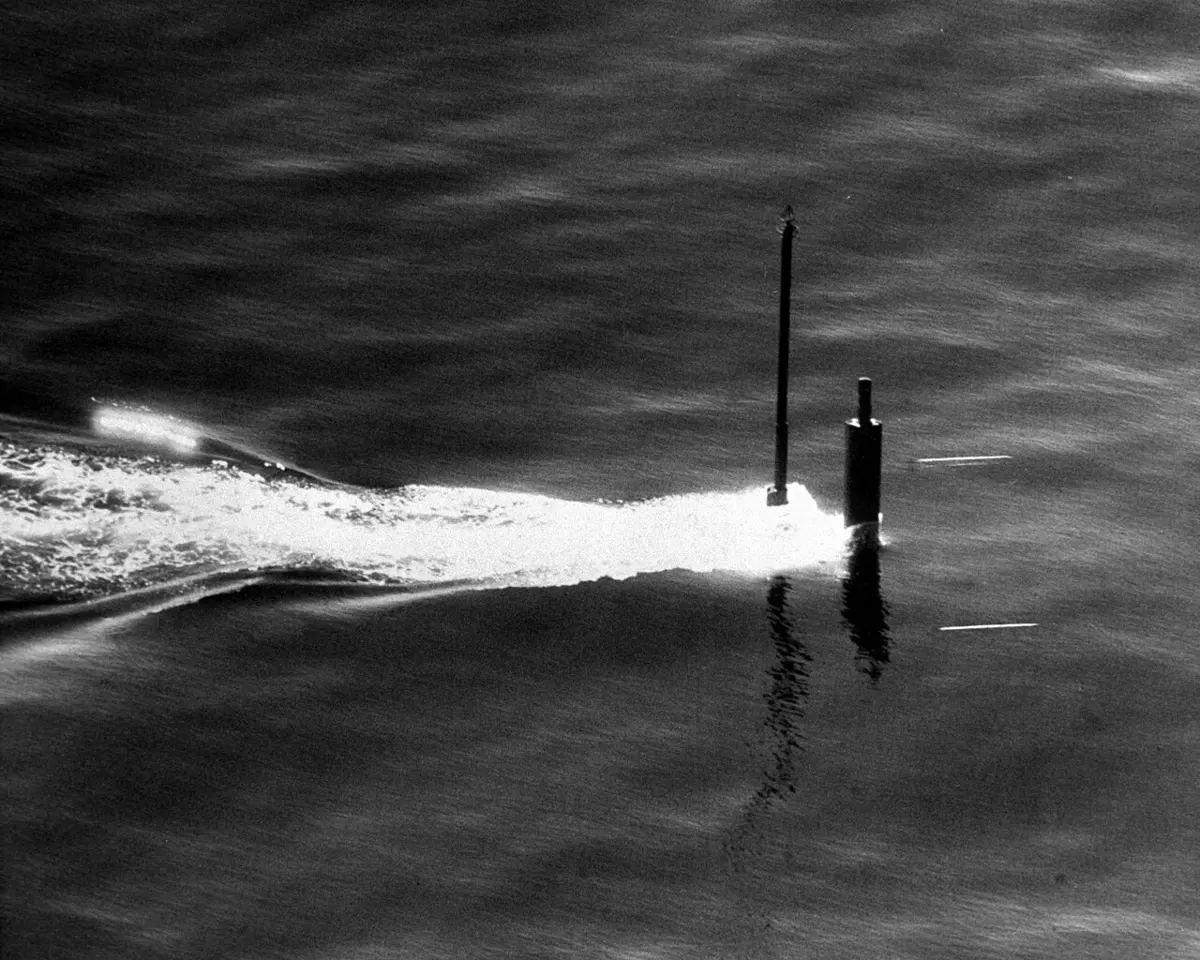
A periscope is an instrument that uses the reflection of light to see over the top of something, from a hidden or low place. It is a tube with two plane mirrors, one at each end, each at 45°, facing each other and parallel. Light from the object enters the top opening and strikes the top mirror, which turns it straight down the tube. The bottom mirror turns it again, out of the bottom opening into your eye. So you can see things that are higher up, over a wall or a crowd, while you stay low.
Applications of the periscope
- a.A submarine uses a periscope to see the surface of the sea and the ships around it while it stays hidden under the water.
- b.In war, soldiers use periscopes to look out from a trench or over a wall, to watch the enemy without showing their heads.
Exercise
7.1 Energy
1. Fill in the blanks
Use these words: lakhs, renewable, carbon dioxide, alternative, saving, non-renewable. (One word is not needed.)
Coal is a ……… source of energy.
Answer
non-renewable
To form a non-renewable source of energy takes ……… of years.
Answer
lakhs (in fact millions, that is many tens of lakhs, of years)
……… gas formed during the burning of fossil fuels pollutes the air.
Answer
carbon dioxide
We should develop the habit of ……… energy.
Answer
saving
We should give more effort to the use of ……… energy to reduce the energy crisis.
Answer
alternative (the word “renewable” is not needed)
2. Choose the correct answer
a. Which of the following is an environment-friendly source of energy?
Pick an answer to see why.
b. Which of the following is a renewable source of energy?
Pick an answer to see why.
c. From which source is most of Nepal’s electricity produced?
Pick an answer to see why.
d. Which of the following is a non-renewable source of energy?
Pick an answer to see why.
e. Read the two sentences and choose the best option.
- The energy we need is obtained from food.
- The energy we get from food really comes from the sun.
Pick an answer to see why.
f. Which is the odd one out?
Pick an answer to see why.
g. Read the statement and the two reasons, and choose the best option.
Statement: LP gas and gobar gas are both fossil fuels.
Reason 1: Gobar (dung) is the remains of animals, so the gas from it is also a fossil fuel.
Reason 2: LP gas is obtained by refining crude oil. Crude oil is a fossil fuel, so LP gas is also a fossil fuel.
Pick an answer to see why.
3. Differentiate between
Renewable energy and non-renewable energy
Answer
| Renewable energy | Non-renewable energy |
|---|---|
| Made again by nature in a short time after use. | Takes millions of years to form; can’t be made again in time. |
| Does not run out. | Decreases with use and may run out one day. |
| Usually causes little pollution. | Fossil fuels pollute the air when burnt. |
| e.g. solar energy, hydroelectricity, wind, biogas | e.g. coal, petrol, diesel, LP gas |
Biofuel and fossil fuel
Answer
| Biofuel | Fossil fuel |
|---|---|
| Made from things that were alive recently (plants, dung). | Formed from plants and animals buried millions of years ago. |
| Renewable. | Non-renewable. |
| Can be made in a short time, even at home. | Takes millions of years to form; dug or pumped from deep underground. |
| e.g. firewood, gobar gas, dung cakes | e.g. coal, petrol, diesel, kerosene |
LP gas and gobar gas
Answer
| LP gas | Gobar gas |
|---|---|
| Obtained by refining crude oil (and from natural gas). | Made from dung (gobar) rotting in a closed tank, without air. |
| A fossil fuel, non-renewable. | A biofuel, renewable. |
| Nepal must import it. | Made at home or in the village from the family’s cattle. |
| Kept as a liquid under pressure in steel cylinders. | Piped straight from the biogas plant to the stove. |
| Leaves nothing useful behind. | Leaves slurry that is good manure. |
4. Answer the following questions
What is an energy crisis? Explain any two efforts made in your surroundings to reduce the energy crisis.
Answer
A shortage of energy, caused by using too much non-renewable energy, is called an energy crisis.
Two efforts (any two, from what you see around you):
- Using alternative energy: families build gobar gas plants and fit solar panels and solar water heaters, often with a subsidy from the government, so they use less LP gas and kerosene.
- Using hydroelectricity instead of fuels: more people cook on induction stoves and ride electric scooters, buses and cars, which run on Nepal’s own electricity instead of imported LP gas and petrol.
- Saving energy: people switch to LED bulbs and switch off lights and machines that are not in use.
Which is the best alternative source of energy for Nepal? Give suitable reasons.
Answer
Hydroelectricity is the best for the country as a whole (with solar energy and gobar gas for remote villages). Reasons:
- Nepal has many rivers flowing fast down steep mountains, fed all year by rain and the Himalayan snow, so it can make a lot of hydroelectricity.
- It is renewable and clean: it gives no smoke.
- It is Nepal’s own: using it for cooking and transport means buying less LP gas, petrol and diesel from abroad.
- Extra electricity can even be sold to other countries.
(Answers that choose solar energy or gobar gas are also right, with reasons: solar for remote hilly places where power lines are hard to bring; gobar gas because most families farm and keep cattle.)
“Economic use of energy is the saving of energy.” Explain with reasons.
Answer
To use energy economically means to use only as much as we need, without waste. Every unit of energy we don’t waste is a unit saved: it stays available for later, and less fuel has to be burnt or bought. For example, switching off a fan in an empty room, cooking with a lid on, or using an LED bulb gets the same work done with less energy. So using energy economically is the same as saving (conserving) it. It also saves money, makes non-renewable fuels last longer, and causes less pollution.
Write the advantages and disadvantages of fossil fuels.
Answer
Advantages:
- Easy to get compared with many other sources.
- Easy to carry from one place to another.
- Have many uses: they run vehicles and factories and cook food.
- Give a very large amount of heat when burnt.
Disadvantages:
- They are non-renewable and may run out because of continuous and heavy use.
- Burning them pollutes the environment (smoke, harmful gases, carbon dioxide).
The use of fossil fuels causes pollution. Which source of energy could be the best alternative to fossil fuels? Give your suggestions.
Answer
Hydroelectricity (and solar energy) could be the best alternative in Nepal, because they are renewable and give no smoke. Suggestions:
- Make more hydroelectricity, and use it for cooking (induction and rice cookers) and for electric vehicles.
- Fit solar panels on roofs and use solar water heaters.
- Build gobar gas plants in villages instead of burning firewood and kerosene.
- Use public transport, cycle or walk for short trips.
Why is hydroelectricity called an alternative source of energy?
Answer
Hydroelectricity can be used in place of non-renewable fuels: electric stoves instead of LP gas, electric vehicles instead of petrol and diesel vehicles, electric lights instead of kerosene lamps. Since it is used to reduce the use of non-renewable energy, it is an alternative source of energy. It is also renewable, because rain and snow keep the rivers flowing.
What is geothermal energy?
Answer
The heat energy that comes from inside the Earth is called geothermal energy. Deep under the ground the rocks are very hot; in some places this heat warms underground water, which comes up as hot springs (tatopani), as in Myagdi. Some countries use it to make electricity and to heat houses. It is a renewable source.
5. Give reasons
Coal is called a fossil fuel.
Answer
Coal formed from the remains of plants that were buried millions of years ago and changed by great pressure and heat under the ground. The remains of living things from long ago are fossils, so coal is a fossil fuel.
Petroleum products are non-renewable energy.
Answer
Petrol, diesel and kerosene are made from crude oil, which took millions of years to form from buried sea creatures. Once we burn them they are gone, and nature can’t make more in a short time, so they are non-renewable.
7.2 Heat and temperature
1. Fill in the blanks and make a summary
Use these words: increase, 100 °C, warmth, temperature, decrease, 0 °C, kelvin, a thermometer, heat, 37 °C.
Heat is a form of energy which gives us the feeling of ……… . Because of heat, the temperature of an object may ……… or ……… . When an object is heated, its ……… increases. ……… is used to measure body temperature. Celsius, Fahrenheit and ……… are the scales of temperature. Normal human body temperature is ……… . ……… flows from a hotter object to a colder object. At sea level, water freezes at ……… and boils at ……… .
Answer
Heat is a form of energy which gives us the feeling of warmth. Because of heat, the temperature of an object may increase or decrease. When an object is heated, its temperature increases. A thermometer is used to measure body temperature. Celsius, Fahrenheit and kelvin are the scales of temperature. Normal human body temperature is 37 °C. Heat flows from a hotter object to a colder object. At sea level, water freezes at 0 °C and boils at 100 °C.
2. Choose the correct answer
a. What is the SI unit of temperature?
Pick an answer to see why.
b. What is the range of temperature on a laboratory thermometer?
Pick an answer to see why.
c. When no outside energy is used, heat:
Pick an answer to see why.
d. Rita and Sarita measured their body temperatures and found 37 °C and 98.6 °F. Choose the best option.
Pick an answer to see why.
e. What does a thermometer measure?
Pick an answer to see why.
f. Read the statement and the two reasons, and choose the best option.
Statement: Heat tells us how hot or cold an object is, but temperature gives the direction in which heat flows.
Reason 1: An object with more heat is hotter, and an object with less heat is colder.
Reason 2: Temperature flows from one object to another, so temperature gives the direction in which heat flows.
Pick an answer to see why.
g. Which option gives, in order, the human body temperature, the boiling point of water and the melting point of ice?
Pick an answer to see why.
h. What happens when two objects at different temperatures touch each other?
Pick an answer to see why.
i. Which of these is true about a laboratory thermometer?
Pick an answer to see why.
j. Which one of these is correct?
Pick an answer to see why.
3. Answer the following questions
What is heat? Write its SI unit.
Answer
Heat is a form of energy that gives us the feeling of warmth. It flows from a hotter object to a colder one. Its SI unit is the joule (J).
Draw a well-labeled diagram of a laboratory thermometer.
Answer
Draw a long glass tube with a bulb at one end, and label: the bulb (thin glass wall), the mercury or alcohol in it, the capillary tube running up the middle, the stem (thick glass), and the scale from −10 °C to 110 °C, as in the figure.
Write any two differences between heat and temperature.
Answer
| Heat | Temperature |
|---|---|
| A form of energy. | The degree of hotness or coldness of an object. |
| Its SI unit is the joule (J). | Its SI unit is the kelvin (K). |
| It flows from a hotter object to a colder one. | It tells us which way heat will flow. |
| Depends on the amount of substance. | Does not depend on the amount of substance. |
We feel cold when we touch well water or tap water in winter. Give a reason.
Answer
In winter, the water cools down to the low temperature of its surroundings, while our body stays at about 37 °C. Heat always flows from a hotter object to a colder one, so when we touch the water, heat flows from our hand into the water. Our hand loses heat, and we feel cold.
Why is a digital thermometer used instead of a clinical thermometer to measure body temperature?
Answer
- It is safer: it has no thin glass that can break and no poisonous mercury that can spill.
- It is easier and quicker to read accurately: it shows the temperature as numbers on a screen, often beeps when ready, and gives the reading in less time.
4. Convert the following
50 °C into °F
Answer
or,
or,
or, F = 90 + 32 = 122 °F
27 °C into K
Answer
or, 27 = K − 273
or, K = 27 + 273 = 300 K
100 K into °C
Answer
or, C = K − 273 = 100 − 273 = −173 °C (far colder than anything on the Earth’s surface)
5. Differentiate between
The Celsius scale and the Fahrenheit scale
Answer
| Celsius scale | Fahrenheit scale |
|---|---|
| Ice melts at 0 °C. | Ice melts at 32 °F. |
| Water boils at 100 °C. | Water boils at 212 °F. |
| 100 equal divisions between the fixed points. | 180 equal divisions between the fixed points. |
| Used in science and weather reports. | Often used for body temperature. |
A clinical thermometer and a laboratory thermometer
Answer
| Clinical thermometer | Laboratory thermometer |
|---|---|
| Measures the temperature of the human body. | Measures the temperature of other substances in a laboratory. |
| Short range: about 35 °C to 42 °C (95 °F to about 108 °F). | Long range: about −10 °C to 110 °C. |
| Has a kink above the bulb, so the reading stays after it is taken out. | Has no kink: the reading changes as soon as it is taken out. |
| Short. | Long. |
7.3 Wave
1. Fill in the blanks
Use these words: meter, frequency, medium, air, vibration, solid. (One word is not needed.)
Sound is produced by the ……… of an object.
Answer
vibration
Sound travels fastest in a ……… medium.
Answer
solid
The SI unit of wavelength is the ……… .
Answer
meter
A ……… is necessary for sound to travel.
Answer
medium (the word “air” is not needed: sound can travel through solids and liquids too)
The number of complete waves formed in one second is called the ……… .
Answer
frequency
2. Choose the correct answer
a. Through which medium can sound travel?
Pick an answer to see why.
b. What is the SI unit of frequency?
Pick an answer to see why.
c. What is wavelength?
Pick an answer to see why.
d. In a longitudinal wave, in which direction do the molecules vibrate, compared with the direction the wave travels?
Pick an answer to see why.
e. What kind of sound is made when a drum is hit hard with a stick?
Pick an answer to see why.
f. Which of the following is the length of one complete wave?
Pick an answer to see why.
g. What happens in a longitudinal wave?
Pick an answer to see why.
h. Which wave can travel without a medium?
Pick an answer to see why.
i. Read the statement and the two reasons, and choose the correct option.
Statement: When a stone is thrown into the middle of a still pond, the wave formed carries the mechanical energy of the stone to the edge of the pond.
Reason 1: The water vibrates parallel to the direction in which the wave travels.
Reason 2: Each particle of water vibrates parallel to the direction in which the wave travels.
Pick an answer to see why.
j. A wave of wavelength 1 m has a velocity of 10 m/s. What is its frequency?
Pick an answer to see why.
3. Differentiate between
Longitudinal wave and transverse wave
Answer
| Longitudinal wave | Transverse wave |
|---|---|
| The particles vibrate along the direction the wave travels. | The particles vibrate at right angles to the direction the wave travels. |
| It forms compressions and rarefactions. | It forms crests and troughs. |
| e.g. sound, a push on a slinky | e.g. a wave on a rope, ripples on water |
Amplitude and frequency
Answer
| Amplitude | Frequency |
|---|---|
| The greatest displacement of a particle from its mean position. | The number of complete waves in one second. |
| Symbol a; SI unit meter (m). | Symbol f; SI unit hertz (Hz). |
| Decides how loud a sound is (or how big the wave is). | Decides how high or low a sound’s pitch is. |
Crest and trough
Answer
| Crest | Trough |
|---|---|
| The part of a wave with the greatest upward displacement from the mean position. | The part of a wave with the greatest downward displacement from the mean position. |
| The highest point (a hump). | The lowest point (a dip). |
Mechanical wave and electromagnetic wave
Answer
| Mechanical wave | Electromagnetic wave |
|---|---|
| Needs a medium to travel. | Can travel without a medium, even through empty space. |
| Can’t travel through a vacuum. | Travels through a vacuum, at 300,000 km/s. |
| e.g. sound, water waves, a wave on a rope | e.g. light, X-rays, radio waves |
4. Answer the following questions
What is sound energy? Write any four sources of sound.
Answer
Sound energy is the form of energy that we hear. It is produced when an object vibrates, and it travels through a medium as a longitudinal wave.
Sources (any four): a drum (madal), a guitar or sarangi, a radio or television, a bell, a human voice (the vocal cords).
How does sound travel when we talk? Explain with a diagram.
Answer
When we talk, our vocal cords in the throat vibrate. Each time they move forward, they push the air molecules in front of them closer together, making a compression. Each time they move back, they leave a space where the molecules are farther apart, making a rarefaction. The air molecules pass this push and pull on to the molecules next to them, so compressions and rarefactions travel outwards through the air, one after another, as a longitudinal wave. Each molecule only vibrates back and forth in its place. When the wave reaches the listener’s ear, it makes the eardrum vibrate, and the listener hears the sound.
When a drum is hit hard, the amplitude of the sound is high. Give a reason.
Answer
Hitting the drum harder gives its skin more energy, so it moves farther up and down from its rest position. It pushes the air harder, so the air molecules are pushed farther from their mean positions: the amplitude is larger. A larger amplitude means more energy, which we hear as a louder sound.
Write the symbol and SI unit of: wavelength, amplitude, frequency and wave speed.
Answer
| Quantity | Symbol | SI unit |
|---|---|---|
| wavelength | λ (lambda) | meter (m) |
| amplitude | a | meter (m) |
| frequency | f | hertz (Hz) |
| wave speed (velocity) | v | meter per second (m/s) |
Draw a diagram of a wave and show the crest, trough, wavelength and amplitude in it.
Answer
Draw a wavy line across a straight middle line (the mean position). Mark a high point as the crest and a low point as the trough. Draw a two-headed arrow from one crest to the next and label it wavelength (λ), and a short arrow from the middle line up to the top of a crest and label it amplitude (a), as in the figure.
Write the features of the compressions and rarefactions in a sound wave. Also explain how they are related.
Answer
Compression:
- A region where the molecules of the medium are crowded close together.
- The pressure and density of the air there are a little higher than normal.
Rarefaction:
- A region where the molecules are spread farther apart.
- The pressure and density there are a little lower than normal.
How they are related: compressions and rarefactions always come one after another, alternately, and travel along together in the direction of the wave. One compression and the rarefaction next to it make one complete wave, so the distance from one compression to the next is one wavelength.
How many complete waves are formed from the beginning of one compression to the end of the next rarefaction? Explain with a diagram.
Answer
One complete wave. A compression and the rarefaction that follows it together make one complete wave (one wavelength). In the diagram, the stretch from the start of one C to the end of the next R is one complete wave.
(If the question asks from one compression to the third rarefaction after it, the answer is three complete waves: C R, C R, C R.)
5. Give reasons
A sound wave is called a mechanical wave.
Answer
A sound wave needs a medium (a solid, liquid or gas) to travel: it travels by making the particles of the medium vibrate. It can’t travel through empty space. A wave that needs a medium is a mechanical wave.
A light wave is an electromagnetic wave.
Answer
Light does not need a medium: it travels even through empty space, which is how sunlight reaches the Earth across 150 million km of space. A wave that can travel without a medium is an electromagnetic wave.
Sound is produced when a guitar string is plucked with a finger.
Answer
Plucking makes the string vibrate quickly to and fro. The vibrating string pushes and pulls the air around it, making compressions and rarefactions that travel to our ears as sound. Sound is always produced by vibration.
7.4 Light
1. Fill in the blanks
Use these words: law, reflect, equal, parallel, perpendicular, refract. (One word is not needed.)
A plane mirror ……… light.
Answer
reflects
In regular reflection, the reflected rays of light are ……… to each other.
Answer
parallel
In the reflection of light, the angle of incidence and the angle of reflection are ……… .
Answer
equal
The periscope is based on the ……… of reflection of light.
Answer
law (the laws of reflection)
The normal is drawn ……… to the surface of a plane mirror.
Answer
perpendicular (the word “refract” is not needed)
2. Choose the correct answer
a. How does light travel?
Pick an answer to see why.
b. Why can’t we see objects in a dark place?
Pick an answer to see why.
c. Why are we able to see the objects around us?
Pick an answer to see why.
d. The angle between an incident ray and its reflected ray is 80°. What is the angle of incidence?
Pick an answer to see why.
e. What kind of mirror is used in a periscope?
Pick an answer to see why.
f. Read the statement and the two reasons, and choose the correct option.
Statement: Reflection of light is the bouncing back of a ray along the same path by which it struck a surface.
Reason 1: In reflection, the angle of incidence and the angle of reflection are parallel.
Reason 2: Because of reflection, objects are seen and images are formed.
Pick an answer to see why.
g. Which of the following statements is correct?
Pick an answer to see why.
h. What is the nature of the image formed by a plane mirror?
Pick an answer to see why.
i. Which of these is true about regular and irregular reflection?
Pick an answer to see why.
j. Which of these is false?
Pick an answer to see why.
3. Differentiate between
Incident ray and reflected ray
Answer
| Incident ray | Reflected ray |
|---|---|
| The ray that comes from a source and strikes the surface. | The ray that bounces back from the surface. |
| Travels towards the surface. | Travels away from the surface. |
| Makes the angle of incidence with the normal. | Makes the angle of reflection with the normal. |
Regular and irregular reflection
Answer
| Regular reflection | Irregular reflection |
|---|---|
| Takes place at a smooth, polished surface. | Takes place at a rough, uneven surface. |
| Parallel rays stay parallel after reflection. | Parallel rays are scattered in different directions. |
| Forms an image. | Does not form an image. |
| e.g. a mirror, still water | e.g. a wall, paper, wood |
Angle of incidence and angle of reflection
Answer
| Angle of incidence | Angle of reflection |
|---|---|
| The angle between the incident ray and the normal. | The angle between the reflected ray and the normal. |
| Written ∠i. | Written ∠r. |
(By the first law of reflection, the two are always equal.)
4. Answer the following questions
What is reflection of light? Write the laws of reflection of light.
Answer
The bouncing back of light after it strikes a surface is called reflection of light.
Laws of reflection:
- The angle of incidence is always equal to the angle of reflection.
- The incident ray, the reflected ray and the normal at the point of incidence all lie in the same plane.
What is irregular reflection of light? Explain with a ray diagram.
Answer
When parallel rays of light fall on a rough or uneven surface, the reflected rays are scattered in different directions. This is irregular reflection. Each ray obeys the laws of reflection at the tiny part of the surface it hits, but the tiny parts face different ways, so the rays leave in different directions. It does not form an image, but it lets us see the objects around us from every side.
Describe any two uses of reflection of light in daily life.
Answer
- Mirrors on vehicles: the side and rear-view mirrors reflect the road behind, so the driver can see vehicles coming from behind without turning round.
- Seeing ourselves: a plane mirror forms an image of our face by regular reflection, so we can comb our hair and dress.
(Others: the mirror of a microscope reflects light up through the slide; a periscope lets us see over walls; irregular reflection lets us see everything around us.)
How does a periscope work? Explain with a ray diagram.
Answer
A periscope is a tube with two plane mirrors, one at each end, at 45° and parallel to each other. Light from an object enters the top opening and strikes the top mirror at 45°. It is reflected through 90°, straight down the tube. At the bottom it strikes the second mirror, again at 45°, and is reflected through 90° once more, out of the bottom opening into the eye. So the eye sees the object, which is high up, from a lower place. It works by the laws of reflection of light.
Study the figure and answer the questions.
- i.Name the incident ray and the reflected ray.
- ii.Name the angle of incidence and the angle of reflection.
- iii.The normal ON makes 90° with which surface?
- iv.What is the value of ∠BON?
Answer
- i.AO is the incident ray and OB is the reflected ray.
- ii.The angle of incidence is ∠AON and the angle of reflection is ∠BON.
- iii.The normal ON makes 90° with the mirror’s surface XY.
- iv.The incident ray makes 30° with the mirror, so ∠AON = 90° − 30° = 60°. Since ∠i = ∠r, ∠BON = 60°.
Worksheet: Energy in Daily Life: energy, heat and temperature (PDF, 4 pages)
Worksheet: Energy in Daily Life: waves and light (PDF, 4 pages)
Practice every question in the book, and keep track of the ones you miss →