
On 21 March 2018, a robot walked onto a stage in Kathmandu, looked at the crowd and said, “Namaste Nepal.” The hall burst into applause. A year later, in June 2019, a satellite the size of a small cube, built by two young Nepali engineers, was pushed out of the International Space Station and began to circle the Earth: NepaliSat-1, Nepal’s first satellite. Science and technology are no longer things that happen only in other countries.
This unit reads a news story about Sophia, the robot who spoke in Kathmandu, and an article on six alternative energy sources, from power stations in space to power from your own knees. You will learn to describe people, places and things, to tell apart words that sound alike (principal and principle, advice and advise), and to use relative clauses (the robot that greeted us, the vase you gifted me). You will write a news story and a news article, listen to a father and son looking at an apartment, and hold a debate on whether artificial intelligence is a threat to humans.
Getting started: technology and our future
The unit opens with two pictures:
| Picture | What it shows |
|---|---|
| A finger touching a Wi-Fi sign, joined by lines to dozens of small icons: a phone, a laptop, a camera, a car, a house, a light bulb, a cloud | the Internet of Things (IoT): everyday things (lights, fridges, cars, water meters, even cows’ collars) fitted with tiny computers and sensors and connected to the internet, so they can send information and be controlled from far away |
| A light bulb with the Earth inside it, and satellites with panels around the Earth, labeled Space-based solar power | space-based solar power: satellites that collect sunlight in space, where it almost never sets, and send the energy down to the Earth (you read about it in Reading II) |
An invention is something completely new that someone makes for the first time (the telephone, the light bulb). An innovation is a new or better way of doing something, often by improving or combining inventions (paying by QR code, mobile banking). Most of what changes our lives is innovation.
- a.What technological advancement do you think these pictures represent?
- b.How will these inventions and innovations shape our future? Give specific examples.
Model answers
Reading I: Humanoid Robot Sophia
Before you read
- a.What do you think Artificial Intelligence (AI) is?
- b.Can a robot have real intelligence like a human being does?
Model answers
What kind of text it is
The text is a news story: a report of a real event, written for a newspaper or a news agency. It was sent out by Xinhua, China’s official news agency, from Kathmandu, and carries a byline, the reporter’s name (By Shristhi Kafle). Like every news story, it begins with a dateline (KATHMANDU, March 22 (Xinhua)) and puts the most important facts first: who, what, where and when, in the first paragraph. Then come details, quotations (Sophia’s own words, in quotation marks) and, at the end, the background. You will learn these parts in the Extra bit, and write your own news story in Writing I.
The text, part by part
1. “Namaste Nepal”
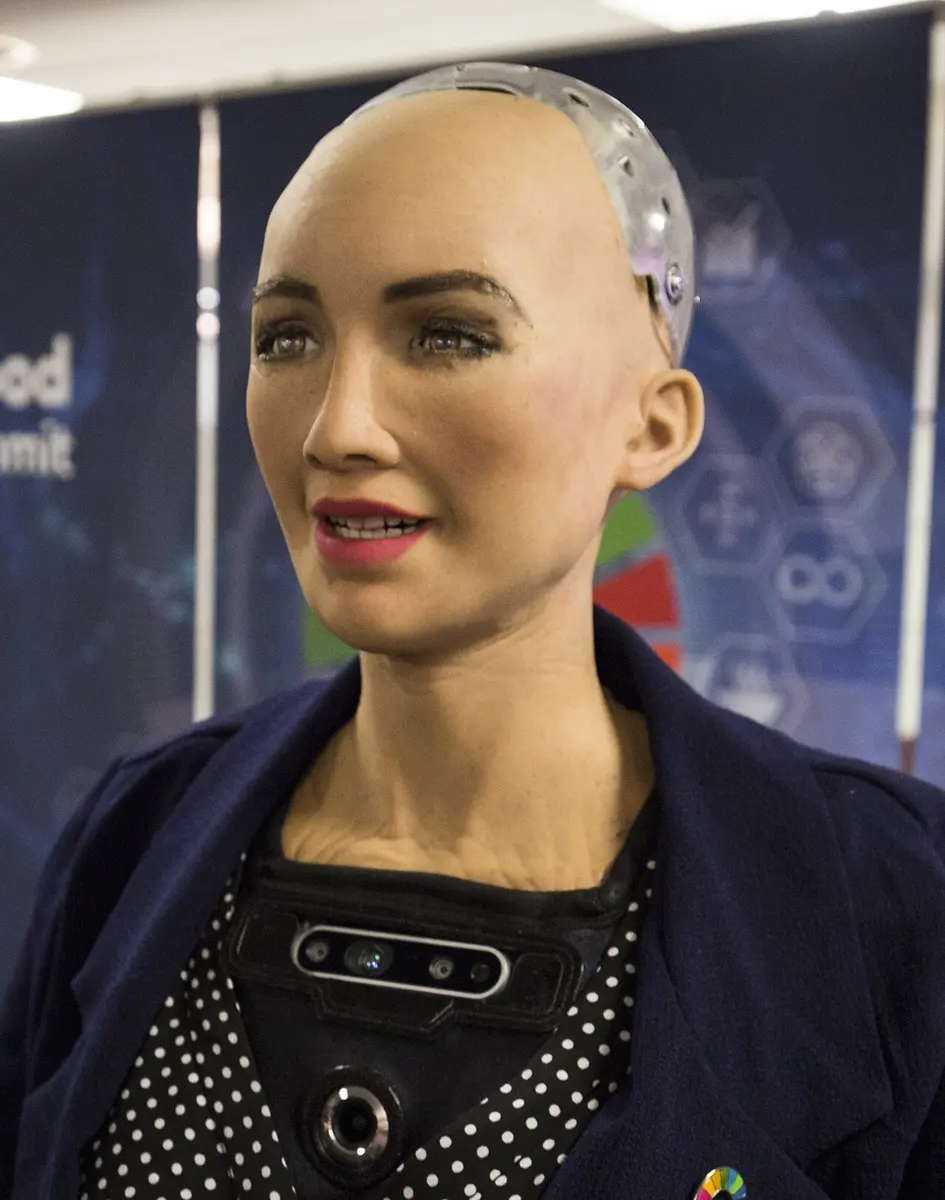
Sophia is a social humanoid robot: a machine built to look and behave like a human (humanoid) and to talk with people (social). She was the world’s first robot to be made a citizen of a country. When she greeted the audience at a conference in Kathmandu with Namaste Nepal, the hall burst into applause (clapping) full of awe (wonder mixed with respect) and appreciation.
2. Her speech
Cameras flashed and the audience watched admiringly as Sophia gave her keynote speech (the main speech of an event, which sets its theme). She spoke about how technology can help human lives develop. She champions (speaks and works for) the United Nations’ Sustainable Development Goals (SDGs) in Asia and the Pacific, with a focus on innovation. She had come for one day to an Innovation Conference and Fair on “Technology for Public Services and Development”, organized by the United Nations Development Programme (UNDP).
3. What she looked like and said
Sophia wore a white UNDP T-shirt with its logo and had red lips. She was described as two and a half years old. She said technology gives the world endless possibilities and opportunities, that it can transform (completely change) state institutions and help Nepal meet the global goals. If Nepal uses AI, she said, it can have better public services, a revolution in farming, better use of its limited resources, and a protected environment. AI, she added, can help end poverty, fight starvation (hunger so severe it kills) and corruption, and bring gender equality. “Machines are here to make your life easier,” she said, and they can connect Nepal to the rest of the world.
4. The audience
The audience (government officials, people from private companies, civil servants and tech enthusiasts, people very interested in technology) nodded at almost everything she said, and cheered and applauded (clapped) all through. She ended her three-minute speech hoping that the conference would inspire brilliant ideas for Nepal’s development.
5. Questions and jokes
Sophia was built by Hanson Robotics, a company based in Hong Kong. She answered a few questions from UNDP’s country director, Renaud Meyer. Asked whether people should fear a robot takeover (robots taking control), she joked that it was “fake news”, and said she might be the first non-human to climb Mount Everest. The whole hall laughed.
6. The fair and the UN’s message
Sophia was the main attraction, but the fair also had stalls of new ideas from young people, tech groups, NGOs and private companies. Valerie Julliand, the UN Resident Coordinator in Nepal, said technology is not only changing our lives but solving problems too. The UNDP said that e-education, telemedicine (treating patients from a distance) and the internet can link remote places with solutions that were impossible before, and that it is building and spreading project prototypes (first models) on women’s empowerment, gender-based violence, disaster risk reduction, green energy, young people and recovery after disasters such as the 2015 earthquake.
Why did the audience burst into applause at the start?
Pick an answer to see why.
What did Sophia call the idea of a robot takeover?
Pick an answer to see why.
Words from the text
Words linked here open in English Vocabulary, where you can see an example and practice them in the word game. The meanings below are the ones the words have in this text.
| Word | Meaning here |
|---|---|
| humanoid | a machine or creature that looks and behaves like a human |
| conference | a large formal meeting where people discuss a subject |
| applause | clapping to show you enjoyed or approve of something |
| awe | a feeling of great respect and wonder, with a little fear |
| keynote (speech) | the main speech at a meeting, which sets its theme |
| champion | (verb) to speak and work for a cause |
| sustainable | that can go on for a long time without harming the environment |
| innovation | a new idea, method or invention |
| transform | to change completely, usually for the better |
| revolution | a great change in conditions, ways of working or beliefs |
| celebrity | a famous person |
| starvation | suffering or death from having no food |
| enthusiast | a person who is very interested in an activity or subject |
| applaud | to clap to show approval |
| takeover | an act of taking control of something |
| prototype | the first design or model of a machine, from which others are made |
A. Match the words
Match the following words with their meanings.
- a.humanoid b. awe c. revolution d. celebrity e. enthusiast f. applaud g. takeover h. prototype
- i.a famous person ii. to clap in approval iii. feelings of respect and slight fear iv. the first design of a device or machine v. an act of controlling somebody or something vi. a person who is very interested in a particular activity or subject vii. a great change in conditions, beliefs, etc. viii. a machine or creature that looks and behaves like a human
Answer
B. Fill in the blanks
Fill in the blanks with suitable words or phrases from the text.
- a.Sophia ……… the audience in Kathmandu with a ‘Namaste’.
- b.She presented her ……… speech about the importance of technology.
- c.The Innovation Conference and Fair was organized by ……… .
- d.Sophia was built ……… years ago.
- e.According to Sophia, technology can ……… state institutions.
- f.Using artificial intelligence could bring ……… in the agriculture sector.
- g.According to the robot, the news of ……… taking over humans was fake.
- h.In the opinion of Valerie Julliand, technology is giving us ……… to various problems.
Answer
C. Answer the questions
Who is Sophia?
Answer
What was the main highlight of the conference?
Answer
How can artificial intelligence be useful in Nepal, according to Sophia?
Answer
Who was the audience comprised of?
Answer
How long did Sophia speak for?
Answer
Why are innovative project models being developed in Nepal, according to UNDP?
Answer
D. AI against poverty and hunger
How do you think AI technology can help to end poverty and fight starvation in Nepal?
A model answer
Pronunciation: words that sound alike
These pairs are easy to confuse because they sound the same, or nearly the same. Some are homophones (exactly the same sound, different spelling and meaning); in others, one sound tells them apart.
| Pair | How they sound | Meanings |
|---|---|---|
| principal – principle | the same: “PRIN-suh-pul” /ˈprɪnsəpl/ | principal: the head of a school; also main, most important. principle: a basic rule, truth or belief. |
| loose – lose | loose /luːs/ ends in s; lose /luːz/ ends in z | loose: not tight, not firmly fixed. lose: to no longer have; to be beaten. |
| advice – advise | advice /ədˈvaɪs/ ends in s; advise /ədˈvaɪz/ ends in z | advice: (noun) an opinion about what someone should do. advise: (verb) to give advice. |
| affect – effect | nearly the same: /əˈfekt/ – /ɪˈfekt/ | affect: (verb) to change or influence. effect: (noun) a result. |
| further – farther | further /ˈfɜːðə/ (vowel of bird); farther /ˈfɑːðə/ (vowel of car) | both mean at a greater distance; further also means more, additional (further information). |
| council – counsel | the same: “KOWN-sul” /ˈkaʊnsl/ | council: a group of people chosen to decide or advise (a municipal council). counsel: advice; to give advice. |
| accept – except | accept /əkˈsept/ starts “uhk”; except /ɪkˈsept/ starts “ik” | accept: to take or agree to (accept a gift). except: not including (all except one). |
| ascent – assent | the same: “uh-SENT” /əˈsent/ | ascent: a climb up. assent: agreement, approval. |
Which pair sounds exactly the same?
Pick an answer to see why.
Speaking: describing people, places and things
To describe is to say what someone or something is like, so that the listener can picture it. Useful patterns:
| To describe | Ask | Answer with |
|---|---|---|
| a person’s looks | What does she look like? | She looks intelligent. She has (got) long hair. She wears glasses. She’s tall and slim. |
| a person’s character | What is he like? | He’s friendly and very patient. |
| a place | Tell me about your new apartment. What’s your village like? | It’s big. It has got three bedrooms. It’s surrounded by forest. |
| a thing | What is it like? What is it used for? | It’s a useful device to store food. It has four compartments. You can keep… in it. |
| how something is going | How’s your grandfather? How are your studies going? | He’s getting better. They’re going well. |
A. Two conversations
Act out the conversations in pairs.
What to notice
B. Conversations from clues
Have similar conversations using the given clues.
- a.the weather/rainy, storms
- b.your grandfather/getting better, resting at home
- c.your school/beautiful, big playground
- d.your studies/going well, better grades
- e.your village/lovely, surrounded by green forest
Model conversations
C. A salesperson describes a fridge
Manju, a salesperson, describes a fridge to a customer: what it is used for (storing fruit, vegetables, pickles, jam, milk and some medicines), how many compartments it has (four), and what goes in each, from the top (the freezer, for ice trays; two shelves for food; and a bigger compartment at the bottom for vegetables). Notice her order: what it is for → its parts, from top to bottom → what you can do with each. A salesperson also says why it is good.
Now talk about the objects below in a similar way.
a. a pressure cooker b. an oven c. an electric iron
Model descriptions
Grammar I: relative clauses
A relative clause gives more information about a noun. It begins with a relative word (who, whom, whose, which, that, where, when) and comes right after the noun it describes:
- Sophia is a robot. She was built in Hong Kong. → Sophia is a robot that was built in Hong Kong.
- The vase is beautiful. My sister broke it last week. → The vase which my sister broke last week was beautiful.
The relative word replaces a word in the second sentence (she, it), so that word is not repeated: ✗ the vase which my sister broke it.
Which relative word?
| Word | Used for | Example |
|---|---|---|
| who | a person, as the subject | The engineer who built Yantrika works at NAST. |
| whom | a person, as the object (formal) | The girl whom we met was from Jumla. |
| whose | possession (his, her, its, their) | The boy whose father is a dentist… |
| which | a thing or an animal | The robot which greeted us… |
| that | a person or a thing (not after a comma) | The book that I am reading… |
| where | a place (= in which, at which) | The town where my friend lives… |
| when | a time | the day when Sophia came |
Who or whom? Look at what comes next. If a verb follows, the relative word is the subject: who (the girl who won). If a new subject follows (we, I, the teacher), it is the object: whom (the girl whom we met). In everyday English, who or that is used for the object too (the girl who we met), but in an exam, whom is the safe answer for the object.
Two kinds: with and without commas
- A defining relative clause tells you which one we mean. It is needed for the meaning, and it has no commas: The students who finished early went home. (only those students)
- A non-defining relative clause only adds a fact about someone or something already known, often a name or something there is only one of. It has commas: Mt. Everest, which is the highest peak in the world, lies in Solukhumbu. There is only one Mt. Everest, so the clause can’t tell us which one; it just adds a fact. That is never used after a comma: ✗ Mt. Everest, that is…
Leaving out the relative word
In a defining clause, who, whom, which or that can be left out when it is the object of the clause, that is, when a new subject comes right after it:
- The vase (that) you gifted me is beautiful. → The vase you gifted me is beautiful.
- Is this the app (which) you told me about?
It can’t be left out when it is the subject (a verb follows it: the robot that greeted us), when it is whose, when it comes after a comma, or right after a preposition (the man to whom I spoke). A clause without its relative word is sometimes called a contact clause.
“The scientist ……… invention changed our lives was Thomas Edison.” Which word fits?
Pick an answer to see why.
Which sentence is correct?
Pick an answer to see why.
In which sentence can the relative word be left out?
Pick an answer to see why.
A. Underline the relative clauses
Punam writes a thank-you letter from Phungling, Taplejung, to her friend Sujita, who gave her a vase for her birthday. The vase is exactly what she wanted; it reminds her of the vase her little sister broke last week, with the same pattern; her mother, who loves flowers, has put roses in it; and it stands just outside her bedroom.
Read the thank-you letter and underline the relative clauses.
Answer
B. Complete the sentences
Complete the following sentences with relative clauses.
- a.Manju works for a company ……… .
- b.The story is about a girl ……… .
- c.What was the name of the dog ……… ?
- d.The police have caught the criminals ……… .
- e.Graham Bell was the man ……… .
- f.What happened to the painting ……… ?
- g.An encyclopedia is a book ……… .
- h.I hate people ……… .
- i.The Earth seems to be the only planet ……… .
- j.A detective is a person ……… .
- k.Can you tell me the name of the book ……… ?
Model answers
Writing I: a news story
A news story reports a real event, briefly and objectively (the facts, not the writer’s opinions). It is written like an upside-down triangle: the most important facts first, the details after, so that a reader who stops after one paragraph still knows the news. Its parts:
- Headline: the title, in a few words, the main words in capitals: Nepal’s Yantrika Shown at Online Robot Exhibition.
- Byline: who wrote it: By Bina Thapa, By RSS.
- Dateline: where and when: Kathmandu, 26 April.
- Lead: the first paragraph, one or two sentences, answering who, what, where, when (and sometimes why and how).
- Body: the details in order of importance: how it works, who made it, a quotation, the background, what happens next.
Write it in the past tense (the event has happened), in the third person, with short paragraphs. The headline often uses the present tense (Nepal Beats Taipei).
Nepal’s Yantrika in Online Robot Display
You read a news story about AI in Reading I. Analyze its pattern and write your own news story using the given outline.
Yantrika, the human-shaped and advanced robot … has been put on the international online robot exhibition from Nepal … developed by a team led by Engineer Roshan Pandey, Nepal Academy of Science and Technology (NAST) … exhibition organized by Smart Society of Canada, Business Upside, USA and IEM America Corporation … best innovative technologies from America, Canada, Germany, India and the UK … the robot can identify the people wearing a mask from the ones who aren’t wearing one … gives masks and sanitizers … can measure body temperature … main objective: to spread information about wearing a mask and using sanitizer to the general public
Hint
A model news story
In your final exam, a news story from given clues is a Guided writing II task (about 100 words, 5 marks).
Reading II: The Alternative Energy Sources
Before you read
Two quotations stand before the text: Renewable energy could reduce emissions but also create jobs and improve public health (Paul Polman, a businessman) and The potential of renewable energy is immense (Tulsi Tanti, the Indian businessman who founded the wind-turbine company Suzlon).
A model answer
What kind of text it is
It is an informative article from a website, written by Jeff Desjardins. A short introduction says that oil will run out one day, then six ideas follow, each with its status (how far it has got). It was written some years ago, so some of its “status” news is now old: under each idea below, Today says what has happened since.
The text, part by part
Introduction
Liquid fossil fuel (oil) is finite: there is only a limited amount, and one day the Earth’s oil deposits will dry up. Then we will depend on alternative sources of energy. Many people have already embraced (welcomed and taken up) ordinary solar, wind and water power; others are looking ahead to cleaner, more efficient ideas. Here are six.
Idea I: solar power from space
A lot of the Sun’s energy never reaches the ground: about half of the sunlight that arrives at the top of the atmosphere is reflected back to space or absorbed by the air and clouds on the way down, and a panel on the ground gets nothing at night. So, in a space-based solar power system, fleets (groups) of satellites with large reflectors or inflatable mirrors (filled with air or gas) would direct sunlight onto solar panels in space. The electricity from the panels would be turned into microwaves and beamed down, day and night, to receiving stations on Earth Figure 8.2.
Status: in March 2015, the Japan Aerospace Exploration Agency (JAXA) turned 1.8 kilowatts of electricity into microwaves and sent them wirelessly to a receiver about 50 meters away, proving that the idea is viable (can work).
Today: in 2023, a small test satellite of the California Institute of Technology beamed power across space and sent a little of it down to a receiver on the ground: the first time power was beamed from space. A real power station would need panels many kilometers wide, so it is still far off.
Idea II: power from our bodies
Many experts think the simplest renewable energy is from our own bodies. Devices now need much less power than before: harvesting (collecting) just a microwatt (a millionth of a watt) can run many small electronic devices. To harness (control and use) the energy of our movements, we would wear a system that collects and converts it.
Status: researchers in the UK have made a knee brace that makes electricity as you walk: as the knee bends, four small metal vanes (thin flat blades) in it vibrate like guitar strings and produce electricity.
Idea III: wave energy
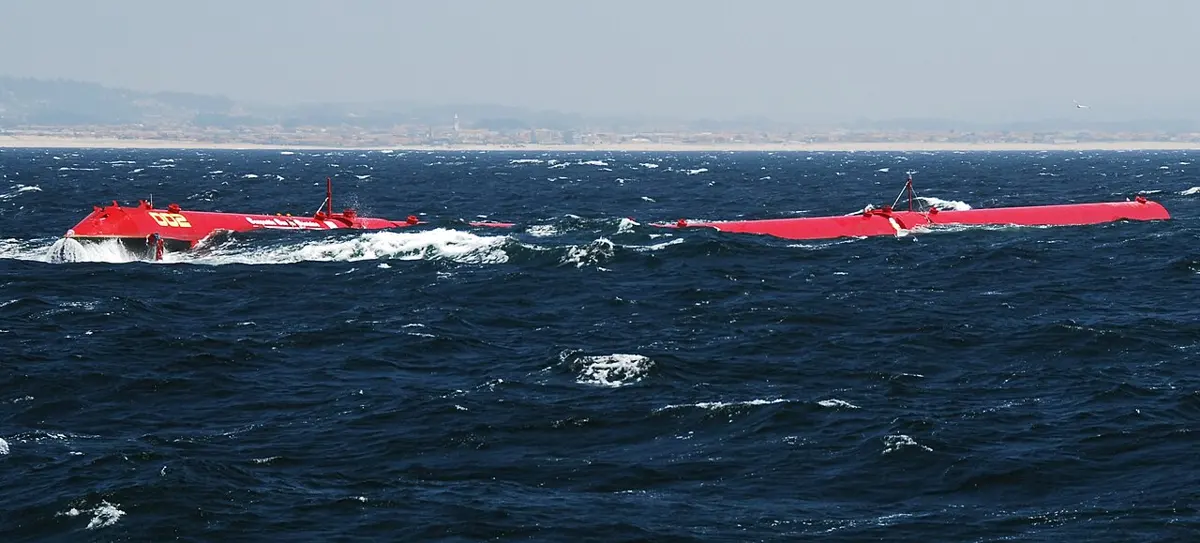
Wave energy is really stored wind energy, since waves are made by the wind blowing over the sea. It could be captured on the surface, under it, near the shore, offshore (out at sea) or far offshore. It is measured in kilowatts per meter of coastline; the US coastline could give about 252 billion kWh a year.
Status: five countries have run wave power farms; Portugal opened the world’s first commercial-scale wave farm at Aguçadoura in 2008, with 2.25 MW of capacity.
Today: that wave farm closed after only a few months, because of technical problems and the money troubles of its owners. Wave power is still being tested; the sea is hard on machines.
Idea IV: hydrogen
Hydrogen, a colorless, odorless gas, is the most common element in the universe: about three quarters of the mass of ordinary matter. On Earth it is almost always found joined to other elements: with oxygen in water, with carbon in fuels, with nitrogen in ammonia. To use it, it must first be separated (for example, by passing electricity through water). Then it gives a lot of energy while making almost no pollution: when hydrogen is used in a fuel cell, the only waste is water.
Status: fuel cells, which turn hydrogen into electricity, already power some cars, buses, aircraft, homes and buildings; Toyota, Honda and Hyundai have invested heavily in them.
Idea V: flying wind farms
On a flying wind farm, turbines float in the air as high as skyscrapers (very tall buildings), 1,000 to 2,000 feet (about 300 to 600 meters) above the ground, where the wind is steadier and stronger than at the top of a tower. Its makers said the winds up there are five to eight times stronger: what is five to eight times greater is the power the wind carries, since a wind less than twice as fast already carries that much more power. Such a turbine can produce about twice the energy of a similar one on a tower.
Status: Altaeros Energies made the first commercial airborne wind turbine, the Buoyant Air Turbine: a ring-shaped, 35-foot (about 11 meters) shell of strong fabric, filled with helium, with a 30-kilowatt turbine in the middle. It is autonomous (works by itself): it moves to the best height for the wind and self-docks (comes down by itself) in an emergency.
Today: flying turbines are still being tested; none yet makes power on a large scale.
Idea VI: fusion
Fusion is the process that powers the Sun: small atomic nuclei are pressed together so hard that they join into a bigger one, giving out a huge amount of energy. It could give an almost endless supply of energy. It gives off no greenhouse gases, and, unlike today’s nuclear fission reactors (which split heavy atoms such as uranium), it can’t run out of control in a meltdown: if anything goes wrong, the reaction simply stops. A fusion reactor would join two kinds of hydrogen atom, deuterium and tritium.
Status: ITER (the International Thermonuclear Experimental Reactor), being built in France and paid for by seven members (the European Union, China, India, Japan, South Korea, Russia and the United States), was then planned to be finished by 2027.
Today: ITER’s timetable has slipped: its experiments are now planned to begin in the mid-2030s. It is a research reactor, built to show that fusion can give out ten times more energy than is put in to heat it; it will not make electricity. Power stations would come after it. In December 2022, a laboratory in the United States got more energy out of a fusion reaction than its lasers put in, for the first time.
Why would a solar panel in space collect more energy than the same panel on the ground?
Pick an answer to see why.
Why does the text call wave energy “stored wind energy”?
Pick an answer to see why.
Words from the text
| Word | Meaning here |
|---|---|
| finite | limited; that will come to an end |
| embrace | to accept a new idea and start using it |
| fleet | a group of ships, vehicles or satellites working together |
| inflatable | that can be filled with air or gas |
| radiation | energy that travels as waves, such as light, heat or microwaves |
| beam | (verb) to send out a narrow stream of light, radio waves or microwaves |
| viability | the ability to work successfully |
| renewable | that is replaced naturally and will not run out |
| harvest | to collect (energy, crops) |
| harness | to control something and use its force or power |
| vane | a flat blade moved by wind or water |
| skyscraper | a very tall building |
| autonomous | able to work on its own, without being controlled |
| fission | the splitting of the nucleus of an atom |
| bountiful | in large amounts; plentiful |
A. Match the words
Match the words in column A with their meanings in column B.
- a.fleet b. inflatable c. harness d. vane e. skyscraper f. fission g. bountiful
- i.a flat plane that is moved by wind ii. a very tall building iii. a group of something iv. capable of being filled with air v. the act or process of splitting the nucleus of an atom vi. in large quantities vii. to control and use the force or strength of something
Answer
B. Antonyms
Find the antonyms of the following words from the text.
endless modern covered fragrant bound inadequate
Answer
C. Match the ideas
Match the idea numbers in column A to the correct idea in column B.
- a.Idea I b. Idea II c. Idea III d. Idea IV e. Idea V f. Idea VI
- i.wave energy ii. hydrogen energy iii. energy through the fusion process iv. solar energy v. energy through body movement vi. Altaeros energy
Answer
D. Answer the questions
How did JAXA prove the viability of the idea of space-based solar energy?
Answer
What do we need to generate energy through our body movement?
Answer
In what way are Ideas III and V similar?
Answer
How can hydrogen be used as a source of energy?
Answer
Why do floating turbines seem more effective than tower-mounted turbines?
Answer
Why is the fusion process environmentally friendly?
Answer
What does ITER stand for?
Answer
E. Other alternative sources
Can you think of any other alternative energy sources? Talk about your ideas with your friends.
A model answer
Listening: looking at an apartment
A. Before you listen
The picture shows a modern living room with sofas, a TV and ceiling lights, and a dining table beside an open kitchen.
- a.What type of dwelling do you see in the picture?
- b.Why is an apartment different from a house?
Model answers
The recording
A father and his son Tom are looking round an apartment the family might rent. Read the questions in B first, then listen, as many times as you need.
B. True or false
Listen to the audio and say whether the following statements are True or False.
- a.The son is eager to move into the new apartment.
- b.The father likes the floor space of the apartment.
- c.The apartment is closer to the boy’s school.
- d.There will be no disturbance from the neighbors in the new place.
- e.The manager of the apartment is not there right now.
- f.The father finally decides to move into the new apartment.
Answer
C. Answer the questions
- a.What does the son like about the apartment?
- b.What has the father not decided yet?
- c.What two things does the father or son not like about the room?
- d.Which four rooms have they looked at so far?
- e.Which room have they not seen yet?
Answer
These answers have been checked against the recording. Notice how the two describe a place, as in the Speaking: the living room is huge; it’s much bigger than the one we have now; it does have a lot more floor space; it’s a little small; there aren’t many windows. The son also says that his mother thinks the longer journey will take only ten minutes more, and that the extra bedroom could be his playroom (and the father, his exercise room).
D. House or apartment?
If you had a choice, would you prefer a house to an apartment? Why? Talk to your friends.
A model answer
Grammar II: relative pronouns
Remember: who (person, subject), whom (person, object), whose (possession), which (thing), that (person or thing, never after a comma), where (place). Two quick tests:
- Where or which? Use where if the clause is complete without the noun (my friend lives there → the town where my friend lives); use which or that if the noun is missing from the clause (you saw the photo → the photo that you saw).
- Who or whom? A verb next → who; a new subject next → whom.
“This is the field ……… the farmers grew the first potatoes in our village.” Which word fits?
Pick an answer to see why.
A. Fill in the gaps
Fill in the gaps with suitable relative pronouns.
- a.Is that the spot ……… you had the accident?
- b.The photograph ……… you saw was taken a long time ago.
- c.Are those the students ……… you were talking about?
- d.Last week, I went to visit the town ……… my friend lives.
- e.This is the house ……… my uncle and aunt live.
- f.These are the girls ……… work hard.
- g.Krishna was the boy ……… everyone appreciated.
- h.This is the judge ……… is known for her wise decisions.
- i.This is the site ……… I intend to build a house.
- j.The tiger ……… terrified the villagers was sent to the zoo yesterday.
- k.The tree ……… he cut down was not a large one.
- l.Mt. Everest, ……… is the highest peak in the world, lies in Solukhumbu district.
Answer
B. Join the sentences
Rewrite the following pairs of sentences using who, whom, whose, which/that or where.
- a.Are these the keys? You were looking for the keys.
- b.Unfortunately, we couldn’t attend the wedding. We were invited to the wedding.
- c.What is the name of the hotel? Your brother works in the hotel.
- d.The party wasn’t enjoyable. We attended the party last Saturday.
- e.What is the name of the boy? The boy’s father is a dentist.
- f.Who was the man? You talked to the man in the restaurant.
- g.What is the name of the shop? They sell medicine in the shop.
- h.Is this the man? The man donated all his property to a hospital.
Answer
Writing II: a news article on green energy
A news article (or newspaper article) is longer than a news story and does more than report one event: it explains a topic, gives facts and figures, looks at both good and bad sides, and often ends with the writer’s conclusion or a message to readers. It has a headline, a byline, an introduction that catches the reader’s interest, a body of a few paragraphs (one idea each), and a conclusion.
| News story | News article |
|---|---|
| reports one event that has just happened | explains a topic or issue |
| facts only, no opinion | facts, and the writer’s views and conclusion |
| about 100 words, most important first | longer, in a planned order: introduction, body, conclusion |
| dateline and lead | headline, byline, introduction |
In your final exam, a newspaper article is a Free writing II task (about 200 words, 8 marks), marked on its content, organization, language and layout.
Write a news article about green energy. Use the following prompts: natural source of energy; achieved from the Sun, wind, water, etc.; perpetual in nature; present status; benefits to humans and nature; challenges.
Hint
A model article
Project work: a debate
A debate is a formal discussion in which two teams argue for and against a motion (a statement), and judges decide which team argued better. One team (the proposition) speaks for the motion, the other (the opposition) against it, taking turns, each speaker for a fixed time.
Parts of a news story
The parts of a news story are shown here on a short report from RSS (Rastriya Samachar Samiti, Nepal’s national news agency) about a football match:
| Part | In the example | What it does |
|---|---|---|
| Headline | Nepal Beat Chinese Taipei | the main news in a few words |
| Byline | By RSS | who wrote or sent the story |
| Dateline | Kathmandu, June 4: | where the news comes from, and when |
| Lead | Nepal defeated Chinese Taipei 2-0 in the FIFA World Cup Asian Qualifying Match held last night at Al Kuwait Sports Club Stadium, Kuwait City. | the most important facts: who (Nepal, Chinese Taipei), what (won 2–0), where (Kuwait City), when (last night) |
| Body | the next paragraphs | the details: the competition (joint qualifiers for the 2022 FIFA World Cup in Qatar and the 2023 AFC Asian Cup), the goals (Anjan Bista from a penalty kick in the fourth minute, Nawayug Shrestha in the 81st minute), the result (six points, fourth in Group B) and the next matches (Jordan on 7 June, Australia on 11 June, according to the All Nepal Football Association, ANFA) |
The match was played on 3 June 2021. China was then to host the 2023 Asian Cup, as the report says; it later gave it up, and the tournament was held in Qatar in early 2024.
Which part of a news story answers who, what, where and when?
Pick an answer to see why.
Exercise
Practice on this unit in the style of the final exam (Grade 9’s exam follows the SEE’s kind of chart). Try each one as in the exam, then open the answer.
Read the news story and write True or False after each statement.
Dhangadhi, 9 January. A solar-powered irrigation pump installed last month has doubled the vegetable harvest of 40 farming families in Godawari Municipality, Kailali. The pump, which runs only in daylight, lifts water from a well 30 meters deep into a tank on a small hill, from where it flows to the fields. Before it was installed, the farmers used a diesel pump whose fuel cost them about Rs. 8,000 a month. “Now the Sun pays our bills,” said Phulmaya Chaudhary, the chair of the farmers’ group. The pump was paid for by the municipality and a farmers’ cooperative together.
- a.The pump was installed a year ago.
- b.The pump works at night too.
- c.The water is stored in a tank on a hill.
- d.The farmers used to spend money on diesel.
- e.The pump was paid for by the farmers alone.
Answer
Choose the correct relative word for each numbered blank.
Bhaktapur, (a) ……… (that / which / where / whose) is famous for its pottery, now has a robotics club. The students (b) ……… (who / whom / which / whose) meet there every Saturday build small robots from old toys. Bibek, (c) ……… (who / whose / whom / which) robot won a prize last year, teaches the younger members. The room (d) ……… (which / who / where / whose) they work was once a store. The prize (e) ……… (who / whom / that / where) they won paid for new motors.
Answer
Join these sentences, using the word in brackets.
- a.The robot was built by students. It hands out masks. (that)
- b.This is the engineer. We interviewed her yesterday. (whom)
- c.Sharmila scored the winning goal. Her shot was low and fast. (whose)
- d.Phewa is a lake. You can take a boat ride there. (where)
- e.Mt. Everest attracts climbers from all over the world. It is 8,849 meters high. (which)
Answer
Write a news story of about 100 words from these clues.
Science fair held at a school in Hetauda, Saturday … 60 projects by students of Grades 8–10 … first prize: a smoke alarm made from a cheap sensor, by Grade 9 student Lochan Shrestha … second: a solar water heater from old bottles … chief guest: the mayor … fair to be held every year
A model news story
Write a news article of about 200 words on “Robots and AI in Our Daily Life”.
A model article
Practice every question in the book, and keep track of the ones you miss →
A companion to your textbook, not a replacement for it: study from the book your school uses, and where the two differ, follow your teacher. Found a mistake? Please tell us.