
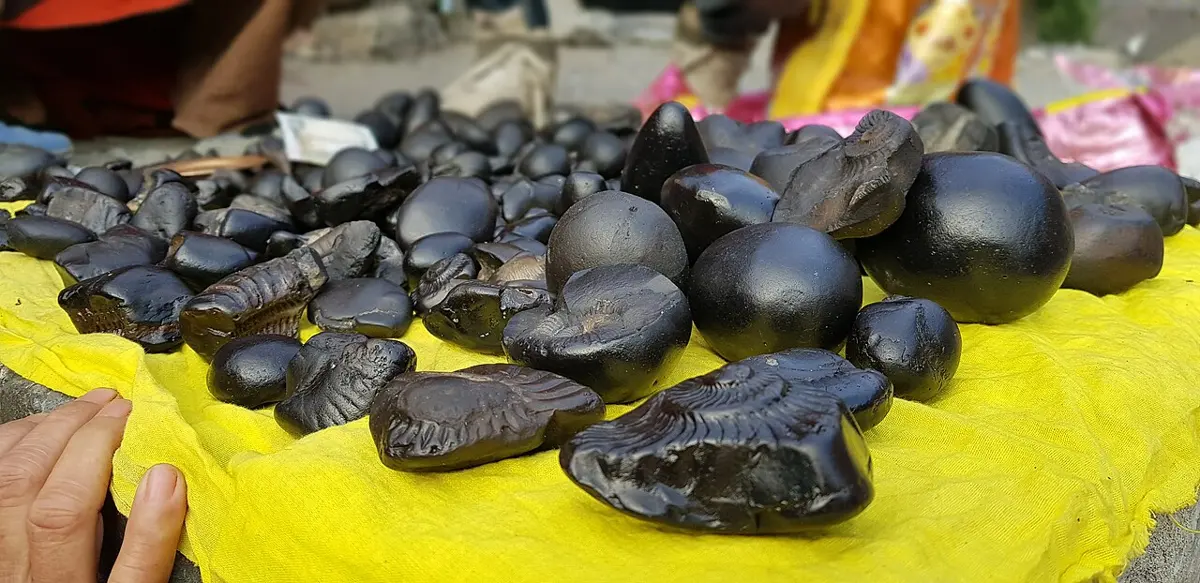
Climb up to Mustang, to the gravel banks of the Kali Gandaki, and you can pick up a smooth black stone that splits open to show a spiral shell inside. Pilgrims call it a shaligram. Geologists call it an ammonite: an animal that swam in a warm sea about 150 million years ago, in rock that is now pushed up thousands of meters into the Himalaya. One stone holds three stories: what the Earth is made of, how the Earth and its life changed over time, and where the Earth sits in a universe far bigger than the sea that ammonite swam in.
This unit tells all three. First, minerals: what rocks are made of, and why a country’s mines matter. Then the Earth’s history: how the Earth may have formed, and how life went from single cells to dinosaurs to us. Last, the universe: the Big Bang, asteroids, comets, shooting stars, galaxies and the patterns of stars you can learn to find from your own roof.
The Earth in the universe
Everything that exists is part of the universe: the Earth, the Moon, the Sun, the other stars, clouds of gas and dust called nebulae, planets, asteroids and meteors. People have suggested many ideas about how the universe began. The one that fits the scientific evidence best is the Big Bang theory, which you will meet in section 11.3.
When the Earth was young it was far too hot for life. Slowly it cooled. Its surface became rock, soil, sand, minerals and water, with a layer of gases above it, the atmosphere, and together these gave living things a place to live. In the early seas, simple chemicals joined into the large molecules of life (biomolecules), such as carbohydrates, proteins and nucleic acids. From these came the first very simple, single-celled living things, and from them, over billions of years of evolution, came all the variety of life on the Earth today.
11.1 Minerals
What a mineral is
The outer layer of the Earth, the crust, is made of rock, soil, sand and stones, with water in its seas, rivers and pores. Look closely at any of them, under a magnifying glass or a microscope, and you find they are built of tiny grains of different substances: elements and compounds. Those natural building blocks are minerals.
In geology (earth science), a mineral is a substance that is:
- natural: made by nature, not by people;
- solid;
- pure, with a definite chemical composition: quartz is always silicon dioxide, SiO₂, wherever it is found;
- usually crystalline: its particles are arranged in a regular, repeating pattern;
- inorganic: not made by living things.
Some minerals are single elements, such as gold, copper, sulphur, graphite and diamond (carbon). Most are compounds, such as quartz (SiO₂), hematite (iron oxide, Fe₂O₃) and calcite (calcium carbonate, CaCO₃). A rock is a mixture of minerals: granite, for example, is made of grains of quartz, feldspar and mica that you can see with your eyes. Water holds minerals too, dissolved in it: that is what makes sea water salty and some well water hard.
There is also a second, everyday meaning. To miners, governments and economists, a mineral is anything useful dug out of the ground (from a mine, which is where the word comes from) and worth money. In this wider sense coal, petroleum, natural gas, limestone, marble, granite, slate, red clay and white clay, diamonds and other gems are all called minerals, or mineral resources. This unit uses the word in both ways, as most books do.
The branch of geology that studies minerals is called mineralogy. More than 6,000 different minerals are known.
Which of these is a mineral in the strict, geologist’s sense?
Pick an answer to see why.
Types of minerals
By what they are made of and how they behave, minerals (in the wide, everyday sense) are put into three groups: metallic minerals, non-metallic minerals and energy minerals. Each group splits further, as in Figure 11.1.
(a) Metallic minerals
Metallic minerals are minerals from which a metal can be got. They are usually hard, shiny (lustrous), heavy for their size (dense), and many conduct heat and electricity well. When a metallic mineral holds enough metal to be worth extracting, it is called an ore. The ores of iron, tin, nickel, copper, gold, silver, zinc and cobalt are metallic minerals. They come in three kinds:
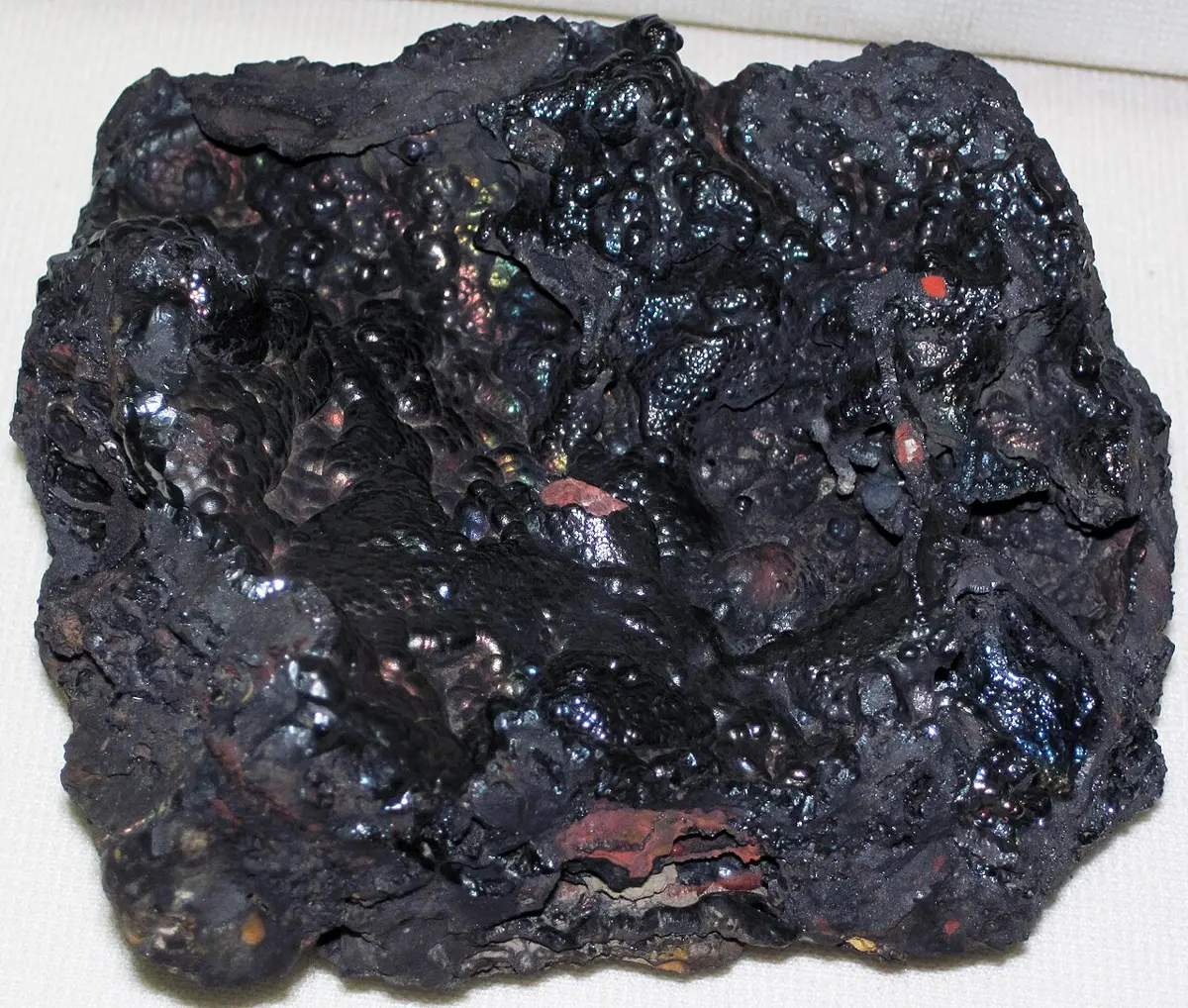
- Ferrous minerals contain iron (Latin ferrum). Iron is extracted from hematite, magnetite, limonite and siderite. Pyrite, a shiny yellow iron mineral, also belongs here, though it is used more for its sulphur than for iron.
- Non-ferrous minerals have no iron, or very little: the ores of copper, lead, tin and aluminium, such as galena (lead sulphide) and bauxite (the ore of aluminium).
- Precious minerals are rare, very valuable, and chemically unreactive, so they don’t rust or tarnish easily: the minerals of gold, silver, platinum and palladium. Gold is found as the pure metal, often as specks in river sand.
(b) Non-metallic minerals
Non-metallic minerals behave like non-metals, even though many contain metal atoms joined to other elements. They are poor conductors of heat and electricity (insulators), and light for their size. Being light, they are found in the upper part of the crust. Most occur mixed in rocks, and some are found pure. They come in two kinds:
- Gems (gemstones): rare, hard, beautiful minerals that sparkle when cut and polished: diamond, emerald, sapphire, ruby, topaz, garnet and tourmaline.
- Non-gems: minerals used in industry and building: silica (quartz sand, for glass), feldspar (for ceramics), mica (an insulator that splits into thin sheets), sulphur, graphite (the “lead” of pencils), gypsum (for plaster and cement) and talc (talcum powder).
(c) Energy minerals
Fuels that come out of the ground, and are burnt or used in industry and homes for energy, are called energy minerals: coal, petroleum, natural gas, and radioactive elements such as uranium (used in nuclear power stations). They took millions of years to form, so once used up they are gone: they are non-renewable sources of energy.
Coal formed from the plants of ancient swamp forests. Buried under mud and rock, squeezed and heated for millions of years, the plant matter slowly lost its water and gases and became richer in carbon, passing through four stages, in Figure 11.3.
Fern: H. A. Köhler, Medizinal-Pflanzen (1887), public domain
Bauxite, from which aluminium is made, is a
Pick an answer to see why.
Properties of minerals
- a.Color. Minerals come in many colors. Iron minerals are black or reddish brown; gold and copper minerals are yellow or reddish; some minerals, such as muscovite (a kind of mica), are colorless. Color can fool you, though: tiny traces of other elements can change it, so geologists also look at the color of a mineral’s powder, its streak.
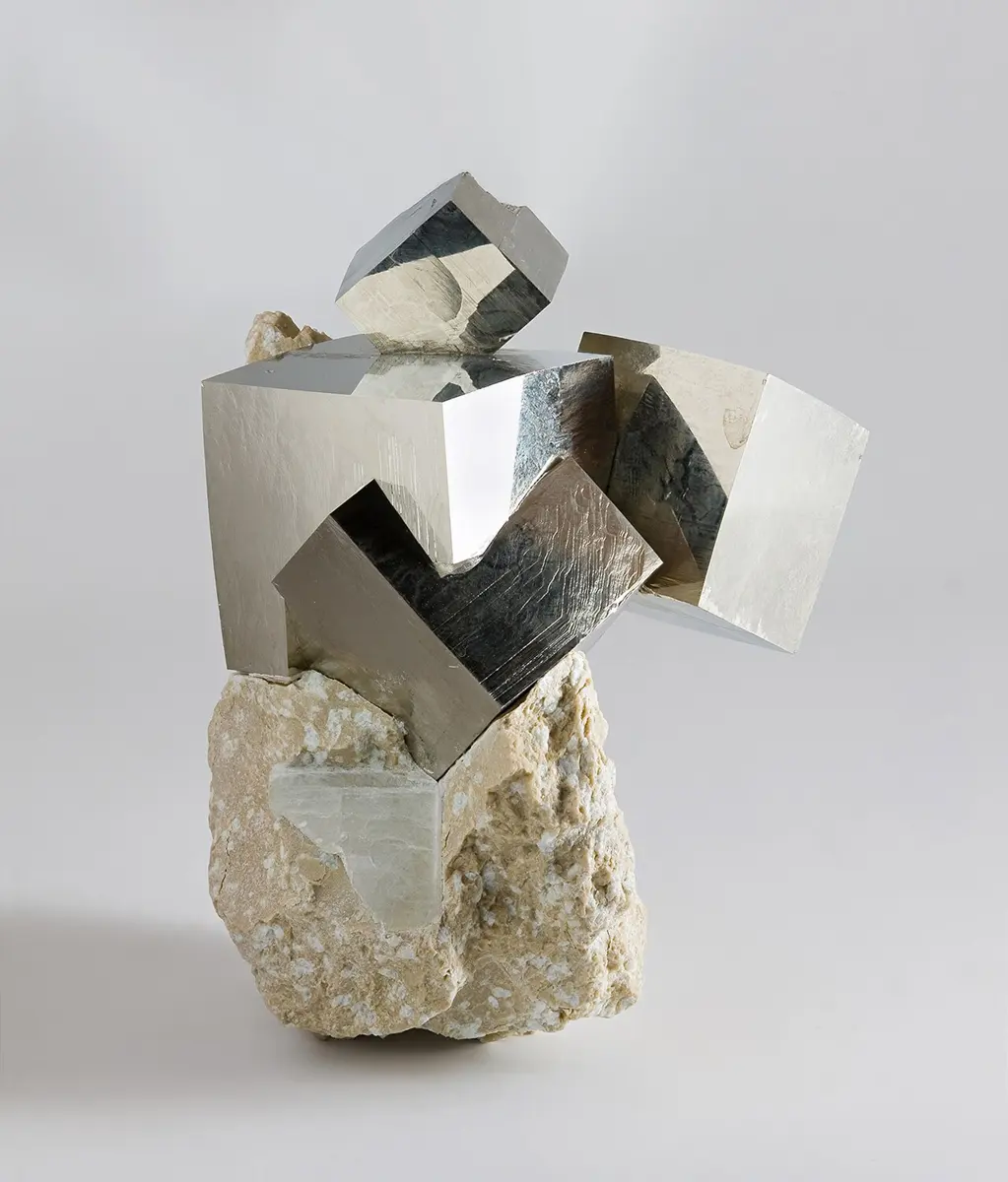
- b.Shape. Most minerals form crystals with a fixed geometric shape, because their particles are packed in a regular pattern. Common shapes are cubes (like pyrite) and long prisms (like tourmaline). A few minerals form no crystals at all: they are amorphous (shapeless), like opal.
- c.Hardness and luster. Many minerals are hard, bright and lustrous, but not all: hardness runs from soft talc, which a fingernail scratches, to diamond, which scratches everything.
- d.Conduction. Metallic minerals usually conduct electricity and heat well; non-metallic minerals are insulators.
- e.State and composition. Minerals are solids. Each is homogeneous (the same all through) with a definite chemical composition.
Which property of minerals explains why a piece of quartz from Nepal and one from Brazil have exactly the same chemical formula?
Pick an answer to see why.
Uses of minerals
Almost everything around you, from the cement in your house to the phone in your pocket, began as a mineral dug from the ground. Many minerals are the raw materials of industries.
(a) In agriculture
Plants need elements such as nitrogen, phosphorus, potassium, calcium, sulphur and iron to grow, stay green, flower and fruit. These come from the soil, and soil gets them from minerals. When crops take them out year after year, farmers put them back with chemical fertilizers, many of which are made from minerals: phosphate rock for phosphorus, potash for potassium, gypsum for calcium and sulphur, and sulphur itself. Lime and dolomite are spread on acid soil. Minerals also go into pesticides, micronutrient mixtures and animal feeds, which support farming, fish farming (pisciculture), animal husbandry and poultry farming.
(b) In industry
Minerals are used in industry as raw materials or as sources of energy. Whole industries are built on them: cement, glass, paint, ceramics, detergents. Silica, mica, gypsum, limestone, magnesite and granite are some of the minerals they use. Nepal has many limestone-based cement factories, among them Udayapur Cement and Hetauda Cement. Electric cables, iron rods, tools, machinery and weapons are made from metals extracted from metallic minerals.
(c) In construction
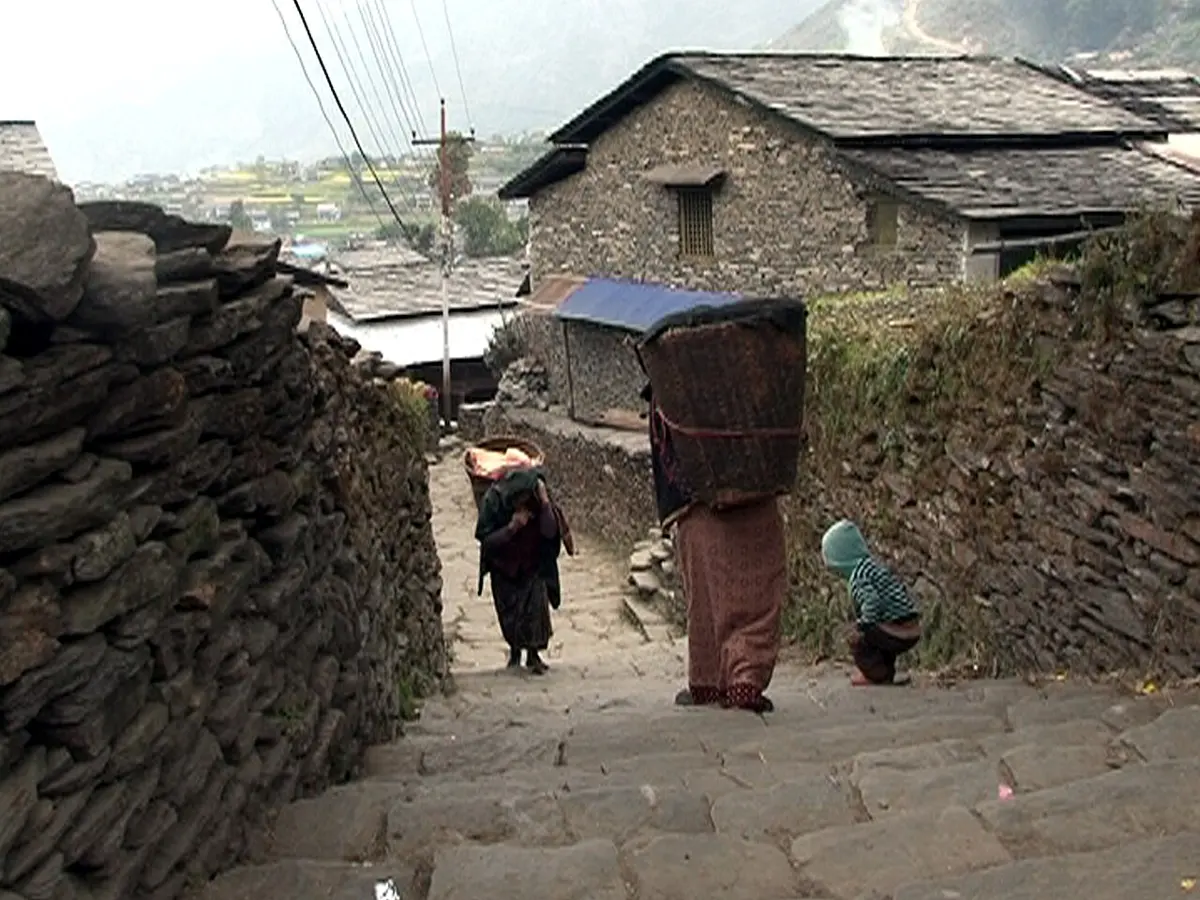
Houses, bridges and roads are built from rocks, sand, gravel, cement and gypsum. In many parts of Nepal where slate splits naturally into flat sheets, houses are roofed with it. Limestone and marble are carved into images, idols and inscriptions, and marble, granite and slate are polished into floors and decorations.
(d) In energy
Petroleum runs vehicles, cooks food and makes electricity. Coal gives the very high temperatures needed in cement factories, brick kilns and the blast furnaces that make iron. Other minerals store electricity in batteries: a dry cell has a zinc case, manganese dioxide and a graphite rod; a car battery has plates of lead; a phone battery uses lithium, graphite and cobalt or manganese. Uranium fuels nuclear power stations.
Which of these uses a mineral as a source of energy, not as a raw material?
Pick an answer to see why.
Minerals in Nepal
More than 60 kinds of minerals have been found in Nepal: about 21 metallic, 23 used for chemical fertilizers and insulating materials, 6 gems, 9 building materials, and 4 related to fuel and geothermal energy.
Where they are likely to be found depends on the land:
- The Terai plains: building materials (sand, gravel), underground water, and possibly petroleum and natural gas.
- The hills and lower Himalaya (the Mahabharat and nearby ranges): iron, zinc, lead, copper, gold, magnesite, phosphorite, limestone, dolomite, slate and garnet.
- The high Himalaya: building stone, radioactive minerals, and possibly petroleum and natural gas.
The Himalaya and its surroundings hold most of the country’s minerals, about 83%. Nepal has metallic, non-metallic and energy minerals, and building and decorative stone, in good amounts: limestone, dolomite, silica, coal, gold, iron, gypsum, mica and even radioactive uranium. People here have mined since ancient times: iron from Thoshe in Ramechhap and from Phulchoki, copper from many hills, and coal in Dang. Even so, not enough research has been done to find and use these minerals, which could raise the country’s income faster than many other resources.
| S.N. | Mineral | Places where it is found or likely |
|---|---|---|
| 1 | Iron | Phulchoki (Lalitpur), Thoshe (Ramechhap), and more than 88 other places |
| 2 | Copper | more than 107 places |
| 3 | Zinc and lead | Ganesh Himal and around it; more than 57 places |
| 4 | Gold | the sands of the Rapti, Sunkoshi, Kali Gandaki, Bishnumati and many other rivers |
| 5 | Limestone | Udayapur, Makwanpur, Chobhar (Kathmandu) |
| 6 | Dolomite | the Mahabharat range |
| 7 | Phosphorite | Dang, Pyuthan, Baitadi |
| 8 | Magnesite | Dolakha, Udayapur, Palpa |
| 9 | Ceramic clay | Makwanpur, Kathmandu Valley |
| 10 | Silica | river sand |
| 11 | Rock salt | Mustang, Dolpa |
| 12 | Quartz crystal | Dailekh, Taplejung, Rasuwa |
| 13 | Marble and granite | Godawari (Lalitpur), Sindhuli |
| 14 | Slate | Dhankuta, Achham, Gorkha, Benighat (Dhading) |
| 15 | Coal | Dang, Palpa, Pyuthan |
| 16 | Uranium (radioactive) | Upper Mustang |
11.2.1 Origin and age of the Earth
How old is the Earth, and how did it form? Nobody was there to watch. But rocks keep records. Some atoms in rocks, such as uranium, slowly and steadily change into other atoms, like the sand running through an hourglass, and by measuring how much has changed, scientists can tell a rock’s age. The oldest pieces of the Earth found so far, tiny crystals of the mineral zircon from Australia, are about 4.4 billion years old; meteorites, leftover pieces from the birth of the planets, are about 4.6 billion. From the ages of rocks, meteorites and fossils, the Earth is estimated to have formed about 4.6 billion years ago (4,600 million years).
The universe itself is much older. The stars, planets and moons formed long after the universe began. Over the last three centuries, several ideas (hypotheses) have been put forward about how the Earth and the other planets formed. Four of them are:
- a.the nebular hypothesis of Kant and Laplace
- b.Buffon’s planetesimal hypothesis
- c.the binary hypothesis of Chamberlin and Moulton
- d.the tidal hypothesis of Jeans and Jeffreys
(a) Nebular hypothesis
In 1755, the German philosopher Immanuel Kant used Newton’s law of gravitation to imagine how the Solar System could have formed. In his picture:
- Where the Solar System is now, there was once a huge, roughly round, flat cloud of gas and dust, a nebula, turning slowly.
- Gravity pulled its particles towards one another and towards the center. As the particles crowded in, swirls (eddies, or eddy currents) in the cloud gathered them even faster, and the center grew bigger and spun faster, the way a dancer spins faster when she pulls in her arms.
- The center became a huge ball of matter, a protostar. Pressure inside it grew so great that its core reached millions of degrees, hot enough for nuclear fusion to begin. The ball began to shine: it became the Sun.
- The rest of the spinning cloud, outside the center, flattened into a disc around the young Sun, the way a lump of dough spun on a finger spreads into a flat roti. (The outward pull that anything spinning seems to feel is often called centrifugal force; it is strongest at the equator, so the cloud spread out there.)
- Inside the disc, particles collected into lumps at many places. The lumps grew into planets, and the material around the planets became their moons (satellites). The leftover bits became asteroids, comets and meteoroids.
In 1796, the French scientist Pierre-Simon Laplace improved the idea. In his version, as the young Sun shrank and spun faster, it threw off rings of matter from its equator, one after another, like drops of water flying off a wet cloth that is spun fast. Each ring gathered into a planet, and the planets threw off rings that became their moons.
Panel 1: Barnard 68, ESO, CC BY 4.0
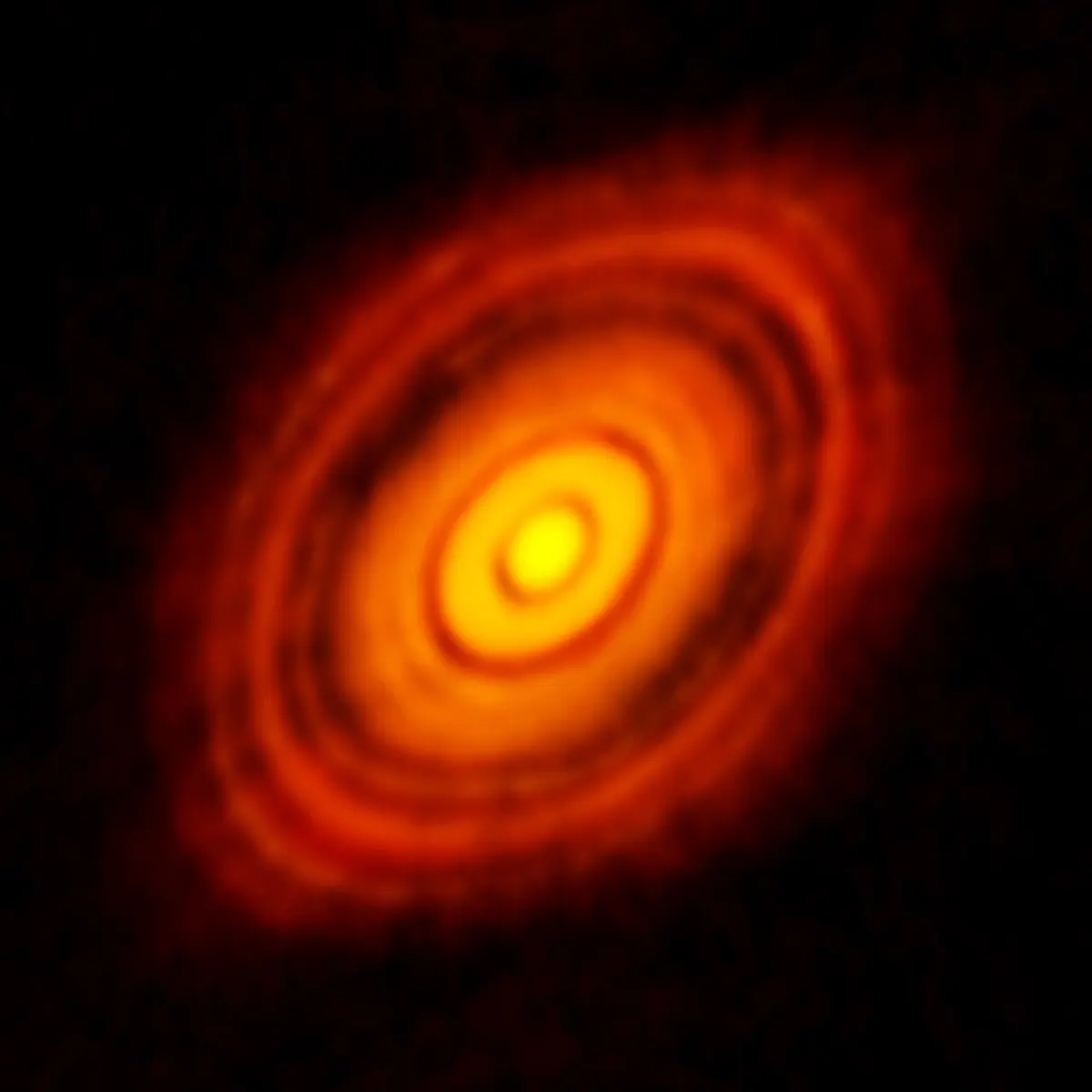
Panel 3: HL Tauri, ALMA (ESO/NAOJ/NRAO), CC BY 4.0
What this hypothesis explains:
- i.The planets and moons formed from cold dust and gas. As lumps crashed together while they grew, the heat of the collisions melted them partly, again and again, and they cooled again.
- ii.Because everything formed from one flat, spinning disc, all the planets go round the Sun in nearly the same flat plane, and in the same direction, the same direction the Sun spins. This is exactly what we see.
(b) Planetesimal hypothesis
Even before Kant, in 1749 (some books say 1745), the French naturalist Georges-Louis Leclerc, Comte de Buffon, had a different idea. In his picture, only the Sun existed at first. Long ago a giant comet crashed into the Sun at a low, glancing angle and splashed out some of its matter. Some of it escaped into space, some fell back into the Sun, and the rest, in pieces he imagined as planetesimals (“tiny planets”), went round the Sun. As they cooled, they became the planets and the other members of the Solar System.
What this hypothesis says:
- a.The Earth and the other planets were extremely hot at first, and have been cooling slowly ever since, each at its own distance from the Sun.
- b.All the planets, moons and asteroids together have less than 1% of the mass of the Sun (about 0.14%). So only a small splash from the Sun would have been needed to make them all.
The problem: a comet is tiny, a ball of ice a few kilometers across. Buffon didn’t know that; he thought comets were huge. A comet hitting the Sun simply vanishes into it.
(c) Binary hypothesis
The binary hypothesis is credited to two American scientists, Thomas Chrowder Chamberlin and Forest Ray Moulton, in 1905. Our Sun, it says, once had a partner star: the two formed a binary (two-star) system, going round each other. Once the partner came very close to the Sun, and its strong gravity pulled out some of the Sun’s matter. The partner star moved swiftly on, before the matter could fall onto it. The matter left behind went round the Sun, slowly cooled, and became the planets, moons and other members of the Solar System.
The criticism: nobody has ever found a partner star of the Sun. The Sun is a single star.
(d) Tidal hypothesis
Around 1917–1919, two English scientists, Sir James Jeans and Harold Jeffreys, put forward the tidal hypothesis. In this galactic neighborhood, they said, there was only the Sun. Then a much bigger star passed close by at high speed. Its strong gravity pulled a huge lump of hot matter out of the Sun’s surface, the way the Moon’s gravity raises the tides in the sea. The lump was shaped like a cigar: thin at both ends and fat in the middle. It went round the Sun, broke up, and its pieces pulled themselves together by their own gravity and cooled into planets.
Planets: NASA (Mercury: MESSENGER; Venus: Mariner 10, processed by Ricardo Nunes; Earth: Apollo 17;
Mars: Viking, USGS; Jupiter: Hubble, with ESA and A. Simon; Saturn: Cassini, JPL/Space Science Institute;
Uranus and Neptune: Voyager 2), public domain
What this hypothesis explains:
- a.Since the cigar was thin at the ends and fat in the middle, the planets formed from its ends are small (Mercury nearest the Sun) and those from the middle are big: Jupiter, from the fattest part, is the biggest of all.
- b.By this pattern, Mars, farther out than the Earth, should be bigger than the Earth, but it is smaller. Supporters of the hypothesis suggested that a planet there must have broken into pieces, forming the thousands of asteroids between the orbits of Mars and Jupiter.
Which idea is right?
The three “catastrophe” ideas (a comet or a star tearing matter out of the Sun) all fail on one point: gas torn from the Sun would be millions of degrees hot, and would spread out into space instead of clumping into planets. Close passes between stars are also extremely rare. And the asteroids are not a broken planet: all of them together have only about 3% of the mass of our Moon. Jupiter’s strong gravity kept stirring them up, so they never managed to gather into a planet.
So scientists today use an improved nebular theory: the Sun and the planets formed together, about 4.6 billion years ago, from a spinning disc of gas and dust. The planets grew from dust grains, to pebbles, to rocks, to planetesimals a few kilometers across, which crashed together into planets. And we can now see it happening around other young stars.
Which fact about the Solar System is best explained by the nebular hypothesis?
Pick an answer to see why.
In the tidal hypothesis, what pulled matter out of the Sun?
Pick an answer to see why.
11.2.2 History of evolution of living beings on Earth
A young, violent Earth
When the Earth was forming, rocks and boulders crashed into it from every direction at tremendous speeds. Each crash released enormous heat, and much of the young Earth melted again and again. Nothing was stable.
In the molten Earth, the heavy metals, such as iron and nickel (and gold), sank towards the center and made the core. Lighter substances, rich in silicon, magnesium and aluminium, floated up and made the mantle and the crust, as in Figure 11.10. As the surface cooled and shrank, and was heated and pushed again from below, it wrinkled into mountains, valleys, plains, anticlines (upward folds of rock) and synclines (downward folds).
Heat broke down the minerals in the rocks, and volcanoes released gases: water vapor, carbon dioxide, sulphur dioxide, nitrogen, ammonia and methane. These gases slowly made the first atmosphere. There was almost no free oxygen in it: you could not have breathed it. As the Earth cooled, the water vapor condensed, and it rained, for a very long time. The rain filled the low places and made the oceans, seas and ponds. Slowly, the Earth became a place where life could begin.
In the early seas, energy from lightning, volcanic heat and sunlight joined simple substances, made of hydrogen, oxygen, nitrogen and carbon, into the large molecules of life: proteins and nucleic acids. From them, more than 3.5 billion years ago, came the first very simple cells, prokaryotes, like bacteria. Every living thing on the Earth today has come from those simplest beginnings, through a slow and continuous process of organic evolution.
Later, tiny living things in the sea began to make their food by photosynthesis, giving off oxygen. Over about two billion years, that oxygen slowly built up in the air. The oxygen you breathe was made by living things.
The geological time scale
The Earth’s history is so long that, to study it, geologists divide it into units, like a calendar divides time into years, months and days. This is the geological time scale. Its longest units are called eons. Here the Earth’s history is divided into two eons, the Cryptozoic and the Phanerozoic, and each eon into three eras.
(a) Cryptozoic eon
Cryptozoic means “hidden life”: life in this eon was tiny and soft, and left few clear fossils, so it stayed hidden for a long time. The Cryptozoic eon is the first part of the Earth’s history. It began when the Earth formed, 4.6 billion years ago, and ended about 540 million years ago (older books say 570). It covers almost 88% of the Earth’s history. Many geologists call it the Precambrian (“before the Cambrian”); some older books call it the Azoic era (“without life”), from a time when no fossils had yet been found in its rocks. We know much less about it than about later times, because its rocks are old and much changed.
It is divided into three eras:
- i.Archaeozoic era: the Earth’s crust, oceans and air (the lithosphere, hydrosphere and atmosphere) formed, making the Earth fit for life; by its end, the first simple single cells, like bacteria, had appeared in the water.
- ii.Proterozoic era: primitive single-celled (unicellular) life spread in the water. Oxygen made by blue-green bacteria began to build up in the air, and the first cells with a nucleus appeared.
- iii.Eozoic era: some soft-bodied single-celled and many-celled sea animals, and algae, evolved in the water.
(b) Phanerozoic eon
Phanerozoic means “visible life”. This eon began about 540 million years ago and is still going on. It is only about 12% of the Earth’s history, but it is the most important for us, because in it life became large, varied and plentiful. By when groups of living things appeared and died out, it is divided into three eras: the Paleozoic, Mesozoic and Cenozoic (“old life”, “middle life” and “new life”).
(i) Paleozoic era
The Paleozoic era began about 540 million years ago and ended about 250 million years ago, a length of nearly 300 million years: the longest of the three eras. (Older books give 570 and 240 million years ago, and a length of 330 million years.)
In the Paleozoic, many kinds of many-celled animals and plants evolved in the water, and some of them slowly moved onto the land. Nearly all the main groups of invertebrates (arthropods, mollusks, echinoderms) appeared, then fish (pisces), amphibians and small reptiles. Among plants came the cryptogams, plants without flowers or seeds.
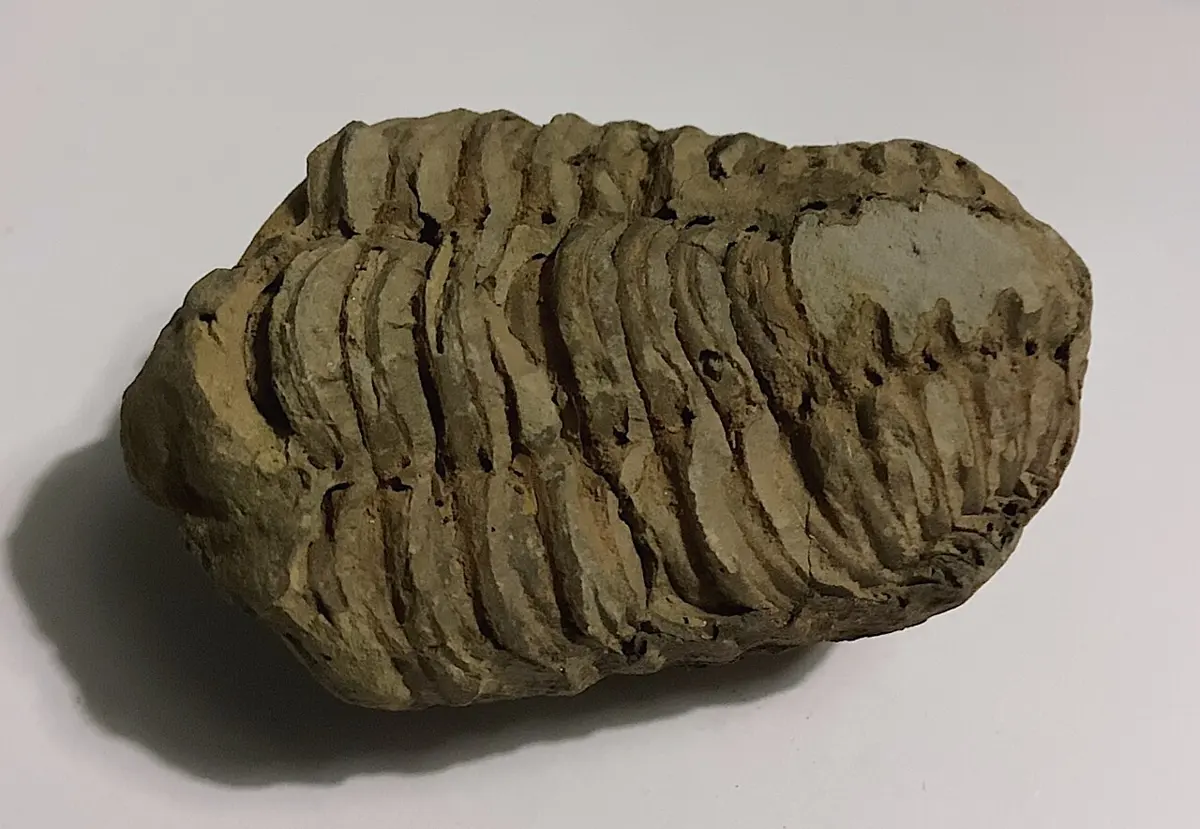
Main events and life. The Earth’s crust was restless all through this era. In its first period, the Cambrian, more kinds of sea animals and algae appeared than in any other period, so quickly that it is called the Cambrian explosion. Over the era came trilobites, crustaceans, mollusks and snails, corals, sea scorpions, lungfish, and the first four-legged animals, the amphibians; and among plants, algae, mosses (bryophytes) and ferns (pteridophytes), with dense forests of tree ferns and club mosses (small ones like lycopodium, which still grows in Nepal’s forests, and giant tree-sized relatives that have died out). At the end of the era, huge volcanic eruptions and changes in the Earth’s crust killed most living things for ever.
(ii) Mesozoic era
The Mesozoic era began about 250 million years ago and ended 66 million years ago, a length of about 185 million years. (Older books give 240 and 65 million years ago, and 175 million years.) Many changes of land and climate happened, and many new, more advanced living things evolved. Because the variety of plants (flora) and animals (fauna) grew so great, this era is very important in the history of evolution.
Main events and life. The climate became drier, and the seasons began to show their effects. Seas got deeper in places, and land spread. Storms, clouds, heavy thunderstorms, and big differences between day and night temperatures were common. Forests of conifers and other gymnosperms (seed plants without flowers), such as cycas, pines, ginkgo, juniper and ephedra, replaced the fern forests on almost all moist land. So the Mesozoic is also called the era of gymnosperms or era of conifers. Later in the era, the first simple flowering plants appeared.
The most striking events of the Mesozoic were the rise and the end of the great reptiles. Dinosaurs ruled the land: some ate plants (herbivores), some ate everything (omnivores), and some were the top meat-eaters (carnivores). At the same time pterosaurs flew in the air and huge sea reptiles swam in the oceans. Dinosaurs first appeared in the first period of the era, the Triassic, became the largest animals on the land in the second, the Jurassic, and died out at the end of the third, the Cretaceous. Crocodiles, lizards, turtles and the first snakes evolved in this era too. Because reptiles were so many and so dominant, the Mesozoic is also called the age of reptiles, or the era of creepers. Small mammals, toothed birds, mosquitoes and fruit-eating insects also evolved during the Mesozoic.
The end of the dinosaurs came suddenly. About 66 million years ago, an asteroid about 10 km wide hit the Earth where Mexico is today, leaving a crater about 180 km across. The crash threw up burning rock and dust that set forests on fire and darkened the sky for months; plants could not grow, and the food chains collapsed. Huge volcanic eruptions in India, already under way, made things worse. (Some books describe a shower of meteors or comets. It was one asteroid.) About three in four kinds of living things died out: all the dinosaurs except the birds, and the pterosaurs and great sea reptiles too.
Why is the Mesozoic era called the era of conifers?
Pick an answer to see why.
(iii) Cenozoic era
The Cenozoic is the era we live in. It began 66 million years ago and is still going on. Mammals, including human beings, and flowering plants (angiosperms) spread across the Earth and evolved into the many kinds we know, so this era is also called the era of mammals and the era of angiosperms.
Main events and life. The continents drifted into the places they are today, slowly, through the movement of the Earth’s crust (plate tectonics), and each developed its own climate. India crashed into Asia, and the Himalaya rose higher and higher. Many mountains, rivers, lakes, plains, plateaus and valleys formed, and the seasons changed regularly. These changes led to the evolution of many modern animals and plants. Many giant mammals evolved, among them elephants and mammoths, horses, cats, monkeys and other primates, rhinos, whales, and the huge pig-like entelodonts; and monocot and dicot plants spread everywhere. Many of the giant mammals have since died out.
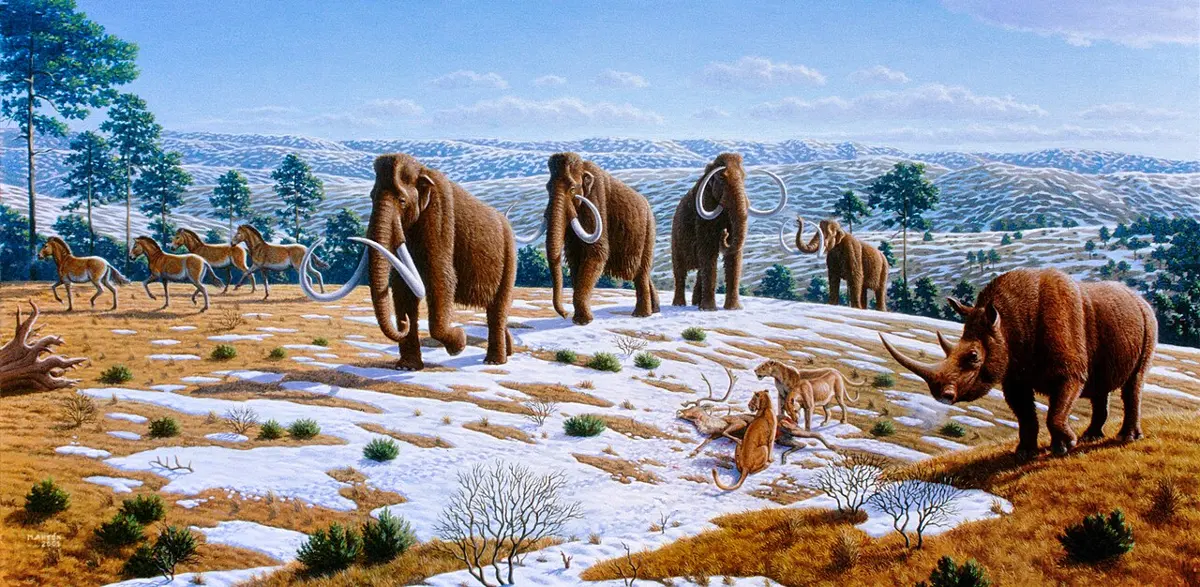
The human story is very recent. The line leading to humans split from that of the other apes about 6 to 7 million years ago, and early humans were walking upright on two legs by about 4 million years ago. Our own species, Homo sapiens, appeared in Africa about 300,000 years ago. Modern humans reached Europe about 45,000 years ago, where their remains are called Cro-Magnons. For most of that time people lived as hunter-gatherers. Only about 10,000 to 12,000 years ago did they begin to grow crops, keep animals and live in villages, building the societies, religions and family life we know. This most recent stretch of time, from about 11,700 years ago to today, is called the Holocene epoch.
Which era is called the era of mammals?
Pick an answer to see why.
Exercise (11.1–11.2 Minerals and the Earth)
1. Choose the correct alternative
a. What is the branch of science that studies minerals called?
Pick an answer to see why.
b. Which mineral is necessary for the proper growth of plants?
Pick an answer to see why.
c. Which statement describes the tidal hypothesis?
Pick an answer to see why.
d. A fish like a carp: in which era did fish evolve?
Pick an answer to see why.
2. Differentiate between
Metallic minerals and non-metallic minerals
Answer
Paleozoic era and Cenozoic era
Answer
3. Give reasons
Minerals are said to be pure chemicals.
Answer
The Mesozoic era is also called the era of conifers.
Answer
Living beings evolved only a very long time after the Earth formed.
Answer
4. Answer the following questions
What is a mineral? Give examples.
Answer
What are the hypotheses about the origin of the Earth? Explain any one of them.
Answer
Explain the importance of minerals for Nepal.
Answer
Make a flowchart of minerals showing their types.
Answer
Which era was unsuitable for the evolution of life, and why? Explain with an example.
Answer
When did mammoths with long tusks, and fish with lungs, evolve?
Answer
Make a list of places in Nepal for any five minerals, with their uses.
Answer
Name the era in which each of these evolved: tree fern, entelodon (a giant wild pig), dinosaur, frog, monocot plants, bacteria, mosquito, trilobite, jellyfish.
Answer
Read the passage and answer the questions.
“Many kinds of minerals are found in Nepal. Recently, valuable minerals like uranium have also been reported. Some minerals, such as iron, copper, coal and gold, have been extracted and used traditionally, but the effective exploration, extraction and commercial use of minerals is yet to be done, and they are not being extracted sustainably.”
- i.Why might minerals not be explored, extracted and used sustainably in Nepal?
- ii.Which minerals are extracted traditionally in Nepal? What should be done to extract and use them sustainably?
Answer
Look at dinosaurs: a long-necked sauropod, a stegosaurus, a triceratops, a tyrannosaurus and a small two-legged meat-eater.
- i.In which era did these animals evolve and die out?
- ii.What were the reasons for their extinction?
- iii.If these animals were still roaming the Earth, what would be the impact on the balance of nature, in your opinion?
Answer
11.3 The Universe
Planets, moons, stars, meteors, asteroids and comets: all the bodies we see in the sky are called heavenly bodies or celestial bodies. Between and around them are dust, gas, clouds and ordinary matter too thin to see, an invisible dark matter that we know only by its pull, tiny particles (such as electrons and other leptons), and light (photons), with the energy they carry. They are all very far from the Earth.
What the universe is
The almost empty region beyond the Earth’s air, stretching out between the planets, the stars and the galaxies, is called space. The sky is what we see of it from the ground: the great dome above us. The universe is everything that exists: all of space and time, and all the matter and energy in it. The Earth, the Moon, the Sun, the stars and every other celestial body are only small parts of it. Nobody knows whether the universe goes on for ever or has an end.
The part of the universe we can see, even in principle, is called the observable universe. Light travels at a fixed speed, and the universe has existed for only 13.8 billion years, so light from beyond a certain distance has not had time to reach us yet. The observable universe is the region whose light has had time to arrive: a huge sphere around us, about 93 billion light-years across. (It is wider than 13.8 billion light-years in every direction because space has been stretching while the light traveled.)
A light-year (ly) is the distance light travels in a vacuum in one year: about 9.46 × 10¹² km, nearly ten trillion kilometers. The branch of science that studies the universe and the heavenly bodies is astronomy.
What is the observable universe?
Pick an answer to see why.
Origin of the universe and the Big Bang theory
The universe began about 13.8 billion years ago. How can anyone know? Not by watching the start, but by measuring the universe as it is now, and working backwards.
In 1924, the American astronomer Edwin Powell Hubble showed that the faint spiral clouds then called “spiral nebulae”, such as the one in Andromeda, are not clouds inside our Milky Way at all: they are other galaxies, enormously far away. In 1927, the Belgian priest and scientist Georges Lemaître worked out that the universe must be expanding, its galaxies moving apart. In 1929, Hubble measured it: the farther away a galaxy is, the faster it is moving away from us.
Lemaître then ran the film backwards. If everything is moving apart now, then yesterday it was a little closer together, and long ago it was all crowded together. Go back 13.8 billion years, and all the matter and energy of the universe is packed into one unimaginably tiny, hot and dense point. In 1931 he called it the primeval atom.
According to this idea, the hot, dense primeval atom began to expand, suddenly and extremely fast, 13.8 billion years ago. This beginning is called the Big Bang. As the universe expanded, it cooled:
- First came energy and the smallest particles (pre-matter), then subatomic particles: protons, neutrons and electrons.
- These combined into atoms, mostly hydrogen and helium, and atoms into molecules.
- Over hundreds of millions of years, gravity pulled the gas together into stars, galaxies and nebulae, and much later, planets like the Earth.
The Big Bang is not just a guess. Three kinds of evidence support it: the galaxies are all moving apart; in 1965, two American scientists picked up a faint glow of microwaves coming from every direction in the sky, the cooled-down afterglow of the Big Bang itself; and the universe has just the amounts of hydrogen and helium the theory predicts. The British scientist Stephen Hawking used mathematics to describe how the universe could begin from a singularity (a point of infinite density), and explained it for everyone in his book A Brief History of Time: From the Big Bang to Black Holes (1988).

Who first put forward the idea that the universe is expanding?
Pick an answer to see why.
Asteroids
Anything that goes round the Sun, big or small, is a member of the Solar System. Besides the eight planets and their moons, there are millions of smaller bodies.
Asteroids are rocky or metallic bodies, too small to be planets, that go round (revolve around) the Sun in their own orbits. Most have no particular shape. They are also called minor planets or “baby planets”. More than a million are known (as of 2025). Their orbits are not all neat circles, and over millions of years some of them have crashed into one another.
Where are they?
- The asteroid belt: most known asteroids go round the Sun between the orbits of Mars and Jupiter.
- Trojans: some asteroids share a planet’s orbit, traveling in two groups, one ahead of the planet and one behind it. Jupiter has thousands of them; Mars and Neptune have a few.
- Near-Earth asteroids: some have orbits that come close to, or cross, the Earth’s orbit. More than 35,000 are known (as of 2025). Once in a long while one hits the Earth and causes great destruction.
- The Kuiper belt: far beyond Neptune lies another belt of small bodies, mostly frozen ice and rock, left over from the material the Solar System formed from. The dwarf planet Pluto is one of them.
The Sun: NASA/SDO; Earth: NASA, Apollo 17; Mars: NASA, Viking, USGS; Jupiter: NASA, ESA and A. Simon (Hubble); Neptune: NASA, Voyager 2; all public domain
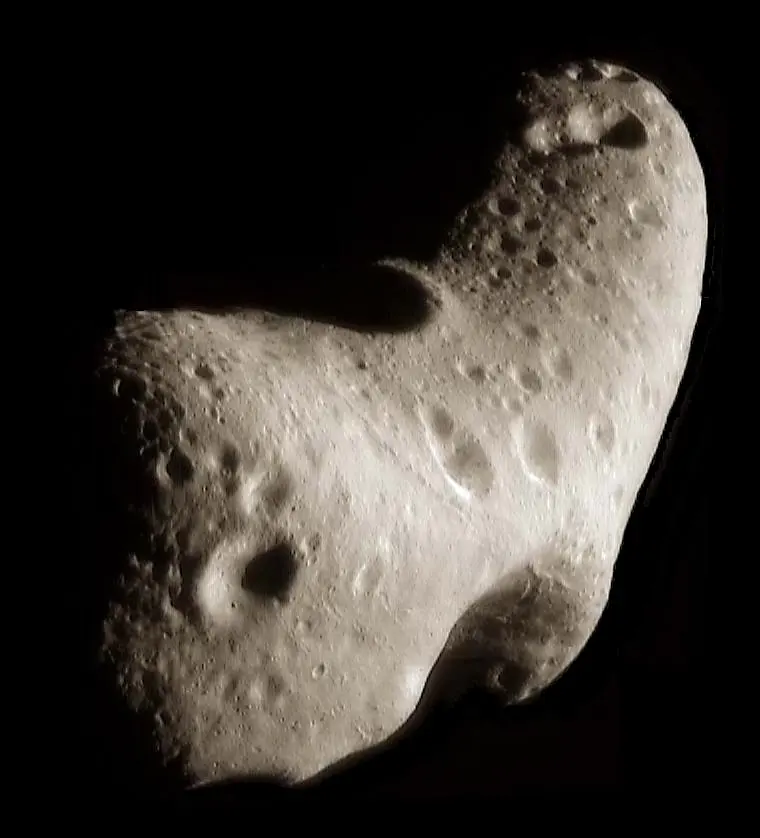
Asteroids come in many sizes, from boulders a few meters across to nearly 1,000 km. Most are irregular: they have so little mass that their gravity is too weak to pull them into a round shape. The largest, Ceres, about 940 km across, is massive enough to be nearly round; since 2006 it has been called a dwarf planet. Eros is long and narrow, like a peanut, about 34 km long and 11 km wide (16.8 km on average). Asteroids are made of rock, minerals, metals (iron and nickel) and clay.
Which statement describes the Trojans?
Pick an answer to see why.
Comets
A comet is a small, icy member of the Solar System that grows a long, bright tail when it comes close to the Sun. A comet’s orbit is a long, stretched ellipse: at one end it swings close to the Sun, and at the other it goes very far away, often far beyond Neptune.
Where do comets come from? Comets that return within about 200 years, the short-period comets, come mostly from the Kuiper belt. Comets with much longer orbits come from the Oort cloud, a vast, faint shell of icy bodies far beyond the Kuiper belt, a quarter of the way to the nearest star. A few comets come from outside the Solar System altogether, pass the Sun once, and leave for ever: the first was found in 2019, and a second, 3I/ATLAS, in 2025.
The parts of a comet
A comet is made of ice (frozen water, carbon dioxide and other gases), dust, and bits of rock: a “dirty snowball”. Its parts:
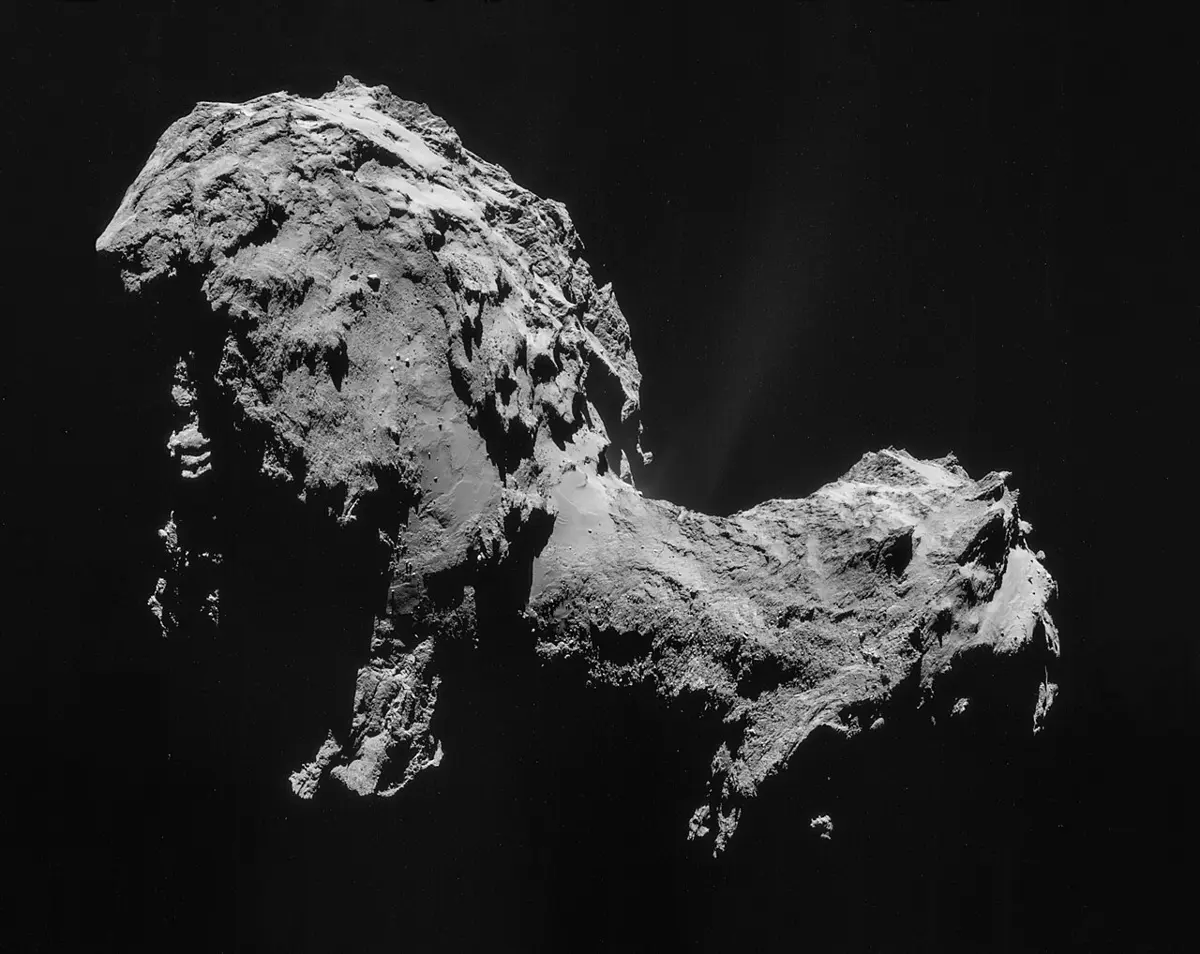
- Nucleus: the solid, icy center, usually only a few kilometers across, and as dark as coal.
- Coma: as the comet nears the Sun, the heat turns its ice straight into gas, which streams out carrying dust. A huge, glowing cloud forms around the nucleus: the coma. It can be bigger than the Sun.
- Tails: the Sun’s light and the solar wind (a stream of charged particles flowing out from the Sun) push the gas and dust away, into tails that always point away from the Sun. There are often two:
- the dust tail, thick, white or yellowish and gently curved, shining by reflected sunlight;
- the ion tail (plasma tail), thin, straight and bluish, made of charged gas that glows.
As a comet comes closer to the Sun, more ice turns to gas, and its tail grows longer and brighter. As it goes away, the tail shrinks and then disappears, and far from the Sun the comet is just a frozen, dark nucleus, lost in the darkness of space.
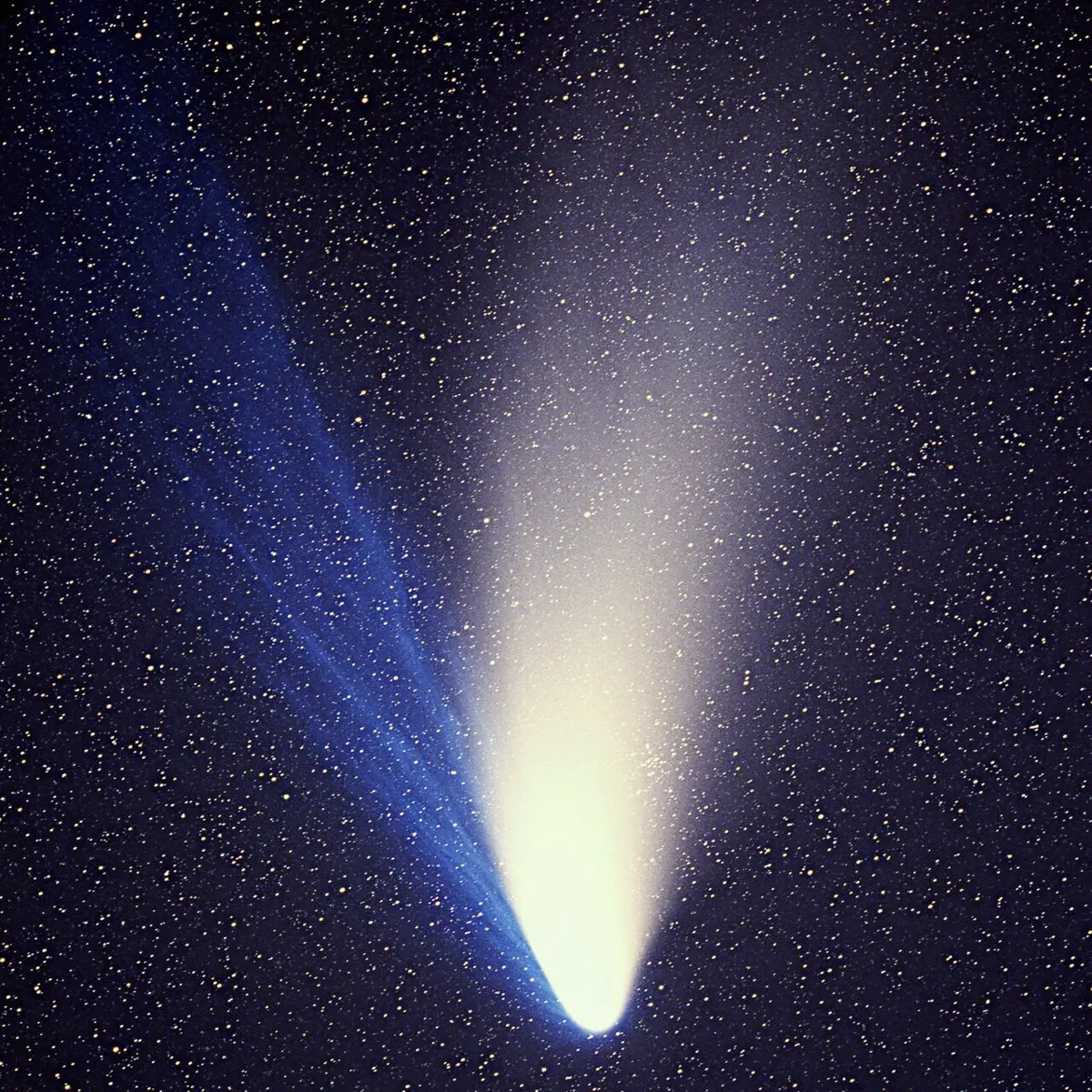
Comets take from about 3 years to hundreds of thousands of years to go once round the Sun. Comet Encke takes only 3.3 years. Comet Hyakutake, which passed close to the Earth in 1996, won’t be back for about 70,000 years.
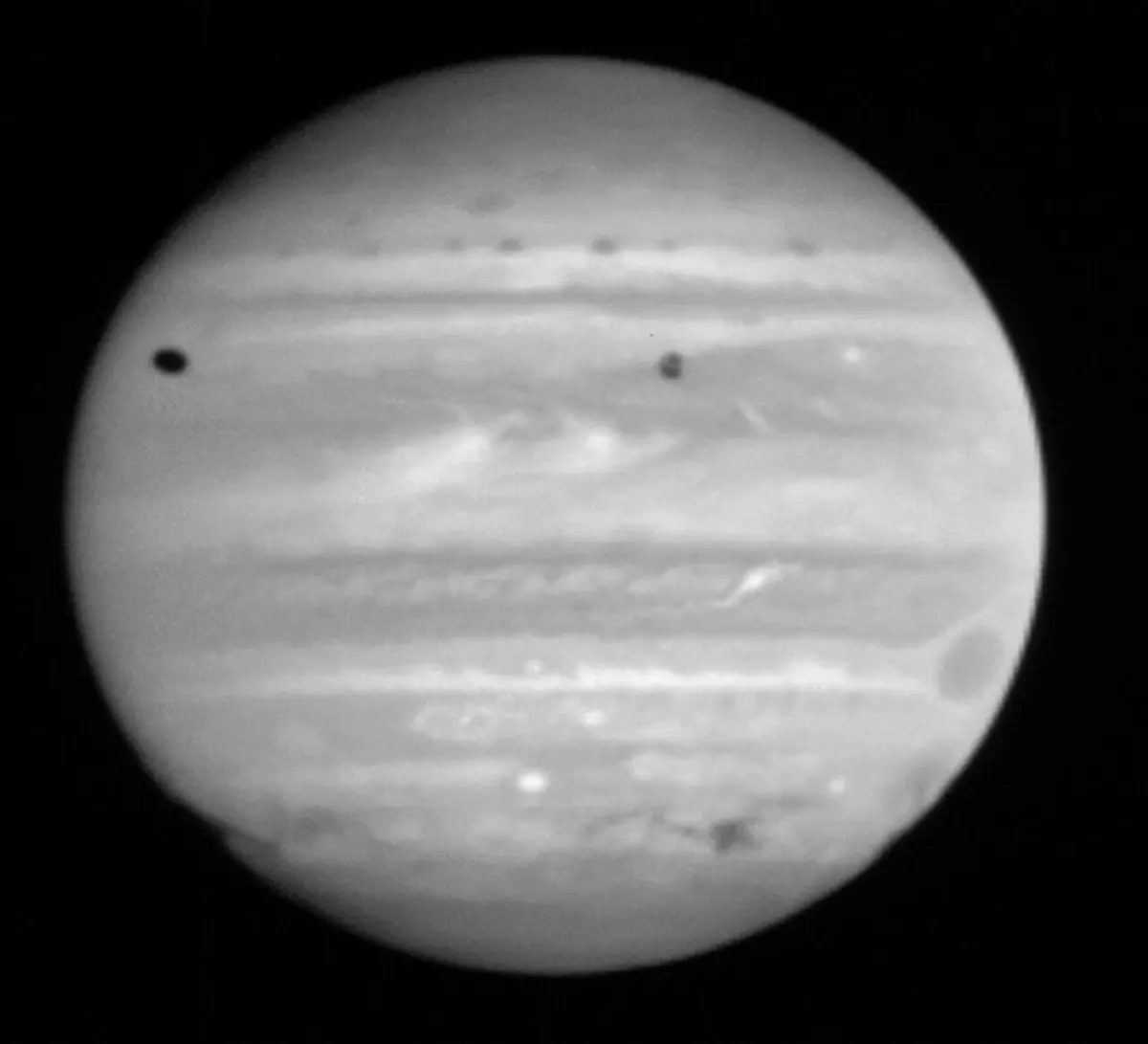
Comets and the debris they shed can hit planets. In 1994, comet Shoemaker–Levy 9, broken into about 20 pieces by Jupiter’s gravity, crashed into Jupiter, one piece after another, leaving dark scars, the biggest about as wide as the Earth. About 4,000 comets are known (as of 2026).
Each time a comet passes the Sun, it loses some of its ice and dust into space. After many trips round, it has lost all its ice and gas. What is left, a dark, dusty rock, behaves like an asteroid. Such a comet is called an extinct comet.
| Comet | Named after | Time to go round the Sun | First seen or predicted |
|---|---|---|---|
| Halley | Edmond Halley, who predicted its return | about 76 years | Halley predicted in 1705 that it would return in 1758, and it did |
| Encke | Johann Encke, who worked out its orbit | 3.3 years | 1786 (orbit found in 1819) |
| Tempel–Tuttle | Ernst Tempel and Horace Tuttle | 33 years | 1865–1866 |
| Tuttle | Horace Tuttle | 13.6 years | 1858 (seen earlier, in 1790) |
Which way does a comet’s tail point?
Pick an answer to see why.
Meteoroids, meteors and meteorites
Small pieces of rock and metal, from a grain of dust to a boulder, drift through the Solar System. Most are crumbs of comets and asteroids. They are called meteoroids. When one meets a planet or a moon, its gravity pulls it in, and it falls at very high speed.
Meteoroids hit the Earth’s air at 11 to 72 kilometers per second: tens of times faster than a rifle bullet. At that speed, the air in front of the meteoroid is squeezed and heated so violently that the meteoroid glows white-hot and burns up, leaving a streak of light that lasts a second or two. This happens high up, mostly about 80 to 100 km above the ground, in the mesosphere. (Many books describe the heating as friction with the air.) The streak of light is called a meteor. People call it a shooting star or a falling star, but it has nothing to do with stars.
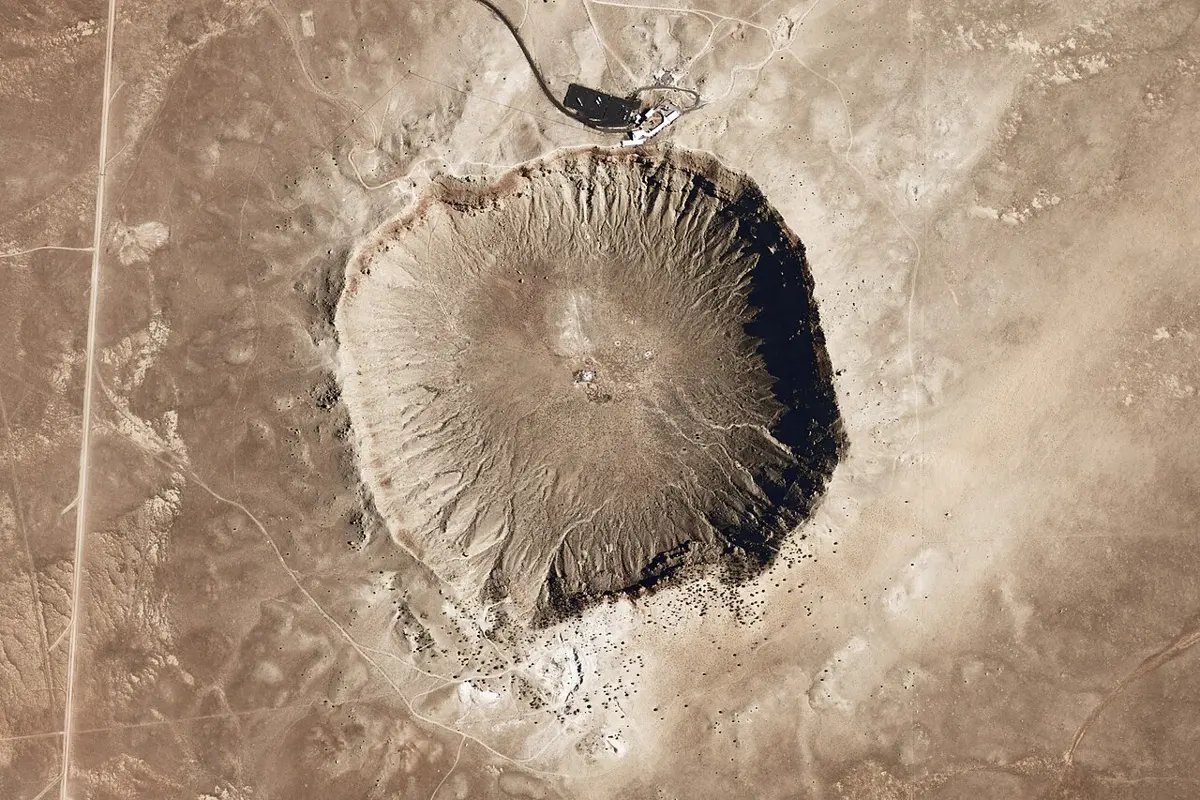
Most meteors burn up completely long before they reach the lower air. But a large one may not burn up entirely: the piece that survives and lands on the Earth is called a meteorite. A very large one can cause great destruction.
The Earth sweeps up about 40 to 50 tonnes of space dust and small rocks every day, almost all of it burning up harmlessly as meteors, too small to see.
A meteor shower happens when the Earth, going round the Sun, passes through the stream of dust left behind by a comet along its orbit. On those nights, many meteors appear, all seeming to come from one point in the sky. Meteor showers come on the same dates every year, because the Earth crosses the same stream at the same point in its orbit. The specks are tiny, like grains of sand, and burn up high in the air: a meteor shower is harmless, and beautiful to watch.
What is the difference between a meteor and a meteorite?
Pick an answer to see why.
Galaxies
On a clear, dark night, some of the faint smudges of light you see are not single stars. A few are huge collections of millions or billions of stars, so far away that they look like one dim spot of light.
A galaxy is a huge collection of stars, together with clouds of gas and dust called nebulae, the remains of old nebulae, the planets of many of its stars, dark matter and energy, all held together by gravity. Our Solar System lies in a galaxy called the Milky Way. The Sun is one of its 100 to 400 billion stars. On a dark night away from city lights, the Milky Way is the pale, glowing band you see across the sky: our galaxy seen from inside.
Galaxies come in different shapes: spiral (like the Milky Way and Andromeda), elliptical (round or egg-shaped), lenticular (lens-shaped), ring-shaped, irregular, and some with strange shapes after colliding with other galaxies. Some well-known galaxies are the Milky Way, Andromeda, the Whirlpool, the Sombrero and Messier 87.
Galaxies: Hubble Space Telescope (NASA, ESA and the Hubble Heritage Team, STScI/AURA), public domain
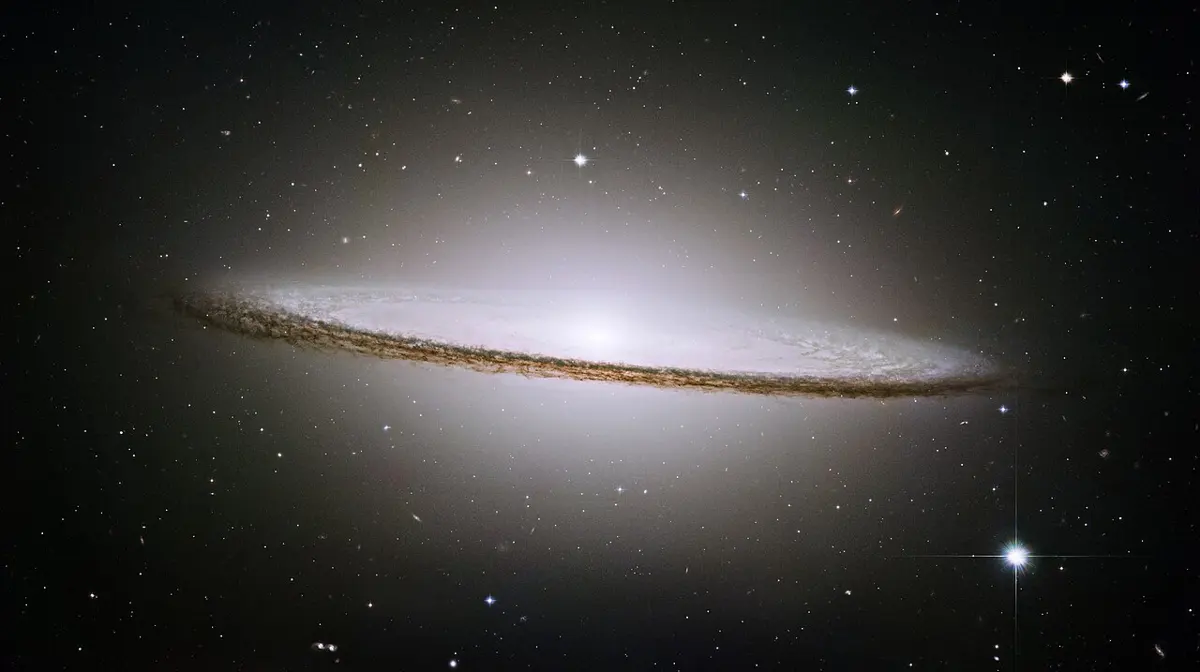
How many galaxies are there? In 2021, scientists used NASA’s New Horizons spacecraft, far beyond Pluto, where space is darker than anywhere near the Earth, to measure the faint glow of all the galaxies together. They found the observable universe holds a few hundred billion galaxies: about 2 × 10¹¹. All of them formed from the matter made in the Big Bang.
At the center of most large galaxies is a supermassive black hole. The one at the heart of the Milky Way, Sagittarius A*, has the mass of about 4 million Suns. The stars of a galaxy all go round its center, in the same direction, pulled by the mass of the whole galaxy. The Sun, carrying the Earth, takes about 230 million years for one trip round.
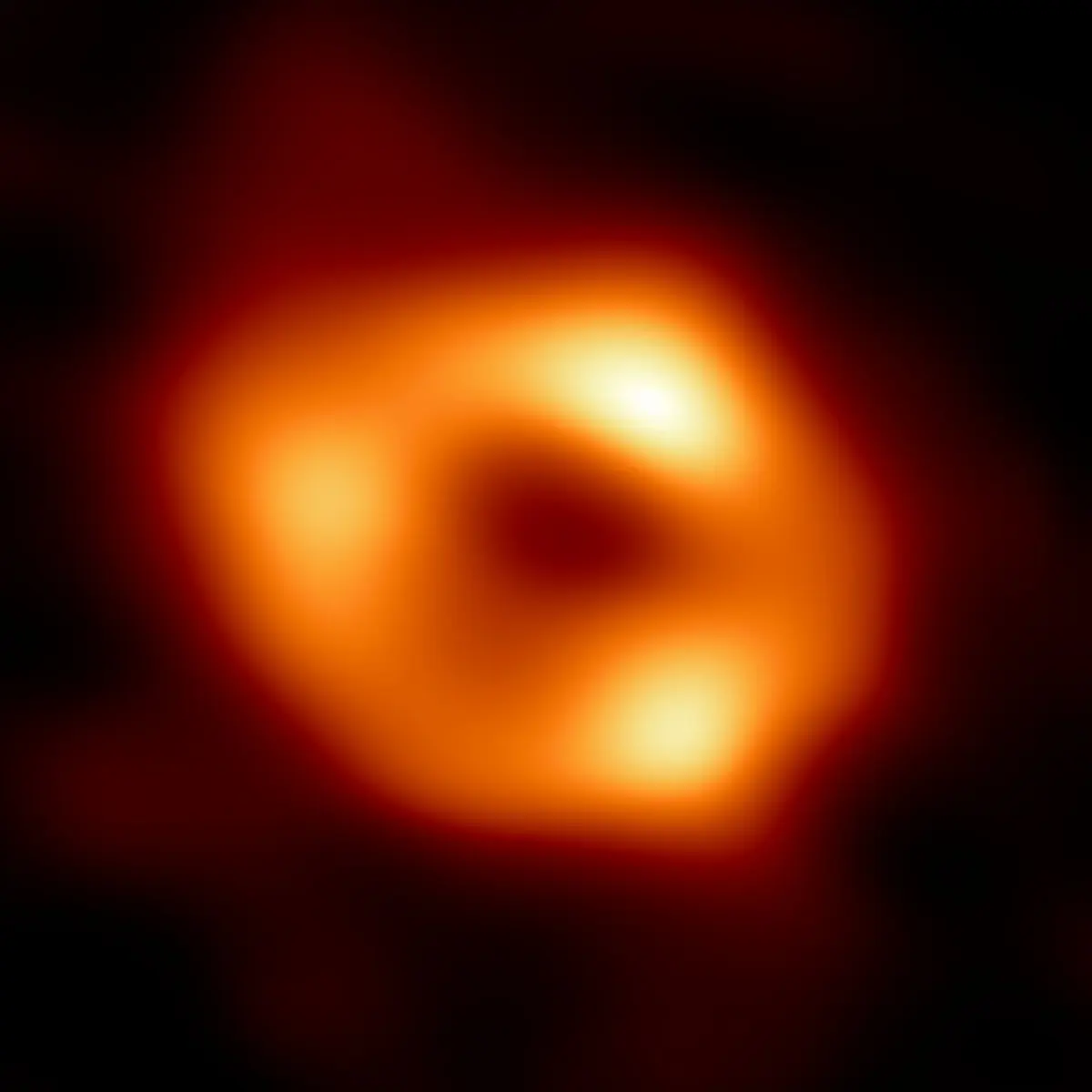
Our Sun is
Pick an answer to see why.
Constellations
Long before telescopes, people joined the bright stars into pictures. A group of stars that seems to make a particular pattern in the sky, and the region of the sky around it, is called a constellation. The patterns can look like animals, people, shapes, tools or other objects. Astronomers have divided the whole sky into 88 constellations, and many of them can be seen with the naked eye.
The stars in a constellation are usually not close together at all: one may be a few light-years from us and another hundreds of light-years behind it. They only look close because they lie in nearly the same direction.
The zodiac
As the Earth goes round the Sun, the Sun seems to move through the stars, making one full circle of the sky in a year. Its path through the stars is called the ecliptic. The twelve constellations along the ecliptic are the zodiac constellations: Aries, Taurus, Gemini, Cancer, Leo, Virgo, Libra, Scorpius, Sagittarius, Capricornus, Aquarius and Pisces. In Nepal they are the twelve rashi: Mesh, Brish, Mithun, Karkat, Simha, Kanya, Tula, Brishchik, Dhanu, Makar, Kumbha and Meen.
Other constellations
Other well-known constellations include Ursa Major (the Great Bear), Orion (the hunter), Carina, Vela, Draco (the dragon), Cepheus, Cassiopeia, Canis Major (the great dog) and Ursa Minor (the little bear). Constellations differ in size and in how many bright stars they have. Seven bright stars of Ursa Major make the shape of a ladle, which in Nepal is called the Saptarishi (the seven sages); five bright stars of Cassiopeia make a W or M. Crux (the Southern Cross) is the smallest constellation, and Hydra (the water snake) the biggest.
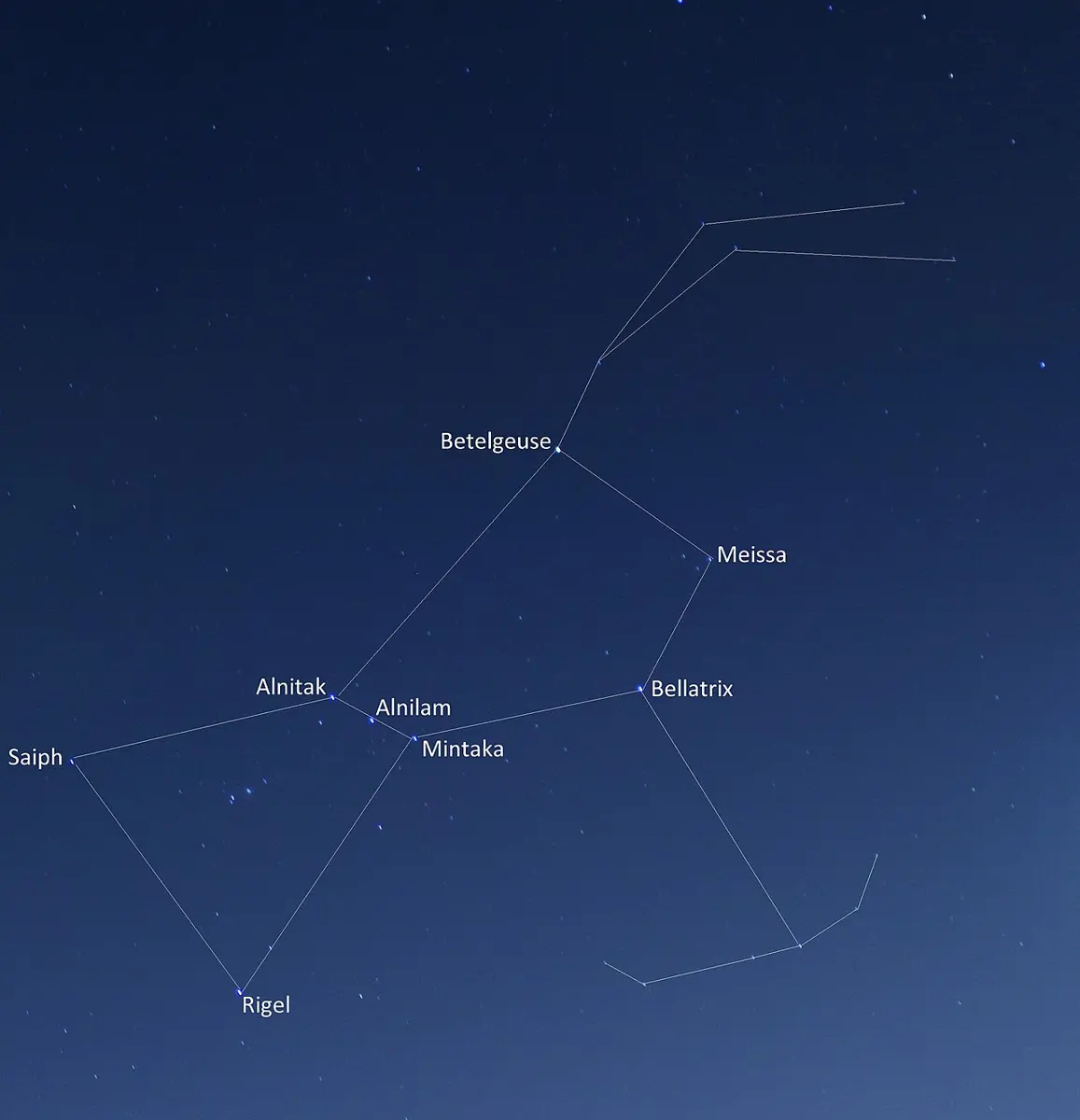
People who know the constellations well can tell the time of night and the season from them: different constellations are up in the evening at different times of the year, and they all turn across the sky through the night. They also show directions. Before clocks and compasses, sailors found their way by the stars. In the northern sky, the two “pointer” stars of the Saptarishi lead to Dhruva Tara, the Pole Star, which stays almost still over the north while every other star turns around it.
Why does the Pole Star (Dhruva Tara) help us find north?
Pick an answer to see why.
Exercise (11.3 The universe)
1. Choose the correct alternative
a. Who put forward the idea of the expanding universe?
Pick an answer to see why.
b. Which comet was destroyed by crashing into Jupiter?
Pick an answer to see why.
c. Which statement describes the Trojans?
Pick an answer to see why.
d. A photograph of deep space shows hundreds of glowing smudges; one, labeled A, is a spiral galaxy. What is A made of?
Pick an answer to see why.
2. Differentiate between
Meteors and meteorites
Answer
Galaxy and constellation
Answer
Asteroids and comets
Answer
3. Give reasons
Near-Earth asteroids are dangerous for our planet.
Answer
Comets gradually lose their material as they go round the Sun many times.
Answer
Most meteors are completely destroyed before they reach the ground.
Answer
Galaxies are more important than other celestial bodies for studying the universe.
Answer
4. Answer the following questions
What is the universe?
Answer
Describe the Big Bang theory in brief.
Answer
Mention the characteristics of asteroids.
Answer
What is a comet? Explain its parts with a suitable diagram.
Answer
What are meteoroids? How do they turn into meteors?
Answer
Explain “meteor shower” and “observable universe”.
Answer
A star map shows the northern sky’s constellations: the Big Dipper and the Little Dipper, Cassiopeia, Cepheus, Cygnus, Pegasus, Hercules, Boötes, Leo, Cancer, Gemini, Aries, Taurus, Auriga, Orion and the two dogs, Canis Major and Canis Minor.
- i.Describe the special features of the celestial bodies shown in the map.
- ii.Why are they important for studying the celestial bodies?
Answer
Worksheet: The Earth and Universe: minerals and the Earth’s history (PDF, 4 pages)
Worksheet: The Earth and Universe: the universe (PDF, 5 pages)
Quiz yourself: Earth and Space, Grades 5–10 →
Practice every question in the book, and keep track of the ones you miss →
A companion to your textbook, not a replacement for it: study from the book your school uses, and where the two differ, follow your teacher. Found a mistake? Please tell us.