
Kanchan sells sweets at a stall in Janakpur and wants a box 11 cm long, 8 cm wide and 4 cm deep, made from one sheet of A4 card. She draws the six rectangles she needs, joined up in a pattern she can fold. The pattern is too long for the sheet, by 3 mm. Must she buy bigger card?
No. The same box can be opened out in other ways, and some of them fit. Nearly every box, carton and tent was once a flat pattern, and somebody chose which one. In this unit you will meet two families of solids, prisms and pyramids, learn which flat patterns fold up and which never can, and in Back to the box you will save Kanchan’s card.
16.0 Review
A solid takes up space: it has length, breadth and height. Its outside is made of surfaces, also called faces. Two faces meet in an edge, and edges meet at a corner, a vertex (more than one: vertices).
Counting a real solid is harder than it sounds, because you can’t see the back. It is easy to count a face twice, or to count an edge as a face. So turn the solid and mark each part as you count, which is just what you can do here.
16.1 Triangular base prism and pyramid
Cut seven equal triangles from card and stack them. Then stack seven more, each a little smaller than the one below, ending in a point. The two stacks are the two families of this section.
A. Triangular prism
A prism is a solid made of plane surfaces, of two kinds:
- The two surfaces at its ends are parallel and congruent. They are the bases of the prism.
- All the other surfaces are the lateral surfaces. In the prisms of this unit they are rectangles.
A prism is named after the shape of its base. A triangular prism has triangular bases, and a rectangular prism has rectangular bases.
A pencil with six flat sides is sharpened at neither end. What is it?
Pick an answer to see why.
B. Pyramid
A pyramid is a solid object with a polygon for its base and triangular faces that meet at one common point, its vertex (or apex). The triangles are its lateral surfaces. A pyramid’s height is measured from the apex straight down to the base, at right angles to it, not along a sloping face.
Pyramids are named after their base: a triangular pyramid has a triangular base, a rectangular pyramid a rectangular base and a square pyramid a square base.
When the base is a regular polygon and the apex is straight above its middle, all the triangular faces are congruent.
What is the most important difference between a prism and a pyramid?
Pick an answer to see why.
| Prism | Pyramid | |
|---|---|---|
| Bases | 2, congruent and parallel | 1 |
| Lateral surfaces | rectangles | triangles |
| Slices parallel to the base | all the same | smaller and smaller |
| With an n-sided base: faces | n + 2 | n + 1 |
| vertices | 2n | n + 1 |
| edges | 3n | 2n |
16.2 Nets of solid objects
Take an empty toothpaste carton or a sweet box. Open its glued flap, and press it flat. The solid has become one flat piece of card.
A net is a flat shape that folds up into a solid. It covers every face once, with nothing overlapping. Usually each face is one piece, joined to the next along an edge. Whoever makes a box starts here, because card is sold flat and is cut flat.
A. Cube
Which arrangements of six squares work? Don’t guess yet. Hunt for them.
You can test a net without scissors. Choose one square as the floor. Now fold the rest in your head and name each square as it rises: left, right, front, back, and, for one that folds over the top, lid. Six squares must give six different names. If a name comes up twice, two squares land in the same place and the net fails.
Two signs show a net is bad at a glance:
- Four squares meet at one point (a 2 × 2 block). Only three faces meet at a cube’s corner.
- A square has two opposites. In a straight line of three squares, the two end squares are opposite faces, and no face has two opposites.
These signs catch 17 of the 24 shapes that fail, not all of them. Four in a line with both arms on the same side shows neither sign and still fails, so when you are in doubt, name the faces.
B. Cuboid
A net of a cuboid has a rectangle 6 cm by 4 cm. Which of these rectangles could be joined to its 6 cm side?
Pick an answer to see why.
C. Tetrahedron
A tetrahedron is a solid with four triangular faces, so it is a triangular pyramid. When all four are equilateral triangles it is a regular tetrahedron, and any of them can be called the base.
Testing triangles is quicker than testing squares. Four equal triangles can be joined edge to edge in only three ways: the large triangle, the strip, and a fan of four round one point. The fan fails, because only three faces meet at a tetrahedron’s corner.
D. Cone
A cone is a solid with a circular base and one curved surface that narrows to a single point, its vertex.
The two parts must fit. The sector’s curved edge, its arc, wraps once round the base, so the arc must be as long as the base’s circumference, . The sector’s radius becomes the sloping length of the cone, the slant height l.
Cut a piece out of a paper circle and join the cut edges, and you get a cone. Which cone depends on what you leave.
E. Cylinder
A cylinder is a solid with two parallel, congruent circles for its bases, joined by one curved surface. The tube that shuttlecocks are sold in is a model of one.
One pair of the rectangle’s sides wraps once round the circle, so each of those sides is as long as the circumference, . The other pair is the cylinder’s height h.
A net has a sector and a circle. What does it make?
Pick an answer to see why.
Back to the box
Kanchan’s box is 11 cm by 8 cm by 4 cm, so she needs two rectangles of each size: 11 by 8, 11 by 4 and 8 by 4. Their total area is 2 × (88 + 44 + 32) = 328 cm². An A4 sheet, 29.7 cm by 21 cm, has about 624 cm². There is plenty of card. The trouble is the shape.
She doesn’t need bigger card: she needs a different net. Wrapped round the long way, the strip of four faces is 11 + 4 + 11 + 4 = 30 cm, 3 mm longer than the sheet. Wrapped round the other way it is 8 + 4 + 8 + 4 = 24 cm long, and with a flap above and below, 11 + 4 + 4 = 19 cm tall. That fits, with room for glue tabs. It is the only size that does: laid square to the sheet, just 3 of this box’s 54 nets fit, all of them 24 cm by 19 cm.
Factories ask the same question with bigger numbers: which net leaves the least waste when thousands are cut from one roll?
Where this is used
- Boxes and cartons. Medicine, toothpaste and sweet boxes are printed and cut flat, as nets, and then folded and glued. Open one and find its tabs.
- Tents. A ridge tent is a triangular prism: two sloping sides, a triangle at each end.
- Roofs. A gable roof is a triangular prism sitting on the walls: two slopes meeting at a ridge. A hip roof slopes down on every side, and on a square building it is shaped like a pyramid.
- Food. Tetrahedron cartons of cream and juice are still made.
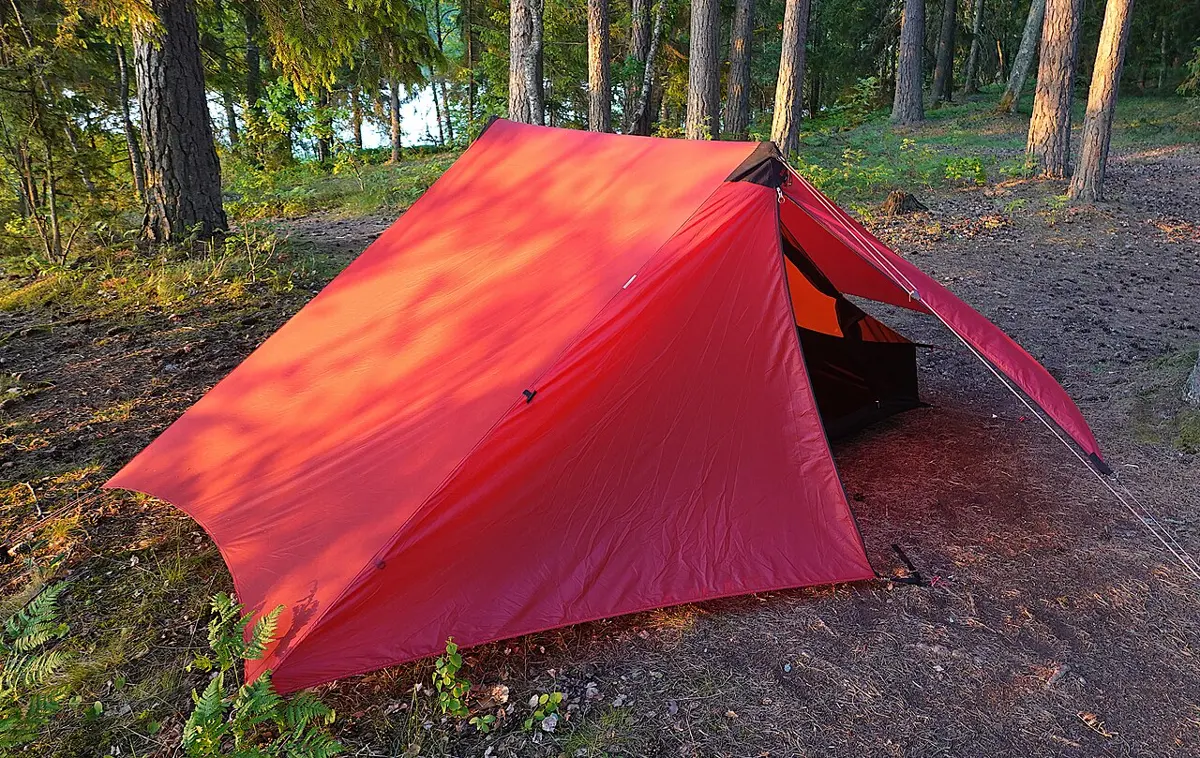
Next time you see a tent, count its faces and find its bases. Then think what its cloth looks like laid flat: that is its net.
How the exam asks it
The grid’s Grade 8 model paper has no question on solids, so this one is ours, in the style of its questions: short parts at different levels. Cover the answer and try it.
Where marks are lost
- Counting edges as faces, or the other way round. Write F, V, E in a table first, and check with F + V = E + 2.
- Treating prisms and pyramids as one thing. Ask: two bases, or a point?
- Calling a tent a rectangular prism because it rests on a rectangle.
- Using the sloping edge of a pyramid as its height.
- Saying a net works because it has the right number of faces. Six squares aren’t always a cube: name them.
- Applying F + V = E + 2 to a cylinder.
Exercise 16
Question 1
Among the given nets, test which ones form a cube.
Answer
Answer
Answer
Hint
Answer
Question 2
Among the given nets, test which ones form a tetrahedron.
Answer
Answer
Answer
Answer
Printable PDFs
- Study notes 2 pages
- Harder practice questions 2 pages Answer key
Practice every question in the book, and keep track of the ones you miss →
Where these facts come from
- The exam (For the exam, How the exam asks it): CDC, विशिष्टीकरण तालिका (कक्षा ६-८) गणित – नमुना प्रश्नहरु (Geometry 15 marks in three questions; all topics of an area to be covered in proportion; the Grade 7 model paper’s question 12 b and the Grade 8 model paper’s questions 9–11, read on the PDF pages); our question is our own.
- The common mistakes (Where marks are lost): CDC, शिक्षक निर्देशिका कक्षा ८ गणित (२०८१), the lesson on solid objects (mixing up edges and surfaces; thinking prisms and pyramids are the same).
- A4: 210 mm by 297 mm, the international paper size.
- The Great Pyramid: Wikipedia, “Great Pyramid of Giza” (146.6 m high at first, base about 230 m, built around 2600 BC), read November 2026.
- The Pyramid laboratory: Ev-K2-CNR, Pyramid Observatory Laboratory (4,980 m; inaugurated in October 1990; more than 500 scientific missions); Follow Alice, What is the Pyramid? (three stories, a square base, opened in 1990, 5,050 m, begun by Italy and Nepal), read November 2026.
- Euler’s rule: Wikipedia, “Euler characteristic” (stated by Euler in 1758; by Maurolico for the regular solids in 1537, unpublished), read November 2026.
- Nets, Dürer, Hirschvogel and Shephard’s question: Wikipedia, “Net (polyhedron)”, read November 2026.
- Tetra Pak: Wikipedia, “Tetra Pak” (Erik Wallenberg, 1944; the first filling machine in 1952, 100 ml of cream; the cartons still in use), read November 2026.
- Dice (opposite faces add up to 7): Wikipedia, “Dice”, read November 2026.
- Roofs: Wikipedia, “Gable roof”, “Hip roof”, “Truss” (the simplest truss is one triangle of rafters and a ceiling joist), read November 2026.
- Counts of nets: worked out here by a computer program: the 35 ways of joining six squares, 11 that fold into a cube; 384 ways of leaving five joins between a cube’s faces, in 11 groups for a cube and 54 for a cuboid with three different lengths; of the 24 shapes of six squares that fail, 17 show one of the two signs; four equal triangles join in 3 ways; 3 nets of the 11 by 8 by 4 cm box fit on A4. The same program folds every net in this unit and checks which close.
- The box and the sweets stall are made up for this unit.
A companion to your textbook, not a replacement for it: study from the book your school uses, and where the two differ, follow your teacher. Found a mistake? Please tell us.