
Anju’s father lays floors in Bhaktapur. At the tile shop she sees square tiles, and six-sided ones, and she asks for tiles with five equal sides, because nobody else’s floor would look like that. The shopkeeper laughs: tiles like that won’t cover a floor. Why not? It isn’t about taste. Lay three of them round a corner and look.
The answer is in the angles. This unit starts with a fact about every triangle, and step by step it leads to the angles of any shape with straight sides. In Back to the tile shop you will work out exactly which tiles can cover a floor. On the way you will also learn to draw rectangles and parallelograms to exact measures.
14.0 Review
A triangle gets two names: one from its sides and one from its angles.
| By sides | By angles | ||
|---|---|---|---|
| equilateral | all three sides equal | acute-angled | all three angles less than 90° |
| isosceles | two sides equal | right-angled | one angle of 90° |
| scalene | no two sides equal | obtuse-angled | one angle more than 90° |
Marks on a drawing tell you what you can’t measure on a screen: sides with the same small stroke are equal, and a small square in a corner means 90°.
14.1 Identification and verification of the properties of triangle
Draw any triangle you like: long and thin, or nearly flat. Its three angles keep changing, but something about them does not. In this section you find that out, and three more facts follow from it. To verify a property means to test it on real cases, by cutting, folding and measuring.
a. Verification of the sum of interior angles
The angles inside a shape are its interior angles.
Testing a few triangles can’t show that it works for all of them. This argument can, and it needs only what you know about parallel lines.
Draw a line DAE through A, parallel to BC. Then ∠DAB = ∠B and ∠EAC = ∠C, because alternate angles are equal. At A, the three angles ∠DAB, ∠BAC and ∠EAC make a straight line. So ∠B + ∠A + ∠C = 180°, for every triangle there is. The torn corners in Activity 1 land in just these places.
Two angles of a triangle are 75° and 45°. What is the third?
Pick an answer to see why.
b. Verification of the angles of an equilateral triangle
A vertex is a corner (the plural is vertices). Three equal angles that add up to 180° must each be 180° ÷ 3 = 60°.
c. Experimental verification of the base angles of an isosceles triangle
In an isosceles triangle, the two equal sides meet at the vertex angle. The third side is the base, and the two angles at its ends are the base angles.
d. Experimental verification of the base angles of a right-angled isosceles triangle
A right-angled isosceles triangle has its two equal sides at the right angle. The longest side is its base here, and the angles at the ends of it are the base angles.
Worked examples
One more, this time an isosceles triangle.
The vertex angle of an isosceles triangle is 40°. What is each base angle?
Pick an answer to see why.
Exercise 14.1
Question 1
Correct each statement that is false.
True or false? The sum of the interior angles of a triangle is 360°.
Answer
True or false? All the angles of an equilateral triangle are equal.
Answer
True or false? All the angles of an isosceles triangle are equal.
Answer
True or false? Each base angle of a right-angled isosceles triangle is 60°.
Answer
Question 2
Name each triangle, and say which of them are isosceles. For those, name their equal sides.
Name this triangle. If it is isosceles, name its equal sides.
Answer
Name this triangle. If it is isosceles, name its equal sides.
Answer
Name this triangle. If it is isosceles, name its equal sides.
Answer
Name this triangle. If it is isosceles, name its equal sides.
Answer
Name this triangle. If it is isosceles, name its equal sides.
Answer
Question 3
Find the values of x, y and z, and the unknown angles, in each figure.
Find the unknown angles.
Answer
Find the unknown angles.
Answer
Find the unknown angles.
Answer
Find the unknown angles.
Answer
Find the unknown angles.
Answer
Find the unknown angles.
Answer
Find the unknown angles.
Answer
Find the unknown angles.
Answer
Find the unknown angles.
Answer
Find the unknown angles.
Answer
Find the unknown angles.
Answer
Find the unknown angles.
Answer
Find the unknown angles.
Answer
Question 4
Find the base angles of an isosceles triangle whose vertex angle is 70°.
Answer
In triangle ABC, ∠BAC = 45° and ∠ABC = 2∠BCA.
- i.Find ∠ABC and ∠BCA.
- ii.What type of triangle is ABC? Give a reason.
Answer
The interior angles of a triangle are in the ratio 2 : 3 : 4. Find the angles.
Answer
Question 5
Draw a triangle like this one in your copy. The side QR of triangle PQR is produced (carried on) to the point S.
- i.Measure ∠QPR, ∠PQR and ∠PRS.
- ii.What is the value of ∠QPR + ∠PQR?
- iii.What is the relationship between ∠QPR + ∠PQR and ∠PRS?
Answer
Draw a triangle like this one in your copy.
- i.Measure the sides AB, BC and AC.
- ii.What is the value of AB + BC?
- iii.What is the relationship between AB + BC and AC?
Answer
Question 6
In the figure, , ∠PNO:∠NOP = 5 : 2 and ∠QMN = 65°. Find ∠NPO.
Answer
In the figure, , ∠BDF = 135° and .
- i.What is the value of ∠CDG?
- ii.Write the relationship between the sides GD and GC.
- iii.What type of triangle is CGD?
Answer
In triangle ABC, ∠BAC = 30°, ∠ABC = 75°, AB = (2x + 1) cm and AC = 9 cm. Find the value of x.
Answer
14.2 Identification and verification of the properties of rhombus, trapezium and kite
A figure with four straight sides is a quadrilateral. You already know the parallelogram, the rectangle and the square. Here they get three relatives, and for each one the question is the same: what is always true of its sides, its angles and its diagonals?
a. Identification and verification of the properties of rhombus
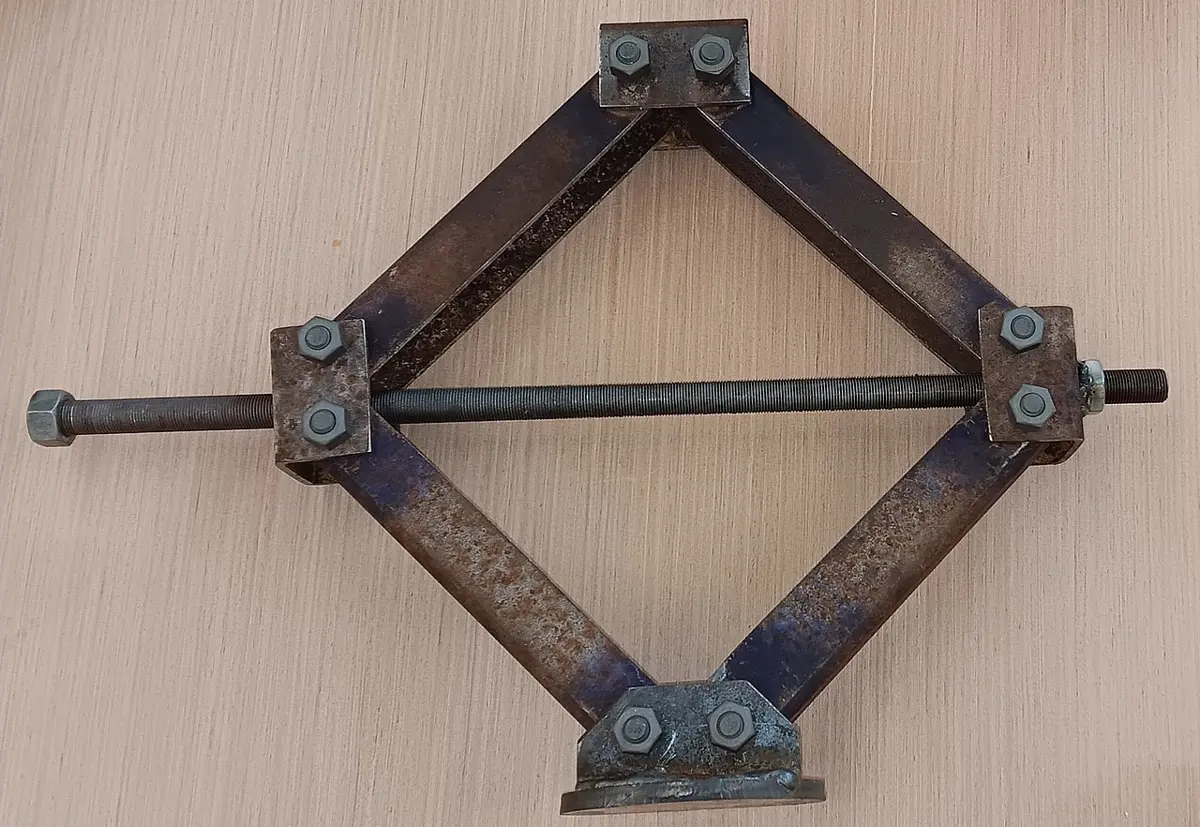
The four arms of a car’s scissor jack make a rhombus hinged at its corners. Turning the screw pulls two opposite corners together, so the other two corners move apart, and the car goes up. Because the diagonals of a rhombus cross at right angles, the top moves straight up, not sideways.
b. Identification and verification of the properties of kite
A kite is a quadrilateral with two pairs of equal adjacent sides. (Adjacent sides are sides that meet at a corner.) Fold the paper one along AC, and its two halves fit exactly: AC is its line of symmetry. That explains everything: B lands on D, so BP = PD, the angles at P are equal and make a straight line, so each is 90°, and ∠ABC = ∠ADC. These two are the angles between the sides of different lengths. A real paper kite is built the same way: a long stick down its middle and a cross-stick tied on at right angles.
In kite ABCD, AB = AD and the longer diagonal AC crosses BD at P. If BD = 10 cm, what is DP?
Pick an answer to see why.
c. Identification and verification of the properties of trapezium
A quadrilateral with only one pair of parallel sides looks like the shapes below. It is called a trapezium.
You met this in Lines and Angles: the non-parallel side of a trapezium is a transversal of its two parallel sides.
Worked examples
Exercise 14.2
Question 1
Write each false statement correctly.
True or false? All rhombuses are squares.
Answer
True or false? All the angles of a rhombus are equal.
Answer
True or false? The shorter diagonal of a kite bisects the longer diagonal.
Answer
True or false? The diagonals of a rhombus bisect each other.
Answer
True or false? The angle between the diagonals of a rhombus is 90°.
Answer
True or false? The opposite sides of a trapezium are parallel.
Answer
True or false? All trapeziums are parallelograms.
Answer
Question 2
The table lists characteristics of quadrilaterals. Copy it and write True or False under each quadrilateral for each characteristic. A characteristic is true only if it holds for every shape of that kind.
| Characteristics | Parallelogram | Rhombus | Trapezium | Square | Rectangle |
|---|---|---|---|---|---|
| All the angles are equal. | |||||
| All the angles are right angles. | |||||
| The opposite angles are equal. | |||||
| All sides are equal. | |||||
| The opposite sides are equal. | |||||
| A pair of opposite sides is parallel. | |||||
| Both pairs of opposite sides are parallel. |
Answer
Question 3
Using a diagram, show how the quadrilaterals of Question 2 are related.
Answer
Question 4
Find the values of a, b, c, x, y and z in these quadrilaterals.
Find the unknown values.
Answer
Find the unknown values.
Answer
Find the unknown values.
Answer
In this rhombus, AB = 5 cm, BO = 4 cm and the whole diagonal AC = x. Find x.
Answer
Find the unknown values.
Answer
In this kite, AO = 3 cm, BO = 4 cm, AD = x cm and DO = y cm. Find x and y.
Answer
In this kite, TP = TS = 5 cm, QR = 13 cm, PS = x and the whole diagonal PR = y. Find x and y.
Answer
Find the unknown values.
Answer
Question 5
Find the values of x, y and z in these kites.
Find the values of x, y and z in this kite.
Answer
Find x, y and z in this kite, where DP = 4 cm and PB = 2y cm.
Answer
Find x, y and z in this kite, where DP = (z + 1) cm and PB = (2z − 1) cm.
The textbook gives AB as (10 − 4y) cm, which makes y = 2 and AD = 2 cm. But AD is the longest side of the right-angled triangle APD, where DP = 3 cm, so the book’s numbers don’t work; here AB is (20 − 4y) cm, which makes AD 4 cm.
Answer
Question 6
Find the values of x, y, z and p in these kites.
Find the unknown values in this kite.
Answer
Find the unknown values in this kite.
Answer
Find the unknown values in this kite.
Answer
14.3 Construction
To construct a figure is to draw it exactly, from given measures, with a ruler and a compass. A construction works because of a property: a rectangle’s right angles, a parallelogram’s equal opposite sides. If you know the property, you never need to learn the steps by heart.
Before every construction, draw a rough sketch, name the corners in order and write the given measures on it. Then the steps follow. You will need the compass angles of 60°, 90°, 120°, 45°, 30° and 75° from Grade 7. Leave every arc showing: the arcs show how you made the figure.
14.3.1 Construction of a rectangle (when two adjacent sides are given)
Now construct a rectangle ABCD with adjacent sides of 5 cm and 3 cm.
- Sketch the rectangle roughly.
- Draw a base line and mark AB = 5 cm.
- At A, construct a right angle with a compass, so that ∠FAB = 90°.
- With center A and radius 3 cm, cut the line AF at D.
- At B, construct a right angle with a compass, so that ∠HBA = 90°.
- With center B and radius 3 cm, cut the line BH at C.
- Join C and D.
ABCD is the rectangle.
14.3.2 Construction of a square (when a side is given)
Now construct a square ABCD with a side of 4 cm. The steps are the rectangle’s, with one length.
- Sketch the square roughly.
- Draw a base line and mark AB = 4 cm.
- At A, construct a right angle with a compass, so that ∠FAB = 90°.
- With center A and radius 4 cm, cut the line AF at D.
- At B, construct a right angle with a compass, so that ∠HBA = 90°.
- With center B and radius 4 cm, cut the line BH at C.
- Join C and D.
ABCD is the square.
14.3.3 Construction of a parallelogram
The steps of all three cases use the same idea: opposite sides are equal. Once you have A, B and one more corner, two arcs find the last corner.
a. Two adjacent sides and the angle between them
Construct a parallelogram with adjacent sides of 7 cm and 4 cm and an angle of 60° between them.
- Sketch the parallelogram roughly.
- Draw a base line and mark AB = 7 cm.
- At A, construct an angle of 60° with a compass, so that ∠FAB = 60°.
- With center A and radius 4 cm, cut the line AF at D.
- With center B and radius equal to AD, draw an arc above B. With center D and radius equal to AB, draw an arc on the right of D. Mark where the arcs meet as C.
- Join C and D, and join B and C.
ABCD is the parallelogram.
b. Two adjacent sides and a diagonal
Construct a parallelogram with adjacent sides of 7 cm and 4 cm and a diagonal of 8 cm.
- Sketch the parallelogram roughly.
- Draw a base line and mark AB = 7 cm.
- With center A and radius 8 cm, and with center B and radius 4 cm, draw arcs that meet at C.
- Join A and C, and join B and C. This makes triangle ABC.
- With center A and radius 4 cm, and with center C and radius 7 cm, draw arcs that meet at D.
- Join A and D, and join C and D.
ABCD is the parallelogram.
c. Two adjacent sides and the angle between a side and a diagonal
Construct a parallelogram ABCD with AB = 7 cm and AD = 4 cm, in which the angle between the side AB and a diagonal is 30°.
- Sketch the parallelogram roughly.
- Draw a base line and mark AB = 7 cm.
- At A, construct an angle of 30° with a compass, so that ∠FAB = 30°.
- With center B and radius 4 cm, cut the line AF at C.
- Join B and C. This makes triangle ABC.
- With center A and radius 4 cm, and with center C and radius 7 cm, draw arcs that meet at D.
- Join A and D, and join C and D.
ABCD is the parallelogram.
Construct it: Angles with a compass, More angles with a compass, A rectangle, A square, A parallelogram from two sides and an angle, A parallelogram from two sides and a diagonal, A parallelogram from a diagonal’s angle
Exercise 14.3
Question 1
Draw these shapes with the measures shown. You may use a ruler, a protractor and a set square.
Draw the square in figure (a): side 3 cm.
Answer
Draw the rectangle in figure (b): sides 5 cm and 3 cm.
Answer
Draw the parallelogram in figure (c): sides 3 cm and 3.5 cm, with an angle of 75° between them.
Answer
Draw the parallelogram in figure (d): sides 3.5 cm and 4 cm, with an angle of 120° between them.
Answer
Draw the parallelogram in figure (e): sides 7 cm and 4 cm, with an angle of 60° between them.
Answer
Question 2
Draw these rectangles. Here you may use a ruler and a set square or protractor for the right angles.
Draw rectangle ABCD with AB = 7 cm and AD = 4 cm.
Answer
Draw a rectangle of length 6 cm and breadth 4 cm.
Answer
Draw a rectangle with adjacent sides of 8 cm and 5 cm.
Answer
Draw a rectangle, taking the length and breadth yourself.
Answer
Question 3
Construct these rectangles with a ruler and compass. From here on, each answer shows the finished construction and its steps, after a rough sketch you draw yourself.
With a ruler and compass, construct rectangle ABCD with AB = 7 cm and AD = 4 cm.
Answer
With a ruler and compass, construct a rectangle of length 6 cm and breadth 4 cm.
Answer
With a ruler and compass, construct a rectangle with adjacent sides of 8 cm and 5 cm.
Answer
Question 4
Construct these squares.
Construct a square of side 4 cm.
Answer
Construct a square of side 4.5 cm.
Answer
Construct a square, taking a length yourself.
Answer
Question 5
Construct these parallelograms.
Construct a parallelogram with adjacent sides of 3 cm and 5 cm, with an angle of 45° between them.
Answer
Construct a parallelogram with adjacent sides of 4 cm and 6 cm, and a diagonal of 7 cm.
Answer
Construct a parallelogram with a side of 4 cm and a diagonal of 8 cm. The diagonal makes an angle of 60° with the side of 4 cm.
Answer
14.4 Polygon
Triangles and quadrilaterals belong to one big family. Once you can see that family, one rule gives the angles of every member, and the tile shop’s question can be answered.
A polygon is a closed figure with three or more straight sides. A polygon with three sides is a triangle. Polygons with four, five and six sides are a quadrilateral, a pentagon and a hexagon.
14.4.1 Regular polygon
A polygon with all its sides equal and all its interior angles equal is a regular polygon. So (a), (b) and (d) are regular polygons, and (c) and (e) are not. An equilateral triangle is a regular triangle, and a square is a regular quadrilateral. Regular polygons with more than four sides are named regular pentagon, regular hexagon, and so on.
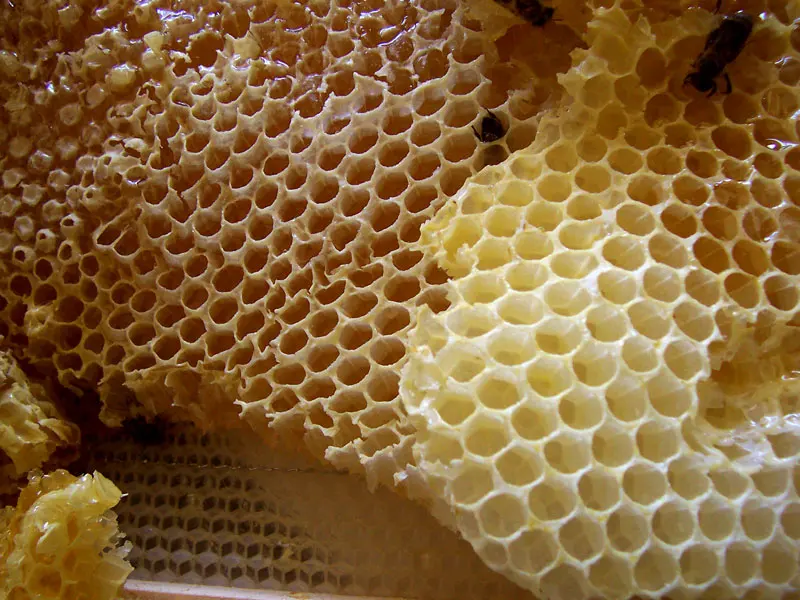
Regular hexagons are the shape of a honeycomb’s cells. For more than 2,000 years people guessed that this pattern divides a flat surface into equal cells with the least total wall, which would save the bees wax. Thomas Hales proved that for a flat surface in 1999.
14.4.2 Measurement of interior angles of a regular polygon
Why two less? Each triangle has one side of the polygon opposite your chosen corner. The two sides that touch that corner get no triangle of their own, so n sides give n − 2 triangles. Together the triangles’ corners fill exactly the polygon’s interior angles, so the polygon’s angles add up to 180° for each triangle.
In a regular polygon all n angles are equal, so divide by n.
14.4.3 Measurement of exterior angles of a regular polygon
When a side of a polygon is carried on past a corner, the angle between that line and the next side is an exterior angle. It and the interior angle at that corner lie on a straight line, so they add up to 180°.
Imagine walking round the polygon’s edge. At each corner you turn through the exterior angle. When you are back where you started, you face the way you first faced. You have made exactly one full turn, however many corners there were.
In Add a side, choose Turns outside and move the slider: the turns get smaller, but they always make one full turn.
The hexagon is the shape you will meet most often, so check it.
What is each interior angle of a regular hexagon?
Pick an answer to see why.
Construct it: A regular hexagon in a circle
Back to the tile shop
Now Anju’s question has an answer in one line: tiles close up round a corner only if the angle of a tile goes into 360° exactly. A regular pentagon’s angle is 108°, and 360 ÷ 108 isn’t a whole number. Three leave 36° empty, and a fourth would overlap.
The angle must divide 360° exactly, so only 60°, 90° and 120° work among the regular polygons: triangles, squares and hexagons. Past the hexagon, the angle is more than 120° and less than 180°, so at most two tiles fit round a corner, and two can’t close up. So no other regular tile can do it alone. That is why a floor of one regular tile is always triangles, squares or hexagons.
How the exam asks it
Grade 8’s final exam follows CDC’s specification grid for Mathematics, Grades 6–8. There, Geometry is 15 marks in three questions, shared by Lines and Angles, this unit, Congruency and Similarity, and the other geometry units. The grid’s Grade 8 model paper uses this unit in question 10:
| Part | Level | Marks | What it asks |
|---|---|---|---|
| a. | application | 3 | construct a parallelogram from two sides and the angle between them |
Part b of that question, proving two triangles congruent, belongs to Unit 15, Congruency and Similarity. The grid also says that a paper’s questions should cover all the topics of each area in proportion, so a real paper may ask for a triangle’s angles, a kite’s diagonals or a polygon’s angles instead. The marks in the worked answer below are our own way of sharing the 3 marks; the grid gives only the total.
A regular polygon has 8 sides.
- i.Find the sum of its interior angles. [1]
- ii.Find each of its interior angles. [1]
- iii.Find each of its exterior angles. [1]
- iv.Can tiles of this shape alone cover a floor? Give a reason. [2]
Answer
In kite ABCD, AB = AD = 13 cm, AC is the longer diagonal, and BD = 10 cm. The diagonals cross at P.
- i.Find BP. [1]
- ii.Find AP. [2]
Answer
Exercise 14.4
Question 1
Which of these are polygons, and which are not?
Answer
Question 2
Write the number of sides and the name of each of these polygons.
Answer
Question 3
Copy these polygons, and cut each into as many triangles as you can with diagonals from one corner.
Answer
Question 4
Find an interior angle of the regular polygon with n = 7.
Answer
Find an interior angle of the regular polygon with n = 10.
Answer
Find an interior angle of the regular polygon with n = 12.
Answer
Question 5
Find an exterior angle of the regular polygon with n = 6.
Answer
Find an exterior angle of the regular polygon with n = 9.
Answer
Find an exterior angle of the regular polygon with n = 11.
Answer
Question 6
Find the sum of the interior angles of the regular polygon with n = 6.
Answer
Find the sum of the interior angles of the regular polygon with n = 9.
Answer
Find the sum of the interior angles of the regular polygon with n = 10.
Answer
Find the sum of the interior angles of the regular polygon with n = 11.
Answer
Question 7
Find the sum of the exterior angles of the regular polygon with n = 6.
Answer
Find the sum of the exterior angles of the regular polygon with n = 9.
Answer
Find the sum of the exterior angles of the regular polygon with n = 10.
Answer
Find the sum of the exterior angles of the regular polygon with n = 11.
Answer
Printable PDFs
- Study notes 2 pages
- Harder practice questions 2 pages Answer key
Practice every question in the book, and keep track of the ones you miss →
Where these facts come from
- The exam (For the exam, How the exam asks it): CDC, विशिष्टीकरण तालिका (कक्षा ६-८) गणित – नमुना प्रश्नहरु (Geometry 15 marks in three questions; Grade 8 model question 10a, 3 marks, application; the note that a paper covers each area’s topics in proportion); our questions and the sharing of the marks are our own.
- Where marks are lost: CDC, शिक्षक निर्देशिका, कक्षा ८, गणित (2081), Lesson 14, its list of students’ usual mistakes; the lines on arcs and half-diagonals are our own.
- Euclid’s proof (14.1): Euclid’s Elements, Book I, Proposition 32, in David E. Joyce’s edition, read November 2026.
- Triangles on a sphere (14.1): Wikipedia, “Sum of angles of a triangle” (a spherical triangle’s angles add up to more than 180°), read November 2026.
- Set squares (14.1): Wikipedia, “Set square”, read November 2026.
- Trusses (14.2): Wikipedia, “Truss”, read November 2026.
- The scissor jack (14.2): Wikipedia, “Jack (device)”, read November 2026.
- Honeycombs (14.4): Wikipedia, “Honeycomb conjecture” (from Varro, 36 BC, to Hales, 1999), read November 2026.
- Tiles (Back to the tile shop): Wikipedia, “Pentagonal tiling” (108° does not divide 360°; the fifteen types; Rice, 2015, Rao), “Euclidean tilings by convex regular polygons” and “Marjorie Rice”, read November 2026.
- Nepal’s flag (Project): Wikipedia, “Flag of Nepal” (the only non-rectangular national flag), read November 2026; the Constitution of Nepal’s steps are on our Draw Nepal’s Flag page.
- Every answer: worked out here and checked by a program.
A companion to your textbook, not a replacement for it: study from the book your school uses, and where the two differ, follow your teacher. Found a mistake? Please tell us.