How tall is the tree in your school ground? You can’t climb it with a tape, and you have no instrument for angles. All you have is a small mirror, a measuring tape and a friend.
Lay the mirror flat on the ground, 9 m from the foot of the tree. Stand close to the mirror, then walk slowly backwards, away from it, until the very top of the tree shows in it. Your friend measures two things: how far your feet are from the mirror, and how high your eyes are. From those two numbers and the 9 m, you can work out the height of the tree. Try it below: step back and forward until the top of the tree shows in the mirror.
Try it
See the top in the mirror
Move the slider to walk towards or away from the mirror. The yellow line is the light from the tree to your eye; it leaves the mirror at the same angle as it arrives.
Your eyes
1.3 m up
In the mirror you see
3.9 m up
In the mirror you see the tree 3.9 m up, not its top. Step closer to the mirror.
You see only sky above the tree. Step back from the mirror.
You see the very top. The two green triangles have the same angles, so they are the same shape: the tree is to 9 m as your eyes’ 1.3 m are to your 3.00 m. Height = 9 × 1.3 ÷ 3.00 ≈ 3.9 m.
Tree: W. Heubach (d. 1923) in O. Schmeil, Lehrbuch der Botanik (1911), No restrictions, via Wikimedia Commons
Why does it work? Because two triangles, yours and the tree’s, have the same angles, and triangles with the same angles are the same shape, only different in size. By Back to the tree you will be able to prove it and find the height in one line. On the way, you will meet the rules that every triangle obeys: what its outside angles are, why two equal sides mean two equal angles, and why one side can never be longer than the other two together.
Remember?
13.0 Review
Draw two triangles on a sheet of paper. Measure all their sides and angles and put the measurements in a table. Discuss with your partner:
a.What type is each triangle, by its sides and by its angles?
b.How can you tell whether two triangles are congruent, similar, or neither?
Present your pair’s work on newsprint, with the figures, in your class.
Figure 13.1 Triangles by their sides: equilateral (all three sides equal), isosceles (two equal), scalene (none equal). Sides marked with the same number of small strokes are equal.
Figure 13.2 Triangles by their angles: acute-angled (every angle less than 90∘°), right-angled (one angle 90∘°, the small square), obtuse-angled (one angle more than 90∘°, here 115∘°).
Every triangle has a name of each kind: an equilateral triangle is always acute-angled, while an isosceles triangle can be acute, right or obtuse. You also know from Grade 8 that the three angles of a triangle add up to 180∘°. That one fact is behind almost everything in this unit.
A triangle has sides 5 cm, 5 cm and 8 cm, and its largest angle is 106∘°. What is it?
13.1 Properties of triangles and their verification
Work in groups. Each group draws a pair of triangles of each kind: equilateral, isosceles, right-angled and scalene. You will use them to test the facts below.
When one side of a triangle is produced (made longer past a corner), it makes an angle outside the triangle with the next side. This is an exterior angle. The interior angle beside it, at the same corner, is its adjacent interior angle; the other two interior angles are the opposite (or non-adjacent) interior angles. An exterior angle and its adjacent interior angle lie on a straight line, so together they make 180∘°.
An experiment shows the rule holds for the triangles we drew. Here is why it holds for every triangle. In Tear off the corners, the dashed line CE, parallel to BA, splits the exterior angle into two parts: one equal to ∠B (corresponding angles) and one equal to ∠A (alternate angles). Or, shorter, from the angle sum:
Statements
Reasons
1.
∠ACB+∠ACD=180∘
BCD is a straight line (linear pair)
2.
∠BAC+∠ABC+∠ACB=180∘
the angles of a triangle add up to 180∘°
3.
∠ACD = ∠BAC + ∠ABC
from 1 and 2, take ∠ACB from both
What it means: you never need to find the third angle first. The outside angle at one corner is just the other two inside angles added.
In triangle PQR, ∠P=48∘ and ∠Q=75∘. QR is produced to S. What is the exterior angle ∠PRS?
Exercise 13.1
Question 1
Write whether each statement is true or false, with a reason.
a.
There are two right angles in a triangle.
Answer
b.
All the angles of a triangle are acute.
Answer
c.
If an exterior angle of a triangle is 130∘°, its adjacent interior angle is also obtuse.
Answer
d.
If an interior angle is acute, its adjacent exterior angle is obtuse.
Answer
Question 2
Find the values of x and y.
a.
Figure 13.8
Answer
b.
Figure 13.9
Answer
c.
Figure 13.10
Answer
d.
Figure 13.11
Answer
Question 3
Find the values of x, y, z and a.
a.
Figure 13.12
Answer
b.
Figure 13.13
Answer
c.
Figure 13.14
Answer
d.
Figure 13.15
Answer
e.
Figure 13.16
Answer
f.
Figure 13.17
Answer
Question 4
4.
The exterior angle of a triangle is 120∘° and the two opposite interior angles are in the ratio 1 : 2. Find all the interior angles of the triangle.
Answer
Question 5
5.
In the figure, ∠BAC:∠ABC:∠ACB = 2:1:1 and ∠ABC = ∠ECD. Find ∠ACE.
Figure 13.18
Answer
13.2 Verification of properties of isosceles triangle
Work in groups. Each group draws a pair of isosceles triangles, measures their sides and angles with a ruler and protractor, and looks for a relation between the equal sides and the angles. Write your conclusion and present it in class.
In an isosceles triangle ABC with AB = AC, the angle between the two equal sides, ∠A, is the vertical angle, the third side BC is the base, and ∠B and ∠C are the base angles.
The fold explains everything at once. An isosceles triangle is symmetric about the line AD: fold it there and one half lies exactly on the other. So, together:
the base angles are equal: ∠B lands on ∠C (and if two angles of a triangle are equal, the sides facing them are equal: the converse);
the bisector of the vertical angle, the perpendicular bisector of the base, and the line from A to the middle of BC are one and the same line.
The same thing, as a proof:
Statements
Reasons
1.
In △ABD and △ACD: i. AB = AC (S) ii. ∠BAD = ∠CAD (A) iii. AD = AD (S)
i.given ii. AD bisects ∠A iii. common side
2.
△ABD≅△ACD
by S.A.S.
3.
BD = DC, ∠ABD = ∠ACD, ∠ADB = ∠ADC
corresponding parts of congruent triangles
4.
∠ADB=∠ADC=90∘
from 3, and together they make 180∘°
Proved: the base angles are equal, and AD is perpendicular to BC and bisects it.
In triangle XYZ, XY = XZ and ∠Y=52∘. What is ∠X?
Exercise 13.2
Question 1
Find the value of x.
a.
Figure 13.24
Answer
b.
Figure 13.25
Answer
c.
Figure 13.26
Answer
Question 2
Find the values of x, y and z.
a.
Figure 13.27
Answer
b.
Figure 13.28
Answer
Question 3
Find the values of x and y.
a.
Figure 13.29
Answer
b.
Figure 13.30
Answer
c.
Figure 13.31
Answer
d.
Figure 13.32
Answer
e.
Figure 13.33
Answer
f.
Figure 13.34
Answer
Question 4
4.
In the figure, XY = 3y, XZ = 7x, XP = 9x and XQ = 13 + 2y. Find the values of x and y. The textbook draws P and Q between Y and Z. With its numbers, XP = 27 comes out longer than XY = 21, but no point between Y and Z is farther from X than Y and Z are, so the book’s figure doesn’t fit its numbers. With P and Q on YZ produced, as drawn here, they fit.
Figure 13.35
Answer
Question 5
5.
Triangles ABC and BCD are isosceles. Find ∠BDE.
Figure 13.36
Answer
Question 6
6.
Two wires of equal length are tied from the top of a pole to the ground. Each wire is 13 m long and the pole is 12 m high.
a.Find the distance on the ground between the foot of the pole and each wire.
b.Are the areas of △ABC and △ABD equal? Justify.
Figure 13.37
Answer
13.3 Relation among sides and angles of triangle
a. The sum of any two sides and the third side
If the sum of two sides is equal to or less than the third side, there is no triangle: as the sticks showed, the two shorter sides lie flat along the longest one, or can’t reach each other at all. This is called the triangle inequality. It is also why a straight road is the shortest way: going from B to C by way of any point A off the road is always longer than going straight.
Which three lengths can be the sides of a triangle?
b. The sides and the angles facing them
What it means: in a triangle, sides and angles come in the same order. Know the order of the angles and you know the order of the sides, without measuring. In a right-angled triangle the right angle is the largest, so the side facing it, the hypotenuse, is always the longest side; in an obtuse-angled triangle the side facing the obtuse angle is the longest.
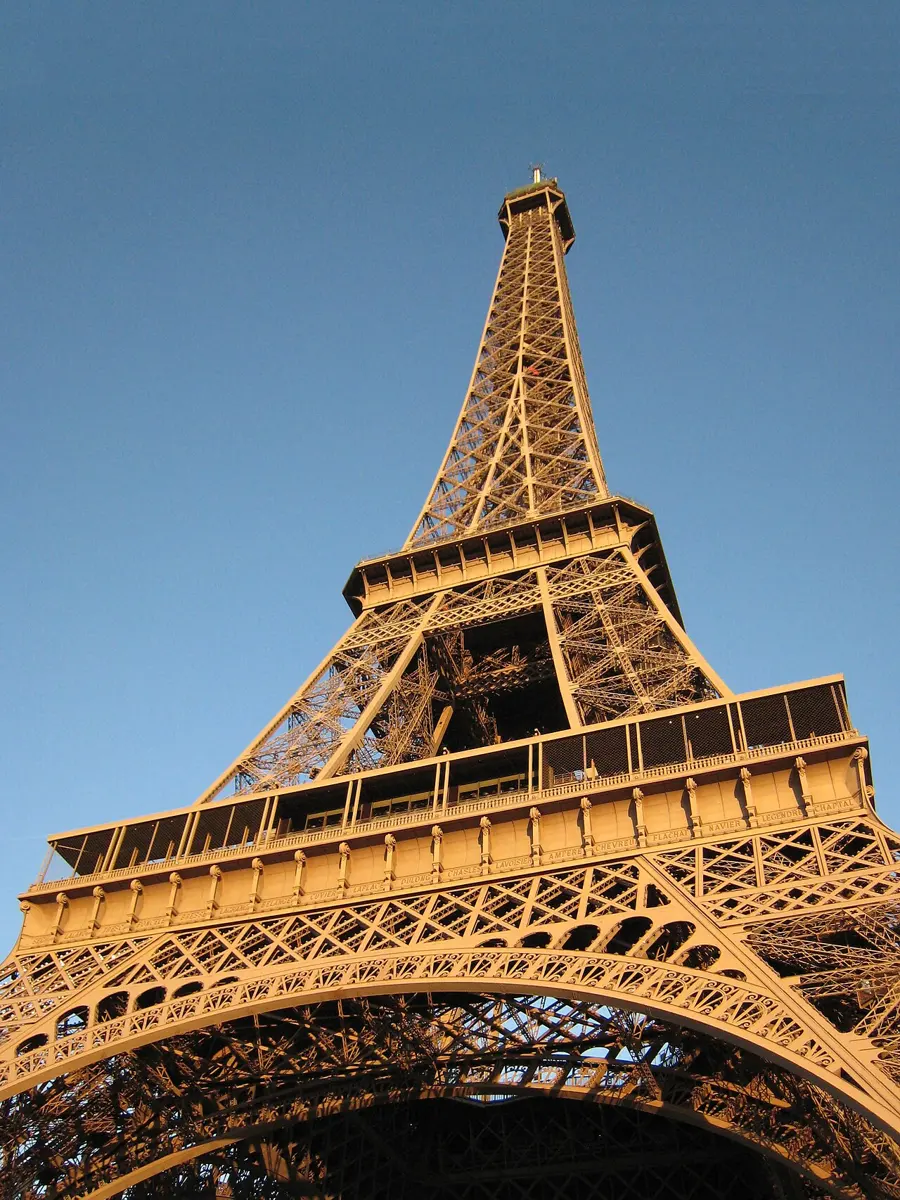
Figure 13.42 The Eiffel Tower, Paris (1889): its iron lattice is braced into triangles all the way up, so it keeps its shape in the wind. Photo: Arnaud Ligny from Paris, France, CC BY-SA 2.0
Exercise 13.3
Question 1
1.
Measure all the sides of triangle ABC, and find its largest and smallest angles from the lengths of the sides.
Figure 13.43
Answer
Question 2
2.
Measure all the angles of triangle ABC, and find its longest and shortest sides from the sizes of the angles.
Figure 13.44
Answer
Question 3
3.
The sides of a triangle are 5 cm, 6 cm and x cm, and x is the longest side. Which of these is correct?
Answer
Question 4
4.
The base of an isosceles triangle is 24 cm and its area is 60 cm². Find the length of each of its other sides.
Answer
Question 5
5.
In the figure, if ∠ABC > ∠DBC, prove that AC > BC.
Figure 13.46
Answer
Question 6
6.
Prove that PQ + QR + RS > SP. (Hint: join P and R.)
Figure 13.47
Answer
13.4 Similar triangles
Figures with the same shape but not necessarily the same size are called similar figures. A photo and its enlargement, a map and the land, a model bus and the bus are all similar.
If the corresponding angles of two triangles are equal, the triangles are similar. We write △ABC∼△DEF (∼ is read “is similar to”), listing the corners in matching order. In the figure, the arcs show which angles are equal.
The sides facing equal angles are the corresponding sides: BC and EF (facing ∠A and ∠D), CA and FD, AB and DE.
Since the angles of a triangle add up to 180∘°, two pairs of equal angles are enough: the third pair must then be equal too.
So for △ABC∼△AEF: ABAE=BCEF=ACAF,orAEAB=EFBC=AFAC Write each ratio with the sides of the same triangle on the same level, top or bottom, and match each side with the side facing the equal angle.
Theorem 1
A line drawn parallel to one side of a triangle cuts the other two sides in the same ratio.
Figure 13.53XY∥BC, cutting AB at E and AC at F.
Given: in △ABC, the line XY is parallel to BC and meets AB at E and AC at F.
To prove:EBAE=FCAF.
Statements
Reasons
1.
In △ABC and △AEF: i. ∠ABC = ∠AEF (A) ii. ∠ACB = ∠AFE (A) iii. ∠BAC = ∠EAF (A)
i.corresponding angles, XY∥BC ii. corresponding angles, XY∥BC iii. common angle
2.
△ABC∼△AEF
all the corresponding angles are equal
3.
AEAB=AFAC
corresponding sides of similar triangles are in the same ratio
4.
AEAE+EB=AFAF+FC
AB = AE + EB, AC = AF + FC
5.
1+AEEB=1+AFFC
dividing each top by its bottom
6.
AEEB=AFFC
taking 1 from both sides
7.
EBAE=FCAF
turning both fractions upside down
Proved.
Try it
Cut the triangle
Drag the corner A, and move the line EF with the slider. It stays parallel to BC.
AE : EB
2.7 : 4.0 = 0.67
AF : FC
3.5 : 5.3 = 0.67
AE/AB, AF/AC, EF/BC
0.40, 0.40, 0.40
Drag A or move EF: AE : EB and AF : FC stay equal, 0.67 each. The green triangle AEF is triangle ABC shrunk to 40% of its size, so every side of it is that fraction of the matching side.
This theorem is how you divide a line segment into any ratio with only a ruler, compass and set square: draw a slanting line from one end, mark equal steps along it, and draw parallels. Practice it in Construct it.
In △ABC, DE∥BC with D on AB and E on AC. AD = 4 cm, DB = 6 cm and AE = 5 cm. What is EC?
Back to the tree
Now look again at the mirror. Call the foot of the tree T and its top P, the point of the mirror M, your feet F and your eyes E.
The tree and you both stand upright: ∠PTM=∠EFM=90∘.
Light leaves a mirror at the same angle as it arrives: ∠PMT = ∠EMF.
Two pairs of equal angles, so △PTM∼△EFM, and their sides are in the same ratio: EFPT=FMTM⇒PT=FMEF×TM In the widget, TM = 9 m, your eyes are EF = 1.3 m up, and you see the top when you stand FM = 1.56 m from the mirror: PT=1.561.3×9=7.5 m The tree is 7.5 m tall. What it means: you measured three short lengths on the ground, and the angles, which you never measured, did the rest. Surveyors, mapmakers and astronomers have measured heights and distances this way for thousands of years.
Grade 9’s final exam is set to CDC’s specification grid for Compulsory Mathematics, Grades 9–10. There, Geometry is 13 marks in three questions. In the grid’s model paper, this unit is question 11:
Part
Level
Marks
What it asks
a.
application
3
verify a property experimentally with two triangles of different sizes
b.
higher ability
2
a ratio of two angles in a figure with an isosceles or equilateral triangle
An experimental verification has three parts to show: two figures of different sizes, a table of measurements, and a conclusion in words. Part b needs two steps: find each angle with a reason, then write the ratio in its lowest terms. Here is one of our own in that shape.
Exercise 13.4
Question 1
1.
In triangle ABC, DE∥BC, AD:DB = 2:3 and EC = 12 cm. Find AE.
Figure 13.58
Answer
Question 2
2.
In triangle XYZ, YZ∥PQ, XQ:QZ = 3:5 and PY = 7.5 cm. Find XY.
Figure 13.59
Answer
Question 3
3.
Find the value of x.
Figure 13.60AB = x, CE = 1.8 cm, BC = 24 cm and CD = 12 cm, drawn to scale.
Answer
Question 4
4.
Two ladders lean at the same angle, as in the figure. The longer ladder is 60 ft long and reaches 45 ft up its wall; the shorter one reaches 18 ft up. Find the length of the shorter ladder.
Figure 13.61 The arcs at the foot of the ladders mark the equal angles they make with the ground.
Answer
Question 5
a.
Find the height of the tree from the figure.
Tree: W. Heubach (d. 1923) in O. Schmeil, Lehrbuch der Botanik (1911), No restrictions, via Wikimedia Commons
Figure 13.62
Answer
b.
A pole 20 m high casts a shadow 30 m long. How high is another pole whose shadow, at the same time, is 7.5 m long?
Answer
Question 6
6.
Mingma puts a mirror flat on the ground between himself and a tree in the school ground. He moves back and forth until he sees the top of the tree in the mirror. How can you find the height of the tree? Discuss with your friends.
The mirror and the tree (opening, MirrorTree, Back to the tree, Exercise 13.4 Q6): the law of reflection, the angle of reflection equals the angle of incidence (any physics textbook; Grade 9 Science). The numbers are our own example.
Euclid’s Elements, Book I: Propositions 5 (base angles of an isosceles triangle), 19 (greater angle, greater side), 20 (triangle inequality) and 32 (exterior angle, angle sum); D. E. Joyce’s online edition (Clark University), read November 2026. Wikipedia, “Pons asinorum” (the name and its medieval use), read November 2026.
Proclus and the Epicureans’ donkey: Wikipedia, “Triangle inequality” (history), and Proclus, A Commentary on the First Book of Euclid’s Elements, on Proposition 20.
Trusses and the rigidity of triangles: Wikipedia, “Truss”, read November 2026. The Eiffel Tower, completed 1889: Wikipedia, “Eiffel Tower”.
Thales and the pyramid: Wikipedia, “Thales of Miletus” (Diogenes Laertius and Plutarch’s accounts of measuring the pyramids by their shadows), read November 2026. The Nyatapola temple, Bhaktapur, about 30 m: Wikipedia, “Nyatapola”.
The exam’s question (For the exam, How the exam asks it): CDC, Specification Grid, Compulsory Mathematics, Grades 9–10 (Geometry 13 marks in three questions) and its model question 11 (3A, 2HA); our question is our own.
Every answer: worked out here; every figure drawn from its stated or computed measures (triangle-figures.ts).
A companion to your textbook, not a replacement for it: study from the book your school uses, and where the two differ, follow your teacher. Found a mistake? Please tell us.