
A bus leaves Bhaktapur for Pokhara. It winds along the hills for about 210 km, yet on a map Pokhara is only about 150 km away in a straight line. It speeds up, slows down, climbs, and stops at a hotel for dal bhat. Why does a stone you drop always fall down? Why does the bus need good tyres to stop on a wet road? And who does more work: a porter carrying a load up a hill, or a guard standing all day at a gate?
Everything moves because of forces: pushes and pulls. In this unit you will learn to describe motion with numbers (distance, displacement, speed, velocity), meet the force that pulls everything towards the Earth (gravity, which gives things their weight), the force that tries to stop every slide (friction), and what scientists mean by work and power.
6.1 Distance and displacement
Ramesh’s house is at point A. His school is at point B, straight to the east. There are two paths. Path Y goes straight across the river, but its bridge has collapsed, so Ramesh walks the long, winding path X, round by the hill.
On path X, Ramesh keeps changing direction: north-east, then south, then east again. Path Y goes in one direction only, east, and it is the shortest way between the house and the school. However he gets there, Ramesh ends up in the same place: at the school, due east of his house.
So we have two different ways of saying “how far”:
- Distance is the total length of the path an object really travels, whatever its shape. Ramesh’s distance is the whole length of path X.
- Displacement is the shortest, straight-line distance from the starting point to the end point, in a particular direction. Ramesh’s displacement is the length of the straight line AB, towards the east.
Scalars and vectors
To tell someone a distance, a number with its unit is enough: “I walked 300 m.” A quantity that is complete with only its size (its magnitude) is called a scalar quantity, or a scalar. Distance is a scalar. Mass, time and speed are scalars too.
A displacement needs more: “300 m” is not enough, you must also say “towards the east”. A quantity that needs both a magnitude and a direction is called a vector quantity, or a vector. Displacement is a vector. Velocity and weight (a force) are vectors too.
| Distance | Displacement | |
|---|---|---|
| Symbol | d | s |
| SI unit | meter (m) | meter (m) |
| Scalar or vector? | scalar | vector |
| Formula | distance = speed × time | displacement = velocity × time |
A bus goes from Kathmandu to Pokhara along the winding road. Which is more: the distance it travels, or the size of its displacement?
Pick an answer to see why.
Activity 6.2: Roshani walks round a rectangle
Roshani starts at corner A of a rectangle 3 m wide and 5 m long. She walks from A to B (3 m north), B to C (5 m east), C to D (3 m south), and D back to A (5 m west).
Answer the activity’s three questions:
Activity 6.3: distance and displacement side by side
6.2 Speed and velocity
Dolma walks from her house to her uncle’s house along the road (path A). The road is 1800 m long, and the walk takes her 30 minutes. In a straight line, her uncle’s house is 1200 m to the east (path B).
How fast did she walk? Divide the distance she covered by the time she took.
The time is 30 min = 30 × 60 s = 1800 s. So
Dolma walked at 1 m/s: on average she covered 1 meter every second. The distance covered by an object in unit time (in one second) is called its speed. Speed is a scalar, and its SI unit is the meter per second (m/s).
Now use the straight line instead. Her displacement is 1200 m east, so
Her velocity is 0.67 m/s towards the east. The displacement of an object in unit time is called its velocity; it is the rate of displacement. Velocity is a vector, so it always has a direction. Its SI unit is also m/s.
A motorbike going round a roundabout at a steady 20 km/h has a constant speed, but its velocity keeps changing, because its direction keeps changing. That is why velocity needs its own name.
A car goes round a circular track at a steady 40 km/h. Which is true?
Pick an answer to see why.
6.2.1 Numerical problems
6.3 Gravity
Look at a waterfall. The water pours down. Drop a stone from a rooftop: it falls down too. Throw a ball up, and it slows, stops, and comes back down. Why does everything go the same way?

Isaac Newton, an English scientist, wondered about this around 1666. The story says he saw an apple fall from a tree. He realized that the Earth pulls the apple towards itself. The force of attraction with which the Earth pulls objects towards its center is called gravity.
Newton went further. He found that it is not only the Earth: every object in the universe pulls every other object towards it. This pull between any two objects is called the gravitational force, and it acts along the line joining their centers. The Earth pulls the Moon; the Sun pulls the Earth; even you and your friend pull on each other, but so weakly that you can never feel it. Only a huge object, like the Earth, pulls hard enough to notice.
What gravity does for us
- It holds the air (the atmosphere) around the Earth. Without gravity, the air would drift away into space.
- It makes rain, snow and hail fall to the ground, and makes rivers flow downhill.
- It keeps the Moon going round the Earth, and the Earth round the Sun.
- It gives every object its weight (next section).
Acceleration due to gravity
Drop a stone from a high window. It doesn’t fall at a steady speed: it goes faster and faster as it falls. The change in velocity of an object in unit time (one second) is called its acceleration. The acceleration produced in a falling object by the Earth’s gravity is called the acceleration due to gravity, written g.
Near the Earth’s surface, g is about 9.8 m/s². This means that a falling object (with no air to slow it) gets 9.8 m/s faster every second: 9.8 m/s after 1 second, 19.6 m/s after 2 seconds, 29.4 m/s after 3 seconds.
In which direction does gravity pull a person standing in Nepal?
Pick an answer to see why.
6.4 Weight and its measurement
The force with which the Earth pulls an object towards its center is called the weight of the object. The more mass an object has, the harder the Earth pulls it, so the more it weighs.
Weight is a force, so its SI unit is the newton (N), and we measure it with a spring balance: the heavier the object, the more the spring stretches. Numerically, weight is the product of the object’s mass and the acceleration due to gravity:
A 1 kg bag of sugar weighs 1 × 9.8 = 9.8 N, about 10 N.
Numerical problems
6.5 Friction and its nature
Have you ever slipped while walking? Think of the place. Was the ground wet or dry? Smooth or rough? Did you step on something that rolled, like a pebble or a marble?
You slip most easily on surfaces that are wet, smooth, or covered in things that roll. On dry, rough surfaces, where nothing rolls, your feet grip. The force that grips, or holds you back, is friction.
Friction is the force that opposes (acts against) the motion when one surface moves, or tries to move, over another. It always acts in the direction opposite to the motion.
Why is there friction?
No surface is perfectly smooth. Even a surface that looks smooth, like a polished table, has tiny bumps (projections, raised parts) and dips (depressions, pressed-in parts). You can see them with a hand lens, and much better with a microscope. When one surface slides over another, their bumps catch on each other and hold back the motion. That is friction.
The amount of friction depends on:
- the nature of the surfaces: friction is more between rough surfaces than between smooth ones;
- the pressing force: the harder the surfaces are pressed together (a heavier load), the more the friction.
A porter drags a sack along a dirt path, then puts a second sack on top and drags both. What happens to the friction?
Pick an answer to see why.
6.5.1 Advantages and disadvantages of friction
Why do you slip more when the pattern on the soles of your shoes or chappals has worn away? Could people and animals walk, or vehicles drive, if there were no friction?
Friction helps us.
- Walking: your feet push back on the ground, and friction stops them sliding. On smooth ice or a wet marble floor, there is too little friction, and you slip.
- Tyres: vehicle tyres have a pattern of grooves (the tread) to increase friction with the road, so they don’t skid.
- Brakes: when you brake a bicycle, the rubber brake pads rub on the wheel rim. Friction stops the bicycle. With no friction, nothing could ever be stopped.
- Holding things together: nails hammered into wood, and nuts and bolts, stay in place because of friction.
- Holding and writing: you can hold a glass, tie a knot, and write with a pencil on paper only because of friction.
Friction also causes problems.
- It turns energy of motion into heat. Rub your hands together hard and feel them warm up. In a machine, this heat is wasted energy, so the machine needs more effort to do the same job, and its efficiency goes down.
- It causes wear and tear: the moving parts of machines, the soles of shoes and the tyres of vehicles wear out by rubbing.
Because we can’t live without it, but it also wastes energy and wears things out, friction is called a necessary evil.
6.5.2 Measures of minimizing friction
Why do we put oil or grease on the hinges of a door and on the chain of a bicycle? Friction lowers the efficiency of a machine, so we reduce friction to make machines work better and last longer.
From these activities, the ways to reduce friction are:
- Lubricants: oil, grease and mobil (engine oil) form a thin, slippery layer between moving parts, so the surfaces don’t grind against each other. Hinges, bicycle chains and engines are oiled.
- Polishing: making the surfaces smoother.
- Wheels and ball bearings: rolling causes far less friction than sliding. A ball bearing has small, hard steel balls between two rings; one ring turns over the balls with very little friction. Ball bearings are used in electric fans, electric motors, bicycle wheels and almost every machine that turns.
- Streamlining: things that move fast through air or water are given a narrow, rounded front and a tapering back, so the air or water flows smoothly round them. This shape is called streamlined. Airplanes, rockets, ships, boats and fast trains are streamlined to reduce the friction of the air or water (called drag).
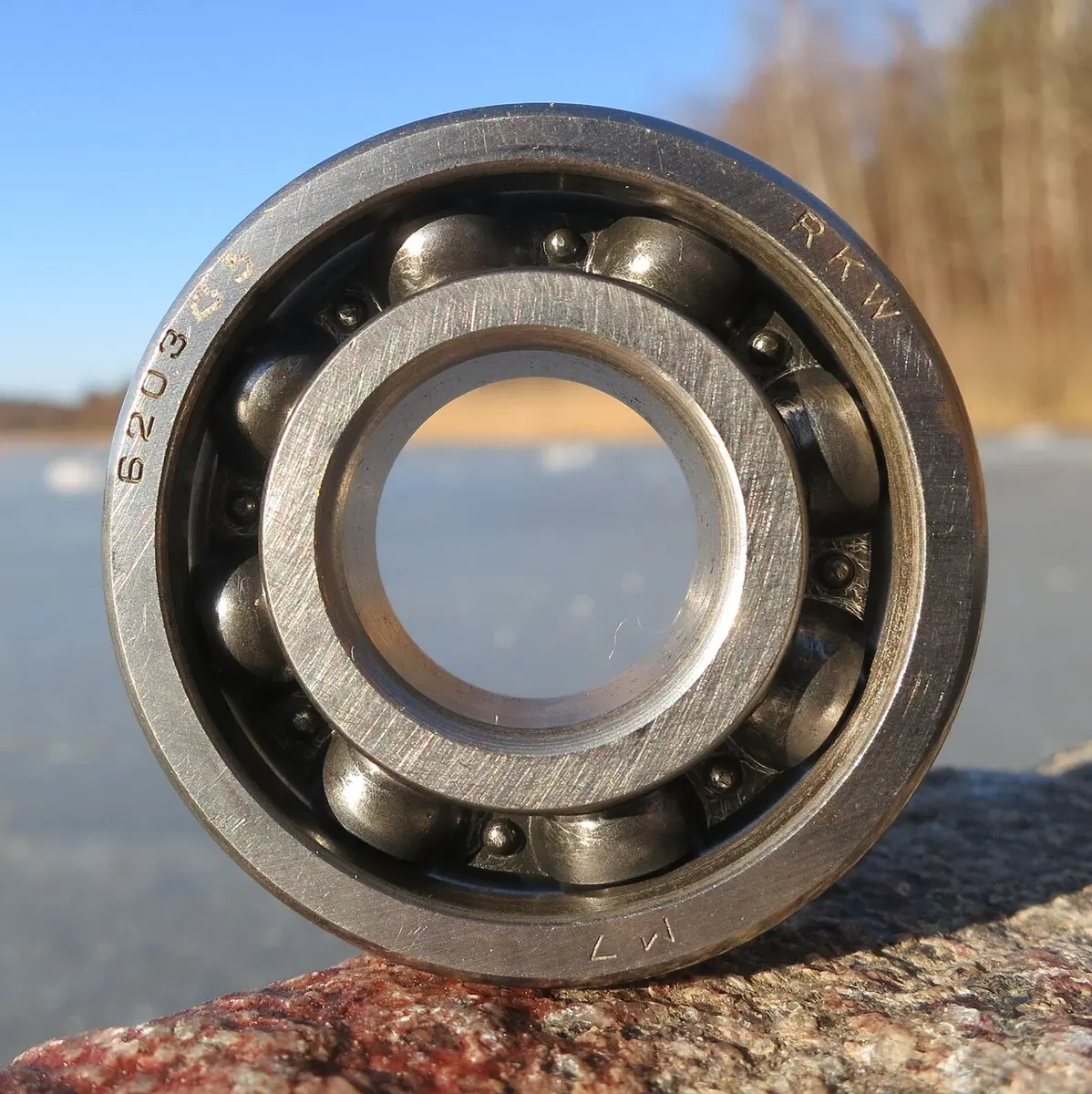
Why does a bicycle have ball bearings in its wheel hubs?
Pick an answer to see why.
6.6 Work and power
6.6.1 Work
Think of four people: a security guard standing at a gate all day, a girl reading a book, a man playing the madal, and a woman walking in a park. All of them may feel tired by evening. Which of them are doing work in the language of science?
In science, work has a special meaning. Work is done when a force moves an object in the direction of the force. Two things are needed:
- a force must act on the object, and
- the object must move in the direction of the force.
If either is missing, no work is done. The guard stands at his post for hours, and the girl sits reading, but nothing is moved by a force, so in science they do no work (thinking hard is not “work” in this sense, though it uses energy). The man playing the madal pushes the drumheads with his hands and moves them, and the woman in the park moves her own body forward, so they are doing work.
Work is measured as the product of the force and the distance moved in the direction of the force:
The SI unit of work is the joule (J), named after the English scientist James Prescott Joule. One joule of work is done when a force of 1 newton moves an object 1 meter in the direction of the force:
Lifting a 100 g apple (weight about 1 N) up 1 m takes about 1 J of work.
Work against friction
When we slide or roll an object along the ground, friction acts against the motion. To keep it moving, we must push or pull in the opposite direction to the friction. The work done is called work against friction. Pushing a cart, dragging a sack along the floor, sliding a box, and cycling along a road are examples.
work against friction = the force needed to overcome friction × the distance moved
Work against gravity
When we lift an object up, we must pull it upwards, against the downward pull of gravity. The work done is called work against gravity. Lifting a load, throwing a ball upwards, pulling up a bucket of water from a well, and climbing stairs or a hill (lifting your own body) are examples. The force needed is the object’s weight, and the distance that counts is the height it is lifted:
work against gravity = weight × height = m × g × h
Which of these people is doing work in the scientific sense?
Pick an answer to see why.
6.6.2 Power
Suppose you have to go to a market far from your house. Which gets you there faster, a bicycle or a motorbike? Both can do the job, but the motorbike does it faster: it can do work at a faster rate.
Dataram digs a field in 3 hours. Sohan digs the same field in 2 hours. They have done the same amount of work, but Sohan did it in less time, so he did more work in each hour. We say Sohan has more power: a greater capacity to do work quickly.
The work done in unit time (in one second) by a person or a machine is called its power. Power is the rate of doing work:
The SI unit of power is the watt (W), named after James Watt, who improved the steam engine. Since work is in joules and time in seconds, power is in joules per second:
A machine with a power of 1 W does 1 J of work in 1 s. If you know a machine’s power, you know how fast it can do a job: a 1000 W water pump fills a tank faster than a 500 W one.
Bigger units of power, and an old one:
| Unit | In watts |
|---|---|
| 1 kilowatt (kW) | 1000 W = 10³ W |
| 1 megawatt (MW) | 1,000,000 W = 10⁶ W = 1000 kW |
| 1 horsepower (hp) | about 746 W |
Exercise
1. Choose the correct answer
a. What is the unit of work?
Pick an answer to see why.
b. What is the product of force and the distance moved in the direction of the force called?
Pick an answer to see why.
c. Which of these is an example of displacement?
Pick an answer to see why.
d. Which of these statements is true?
Pick an answer to see why.
e. Which of these statements is true?
Pick an answer to see why.
f. A man walks 70 m right round his house, starting and ending at the main gate. Which statement is true?
Pick an answer to see why.
g. Why does a big stone weigh more than a small stone?
Pick an answer to see why.
h. Which statement is true about sliding friction?
Pick an answer to see why.
i. Which of these relations is incorrect?
Pick an answer to see why.
2. Fill in the blanks
Use these words: power, gravity, velocity, speed, friction, watt. (Two words are not needed.)
The distance covered in unit time is ……… .
Answer
speed
The unit of power is ……… .
Answer
watt
The rate of doing work is called ……… .
Answer
power
The use of ball bearings reduces ……… .
Answer
friction. (“Gravity” and “velocity” are not used.)
3. Answer the following questions
Write the SI unit of each of these physical quantities: distance, displacement, work, power, speed, velocity.
Answer
| Quantity | SI unit |
|---|---|
| distance | meter (m) |
| displacement | meter (m) |
| work | joule (J) |
| power | watt (W) |
| speed | meter per second (m/s) |
| velocity | meter per second (m/s) |
Explain distance and displacement with suitable examples.
Answer
Distance is the total length of the path an object travels. It has only magnitude, so it is a scalar. Example: a student walks 500 m along a winding lane from home to school; the distance is 500 m.
Displacement is the shortest, straight-line distance from the starting point to the end point, in a particular direction. It has magnitude and direction, so it is a vector. Example: if the school is 300 m east of the home in a straight line, the displacement is 300 m east.
After a round trip (home to school and back), the distance is 1000 m but the displacement is zero.
“Friction is a necessary evil.” Justify the statement.
Answer
Friction is necessary because we can’t do without it: it lets us walk without slipping, lets tyres grip the road, lets brakes stop vehicles, holds nails and screws in place, and lets us hold things and write.
It is an evil because it also causes harm: it turns useful energy into wasted heat, lowers the efficiency of machines, and wears out machine parts, tyres and shoes.
Since it is both useful and harmful, friction is called a necessary evil.
Define work and write its unit.
Answer
Work is said to be done when a force moves an object in the direction of the force. It is measured as the product of the force and the displacement in the direction of the force: W = F × d. Its SI unit is the joule (J); 1 J of work is done when a force of 1 N moves an object 1 m in its direction.
Write any three ways of reducing friction.
Answer
- Using lubricants such as oil, grease and mobil between moving parts.
- Using wheels and ball bearings, because rolling friction is less than sliding friction.
- Polishing surfaces to make them smooth.
- Making fast-moving objects (airplanes, boats) streamlined.
(Any three.)
Define power and give its unit.
Answer
The work done in unit time by a person or a machine is called its power: power = work ÷ time. It is the rate of doing work. Its SI unit is the watt (W); 1 W = 1 J/s.
Complete the formulas: work = ……, speed = ……, velocity = ……, power = …… .
Answer
work = force × displacement
speed = distance ÷ time
velocity = displacement ÷ time
power = work ÷ time
“Friction also helps us.” Justify the statement.
Answer
Many everyday jobs are possible only because of friction:
- We can walk without slipping because of friction between our feet and the ground.
- Vehicles move and stop because of friction between the tyres and the road, and between the brake pads and the wheels.
- Nails, screws, nuts and bolts hold things together because of friction.
- We can hold a pen and write, and tie knots, because of friction.
So friction is helpful in our daily life.
Why do we reduce friction?
Answer
Friction in machines turns useful energy into wasted heat, so the machine needs more effort and its efficiency goes down. Friction also wears out the moving parts, so the machine breaks down sooner. Reducing friction makes machines work more efficiently, use less fuel or electricity, and last longer.
A car starts from A and goes to D through B and C, at a steady speed of 5 m/s, as in Figure 6.13. A to B is towards the east, B to C towards the south, and C to D towards the west.
- i.What is the velocity of the car on the path AB? Why?
- ii.What is its velocity on BC? Why?
- iii.What is its velocity on CD? Why?
Answer
- i.5 m/s towards the east. On AB the car moves in a straight line towards the east at 5 m/s.
- ii.5 m/s towards the south. The speed is the same, but the direction has changed.
- iii.5 m/s towards the west.
The car’s speed is 5 m/s all the time, but its velocity is different on each part, because velocity includes the direction, and the direction changes at every corner.
Is a person pushing the wall of a house doing work? Give a reason.
Answer
No. Work is done only when the force moves the object in the direction of the force. The wall doesn’t move (its displacement is zero), so the work done on it is F × 0 = 0, however hard the person pushes.
Two people do the same amount of work. When is their power the same, and when is it different? Explain.
Answer
Power = work ÷ time. If both do the same work in the same time, their power is the same. If one takes less time than the other for the same work, that person has more power. For example, if Dataram digs a field in 3 hours and Sohan digs the same field in 2 hours, Sohan’s power is greater.
A person walks along a level road carrying a load on his head. Is he doing work on the load? Explain.
Answer
No work is done against gravity on the load. Gravity pulls the load downwards, and his head holds it up with an upward force, but the load moves sideways, not up. The force and the motion are not in the same direction, so in science no work is done on the load, even though the person gets tired (his muscles use energy just to hold it). He would do work against gravity on the load only if he lifted it, or climbed uphill with it.
4. Solve these numerical problems
Rohit runs 400 m along a straight path in 35 s. Calculate his velocity.
Answer
Displacement (s) = 400 m (straight path, in one direction), time (t) = 35 s
velocity = s ÷ t = 400 m ÷ 35 s = 11.43 m/s, in the direction he runs.
An object covers a distance of 100 m in 5 s. Calculate its speed.
Answer
speed = d ÷ t = 100 m ÷ 5 s = 20 m/s
What distance does a car cover in 10 s, if it is traveling at a speed of 20 m/s?
Answer
distance = speed × time = 20 m/s × 10 s = 200 m
A crane takes 20 s to lift a jeep of mass 1500 kg to a height of 120 m. Calculate the work done by the crane and its power. (g = 9.8 m/s²)
Answer
Here, m = 1500 kg, h = 120 m, t = 20 s, g = 9.8 m/s²
Force needed = weight = m × g = 1500 × 9.8 = 14,700 N
Work = F × h = 14,700 N × 120 m = 1,764,000 J
Power = W ÷ t = 1,764,000 J ÷ 20 s = 88,200 W (88.2 kW)
A porter lifts a 50 kg sack of rice from the ground onto the roof of a bus, 3 m high, as in Figure 6.12. Then he slides the sack 4 m towards the front of the bus, pushing with a force of 450 N. (g = 9.8 m/s²)
- i.How much work does he do against gravity?
- ii.How much work does he do against friction?
Answer
i. Force needed = weight = m × g = 50 × 9.8 = 490 N
Work against gravity = weight × height = 490 N × 3 m = 1470 J
ii. Work against friction = force × distance = 450 N × 4 m = 1800 J
An object moves along the path ABCD, as in Figure 6.14. It goes from A to B at 4 m/s for 4 s, from B to C at 3 m/s for 2 s, and from C to D at 2 m/s for 6 s. What is the total distance it covers?
Answer
distance = speed × time for each part:
AB = 4 m/s × 4 s = 16 m
BC = 3 m/s × 2 s = 6 m
CD = 2 m/s × 6 s = 12 m
Total distance = 16 m + 6 m + 12 m = 34 m
5. Write the differences
Distance and displacement.
Answer
| Distance | Displacement |
|---|---|
| The total length of the path traveled. | The shortest (straight-line) distance from the start to the end, in a particular direction. |
| It has magnitude only: a scalar. | It has magnitude and direction: a vector. |
| distance = speed × time | displacement = velocity × time |
| It can’t be zero once the object has moved. | It is zero after a round trip. |
Speed and velocity.
Answer
| Speed | Velocity |
|---|---|
| The distance covered in unit time. | The displacement in unit time. |
| It has magnitude only: a scalar. | It has magnitude and direction: a vector. |
| speed = distance ÷ time | velocity = displacement ÷ time |
| Example: 5 m/s. | Example: 5 m/s towards the east. |
Work and power.
Answer
| Work | Power |
|---|---|
| Work is done when a force moves an object in the direction of the force. | Power is the work done in unit time, the rate of doing work. |
| work = force × displacement | power = work ÷ time |
| It doesn’t depend on how long the job takes. | It depends on the time: the faster the job, the more the power. |
| SI unit: joule (J). | SI unit: watt (W). |
6. Give reasons
It is harder to drag an object over a rough surface than over a smooth one.
Answer
A rough surface has bigger bumps and dips. As the object is dragged, the bumps of the two surfaces catch on each other more, so the friction is greater, and a bigger force is needed to keep the object moving. A smooth surface has smaller bumps, so the friction is less.
A person standing still while holding up a heavy load is not doing work.
Answer
Work is done only when a force moves an object in the direction of the force. The person pushes the load up, but the load doesn’t move at all, so its displacement is zero and the work done on it is force × 0 = 0. The person gets tired because the muscles use energy to hold the load, but in science no work is done on it.
Practice every question in the book, and keep track of the ones you miss →