
How tall is Everest? How far is your school? How much does your bag weigh? We ask about quantity, how much, how many, how big, how far, every day, and the answers are numbers with their units: 8,848.86 meters, five kilometers, three kilos.
This unit is about talking about quantity. You will read about K2, the world’s second highest mountain and one of the hardest to climb, describe Rara Lake from a map of facts, hear the numbers of the Panama Canal, read a school’s prospectus and make one for your own school. In grammar you will make the verb agree with its subject (one of my friends is, ten kilos is), and ask questions with How tall…? How far…? How long…? How much…?
Getting started
A. How tall? How far?
The four pictures come with clues: climbers on the snowy top of Everest (How tall? / 8,848.86 meters), a shopkeeper and a customer beside a sack of sugar marked 5 kg (How much? / 5 kg), three students pointing to their school on a far hill (How far? / five kilometers), and two people looking up at a tall tree (How tall? / about 20 meters).
Look at the pictures. Ask and answer the questions in pairs. Use the given clues.
Model answers
B. Listen and sing
The song Tall Trees is a short, quiet poem by Eileen Mathias about tall trees through one day. In the first part, the trees stand with their roots in the earth and their tops so high that they seem to touch the sky; they stand still and watch the clouds drift past. In the second part, when evening comes, the birds hurry home and the trees give them a safe place to sleep in their nests. In the last part, at night, the moon shines on a sleeping world while the trees, still awake, seem to peep at it.
Do you agree with the following statements? Write ‘Yes’ if you agree and ‘No’ if you don’t.
- a.The trees watch the clouds and go above them.
- b.The birds return to the shelter at midday.
- c.The birds have made their nests on the rocks.
Answer
Reading I: Mt. K2
Before you read
Have you ever seen a snow-covered mountain from another country?
A model answer
Do you know the name of any three mountains? If yes, tell your friends about them.
A model answer
The text, part by part
The reading is a factual text: it gives facts, names, dates and numbers, not a story.
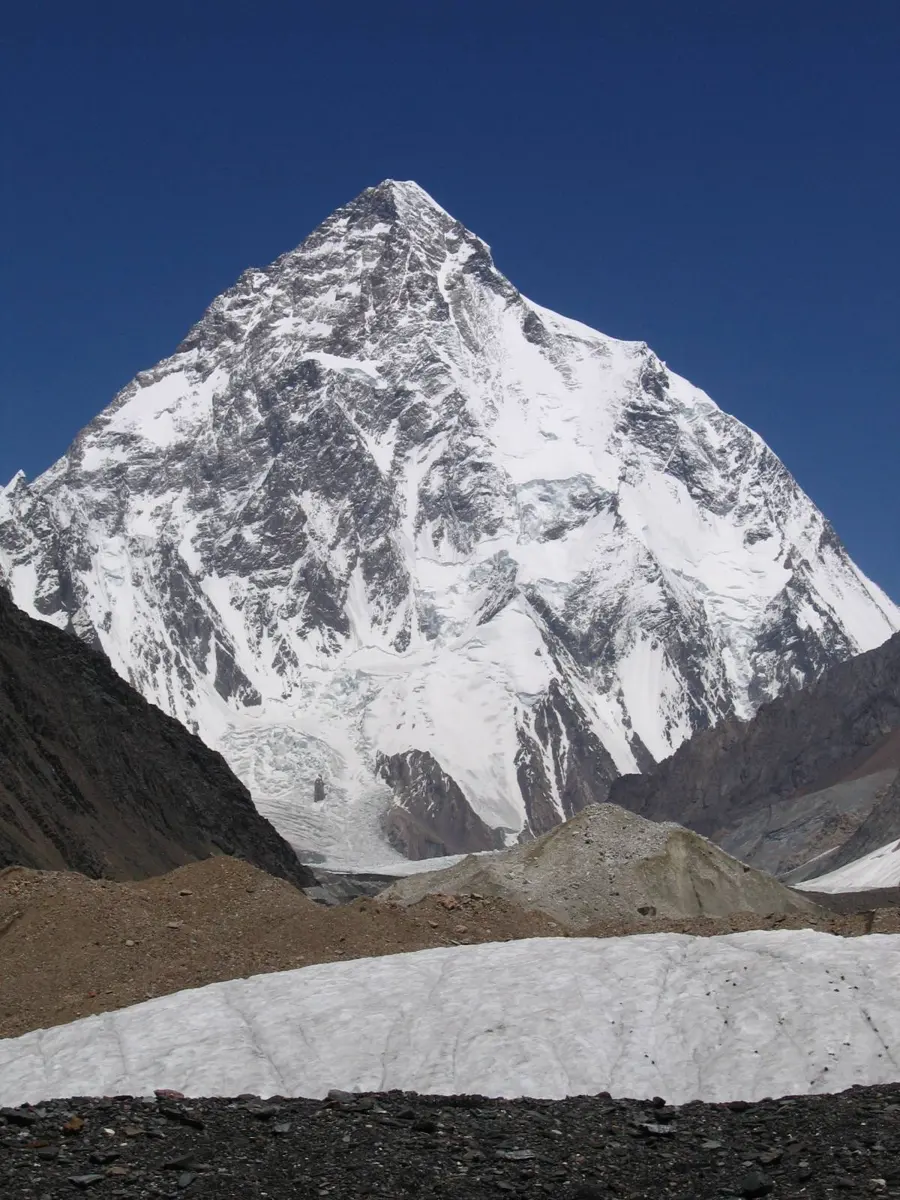
- What and where. K2 is the second highest mountain in the world, at 8,611 meters, after Everest. People who live near it call it Dapsang or Chogori; it is also called Mount Godwin Austen. It stands in the Karakoram Range, in the part of Kashmir called Gilgit-Baltistan, which Pakistan rules. Its foot is on the Godwin Austen Glacier, at about 4,570 meters.
- Its names. In 1856, Colonel T. G. Montgomerie of the Survey of India listed the peaks of the Karakoram as K1, K2, K3…; K2 was the second peak he measured, and the name stuck. The other name honors H. H. Godwin Austen, an English geographer of the 1800s who first surveyed (measured and mapped) the area round it.
- The attempts. The first team to try, an Anglo-Swiss expedition (British and Swiss) in 1902, reached only 5,670 meters. An Italian team in 1909 got to about 6,100 m, and American teams in 1938, 1939 and 1953 (two of them led by Charles Houston) climbed higher and higher (the highest, in 1939, to about 8,380 m), but none reached the top.
- The first climb to the top. In 1954, a large Italian expedition (scientists, a doctor, a photographer and others, among them a Pakistani) climbed by the Abruzzi Ridge and reached the summit at 6 p.m. on 31 July, in spite of terrible weather. One of the team, Mario Puchoz, died of pneumonia on the way.
- Why it is so hard. K2 has frequent, violent storms, and its slopes are steep and dangerous; and at such a height the human body struggles to work. Far fewer people have stood on its top than on Everest’s. Fewer people have died on K2 than on Everest, but out of every hundred who try, a much larger share die.
Words from the text
| Word | Meaning |
|---|---|
| located | in a place, situated |
| glacier | a huge, slow river of ice |
| discover | to find out something for the first time |
| survey | to measure and map land |
| expedition | an organized journey for a special purpose, such as climbing a mountain |
| ascend | to go up, climb |
| summit | the highest point of a mountain |
| conquer | to defeat; to climb a mountain to the top |
| elevation | the height of a place above sea level |
| prone to | likely to suffer from something |
| constitute | to form or make up |
| fraction | a small part of something |
| proportion | a part compared with the whole; a share |
| route | a way from one place to another |
A. The crossword
Solve the crossword puzzle. Use the clues below.
Across: 2. situated · 5. found out · 7. climbed/went up · 9. way
Down: 1. to defeat · 3. forms or makes · 4. height of a place from sea level · 6. an organized journey for a particular purpose · 8. the highest point of a mountain
Answer
B. Answer the questions
What is the local name of K2?
Answer
When was the mountain discovered?
Answer
Who is H. H. Godwin Austen?
Answer
When did people start to climb K2?
Answer
When did people successfully reach the top of K2?
Answer
What makes the climbing of K2 more difficult?
Answer
C. True or false?
K2 is the highest mountain in the world.
Answer
The mountain was unknown until the 1900s.
Answer
A team of Americans first attempted to climb K2.
Answer
The first successful expedition was a complete success without any death.
Answer
Mt. Everest is easier to climb than K2.
Answer
Why is K2 called K2?
Pick an answer to see why.
D. Nepal’s mountains
Compare the heights by asking about two of them: How high is Lhotse? Is it higher than Makalu?
There are many mountains in the northern part of Nepal. Make a list of the mountains and find out their heights and compare them.
A model answer
Pronunciation: where the stress goes
In a word of two or more syllables, one syllable is said louder and a little longer: that is the stressed syllable. Dictionaries mark it with a small raised line ˈ just before it: ˈsummit, expeˈdition. Put the stress in the wrong place and a word can be hard to understand, even when every sound is right.
A useful rule: in words ending in -tion, the stress falls just before -tion: ex·pe·DI·tion, e·le·VA·tion, FRAC·tion, pro·POR·tion.
| Stress on the first syllable | Stress later in the word |
|---|---|
| ˈportion, ˈglacier, ˈsummit, ˈconquer, ˈfraction | expeˈdition, apˈproximately, eleˈvation, proˈportion, sucˈcessfully |
Listen to your teacher and repeat after him/her. Notice the mark ‘ˈ’.
portion, glacier, summit, expedition, approximately, conquer, elevation, fraction, proportion, successfully
Answer
Which word has its stress on the second syllable?
Pick an answer to see why.
Writing I: from an idea map to a description
An idea map (or mind map) puts the topic in the middle and a fact on each branch round it. It is a quick way to collect facts before you write. To turn it into a paragraph:
- Start with a topic sentence that names the place and says something general about it.
- Turn each branch into one sentence, in a sensible order: where it is, then what it is, then its size, height and depth, then what is around it.
- Join the sentences with words like it, also, and, so they don’t all start the same way.
- End with a closing sentence: why it is special, or why people visit it.
A. The idea map
The book’s map of Rara Lake gives its location (Mugu District), its area, that it is the biggest freshwater lake in Nepal, its height (2,990 m), its greatest depth (167 m) and what surrounds it (Rara National Park, the smallest national park).
Tap the branches in the order you would write about them: each fact becomes a sentence.
B. Write a description
Using the idea map, write a short description of Rara Lake.
A model description
Grammar I: subject–verb agreement
A. Study the sentences
Study the sentences. Notice the subjects and the verb forms.
- a.One of my friends is very rich. He offers us parties on special days.
- b.My friends are busy doing their class work.
- c.Twenty dollars is not a small amount.
- d.Someone bangs on the door every night.
- e.Either you or Hari is top of the class.
- f.Look! The goats are grazing there.
- g.This furniture costs a lot these days.
Answer
Subject–verb agreement means the verb must match its subject: one thing, a singular verb; more than one, a plural verb. In the present simple, the singular verb takes -s: She runs; They run.
| Rule | Example |
|---|---|
| One of + plural noun: the subject is one, so singular | One of my friends is a singer. |
| The subject, not the nearest noun, decides | The man with roses looks like your brother. |
| Amounts of money, time, weight or distance are singular | Ten kilos of sugar is enough. Two hours is a long time. |
| Every, each, someone, everyone, nobody are singular | Every student has a book. |
| Uncountable nouns are singular | The furniture costs a lot. The news is good. |
| Either … or / neither … nor: agree with the nearer noun | Either the boys or Hari is right. Either Hari or the boys are right. |
| Police, people, cattle are plural | The police are coming. |
| A lot of / some + plural noun: plural | A lot of changes have happened. |
B. Choose the verb
Choose a verb from the brackets to complete the sentences.
- a.Every generation ……… its own characteristics. (has/have)
- b.A generation gap ……… of differences in different aspects. (consists/consist)
- c.A lot of changes ……… occurred in the village since I left it. (have/has)
- d.The beautiful scenery of the place ……… more tourists. (attract/attracts)
- e.Ten kilos of sugar ……… sufficient for us now. (are/is)
- f.Police ……… investigating the case carefully. (were/was)
- g.One of the students ……… been selected for the school award. (has/have)
- h.The man with roses in his hands ……… like your brother. (look/looks)
Answer
Which sentence is correct?
Pick an answer to see why.
Listening: the Panama Canal
A. Before you listen
The picture shows a big ship in a narrow channel of water between concrete walls, with land on both sides.
Look at the picture and answer the questions.
- a.What do you see in the picture?
- b.Have you seen this in your locality? Where?
- c.What is it used for?
Model answers
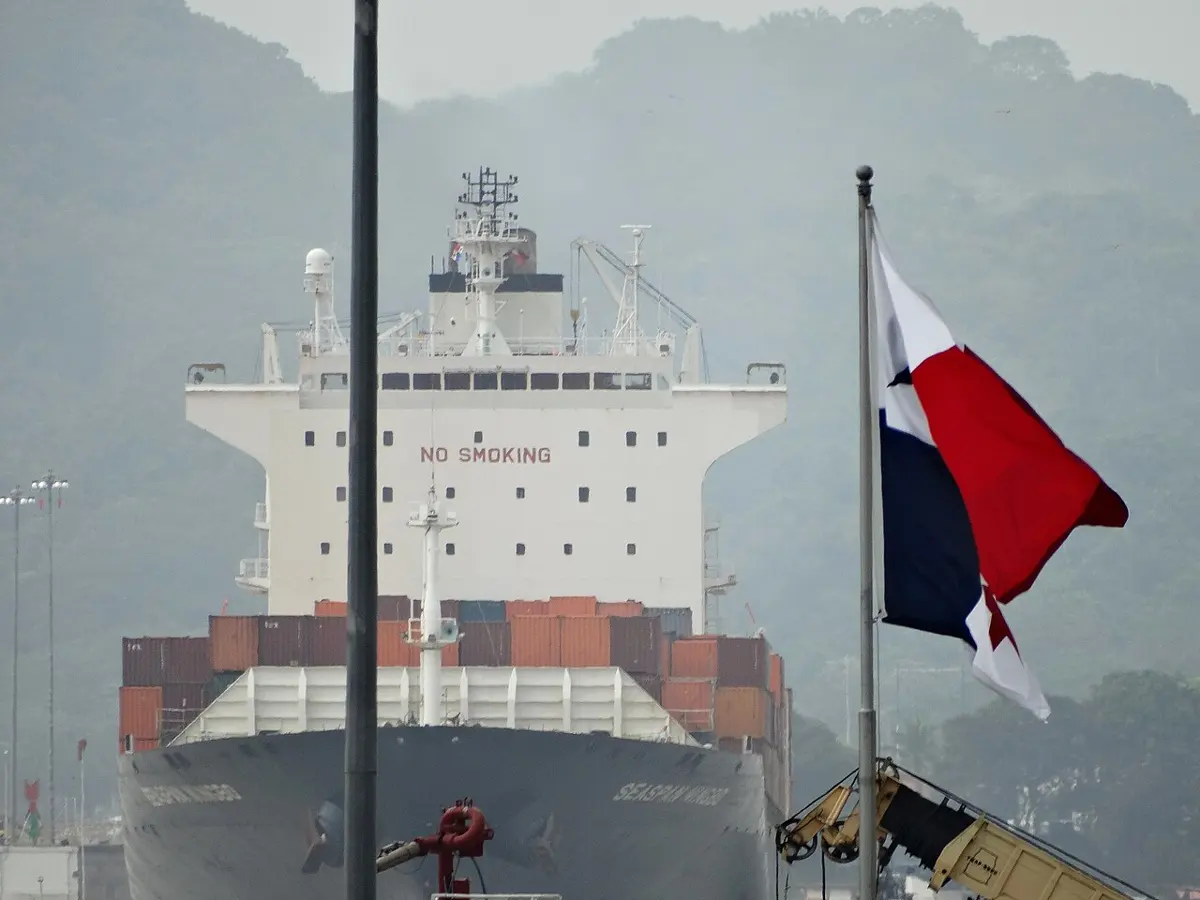
You will hear a short talk about the Panama Canal, a waterway across the narrow land of Panama, in Central America. Read B first: each gap needs one word, often a number.
B. Complete the sentences
Now, listen to the audio and complete the sentences. Use one word only.
- a.The Panama Canal connects the Pacific and the ……… Ocean.
- b.The ……… began to construct the canal in 1881.
- c.Almost ……… people died while building the canal.
- d.The USA handed the canal to Panama in ……… .
- e.Every year, almost 40,000 ……… come through the canal.
Answer
C. More about the canal
Surf the internet or visit the library and find out more statistics about the Panama Canal and share them with your friends.
Some facts to share
Reading II: a school prospectus
Before you read
Have you ever seen this type of document? Where?
A model answer
What is it called?
Answer
Does your school have one?
A model answer
What a prospectus is
A prospectus is a booklet (or a page or a leaflet) in which a school or college tells new students and their parents about itself. It is meant to inform and to attract students, so it shows the school at its best. Most prospectuses have the same parts, each with a heading:
| Part | What it tells you |
|---|---|
| Introduction | the school’s name, when it was founded, which classes it runs |
| Vision and mission | what the school hopes to become, and what it does to get there |
| Programs | the levels and courses it offers |
| Salient (main) features | teachers, labs, library, transport, meetings with parents |
| Admission | who can join, and how (an entrance test) |
| Fees and scholarships | what it costs, and help for those who can’t pay |
| Contact | the address, phone and email |
The prospectus, part by part
- Introduction. Saraswati Secondary School, in Ilam, was founded in 2018 BS. Since 2070 BS it has run classes from Grade 1 to Grade 12.
- Vision and mission. It wants to be a center of academic excellence and to produce skilled, creative young people. Its mission is to give quality education to children from underprivileged and marginalized communities (poor families, and groups that have been pushed to the edges of society), and to be inclusive, a school where every student and teacher belongs.
- Programs. Montessori-style pre-primary classes, basic level (Grades 1–8) and secondary level (Grades 9–12).
- Main features. Well-qualified, trained teachers; regular meetings with students and guardians; weekly tests and support classes for those who need extra help; practical classes; a computer lab, library and science lab; free Wi-Fi; audio-visual classes; extra classes if needed; and a cafeteria.
- Scholarships. Several kinds, for good students and for students from underprivileged and marginalized groups.
- Admission and uniform. Anyone who meets the school’s basic conditions can sit the entrance test for Grades 6, 9 and 11. Students wear the school uniform.
- Fees. Only nominal (very small) fees, for the bus, for Grades 11 and 12: the school believes no one should be deprived of (kept from having) education.
- Contact. Its address in Ilam Municipality–9 and its email.
Words from the prospectus
| Word | Meaning |
|---|---|
| prospectus | a booklet that tells about a school or college |
| motto | a short sentence that says what a group believes in |
| salient | most important, standing out |
| devoted to | giving all your time and effort to something |
| human resources | people and their skills, seen as a country’s or a company’s wealth |
| underprivileged | poorer, with fewer chances than others |
| marginalized | pushed to the edge of society, left out |
| ensure | to make sure |
| support | help |
| cafeteria | a place in a school or office where you buy food and eat |
| nominal | very small, much less than the real cost |
| deprived of | kept from having something you need |
| inclusive | open to everyone, leaving no one out |
A. Use the words
Choose the words from the box to complete the sentences.
nominal, underprivileged, devoted, human resources, support, cafeteria, ensure, deprived of
- a.The baby is still not well. He was ……… oxygen during birth.
- b.She takes a bath regularly. She wants to ……… personal hygiene.
- c.These children are from an ……… community. We’ve provided them with necessary things at school.
- d.Thirty percent of the students need ……… classes in Mathematics.
- e.Nepal needs skilled ……… to utilize the available natural resources.
- f.Our school canteen is cheap. It provides its services at ……… prices.
- g.No one brings homemade food. Everyone eats at the ……… .
- h.After finishing her higher education, Ms. Tharu ……… herself to social work.
Answer
B. True or false?
The school was established more than 50 years ago.
Answer
The school is located in a remote village.
Answer
Students and guardians get a chance to interact with the school family.
Answer
The students can eat at the school cafeteria.
Answer
The school is one of the most expensive schools in Nepal.
Answer
C. Answer the questions
When was the school established?
Answer
Make a list of the programs offered by the school.
Answer
Is the school suitable for underprivileged students? How do you know?
Answer
Has the school got computers? How do you know?
Answer
What is the email address of the school?
Answer
Why does a prospectus list a school’s best features?
Pick an answer to see why.
D. Your school’s facilities
Visit different sections of your school and list the facilities available there.
A model answer
Speaking: how tall, how much, how far?
A. Act out the conversations
Act out the following conversations.
- a.A: How tall is this tree? B: It’s about 20 meters tall.
- b.A: How much does it weigh? B: It’s twenty kilos.
- c.A: How far is the nearest museum from here? B: It’s about a 20 minute walk.
Answer
B. Ask and answer
Work in pairs. Take turns to ask and answer questions based on these clues.
- a.time to get to your school/20 minutes
- b.kerosene you need/5 liters
- c.your school from the bus park/3 km
- d.your father/5 feet
- e.your weight/35 kg
- f.your classroom window/3 feet
- g.how long/Koshi River/720 km
Answer
C. Your own questions
Work in groups. Take turns to ask and answer questions. Think about different questions you could ask about height, weight and distance. Be honest with your answers.
Model questions
Writing II: a prospectus for your school
Use the parts of Saraswati Secondary School’s prospectus, and the facts you found in Reading II D. Keep each part short, under its own heading, and write in the present simple (The school offers…, Students wear…). First, see how the parts fit together in a made-up school’s prospectus.
Read the Reading II once again. And, design a similar prospectus for your school with the help of the given outline. Get help from your teacher. Use a photo if possible.
Introduction: the name, when it was established · Vision: to develop school as a center of excellence · Mission: to provide quality education to all (inclusive school) · Major programs · Main features (science lab/library/canteen/classroom equipment, etc.) · Admission process · Fee structure · Scholarships
A model prospectus
Grammar II: how tall, how far, how much?
To ask about size or quantity, put How before an adjective or much/many:
| Question word | Asks about | Example |
|---|---|---|
| How tall | height of people, trees, buildings | How tall is your brother? |
| How high | height of mountains, or how far up | How high is K2? How high can you jump? |
| How long | length, or time | How long is the bridge? How long does it take? |
| How far | distance | How far is Pokhara from Kathmandu? |
| How much | an amount, a weight, a price | How much water do you drink? How much does it weigh? How much is it? |
| How many | a number of countable things | How many students are there? |
| How old / wide / deep / heavy | age, width, depth, weight | How deep is Rara Lake? |
The word order after How + adjective is the order of any question: How tall + is + the tree? With another verb, add do/does/did: How much water + do + you + drink? With a helper like can or has, it moves in front of the subject: How high + can + you + reach?
A. Match the questions and answers
Match the questions in column A with their possible answers in column B.
Column A: a. How tall is your house? · b. How long is the East West highway? · c. How much water do you drink a day? · d. How far is Kathmandu from Pokhara? · e. How tall is your younger brother? · f. How much does your bag weigh?
Column B: i. It’s about 2.5 kilograms. · ii. He’s 3’5”. · iii. It’s 1027.67 kilometers. · iv. It’s about 20 feet. · v. It’s about 200 kilometers. · vi. I drink 2 liters of water every day.
Answer
B. Make the questions
Rearrange the words to make sensible questions. (Example: How much can Shiva carry?)
- a.has/How far/reached/the pilot?
- b.the Karnali Bridge/long/is/How?
- c.tall/a giraffe/is/How?
- d.How/can/high/you/reach?
- e.long/is/your ruler/How?
Answer
Project work: prospectuses
Extra bit: words for quantity
Some words of quantity go with countable nouns (things you can count: books, friends, pages), some with uncountable ones (water, money, rice, time), and some with both.
| Word | With | Use | Example |
|---|---|---|---|
| some | both | positive sentences; offers and requests | We saw some tigers. Would you like some tea? |
| any | both | questions and negatives | Do you have any children? I haven’t got any money. |
| many | countable | a large number (mostly in questions and negatives) | I have many friends. |
| several | countable | more than two, but not many | She has several books. |
| a few | countable | a small number, but some (positive) | I have a few pages left to read. |
| few | countable | very few, almost none (negative) | Few people came to the meeting. |
| a little | uncountable | a small amount, but some | Would you like a little water? |
| much | uncountable | a large amount (mostly in questions and negatives) | I don’t have much money. |
| a bit of | uncountable | a small amount (everyday English) | Add a bit of salt. |
Exercise
Practice the whole unit. Try each one, then open the answer.
Choose the right verb.
- a.Each of the players (has/have) a number on his shirt.
- b.Five hundred rupees (is/are) too much for a pen.
- c.The cattle (is/are) grazing by the river.
- d.The boy with the two dogs (live/lives) next door.
Answer
Write the question for each answer.
- a.It’s 8,611 meters high. (K2)
- b.It’s about 200 kilometers. (Kathmandu to Pokhara)
- c.I weigh 38 kilos.
Answer
Fill in a few, a little, much or many.
- a.Hurry up! We don’t have ……… time.
- b.Could I have ……… sugar in my tea?
- c.There were ……… people at the bus stop, so we got seats.
- d.How ……… mountains in Nepal are over 8,000 meters?
Answer
Where is the stress in elevation and glacier?
Answer
Name four parts of a school prospectus.
Answer
Printable PDFs
- Study notes 2 pages
- Harder practice questions 2 pages Answer key
Practice every question in the book, and keep track of the ones you miss →
A companion to your textbook, not a replacement for it: study from the book your school uses, and where the two differ, follow your teacher. Found a mistake? Please tell us.