
How much does a kilo of rice cost at your nearest shop? How many kinds of daal does it sell? Every time you shop, you are working with units (kilograms, liters, rupees) and quantities (how much, how many).
This unit is about units and quantities. You will read a shop’s price list and an advertisement for a New Year sale, ask How much…? and How many…?, listen to the day’s vegetable prices, and learn when to say much or many, a little or a few, some, any or no. You will write a short report comparing prices, and in the Extra bit you will meet multiword verbs like look after and give back.
Getting started
A. What units do they show?
The unit opens with four pictures: a packet of sunflower oil marked 1 Liter, a sack marked RICE 20 KG, a milestone by a road saying POKHARA 20 Km, and a fifty-rupee note.
Look at the pictures and say what units they indicate.
Answer
| Measuring | Units | Short form |
|---|---|---|
| length, distance | millimeter, centimeter, meter, kilometer | mm, cm, m, km |
| mass (weight) | gram, kilogram | g, kg |
| volume (liquids) | milliliter, liter | ml, l |
| time | second, minute, hour | s, min, h |
| money in Nepal | paisa, rupee | Rs. or NRs. |
B. Listen and sing
The song is by George Cooper, and it imagines autumn as a game. The wind speaks to the leaves like a friend. It invites them to come and play in the meadows (wide fields of grass), and to put on their dresses of red and gold, because summer is over and the days are getting cold.
In the second verse, the leaves hear the call and come fluttering down (moving lightly, like little wings), all of them together. They dance and fly over the meadows, singing their soft songs.
The leaves’ “dresses of red and gold” are the colors leaves turn before they fall in autumn. The lines rhyme in pairs (day and play, gold and cold, call and all, flew and knew), and the beat runs light and quick, like leaves blown in the wind.
C. Things around you
Look around your class for a minute. What objects do you see? Talk about their uses too.
A model answer
Reading I: a price list
Before you read
Have you ever seen a chart like the following?
A model answer
Where do you see this?
A model answer
The price list, part by part
The chart is a price list from a shop called All in One Store. It is in two parts.
- Rice items (rows 1 to 7): five kinds of rice and two kinds of beaten rice (chiura), with the price of one kilogram of each.
- Daal items (rows 8 to 14): seven kinds of lentil and gram, each with its Nepali name in brackets: mas (black gram), moong (green gram), musuro (red lentil), rahar (split red gram) and chana daal (split Bengal gram).
The last column says Price/kg NRs.: the price for one kilogram, in Nepalese rupees. So 80 beside Pokhreli rice means Rs. 80 for one kilogram. S.N. at the top of the first column means serial number, the number of each row.
Read the list here, and answer the questions by tapping the rows.
A. True or false?
a. Pokhreli Rice is the most expensive rice item.
Pick an answer to see why.
b. Mansuli Rice is cheaper than Sona Mansuli Rice.
Pick an answer to see why.
c. Normal Beaten Rice is cheaper than Taichin Beaten Rice.
Pick an answer to see why.
d. Red Lentil No. 1 is less expensive than Red Lentil No. 2.
Pick an answer to see why.
e. Split Red Gram is the most expensive daal item.
Pick an answer to see why.
B. Answer the questions
Which shop does the price chart belong to?
A model answer
Which beaten rice will you buy if you have only 100 rupees?
A model answer
Which daal items have equal price?
A model answer
How many daal items are available in the shop?
A model answer
C. A price chart from home
Ask your parents about the price of food items at your home and make a price chart.
A model chart
Speaking: how much or how many?
A. Ask about the pictures
The question word depends on the noun after it.
| Use with | Examples | |
|---|---|---|
| How many…? | things you can count (plural nouns) | How many pens? How many coins? |
| How much…? | things you can’t count (uncountable nouns) | How much water? How much music? |
You can count pens: one pen, two pens. You can’t count water: you can’t say one water, two waters; you count it in units instead (two liters of water, a glass of water). How much…? also asks a price: How much is this pen?
The pictures show, in order: pens (the example), muffins, coins, music on headphones, rain, earrings, toys and water.
Fill each gap with How much or How many, then answer the questions about yourself.
Example: How many pens do you have?
- a.……… muffins can you eat?
- b.……… coins are there in your pocket?
- c.……… music do you listen to?
- d.……… rain fell in the morning?
- e.……… earrings are you wearing?
- f.……… toys do you have?
- g.……… water do you drink a day?
Answer
Twelve more pictures follow: a computer, a globe, a clock, books, a person exercising, friends round a table, money, two hands in a high five, a cup of tea, fruit, a dog, and children waving.
Ask and answer with How much…? or How many…? about the pictures.
Example: A: How many computers do you have? B: I have only one computer.
Model questions and answers
B. Things you have
In pairs, ask and answer about things you have, with How many…? or How much…?
A model conversation
Listening: vegetable prices
A. Before you listen
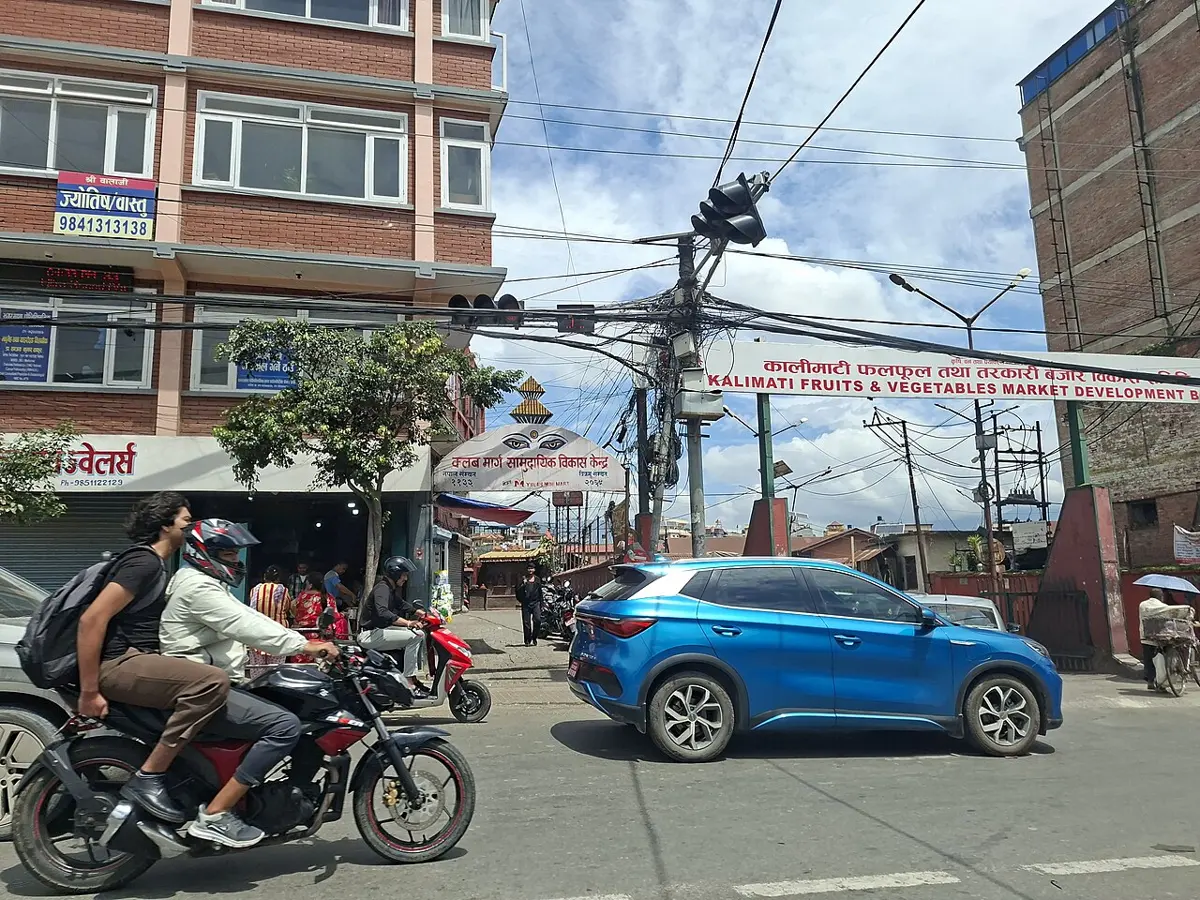
The picture shows a busy market. People are buying vegetables and fruit from a cart and from piles on the ground, a woman buys bananas from a shop, and a man sells balloons.
- a.What are the people doing there?
- b.Is there any place like this in your locality?
- c.What do you do there?
Model answers
The recording
You will hear Umesh reading the day’s vegetable prices from the market at Kalimati, rupees for a kilo. Listen once to hear how the list goes, and a second time to fill in the table.
B. Complete the table
Listen and complete the table: some rows need the vegetable, some the price.
| Vegetable | Price (Rs./kg) |
|---|---|
| Cabbage | ……… |
| ……… | 30 |
| Broccoli | ……… |
| ……… | 50 |
| Cauliflower | ……… |
| Lady’s finger | ……… |
| ……… | 65 |
Answer
C. A stationery price list
What stationery items do you have? Prepare a price list of the items.
A model price list
Grammar: much, many, a few, a little, some, any, no
A. Words for quantity
The key question is again: can you count it?
| Word | With | Example |
|---|---|---|
| many | countable (plural) | I saw many wild animals in Chitwan National Park. |
| much | uncountable | There isn’t much water in the bucket. |
| a few | countable: a small number | Last night I read a few pages. |
| a little | uncountable: a small amount | Add a little salt. |
| a lot of / lots of | both | a lot of books · a lot of milk |
| some | both, mostly in positive sentences and offers | I have some money. Would you like some tea? |
| any | both, in questions and negatives | Is there any food? I don’t have any money. |
| no | both: none at all, with a positive verb | I have no time to cook. |
Fill each gap with the right word.
B. Choose the right words
Complete the paragraph with the right words from the brackets.
I’m not a very good cook because I don’t have ……… (much/many) time. During the week, I don’t make ……… (any/no) meals except breakfast. I usually have ……… (a/some) toast and a ……… (few/little) orange juice. At the weekend, I sometimes help to make lunch, but I don’t know ……… (much/many) good recipes. So I just follow my sister’s instructions. She is a great cook and makes ……… (many/a lot of) really nice food.
Answer
C. Complete the sentences
Complete the sentences with phrases from the box: few people · many good friends · three big rivers · many metropolitan cities · any outdoor game · three birds · many colorful butterflies · many countries.
- a.Do you know how ……… there are in Nepal?
- b.I often visit the garden to see ……… .
- c.Don’t you want to play ……… ?
- d.Although the song was beautiful, only a ……… were listening to it.
- e.How ……… are there in South Asia?
- f.Can you name any ……… of Nepal?
- g.There are ……… flying in the sky.
- h.I am proud of having ……… .
Answer
Writing: a report on prices
A. Read a model report
Writing A is a short report on the rice part of the price list. It does two things, in two paragraphs.
- The facts. It says what the table is about (the price of rice items), then gives the prices, joining them so they don’t read like a list: two that are equal; one that costs Rs. 100 whereas another costs Rs. 65 (whereas sets two facts side by side to contrast them); two given at once with respectively (Rs. 120 and Rs. 70, respectively: in the same order as the items just named).
- The comparison. It compares them: one is costlier than another, one cheaper than another, and it ends with the most expensive and the cheapest.
| To say | Words to use |
|---|---|
| the same price | The price of A and B is equal. · A costs the same as B. |
| two prices side by side | A costs Rs. 100, whereas B costs Rs. 65. |
| two prices in one go | A and B cost Rs. 120 and Rs. 70, respectively. |
| higher | A is more expensive than B. · A is costlier than B. · A is dearer than B. |
| lower | B is cheaper than A. · B is less expensive than A. |
| the top and the bottom | A is the most expensive. · B is the cheapest. |
B. Write a similar report
Compare the stationery prices first: tap two bars and choose the word.
Write a similar report on this price list: Pilot pen Rs. 80, Gel pen Rs. 30, Pencil box Rs. 100, Geometry box Rs. 150, Ruler Rs. 40, Marker Rs. 50.
A model report
Reading II: an advertisement
Before you read
What is this text about? Discuss.
A model answer
The advertisement, part by part
An advertisement (an ad) tries to make people buy something. This one is a bright poster.
- The heading, in big letters, starts with Hurry up! and says there is a 20% discount for two weeks, for the New Year. Hurry up makes people feel they must come quickly, before the offer ends.
- The pictures: colored pencils (Rs. 90), pens (Rs. 20), exercise books (Rs. 50), a geometry box (Rs. 75) and a calculator (Rs. 350), each price in a yellow star.
- A big red –20% in the middle, so nobody misses the offer.
A. Answer the questions
What is the special offer?
A model answer
How long does the discount offer remain?
A model answer
Which is the cheapest item?
A model answer
Which is the most expensive item?
A model answer
B. What is a discount?
What do you mean by discount? Talk to your friends.
A model answer
Project work
Extra bit: multiword verbs
A multiword verb (also called a phrasal verb) is a verb with one or two small words after it (up, on, off, out, in, after…) that together mean something new. Look means to use your eyes, but look after means take care of, and look up means find in a book or online.
| Verb | Meaning | Example |
|---|---|---|
| clean up | make a place clean | We cleaned up the classroom after the party. |
| fill in | write the information in a form | Fill in your name and address. |
| fill out | complete a form | Please fill out this application form. |
| give back | return | Give back my pen, please. |
| hand in | give work to a teacher | Hand in your homework tomorrow. |
| hand over | give something to someone | The thief handed over the bag to the police. |
| hold up | delay | A landslide held up our bus for three hours. |
| line up | stand in a line | Line up at the door, please. |
| look over | look at quickly to check | Look over your answers before you hand them in. |
| look up | find a fact or word | Look up the word in the dictionary. |
| point out | show, draw attention to | She pointed out a mistake in my sum. |
| put on | dress in | Put on your jacket; it’s cold. |
| set up | arrange, start | We set up a stall at the fair. |
| try out | test | Try out the new bicycle before you buy it. |
| take off | remove (clothes or shoes) | Take off your shoes at the temple door. |
| turn off / turn on | stop / start a light or machine | Turn off the fan. · Turn on the light. |
| wrap up | finish | Let’s wrap up the meeting. |
| bump into | meet by chance | I bumped into my old teacher at the market. |
| look after | take care of | Grandma looks after the goats. |
| bend over | lean your body forward | He bent over to pick up the coin. |
| check in / check out | register at / leave a hotel | We checked in at noon and checked out the next morning. |
| get away | escape | The thief got away. |
| get together | meet | Let’s get together on Saturday. |
| get up | rise from bed | I get up at six. |
| slip up | make a mistake | I slipped up on the last question. |
| break down | stop working | Our car broke down on the highway. |
| end up | finally be in a place or state | We got lost and ended up in Bhaktapur. |
| grow up | become an adult | She grew up in Ilam. |
| pass away | die (a gentle way to say it) | My great-grandfather passed away last year. |
| show up | arrive, appear | Only three people showed up. |
| shut up | stop talking (rude!) | Say please be quiet instead. |
Match each multiword verb to its meaning.
“Our bus ___ near Mugling, so we waited for two hours.” Which fits?
Pick an answer to see why.
“Can you ___ my plants while I am in Pokhara?” Which fits?
Pick an answer to see why.
Exercise
Practice the whole unit. Try each one, then open the answer.
Write How much or How many.
- a.……… sugar do you put in your tea?
- b.……… sisters do you have?
- c.……… time do we have?
- d.……… students are absent today?
- e.……… is this jacket?
Answer
Choose the right word.
- a.There are only (a few / a little) mangoes left.
- b.Can I have (a few / a little) milk?
- c.I don’t have (some / any) money.
- d.There is (no / any) water in the bottle.
- e.We saw (many / much) birds at Taudaha.
Answer
Look at the price list in Reading I. Write three sentences comparing prices.
Model answers
A pair of shoes costs Rs. 2,000. The shop gives a 10% discount. How much do you pay?
Answer
Use the right multiword verb: look after, turn off, get up, give back, hand in.
- a.Please ……… the lights when you leave.
- b.I ……… at six every morning.
- c.Can you ……… my bag while I buy the tickets?
- d.……… your homework on Friday.
- e.……… the book when you have read it.
Answer
Printable PDFs
- Study notes 2 pages
- Harder practice questions 2 pages Answer key
Practice every question in the book, and keep track of the ones you miss →
A companion to your textbook, not a replacement for it: study from the book your school uses, and where the two differ, follow your teacher. Found a mistake? Please tell us.