
Which is the biggest lake in Nepal? Which café has the cheaper momo? Who is the tallest in your class? Every day you compare things, and English has a neat way to do it: big, bigger, the biggest.
In this unit you will visit Rara Lake, the biggest lake in Nepal, read two real-looking menus from Lamjung side by side, and listen to a man ordering momo on the phone. You will learn when to add -er and -est, when to use more and most, and why we say better, not gooder.
Getting started
A. Compare the pictures
The unit opens with three pairs of pictures.
- A green village on a hillside, with terraced fields and snowy mountains behind it; beside it, a crowded city with tall buildings and smoking chimneys.
- A family working in a field with a plow and two oxen; beside it, rows of workers in yellow uniforms in a big factory.
- Three children playing with pebbles on the ground; beside it, three older friends walking together.
Compare these pairs of pictures.
Model answers
B. Listen and sing
The song is about comparing. The singer asks whether you can really compare the moon with the earth, or a death with a birth. They know what big, bigger, biggest means, but still can’t decide which is best, the earth or the moon. In the second verse they say that earning money is good but learning is the best, and that discipline (keeping to your rules and work) beats everything else. School feels hard to them, and they end with a question: what is the easiest way to live?
Listen for the comparing words: big, bigger, biggest, good … the best, the easiest. And listen for the rhymes at the ends of the lines: earth and birth, biggest and best, best and rest, tall and all.
Sing the song. Find three words in it that compare.
Answer
C. Easier or more difficult?
Which subject is easier or more difficult for you? Talk to your friends.
A model answer
Reading I: Rara Lake
Before you read
What are some popular lakes in Nepal?
A model answer
Where is Rara Lake located?
A model answer
Why do people go there?
A model answer
The text, part by part
This reading is a description: it tells you what a place is like, so that you can see it in your mind. It moves from the facts (where, how big, how deep, how high) to what makes the place special, and ends with how to get there.
- The facts. Rara is the biggest lake in Nepal. The text gives three numbers: its water covers 10.8 square kilometers, it is 167 meters deep at its deepest, and it lies at an altitude (height above the sea) of 2,990 meters. It is the jewel of Rara National Park.
- A lake of many colors. Visitors say the water changes color during the day, and that the scene behind it seems to change again and again. People call these the lake’s mysteries: things that are hard to explain.
- The mirror. The water is so clear and still that, from a boat, you hardly feel you are on water. The hills and green forests in front of you are there again, upside down, in the lake, and so is your own face.
- For walkers and nature lovers. Trekkers come to hike on the hills around the lake. The park’s flora (plants) and fauna (animals) are another reason to come: the text counts more than 214 kinds of birds, 20 kinds of mammals and 500 kinds of flowers. Rare animals such as the red panda, the musk deer, the Himalayan black bear, the leopard and the wild boar live there.
- Clean and quiet. Few people live or visit there, and nothing dirties the water, so the lake is not polluted. Nature lovers find solitude, the peace of being alone, among the Himalayan hills.
- Getting there. You can fly from Nepalgunj to Talcha airport in Mugu, or travel on the Karnali Highway by bus or jeep.
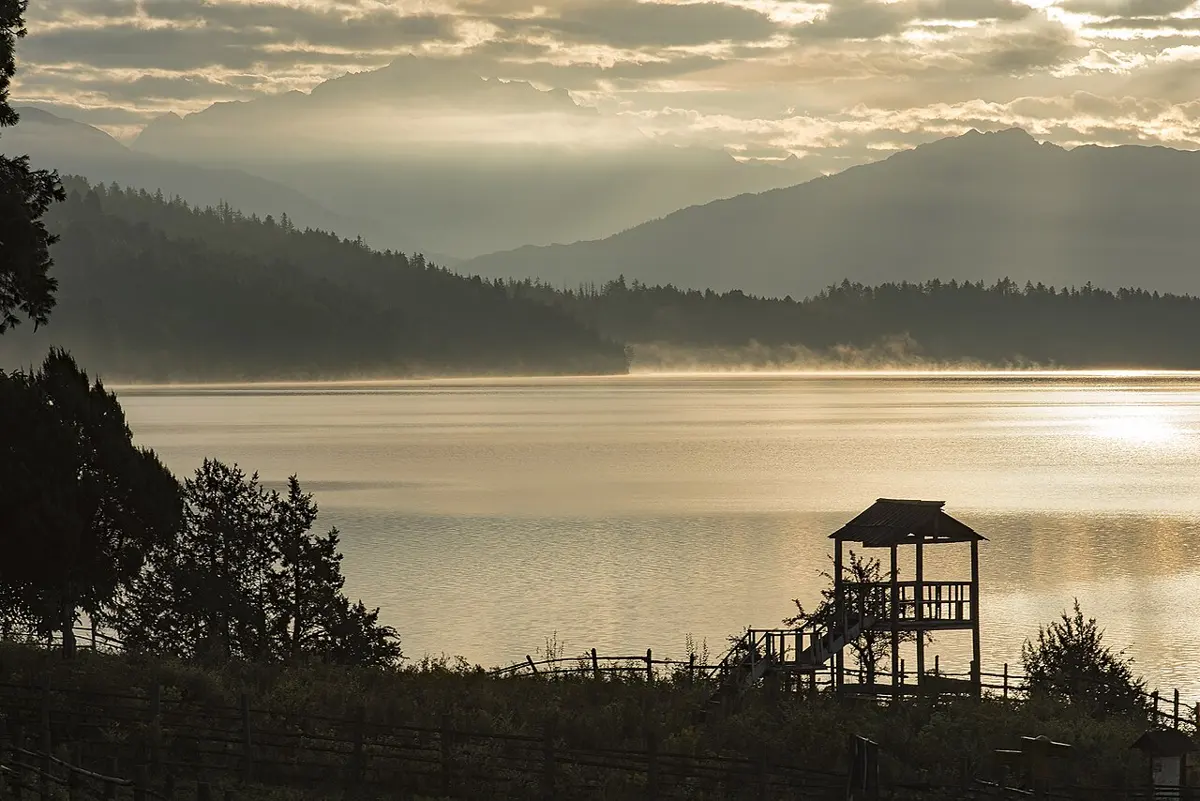
Why can visitors see the hills “inside” the water?
Pick an answer to see why.
How does Rara compare with Nepal’s other famous lakes? Tap two lakes and choose the word, or find the biggest and the highest.
Words from the text
| Word | Meaning |
|---|---|
| altitude | height above the level of the sea |
| amazing | very surprising, in a good way |
| mystery | something that is difficult to understand or explain |
| crystal clear | completely clear, like glass |
| magnificent | grand and very beautiful to look at |
| destination | the place someone is traveling to |
| flora and fauna | the plants and the animals of a place |
| endangered | in danger of dying out |
| solitude | being alone, in peace and quiet |
| contamination | making something dirty or harmful |
| splendid | very fine and beautiful |
A. Match the words
Match the words in column A with their meanings in column B.
| Column A | Column B |
|---|---|
| a.mystery | i.silence |
| b.magnificent | ii.going to die out |
| c.endangered | iii.difficult to understand |
| d.solitude | iv.grand in appearance |
Answer
B. True or false?
Rara Lake is the second largest lake in Nepal.
Pick an answer to see why.
The visitors can also go for hiking around the Rara Lake.
Pick an answer to see why.
The visitors can see the images of hills in the water.
Pick an answer to see why.
Talcha is the nearest airport to get to Rara.
Pick an answer to see why.
C. Answer the questions
What are the two amazing things about the lake?
A model answer
Why is Rara one of the best destinations for trekkers and visitors?
A model answer
Make a list of the endangered animals found in Rara National Park.
A model answer
Why is the water in Rara Lake less polluted?
A model answer
How can one get to Rara Lake?
A model answer
D. Your lake
Have you ever visited any lake? Share your experience.
A model answer
Speaking
A. Thin, thinner, thinnest
There are three rows of pictures, each with a number under it.
| Plain | Comparative | Superlative |
|---|---|---|
| a book: thin (50 pages) | a book: thinner (30 pages) | a book: thinnest (10 pages) |
| a car: fast (50 km/h) | a car: faster (70 km/h) | a car: fastest (100 km/h) |
| a school bag: heavy (5 kg) | a sports bag: heavier (15 kg) | a big backpack: heaviest (30 kg) |
An adjective has three forms.
- The plain form describes one thing: This book is thin.
- The comparative (-er or more) compares two things: The second book is thinner than the first.
- The superlative (-est or most) picks out one from three or more: The third book is the thinnest of all.
Look at the pictures and words under them. What do they mean?
Model answers
A bag weighs 15 kg and another weighs 30 kg. Which sentence is right?
Pick an answer to see why.
B. Study these words
| Plain | Comparative | Superlative |
|---|---|---|
| good | better | best |
| bad | worse | worst |
| scary | scarier | scariest |
| hot | hotter | hottest |
| old | older | oldest |
| young | younger | youngest |
| dangerous | more dangerous | most dangerous |
| interesting | more interesting | most interesting |
| embarrassing | more embarrassing | most embarrassing |
| important | more important | most important |
| disgusting | more disgusting | most disgusting |
The words in the second column are comparative adjectives; those in the third are superlative adjectives. Look at how each one is made:
- Short words (one part, like old, hot) add -er and -est.
- Words ending in -y (scary) change it to -ier, -iest.
- Long words (three parts or more, like dan-ger-ous) use more and most.
- good and bad change completely: better, best; worse, worst.
C. Ask and answer
Work in pairs. Insert a comparative or superlative into the questions below. When finished, ask and answer.
Student A
- a.What country is …… (good) to live in? Why?
- b.What is …… (scary) movie you have watched?
- c.Is it …… (good) to be smart and ugly or unintelligent and good-looking?
- d.What is …… (hot) place you have ever been to?
- e.What is …… (bad) present you have ever gotten?
- f.What is …… (dangerous) job? Driving or farming?
Student B
- a.Who is …… (interesting) person you know?
- b.Which is …… (bad) for your health: junk food or fresh fruit?
- c.What is …… (embarrassing) thing you have done recently?
- d.Which is better? To make friendship with someone who is …… (old) or …… (young) than you?
- e.What was …… (important) invention in history?
- f.What is …… (disgusting) dish you have ever eaten?
- g.Which is …… (bad): having your toe cut off, or having a leg cut off?
Answers
Listening
A. Before you listen
The picture shows a young woman at a reception desk under a sign that says HOTEL. She is talking on the phone and writing something down.
- a.Do you know which place it is?
- b.Why do we go to this place?
- c.Can you guess what the person is talking about?
Model answers
The recording
Listen once for the main idea, and a second time for the numbers. Numbers are easy to mix up, so write each one down as you hear it.
A man called Rahul phones a restaurant. The receptionist, Rama, answers with the restaurant’s name. Rahul asks whether it is open and whether it delivers food to homes. It does. He says where he lives and how far it is on foot, then orders his food. Rama says how long the delivery will take, and then works out the bill: the food, plus a little extra for delivery.
B. Tick the correct answer
a. Rahul is from ______.
Pick an answer to see why.
b. It takes ______ to reach the restaurant from Rahul’s place on foot.
Pick an answer to see why.
c. The caller ordered ______ of vegetable momo.
Pick an answer to see why.
d. The total amount for the food and delivery is ______.
Pick an answer to see why.
C. Eating out
Have you ever visited a hotel or a restaurant for your meals or breakfast? What do you like to eat there? Talk to your friends.
A model answer
Grammar: comparatives and superlatives
A. Look at the pictures
There are four pictures, each with a sentence:
- Two men walk their dogs. One says: My dog is bigger than his dog.
- A horse and a cow run across a field: The horse is running faster than the cow.
- A high snowy peak: Mt. Everest is the tallest mountain of the world.
- Three packets of biscuits, Rs. 20, Rs. 10 and Rs. 30: All three biscuits are cheap, but the second one is the cheapest of all.
The rule in one line: two things → -er than (or more … than); one out of three or more → the -est (or the most).
B. Make the forms
Write the comparative and superlative forms of these adjectives.
Example: young · younger · youngest
small · big · tall · heavy · clean · happy · loud · large · noisy · fast · fat · thin · great · hot · cold · close · beautiful · interesting · popular · difficult
Answer
C. Complete the sentences
Complete the following sentences using suitable forms of the adjectives in brackets.
- a.It is …… (hot) in summer in Kathmandu. But Biratnagar is …… (hot) than Kathmandu.
- b.My notebook is very …… (clean).
- c.Which is the …… (long) river in Nepal?
- d.All the classrooms of our school are large. But our class is the …… (large) of all.
- e.Why are you debating with me? My jacket is …… (warm) than yours.
- f.We wear …… (thin) clothes in summer season.
- g.Let’s see whose pencil is the …… (long) of all.
- h.Do you know who is the …… (tall) student of our class?
Answer
Writing
A. Describe the village
The picture shows a small village on a sunny day. There are two water towers on iron legs, one taller than the other. In the middle stands a tall, thin pine tree; to its left is a round, leafy mango tree, shorter than the pine. A white house with a tin roof stands on the left, and a small hut with a straw roof beside it. Two children with school bags walk along a path, past two dogs. Behind them, cows graze on the grass, and in the front there are two long wooden benches. A purple-roofed house stands far away on the right.
Look at the picture and describe it using appropriate forms of the adjectives in the box: tall · short · long · big · small · high · low · thick · thin
Begin like this: This is a beautiful village. There are houses, towers, trees, flowers and many other things in the village. The pine tree is taller than the mango tree.
A model answer
B. Our classroom
Write a description of how your classroom is different from others. Use comparative adjectives.
A model answer
Reading II: Two menus from Lamjung
Before you read
What do the following tables show?
A model answer
Have you ever seen tables like these? Where?
A model answer
The menus
A menu is a kind of table. You don’t read it from top to bottom like a story: you find the item you want in the left column, then read across to its price. To compare two menus, read across the same row in both.
| Item | Besisahar Chamena Griha (Rs.) | Deurali Restaurant (Rs.) |
|---|---|---|
| Black tea | 10 | 15 |
| Milk tea | 20 | 25 |
| Cold drinks | 45 | 45 |
| French fries | 85 | 80 |
| Momo (veg/chicken) | 80/120 | 75/115 |
| Chow mein (veg/chicken) | 80/120 | 85/125 |
| Thakali khana (veg/chicken) | 120/150 | 130/180 |
A Chamena Griha is a small eating house (chamena means a snack or a light meal). Here the two menus are put side by side in one table, so you can compare each row at a glance.
Answer the questions by tapping the right row.
A. Fill in the blanks
Fill in the blanks with correct information.
- a.The price of milk tea is …… in Besisahar Chamena Griha.
- b.Momo and …… are cheaper in Deurali Restaurant than in Besisahar Chamena Griha.
- c.The price of …… is the same in both places.
- d.The price of veg chow mein between the two places differs by ……
Answer
Which is cheaper at Besisahar Chamena Griha than at Deurali Restaurant?
Pick an answer to see why.
B. Which place?
Which place do you choose for Thakali khana? Why?
A model answer
C. Make a menu
Prepare a menu for a restaurant or a hotel.
A model answer
Project work
A brochure or leaflet is a short printed paper that tells visitors about a place: what it is, why it is worth seeing, how to get there and what to bring. It uses headings, short lines and pictures, so it can be read in a minute.
Put the parts of a leaflet about Rara in the right places.
Extra bit: adjectives
An adjective tells you more about a noun (a person, place or thing) or a pronoun.
Where an adjective goes
An adjective can stand in two places.
- Before a noun: They have a beautiful house. We saw a very exciting film last night.
- After a linking verb such as be, look, feel, seem: Their house is beautiful. That film looks interesting. I feel tired.
Comparatives and superlatives
- A comparative shows a change, or compares one thing with another; use than before the second thing: I’m feeling happier now. We need a bigger garden. She is two years older than me. He is a better player than his brother.
- A superlative names the thing at the top or bottom of a quality: Rara is the biggest lake in Nepal. Everest is the highest mountain on Earth. Dashain is the longest holiday of our school year. Of my three cousins, Kriti is the oldest and Diya is the youngest.
The spelling rules
| The word | What to do | Examples |
|---|---|---|
| one syllable | add -er, -est | old → older → oldest |
| ends in -e | add only -r, -st | large → larger → largest |
| one syllable ending in one vowel + one consonant | double the consonant | big → bigger → biggest; hot → hotter |
| ends in a consonant + -y | change y to i, add -er, -est | happy → happier → happiest |
| most two-syllable words, every word of three syllables or more | more, most | beautiful → more beautiful → most beautiful |
| irregular | learn them | good → better → best; bad → worse → worst; far → farther/further → farthest/furthest |
A syllable is a beat of a word: old has one, hap-py two, beau-ti-ful three. Clap the beats to count them.
Practice the spelling rules: choose the right form for each gap.
Which is spelled correctly?
Pick an answer to see why.
Exercise
Practice the whole unit. Try each one, then open the answer.
Write the comparative and superlative of: dry, wet, wide, funny, careful, bad.
Answer
Correct the mistake in each sentence.
- a.Pokhara is more cooler than Birgunj in summer.
- b.Rara is the bigger lake in Nepal.
- c.This road is the most longest in our district.
- d.My brother is taller from me.
Answer
Use the numbers to write one comparative and one superlative sentence.
Phewa Lake: about 742 m above the sea · Rara Lake: about 2,990 m · Tilicho Lake: about 4,919 m
Model answers
At Deurali Restaurant, black tea costs Rs. 15 and milk tea Rs. 25. At Besisahar Chamena Griha, they cost Rs. 10 and Rs. 20. Write two sentences comparing the prices.
Model answers
Write four or five sentences comparing two places you know: your village or town and another place.
A model answer
Printable PDFs
- Study notes 2 pages
- Harder practice questions 2 pages Answer key
Practice every question in the book, and keep track of the ones you miss →
A companion to your textbook, not a replacement for it: study from the book your school uses, and where the two differ, follow your teacher. Found a mistake? Please tell us.