
Can you swim? Could you read when you were four? And if you can’t do something, there is nearly always a reason: I can’t come because I have a test tomorrow.
This unit is about ability and reasons: what people can and can’t do, what they could do in the past, and why. You will read about a night when a ceiling fell on an empty bed, sing a song about what anyone can do and what only a few can, put a famous race between a hare and a tortoise in order, and read an old poem about children playing on a village green. In grammar you will use can, could, can’t and couldn’t, and give reasons with because, because of, since and as.
Getting started
A. What can they do?
The four pictures show: a runner in a vest with the number 5, racing on a track; a man carrying a huge, heavy sack on his back; a young woman with headphones, singing into a studio microphone; and two boys playing football on the grass.
Look at the pictures. What do you think they can/can’t do and why?
Model answers
B. Listen and sing
The song is a list of opposites. Each line has two halves: “Any … can …” says what everyone can do easily, and “few can …” says what only a few people can do. Anyone can promise, but few keep their word. Anyone can make a claim, but few can find what they claimed. Anyone can stop, but few can wait patiently. The easy half is always something quick; the hard half needs patience, courage or skill.
What can any woman/man/girl/brain/kid/gang/soul/dog do? Talk to your friends.
Answer
Reading I: A Terrifying Night
Before you read
The picture shows three people sitting round a small fire outside an old two-storey wooden house with a long balcony. An older man in a cap is talking, and two boys listen closely.
What do you think the people are doing in the picture?
A model answer
Who do you think they are?
A model answer
The story, part by part
The writer tells this story in the first person (I, we), looking back on something that happened to him as a boy.
- The cottage. Soon after a war, the writer and his brother go to stay for a few days with their uncle, who has just come back from living abroad (in another country). The uncle has rented a small house, a cottage, in the countryside, but he hardly ever stays there. When the boys arrive, they see why: there is no comfortable furniture, many windows are broken, and the roof lets in rain, so the whole house is damp (a little wet).
- Stories by the fire. On the first evening, after supper, they sit by the fire while the uncle tells about his adventures (exciting and sometimes dangerous experiences) in faraway countries. The writer is very tired after a long train journey and would like to go to bed, but he can’t bear to miss a single story.
- The crash. In the middle of a frightening story, there is a loud crash from the room upstairs: the very bedroom where the two boys are to sleep. The uncle laughs and jokes that the roof must have fallen in.
- The bedroom. They climb the stairs and open the door, but at first they can see nothing: the room is full of thick dust. When it settles, they see that a big piece of the ceiling has collapsed (fallen down), right on the writer’s pillow. If he had gone to bed early, he would have been badly injured (hurt), or even killed. Staying up for the stories saved him.
- The end of the holiday. Nobody sleeps upstairs that night; they all sleep on the floor downstairs. The next morning the boys leave for London, and the uncle gives up the cottage. It was an adventure, the writer says drily, but not the kind they wanted.
Words from the story
| Word | Meaning |
|---|---|
| abroad | in or to another country |
| cottage | a small house, usually in the countryside |
| rent | to pay money to use a house or room that belongs to someone else |
| rarely | not often |
| leak | to let water or air in or out through a hole or crack |
| damp | a little wet, in an unpleasant way |
| adventure | an exciting, unusual, sometimes dangerous experience |
| bear | (here) to put up with; can’t bear to miss means really don’t want to miss |
| terrifying | very frightening |
| exclaim | to say something suddenly and loudly |
| ceiling | the inside surface at the top of a room |
| collapse | to fall down suddenly |
| injured | hurt, wounded |
| give up | to stop having or doing something |
A. Use the words
Learn these words and use them in the sentences below: abroad, damp, adventure, terrifying, collapsed
- a.The road to Karnali is dangerous; however, it’s an ……… to travel along the road.
- b.Look! The building has ……… . Let’s not go nearer.
- c.My sister studies ……… . She is in Australia.
- d.Our grandfather tells us ……… stories about witches.
- e.The roof of the cottage leaks. It makes the cottage ……… throughout the rainy season.
Answer
B. Choose the correct answer
a. The writer did not go to bed immediately after supper because
Pick an answer to see why.
b. It was quite clear that the ceiling had fallen in
Pick an answer to see why.
c. The word “leaked” in the passage means
Pick an answer to see why.
d. The word “injured” means
Pick an answer to see why.
C. Answer the questions
Had the writer’s uncle bought or rented the cottage?
Answer
Why didn’t the writer’s uncle spend much time in his cottage?
Answer
Why did the writer not go to sleep?
Answer
Was the writer’s uncle amused when he heard the loud noise?
Answer
What could have happened to the writer if he had gone to sleep earlier?
Answer
Why were they afraid to sleep upstairs that night?
Answer
Did the writer’s uncle continue living in his cottage?
Answer
Which sentence tells the story’s twist best?
Pick an answer to see why.
D. Tell it as the uncle
Imagine that you were the writer’s uncle. Tell your friends about the incident.
A model answer
Writing I: a lucky escape
A good story about a real incident answers four questions, in order: When and where did it happen? What were you doing? What happened suddenly? How did it end, and how did you feel? Use the past simple for the events, and the past continuous for what was going on when it happened (We were eating when the lights went out).
Have either you, your family members or friends ever experienced a similar incident to the one in the story? What happened? Write a paragraph.
Hint
A model paragraph
Pronunciation: the letter r
The letter r is not always said the same way. In British English, the kind most of our dictionaries show, an r is said only when a vowel sound comes after it: train, story, roof, very. At the end of a word, or before a consonant, it is silent, and the vowel before it is just a little longer: war sounds like “waw”, for like “faw”.
In American English, every r is said: war, for, our. Both are correct; choose one and keep to it.
| r is said (a vowel comes next) | r is silent in British English (end of word, or before a consonant) |
|---|---|
| train, story, roof, very, brother (the first r) | war, for, our, were, other, wear, otherwise (the r before w) |
Listen to your teacher and learn how to pronounce these words. Notice the letter “r”: war, brother, for, our, were, other, train, story, roof, otherwise, very, wear
Answer
Grammar I: can, could, and giving reasons
A. Sentences from the story
These four sentences come from the story. Each says what someone could or couldn’t do, and why.
| Ability | Reason |
|---|---|
| The writer couldn’t bear to miss any of his uncle’s exciting stories. | (They were too exciting.) |
| The writer could see nothing | because of the thick cloud of dust. |
| They couldn’t sleep upstairs | because the roof might fall in at any time. |
| The writer couldn’t stay there the next day | because of his fear. |
B. Can and could
Study these sentences too.
- a.I can touch the ceiling because I’m tall.
- b.I could run fast when I was a child.
- c.I couldn’t speak English when I was in grade one.
- d.I can’t run because I have a problem with my leg.
- e.He can’t come to school because of his illness.
Answer
We use can and could for ability: what someone is able to do.
| Now | The past | |
|---|---|---|
| able | I can swim. | I could swim when I was six. |
| not able | I can’t (cannot) swim. | I couldn’t (could not) swim then. |
| question | Can you swim? | Could you swim when you were six? |
| short answer | Yes, I can. / No, I can’t. | Yes, I could. / No, I couldn’t. |
Three rules never change:
- After can and could comes the plain verb: She can swim, not She can swims or She can to swim.
- Can never takes -s: He can drive, not He cans drive.
- In a question, can or could jumps in front: Can he drive? No do is needed: not Does he can drive?
Cannot is written as one word.
Choose the word for each sentence: is it about now or the past, able or not able?
C. Choose the correct answer
Choose the correct answer.
- a.……… drive a car? (i. He can ii. Can he iii. Can he to)
- b.Can the children read yet? Yes, ……… . (i. they read. ii. you can. iii. they can.)
- c.He ……… when he was a child. (i. couldn’t swim ii. couldn’t to swim iii. can swim)
- d.……… draw well when you were a child? (i. You could ii. Could you to iii. Could you)
- e.She ……… two kilometers. (i. can to swim ii. can swim iii. can swims)
Answer
D. Giving a reason
You learned these four in Grade 6. The test is what comes after the word:
| Word | What follows | Example |
|---|---|---|
| because | a whole sentence, with a verb | He can’t run because he hurt his leg. |
| since | a whole sentence | Since it was raining, we played indoors. |
| as | a whole sentence | As she was tired, she went to bed early. |
| because of | a noun, with no verb of its own | He can’t run because of his bad leg. |
Since and as usually start the sentence, with a comma after the reason. Because usually comes in the middle.
Complete these sentences with the words from the brackets.
- a.We stayed inside ……… the storm. (because/because of)
- b.I wanted to stay longer ……… I was really enjoying the party. (since/because of)
- c.……… she hated cats, she wasn’t happy when her husband bought three. (As/Because of)
- d.John didn’t go to work ……… his illness. (because of/as)
- e.I didn’t want to leave ……… I was having a great time. (because of/as)
- f.Luca bought the shoes ……… they were perfect. (because of/since)
- g.……… it was really cold, I put on my gloves and my hat. (As/Because of)
- h.We stopped playing tennis ……… the rain. (because of/because)
- i.It was all ……… her that we got into trouble. (because/because of)
- j.We had to hurry indoors ……… it was raining. (because of/because)
- k.I am late ……… the traffic. (because/because of)
- l.We didn’t arrive until seven o’clock ……… the traffic was terrible. (because/because of)
Answer
Which sentence is correct?
Pick an answer to see why.
Listening: what can they do?
A. Before you listen
Make a list of things that you can and can’t do. Share it with your friends.
A model answer
You will hear a girl and a boy, Billy, talking about what they are good at: first sports, then music and cooking. Read the table in B first.
B. Tick or cross
Listen to the audio. Tick (√) the things the girl and the boy can do and cross (X) the things they can’t do.
Answer
C. Sports and food
Can you recall the names of any sports and any food from the audio? Make a list and say who in your class can play/cook those things.
A model answer
Speaking: can you…?
A. Study the sentences
Study the following sentences.
- a.A: Can you lift this table? B: Yes, I can.
- b.A: Can you speak English? B: No, I can’t.
- c.A: Can you help me? B: Yes, I can.
- d.A: Can you play the piano? B: No, I can’t.
- e.I can speak three languages.
- f.He can swim two kilometers because he has practiced a lot.
- g.I could play football very well when I was a child.
- h.I cannot play tennis because I have never played it.
- i.I cannot touch the ceiling because I’m too short.
Answer
B. Find someone who…
Walk round the class asking Can you…? When someone says Yes, I can, ask them to show you, then write their name.
Move around the class. Talk to your friends and find at least one person who can do these things below. (Ask them to show you too.) When you finish, report back to your class. Use the question: Can you …? Report like: ……… can name ten colors.
name ten colors · raise one eyebrow · name three countries in Africa · draw an elephant · make a paper bird · sing a song · bark like a dog · dance · say the English alphabet backwards · hold their breath for ten seconds
A model report
C. What can they do at work?
What do the people on the left typically do? Match the descriptions and tell your partner. (Example: A farmer can grow vegetables and fruits on his/her farm.)
- a.Farmer · b. Painter · c. Cook · d. Musician · e. Carpenter · f. Teacher · g. Magician · h. Dentist · i. Waiter · j. Scientist · k. Police officer
- i.I can cook you nice dishes in a restaurant.
- ii.I can play the drums in a band.
- iii.I can serve your food in a restaurant.
- iv.I can grow vegetables and fruits on my farm.
- v.I can treat you when you have a toothache.
- vi.I can catch thieves and robbers.
- vii.I can paint houses and buildings.
- viii.I can teach kids new things at school.
- ix.I can do experiments in my laboratory.
- x.I can do tricks to make you surprised.
- xi.I can make furniture from wood.
Answer
D. Why can’t they?
Give any reason why the people in the next sentences can/could or can’t/couldn’t do the task. (Example: She couldn’t come to school yesterday. → She couldn’t come to school yesterday because she was ill.)
- a.He can’t jump high.
- b.Naren can’t help you.
- c.Shital can help you with your homework.
- d.Namita couldn’t call you yesterday.
- e.They couldn’t attend the prayer meeting.
- f.The teacher can help you with this task.
- g.She can give you the book.
- h.Birendra can attend the show.
Model answers
Writing II: two old stories
A. The Hare and the Tortoise
This is one of Aesop’s fables, short stories with a lesson, told in ancient Greece more than 2,000 years ago. A hare laughs at a tortoise for being slow, and the tortoise challenges him to a race. The hare runs far ahead, then lies down for a nap. The tortoise never stops, passes the sleeping hare, and wins. Ten sentences of the story are mixed up: put them back in order.
| Word | Meaning |
|---|---|
| mocking | laughing at someone in an unkind way |
| amused | finding something funny |
| consent | to agree to something |
| steadily | in a smooth, even way, without stopping |
| swiftest | fastest |
| overtake | to catch up with someone and go past them |
Have you heard the story “The Hare and the Tortoise”? Put these sentences in order to make the story.
- a.But the hare slept on very peacefully; and when at last he did wake up, the tortoise was near the goal.
- b.The hare was soon far out of sight.
- c.The tortoise, meanwhile, kept going slowly but steadily, and, after a time, passed the place where the hare was sleeping.
- d.The hare now ran his swiftest, but he could not overtake the tortoise in time.
- e.A hare was making fun of the tortoise one day for being so slow.
- f.The fox, who had consented to act as judge, marked the distance and started the runners off.
- g.The hare was much amused at the idea of running a race with the tortoise, but for the fun of the thing he agreed.
- h.“Yes,” replied the tortoise, “and I get there sooner than you think. I’ll run you a race and prove it.”
- i.He lay down beside the course to take a nap until the tortoise could catch up.
- j.“Do you ever get anywhere?” he asked with a mocking laugh.
Answer
B. The Thirsty Crow
Another fable: a crow, dying of thirst, finds a pitcher (a tall jug) with a little water at the bottom, too low for its beak. It drops pebbles in, one by one, until the water rises high enough to drink.
Have you heard the story of a thirsty crow? Read the hints below and write the story. Use the past tense.
A thirsty crow … searches water … finds a pitcher … can’t drink … the water is low … has an idea … picks up pebbles in its beak … drops them into the pitcher … water level rises … can drink.
Hint
A model story
Reading II: The Echoing Green
Before you read
The picture shows a wide, sunny meadow under tall trees, their long shadows lying across the green grass.
Do you think the scene in the picture is beautiful? Why?
A model answer
Do you like greenery? Why?
A model answer
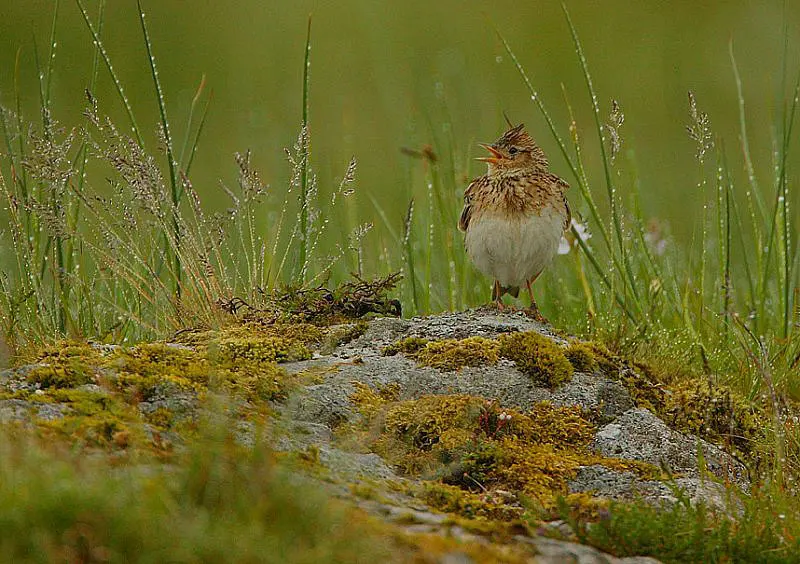
The poem, part by part
The poem is by William Blake, an English poet and painter, from his book Songs of Innocence (1789). A green here is a village green: an open, grassy space in the middle of an English village where everyone can meet and children play. It is echoing because it rings with the sound of bells, birds and children’s games. The poem follows one day, from sunrise to sunset, in three parts.
- Morning. The sun comes up and makes the sky look happy. Church bells ring merrily to welcome the spring. Birds of the fields and hedges, the skylark and the thrush, sing louder, joining in with the bells. And on the green, the children start their games.
- Midday. An old man, Old John, with white hair, sits under an oak tree with the other old folk (people). Watching the children play, they laugh and forget their worries, and they remember: when they were young, they had the very same joys on this very same green.
- Evening. The little ones grow weary (very tired) and can’t be merry any more. The sun goes down (descends), and the games end. Like birds in a nest, the brothers and sisters gather round their mothers, ready to rest, and the green grows dark and quiet.
How it sounds. The lines are short, with a quick, bouncing beat, like children’s feet running, and they rhyme in pairs (each line rhymes with the next). Every part ends on the green: “echoing” in the first two, and “darkening” in the last, as the day ends.
What it means. The day is like a whole life: the morning is childhood, Old John is old age, and the evening is rest. The old people were children here once, and the children will be old here one day. Joy goes round, from one generation to the next.
Words from the poem
| Word | Meaning |
|---|---|
| arise | to come up, to rise |
| merry | happy and cheerful |
| skylark, thrush | two singing birds of fields and gardens |
| bush | a small, thick plant like a small tree |
| cheerful | happy and bright |
| echoing | full of sounds that ring and repeat |
| oak | a big tree with strong wood; its seeds are acorns |
| folk | people |
| weary | very tired |
| descend | to go down |
| lap | the top of your legs when you sit; a child sits on a mother’s lap |
| darkening | becoming dark |
A. Match the words
Match the words in column A with their meanings from column B.
Column A: a. oak · b. merry · c. folk · d. arise · e. descend · f. weary
Column B: i. happy · ii. to rise · iii. a kind of tree · iv. to go down · v. very tired · vi. people in general
Answer
B. Choose the correct answer
a. The sun makes the sky …
Pick an answer to see why.
b. The merry bells welcome the …
Pick an answer to see why.
c. Old John has …
Pick an answer to see why.
d. The old men are sitting under …
Pick an answer to see why.
e. In the evening, the children come to the laps of the …
Pick an answer to see why.
Writing: the poem in the present simple
A description of a poem, a story or a picture is usually written in the present simple: The poem describes a day. The sun shines. The present simple says what is in it, as if it is happening in front of you each time you read it.
This is a description of the above poem. Use present simple forms of verbs from the brackets to rewrite the passage.
The poem (describe) the joy and happiness after the arrival of the spring. The sun (shine) brightly. The sky (look) beautiful. The sound of bells coming from nearby (be) very pleasant. Birds (sing) cheerfully. The sounds of bells and the songs of the birds (mix) into a beautiful melody worthy of the season of spring. The old people of the village (sit) under the trees on the green and young innocent children (play) their favorite games there.
During the day the green grass (be) filled with the noises of the children playing different games. The children (be) happy and excited. The old people (watch) their children play happily on the green and (think) of the happy days of their childhood. They, too, had played on the same green. They even had the same excitement and joy which only young children can experience. When the sun sets, it (become) dark and lonely. Then, the evening (come). Children (grow) tired. They (return) home to rest in the laps of their sisters and mothers.
Answer
Grammar II: because or because of?
One quick test: cover the word and look at what follows. If it has a verb (he was feeling dizzy), use because. If it is only a noun or a pronoun (the rain, his illness, your mother), use because of.
Complete the sentences with because or because of.
- a.We canceled the trip ……… the rain.
- b.He sat down ……… he was feeling dizzy.
- c.It is ……… your mother that we got into this mess.
- d.We hurried indoors ……… it was raining.
- e.I was late ……… the traffic.
- f.We could not arrive on time ……… the traffic was terrible.
- g.The exam was easy ……… he knew all the answers.
- h.He can’t walk ……… his illness.
- i.He lost his job ……… the strike.
- j.……… the language problem, I couldn’t win the argument.
Answer
Which one needs because of?
Pick an answer to see why.
Project work: can and can’t at work
Extra bit: a news story
A news story is laid out in a fixed way, so that a reader can get the main facts in seconds:
- The headline, in big letters, says the news in a few words, often with a verb in the present: Nepal Wins…
- The dateline says where the story was written and when, often with the news agency’s name (here Xinhua, China’s news agency).
- The lead, the first sentence, gives the most important facts: who, what, where and when.
- The details follow, the most important first: who scored, the prize money, the history.
The news story in this lesson is about the final of the Three Nations Cup, a football tournament in Kathmandu with Nepal, Bangladesh and Kyrgyzstan. Here is a short story of our own, about the same match, laid out the same way.
Read the following news story and find the answers to these questions.
- a.What is the headline?
- b.When was the news written?
- c.Which nation won the match?
- d.How many goals did Nepal score?
- e.Who scored the goal for Bangladesh? At what time?
- f.How much was the prize for the winner?
- g.Was it the first time Nepal and Bangladesh played football together?
- h.Who organized the game?
Answer
Exercise
Practice the whole unit. Try each one, then open the answer.
Correct the mistakes.
- a.Can you to speak French?
- b.My brother cans play the guitar.
- c.When I was five, I can’t read.
- d.Does she can swim?
Answer
Join each pair with the word in brackets.
- a.The flight was canceled. There was fog. (because)
- b.The flight was canceled. the fog (because of)
- c.It was a holiday. The school was closed. (as)
Answer
Write two true sentences about yourself: one thing you could do when you were five, and one thing you couldn’t do then but can do now.
A model answer
In which word is the r said in British English? war, train, our, wear
Answer
Why did the writer of “A Terrifying Night” escape injury?
Answer
Printable PDFs
- Study notes 2 pages
- Harder practice questions 2 pages Answer key
Practice every question in the book, and keep track of the ones you miss →
A companion to your textbook, not a replacement for it: study from the book your school uses, and where the two differ, follow your teacher. Found a mistake? Please tell us.