
You go to the shop with a list. Rice, milk, ghee. But how much rice? How many eggs? The shopkeeper will ask, and you need the right words to answer.
This unit is about quantity: how much or how many of something there is. You will read a talk between a customer and a grocer. You will learn which things we can count and which we can’t. You will practice how much and how many, and the little words a and an.
Getting started
A. Ask and answer
The unit opens with five pictures:
- a forest path with lots of trees;
- a fan of Nepali rupee notes;
- a glass of water;
- four colored glass bottles in a row;
- two elephants, a mother and her baby.
The example asks: How many trees are there in your garden? The answer: There are many trees.
Look at the pictures. Take turns to ask and answer questions about them, as in the example.
Model questions and answers
Look at the questions again. We ask how many trees, bottles and elephants. We ask how much money and water. Why the difference? You will find out in Grammar I.
B. Listen and sing
This song is about the months and seasons of the year. A calendar sits beside it.
The first part says there are twelve months in a row. Use each month well, it says. Welcome each new month without fear, and let it go without crying. The second part names the seasons as they pass, one after another. Each one is a gift. At the end it comes back to its main idea: enjoy each month while it lasts.
Listen to the end words. Go rhymes with row. Fear rhymes with tear. Miracle and beautiful almost rhyme. Rhymes like these make a song easy to remember.
How many seasons are mentioned in the song? What is your favorite season? Why? Talk to your friends.
A model answer
Reading I: At a Grocery Store
Before you read
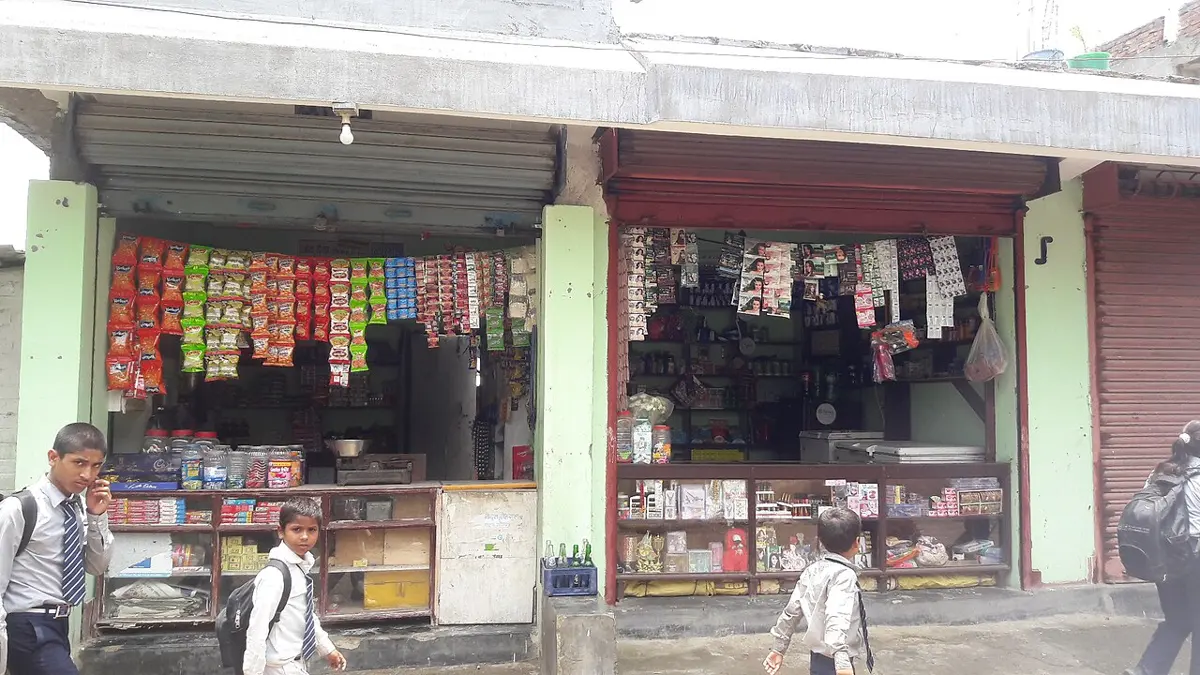
The picture shows a small shop with sacks and jars of food. A man in a cap stands behind the counter. Another person, a man, stands in front of it, with a bag beside him.
Who do you think these people are?
A model answer
Where do you think they are?
A model answer
What do you think the man is going to buy?
A model answer
The conversation
The reading is a conversation between Sanju and a grocer. A grocer is a person who runs a grocery store. Read it in your book, then read our notes.
The rice. The grocer greets Sanju and asks how he can help. She wants to buy a few things. First, she asks for basmati rice. The grocer shows her the basmati, but she doesn’t like how it looks. She points to another rice and asks what it is. It is Long Grain Rice, and she buys 5 kg of that.
The milk. Next, she wants 500 gm of powdered milk, from the DDC brand. A brand is the name a company gives to what it sells. The grocer doesn’t have DDC. He only has Kabhreli Milk. Sanju says that’s fine.
The ghee. Sanju asks for a tin of ghee. The grocer only has fresh ghee, not in a tin. Sanju asks if it is good. The grocer says it is the best in the market. She buys a kilogram. It costs Rs. 1,150 a kilo.
The last things. Sanju also asks for a 200 gm packet of powdered spices and a tube of toothpaste. Then she asks for the total. Altogether it is 1,580 rupees. She pays, and they thank each other.
Look at how Sanju says each amount. She never says just rice or ghee. She says 5 kg of rice, a kilogram, a packet of spices, a tube of toothpaste. These are quantity words.
Sanju wanted DDC powdered milk. What did she get?
Pick an answer to see why.
Words from the conversation
| Word | Meaning |
|---|---|
| grocer | a person who runs a shop selling food and things for the home |
| brand | the name a company gives to what it makes, like DDC |
| powdered | made into a fine powder, like flour |
| fresh | newly made or picked, not old or kept in a tin |
| quality | how good something is |
| market | a place where people buy and sell things |
| expensive | costing a lot of money |
| spices | dried seeds and plants used in cooking, like cumin and turmeric |
| altogether | all added together |
A. Unjumble the words
These words are from the conversation, but their letters are jumbled. Arrange the letters to form the correct words: uqialty, dpoweder, paetck, shfre, rkmaet, eymon.
Answer
B. Complete the sentences
Now complete these sentences with the words you have formed.
- a.They went to the ……… and bought a lot of things.
- b.This store sells the best ……… items only.
- c.She never feeds ……… milk to her baby.
- d.Sanju spent a lot of ……… buying things from the market.
- e.She always eats ……… fruits in the morning.
- f.Could you please give me a ……… of biscuits?
Answer
C. Answer the questions
When did Sanju go to the grocery store?
Answer
Did Sanju buy the rice she wanted? Why?
Answer
Which brand of milk was Sanju searching for?
Answer
How much ghee did Sanju buy?
Answer
Make a list of the items Sanju bought.
Answer
How much did she pay in total?
Answer
D. Your own shopping
Recall the time you went to a grocery store. What items did you buy and in what quantity? Share with your friends.
A model answer
Pronunciation
Some words have two consonant sounds side by side, with no vowel between them. In price, the p and r go together: pr. Groups like this are called consonant clusters.
In Nepali, we often put a little vowel inside a cluster without noticing. Price becomes pa-rice, and sky becomes i-sky. In English, say the two sounds together, quickly.
| Word | The cluster | Say it |
|---|---|---|
| price | pr at the start | pr-ice, not pa-rice |
| brand | br at the start | br-and |
| company | mp in the middle | com-pa-ny |
| blackboard | bl at the start | bl-ack-board |
| important | mp in the middle | im-por-tant |
| sky | sk at the start | sky, not i-sky |
| symbolic | mb in the middle | sym-bol-ic |
| faster | st in the middle | fa-ster |
Pronounce the words in the box. Notice how the letters in red are pronounced: price, brand, company, blackboard, important, sky, symbolic, faster.
How to say them
Grammar I: how much and how many
Things we count, and things we don’t
Some things we can count: one onion, two onions, three onions. Their names are countable nouns. They have a plural, usually with -s.
Some things we can’t count one by one: rice, milk, water, money, sugar. Their names are uncountable nouns. We don’t say two rices or three milks. They have no plural.
To say how much of an uncountable thing there is, we count something else: its weight, or its container.
- 5 kg of rice, 500 gm of milk powder
- a packet of spices, a tube of toothpaste, a glass of water, a cup of tea
So we ask about them in two ways:
| Countable | Uncountable | |
|---|---|---|
| We ask | How many …? | How much …? |
| The noun is | plural | singular, no -s |
| Example | How many eggs do we need? | How much milk do we need? |
| Answers | many, a few, three, lots of | much, a little, a liter, lots of |
A. Countable or uncountable?
Study the following sentences. Decide whether the colored nouns are countable or uncountable.
- a.How many students are there in your class?
- b.How many books do you have?
- c.How much money do you spend every day on tiffin?
- d.How much meat are you going to buy?
- e.How many films did Tom watch last year?
Answer
B. How much or how many?
Complete this dialogue with how much or how many.
Dad: Okay, dear, ……… onions do we need?
Son: Only one kg, I think.
Dad: Very good. And ……… cheese?
Son: Mom said about 100 gm.
Dad: Umm … 100 gm. Fine. Now, ……… tomatoes, Ragav?
Son: We need half a kilogram.
Dad: What about spaghetti? ……… packets of spaghetti do we need?
Son: We don’t need to buy any. We have some at home.
Dad: Right. The last thing is meat. ……… meat do we need?
Son: Meat? Oh, 500 gm. That’s 500 gm of chicken.
Answer
C. Correct the sentences
Correct these sentences and rewrite them, as in the example. Example: He bought lots of sugars. → He bought lots of sugar.
- a.We drank many cup of coffee yesterday.
- b.The room was full of dusts.
- c.There are fifty boy in my class.
- d.Shall we borrow some moneys?
- e.How many money did you ask for?
- f.I ate three mango.
- g.These childs are flying kites.
- h.These houses are made of muds and stone.
Answer
D. Plurals
Most nouns add -s for the plural: book → books. Some change more:
| The noun | The plural | Examples |
|---|---|---|
| ends in -s, -sh, -ch, -x | add -es | bus → buses, box → boxes |
| ends in consonant + y | y → ies | baby → babies |
| ends in vowel + y | add -s | key → keys, boy → boys |
| ends in -f or -fe | often -ves | wolf → wolves, knife → knives |
| ends in -o | often -es | mango → mangoes, tomato → tomatoes |
| special words | change inside | child → children, tooth → teeth, foot → feet, man → men |
| a few words | don’t change | sheep → sheep, deer → deer |
Rewrite the following sentences. Use the plural forms of the underlined nouns.
- a.The wolf chased the sheep.
- b.Put the book on the shelf.
- c.The police officer ran after the thief.
- d.The doctor pulled out the aching tooth.
- e.The lady took the key from her bag.
- f.The child flew the kite.
- g.The worker had swept the chimney.
- h.She bought a computer and a keyboard.
Answer
Which sentence is correct?
Pick an answer to see why.
Listening
A. Before you listen
The picture shows a boy standing in front of a board. The board says English Speaking Contest.
What do you think the boy is doing?
A model answer
Do you feel shy or confident when speaking in English? Why?
A model answer
Now listen. A student talks about speaking English. Read the sentences in B first.
B. True or false?
The speaker is shy about speaking in English.
Answer
The speaker’s friends also worry about making mistakes.
Answer
His friends do not care about using correct grammar.
Answer
The teacher suggests it is best to learn by doing.
Answer
The speaker has long conversations with himself.
Answer
He reads his short stories aloud.
Answer
C. Talk about it
How do your family members feel about speaking in English? Why? Talk to your friends.
A model answer
Reading II: Bright and Beautiful
Before you read
What do you see in the picture?
A model answer
How does it look to you?
A model answer
The poem
This poem was written by Cecil Frances Alexander, an Irish writer, in 1848. It was first printed in a book of hymns for children. A hymn is a song of praise to God, sung in churches. The poem in this unit is a little shorter than her hymn, and some words are changed.
Read it first. Here is what each part says.
Verse 1. Everything in the world that is bright, beautiful, wise and wonderful was made by God, the creator. So were all creatures, big and small.
Verse 2. It looks closely at small things. God made each little flower that opens, and each little bird that sings. He made their bright colors and their tiny wings.
Verse 3. It speaks of people. A rich man lives in a castle, and a poor man stands at his gate. The poem says God made some people high and some low, and decided what happens to them. Many people today don’t agree with this verse, and many hymn books now leave it out.
Verse 4. We have eyes to enjoy all these things, the poet says, and a voice to praise their maker, who made everything well.
The poem rhymes on every second line: small and all, sings and wings, gate and fate, tell and well. Say it aloud and you will hear the beat, like a song.
What do these words mean? creature, creator, lowly, fate
Answer
A. Match the words
Match the words on the left with their meanings on the right.
- a.bright — i. a big stone building
- b.creator — ii. very small
- c.castle — iii. full of lights
- d.tiny — iv. very good
- e.well — v. someone who creates something
Answer
B. True or false?
Write True for the true statements and False for the false ones.
- a.Some creatures are great while others are small.
- b.The wings of the little birds are large.
- c.The rich man lives in a castle.
- d.God gave us ears to see.
- e.God has made all the things well.
Answer
C. Your opinion
Do you believe that God created everything? Share your opinion with the class.
How to answer
Speaking
A. Three short conversations
Speaking A has three short conversations. In each one, notice the quantity words.
- Garima and Puspa: Garima asks how many animals are grazing in a field. Puspa can see ten.
- A shopkeeper and a customer: the shopkeeper asks how much sugar the customer needs. The answer is a kilogram.
- A mother and her son: she asks how many clothes he has washed. He has washed lots of them.
Read the conversations, act them out and notice the quantity words.
The quantity words
B. Ruchi’s kitchen
The picture shows Ruchi’s kitchen. On the counter there is a bowl of oranges, more fruit in a dish, a stack of plates and two bottles. There is a pot on the stove.
Look at the picture. Ask and answer questions using how much and how many about the things in the kitchen.
Model questions and answers
C. Talk about yourself
In the example, Bindu asks Kamala how much money she has in her pocket. Kamala has fifty rupees. Bindu has only ten.
Talk about yourself with your friend. Ask and answer about the things you have.
A model conversation
Grammar II: a or an?
A. Study the sentences
Study these sentences. Notice the use of a or an.
- a.I saw an accident yesterday.
- b.That is a good idea.
- c.I need a kilogram of fresh apples.
- d.A school inspector is coming to our school today.
- e.Alina wants to be an engineer.
Answer
A and an both mean “one”. We use them with a singular countable noun we haven’t talked about before: a dog, an egg.
The rule is about the sound at the start of the next word, not the letter.
| Use | before | Examples |
|---|---|---|
| a | a consonant sound | a book, a tree, a university (“yoo”), a one-rupee coin (“wun”) |
| an | a vowel sound | an apple, an engineer, an hour (the h is silent), an honest girl |
B. Complete with a or an
Complete these sentences with a or an.
- a.I want to ask you ……… question.
- b.It is ……… nice day today, isn’t it?
- c.Mohini works in ……… bank.
- d.……… elderly man was carrying a heavy load this morning.
- e.Muna is ……… engineer in ……… company.
- f.He belongs to ……… different profession.
- g.They are searching for ……… location to start the business.
- h.Art is ……… wonderful subject.
- i.Did you write ……… essay last night?
Answer
C. a, an or nothing
Complete these paragraphs with a or an. Write X if no article is needed.
- a.My mother is ……… English teacher. I am ……… student at Ganesh Secondary School. When I get home from school, I watch ……… programs on TV. That’s the best part of my day.
- b.Once upon ……… time, there lived ……… grasshopper. It was very lazy. There was also ……… ant who was very active.
- c.Yesterday, my mother told me ……… story. In the story, there was ……… old man and his wife. The couple had ……… daughter who wanted to become ……… engineer. They sent her to ……… good school.
Answer
Which is correct?
Pick an answer to see why.
Writing
A. Singular and plural
Writing A is a short paragraph by Anoj. He went shopping with his father last evening. First they went to a clothing store, then a shoe store, then a grocery store. Last, they bought fruits and went home. Read it first. Some nouns in it are in bold.
Study the paragraph. Underline the bold singular nouns in blue ink and the plural nouns in black.
Answer
B. Your shopping trip
Write a similar paragraph about a shopping trip of your own. Include where you went, who you went with, what things you bought, and what quantities you bought.
A model paragraph
Do it yourself
Exercise
Which word is uncountable?
Pick an answer to see why.
“……… students are there in your class?”
Pick an answer to see why.
Which plural is correct?
Pick an answer to see why.
“My uncle is ……… honest man.”
Pick an answer to see why.
Sanju asks for “a ……… of toothpaste”.
Pick an answer to see why.
Write the plural of: box, baby, leaf, foot, potato, day.
Answer
Write two questions with how much and two with how many to ask a shopkeeper.
Model questions
Printable PDFs
- Study notes 2 pages
- Harder practice questions 2 pages Answer key
Practice every question in the book, and keep track of the ones you miss →
A companion to your textbook, not a replacement for it: study from the book your school uses, and where the two differ, follow your teacher. Found a mistake? Please tell us.