
Happy Lhosar! and I wish I had a bicycle both use the word “wish”, but they are very different. The first is a kind word for someone else on their happy day. The second is a dream about your own life, something that isn’t true now.
This unit is about expressing wishes in both ways. You will read about three festivals of Nepal, Lhosar, Gai Jatra and Buddha Jayanti, and an email about a birthday full of surprises. You will learn to say I wish I could fly, and you will practice the past simple, the tense we use to tell what happened. At the end, a poor couple get three wishes from a fairy, and waste every one of them on a banana.
Getting started
A. Festival pictures
The unit opens with four pictures of people at their festivals.
- A boy and a girl, laughing, rub bright colors on each other’s faces and clothes, and one squirts colored water.
- Men kneel in rows on prayer mats in front of a mosque, and one man reads from a holy book on a stand.
- A family sits on a mat while an elder puts tika on a young person’s forehead; beside them, a boy plays on a tall bamboo swing.
- Women in bright saris stand in water, holding baskets of fruit and offerings.
Look at these pictures. What do you think people do during their festivals? Talk to your friends.
Model answers
B. Listen and sing
The song is a long list of good wishes for a friend. The singer wishes the friend friends who are always fair, ribbons for their hair, plenty of cheer and many happy years, the freedom to do what they love, blessings and kindness, and sunshine breaking through the clouds. It ends with a hope that the friend will laugh out loud.
Listen to how often the singer says I wish you… and Wanna wish you… (wanna is a spoken way of saying want to; don’t write it in your own English). Every line wishes something good for someone else.
Why do people make wishes? Talk in pairs.
A model answer
Reading I: Some Festivals of Nepal
Before you read
What festivals are celebrated in your community?
A model answer
What do people do at the festivals you have identified?
A model answer
Which festival do you like most? Why?
A model answer
The text, part by part
The text describes three festivals. For each one, look for who celebrates it, why, and what people do.
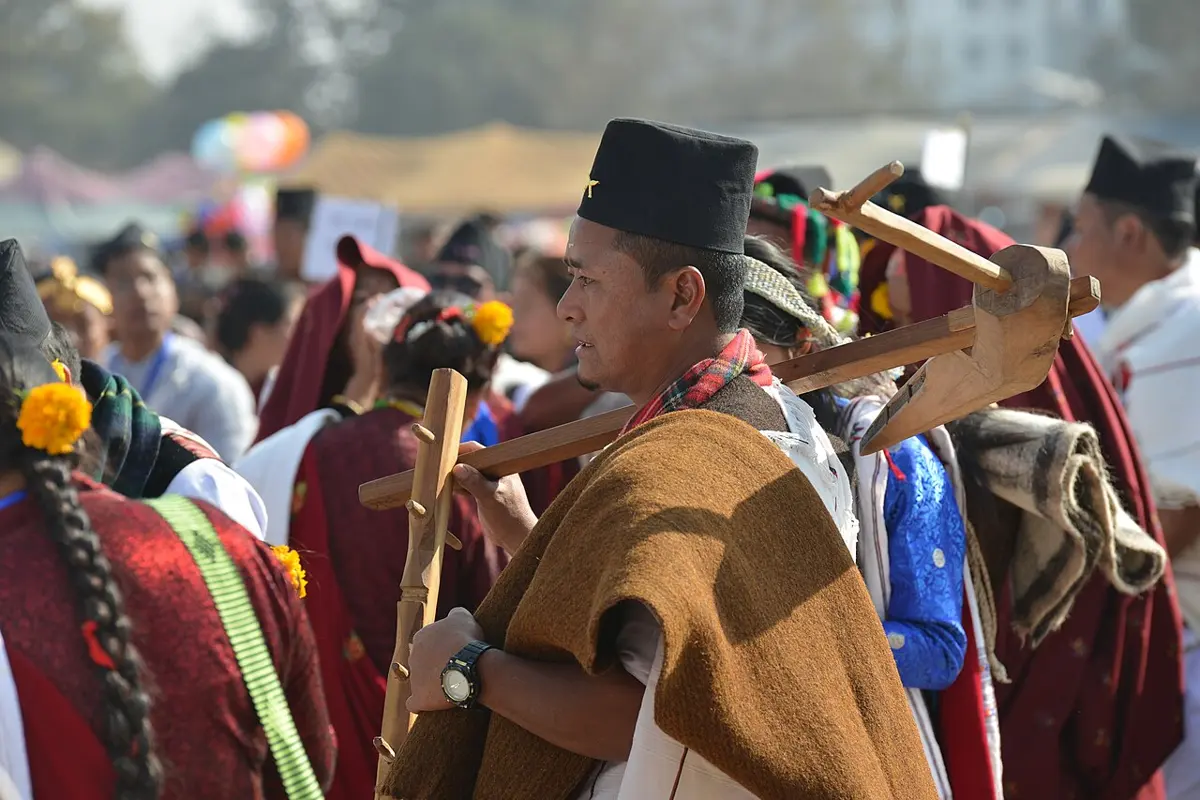
1. Lhosar. The name has two parts: lho means year and sar means new, so Lhosar is New Year. It is one of Nepal’s most popular festivals, but different communities celebrate it on different days:
| Lhosar | Celebrated by |
|---|---|
| Tamu Lhosar | the Gurung community |
| Sonam Lhosar | the Tamang and Yolmo communities |
| Gyalbo Lhosar | the Tibetan and Sherpa communities |
To welcome the new year, people sing and dance, and families meet up and exchange greetings and gifts (give them to each other). Families pray together and enjoy special food.
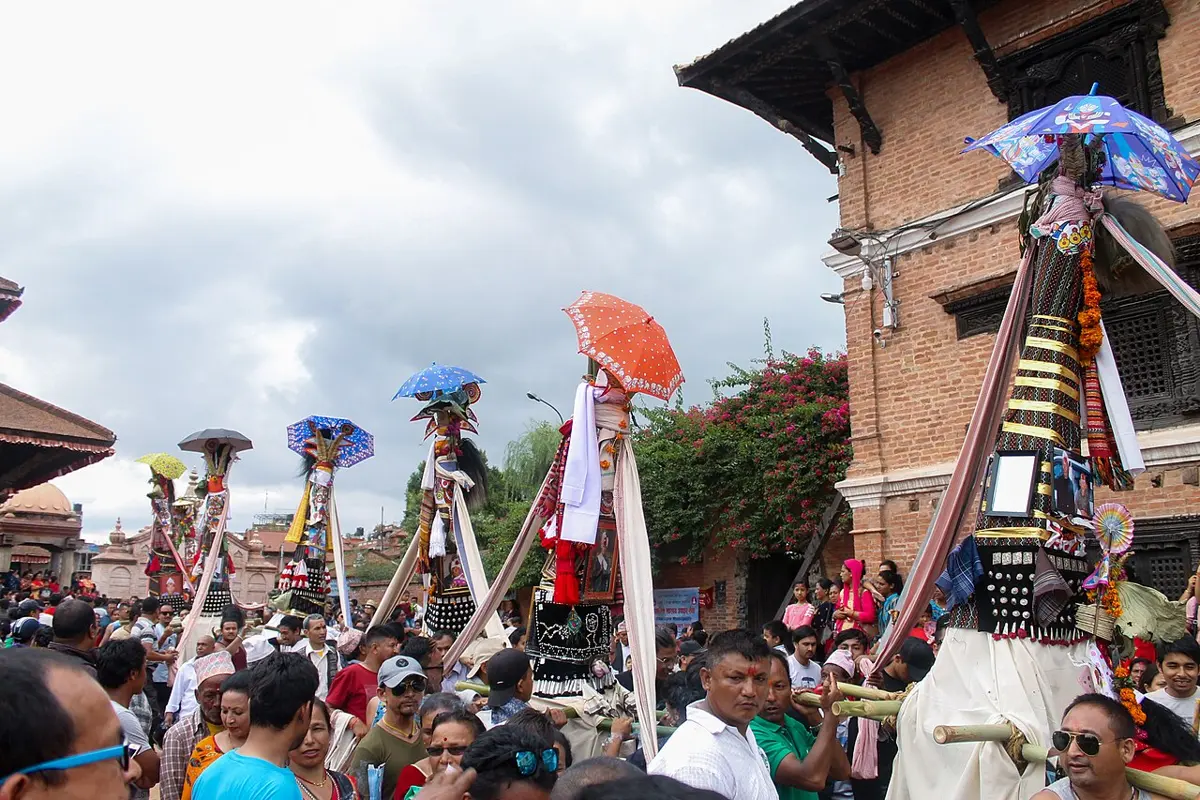
2. Gai Jatra. Gai means cow and jatra means procession (people moving along in a line). It is celebrated to commemorate the people who died during the year: to remember them with respect. Local people believe that cows help the deceased (the dead) reach Yama, the god of death. Cows are decorated and led through the streets. The families of those who died join the procession and give out food and fruit. To make the grief lighter, people join rallies, men dress up in women’s clothes, people sing, and the Lakhe dance is seen too. So the festival begins in sorrow and turns into laughter.
3. Buddha Jayanti. This is a national festival: the day Lord Buddha was born in Lumbini. Buddhists from all over the world visit Nepal at this time. Boudhanath, Swayambhunath and Lumbini are decorated with prayer flags. Monks (men who live in a monastery and give their lives to religion) gather to pray and chant Buddhist mantras (sacred words, said again and again). People visit the stupas and observe the day, and every household cooks kheer, a sweet rice pudding.
Which festival is the Tamang community’s new year?
Pick an answer to see why.
Why are cows led through the streets at Gai Jatra?
Pick an answer to see why.
Words from the text
| Word | Meaning |
|---|---|
| combination | two or more things joined together |
| observe | to celebrate a festival or a special day |
| exchange | to give something and receive something back |
| commemorate | to remember a person or an event with respect, often with a ceremony |
| deceased | dead; the deceased means the person who has died |
| decorate | to make something look more beautiful by putting things on it |
| procession | a line of people (or animals or vehicles) moving slowly along, as part of a ceremony |
| monk | a man who lives in a monastery and gives his life to religion |
| chant | to say or sing words again and again in a steady rhythm |
| grief | deep sadness, especially when someone dies |
A. Match the meanings with the words
Match the meanings with their corresponding words.
| Meanings | Words |
|---|---|
| a.two or more things joined together | i.monk |
| b.celebrated a festival, birthday, etc. | ii.decorated |
| c.give and receive something | iii.commemorate |
| d.recall and show respect for someone or something | iv.deceased |
| e.made something look more attractive by putting things on it | v.procession |
| f.dead | vi.exchange |
| g.a line of people that move along slowly | vii.observed |
| h.a member of a religious group of men who live apart in a monastery and who do not marry | viii.combination |
Answer
B. Complete the sentences
Complete the following sentences with the correct forms of the words in A above.
- a.Look! They are Buddhist ……… .
- b.The ……… made its way down the hill.
- c.I buy you lunch and you fix my computer. Is that a fair ……… ?
- d.His treatment was a ……… of surgery, radiation and drugs.
- e.Do they ……… Dashain?
- f.The family of the ……… are crying.
- g.He is ……… the car with flowers.
Answer
C. Answer the questions
Who celebrates Sonam Lhosar?
Answer
Why is Gai Jatra celebrated?
Answer
Who is Yama?
Answer
What is done with cows at Gai Jatra?
Answer
What do monks do at Buddha Jayanti?
Answer
D. Festivals in your country
What festivals are celebrated in your country? Which of them do you like most? Why?
A model answer
Pronunciation: good wishes
Good wishes are short, and they are said with feeling. The voice is strongest on the most important word, and it usually falls at the end, warmly. Listen and say each one after the voice.
Practice the following expressions: Happy Eid / Dashain / Lhosar! · Happy birthday to you! · Good luck! · Have a nice journey! · Have a wonderful holiday! · Enjoy the meal!
When to use each
Writing I: describing a festival
A good festival description answers the same questions you used for the reading: what the festival is, who celebrates it, when, and what people do. Write it in the present simple, because it happens every year: People light lamps. Sisters put tika on their brothers.
Which festival have you celebrated recently? Write a short description of it. Describe what people do at the festival.
Hint
A model description
Grammar I: I wish…
A. What do the sentences mean?
The pictures show four people dreaming. A man pictures a pile of money. A girl pictures a group of laughing friends. A boy pictures a new smartphone. A woman with straight hair pictures herself with curls.
Study the pictures and read the sentences. What do they mean? I wish I had more money. · I wish I had more friends. · I wish I had a smartphone. · I wish I had curly hair.
Answer
How I wish works
When we wish that the present were different, the verb after I wish steps one step back into the past, even though we are talking about now. The past form shows that the wish isn’t true.
| What is true now | The wish |
|---|---|
| I don’t have a bicycle. | I wish I had a bicycle. |
| I live far from school. | I wish I lived near school. |
| I can’t swim. | I wish I could swim. |
| I am short. | I wish I were taller. |
| It is cold. | I wish it weren’t so cold. |
| We have to wear a tie. | I wish we didn’t have to wear a tie. |
So: have → had, don’t have → had, can → could, can’t → could, am/is/are → were, have to → didn’t have to.
Kunsang can’t whistle. What does he wish?
Pick an answer to see why.
“It’s raining, and we wanted to play football. I wish it ___ raining.”
Pick an answer to see why.
B. Make the wishes
Complete the following sentences with the given beginnings, as in the example. (I don’t have a car. → I wish I had a car.)
- a.I can’t play the piano. → I wish …
- b.I’m at work. → I wish …
- c.It’s winter. → I wish …
- d.I’m ill. → I wish …
- e.I don’t have new shoes. → I wish …
- f.I can’t afford to go on a holiday. → I wish …
Answer
C. Use the right form
Complete the sentences using the correct forms of the verbs in the brackets.
- a.I wish we ……… (not have) a test today.
- b.I wish these exercises ……… (not be) so difficult.
- c.I wish we ……… (live) near the beach.
- d.Do you ever wish you ……… (can travel) more?
- e.I wish I ……… (be) better at maths.
- f.I wish we ……… (not have to) wear a school uniform.
- g.Sometimes, I wish I ……… (can fly).
- h.I wish we ……… (can go) to Disney World.
Answer
Listening: three birthdays
A. Before you listen
Answer the following questions.
- a.When is your birthday?
- b.How do you celebrate your birthday?
- c.What do people give you on your birthday?
Model answers
Now you will hear three young people talk about their birthdays: Martha from Taiwan, Kenji from Japan and Sun-Hyi from Korea. Read the table in B first, so you know what to listen for.
B. Complete the table
Listen to the audio and complete the table with the information you heard. Use no more than two words.
Martha: She’s from ……… · What does she do? ……… · Who does she usually celebrate her birthday with? ……… · Who gives her money? Her parents and ……… .
Kenji: He lives in ……… · When is his birthday? ……… · Where does he go for a picnic? ……… · What does his family buy for him? ……… · What are his parents giving him this year? ……… .
Sun-Hyi: She’s from Busan, ……… · When is her birthday? ……… · Very special age in her country ……… · Who cooks a special meal? ……… .
Answer
How old will Kenji be this year?
Pick an answer to see why.
C. Talk about it
What do the people speaking in the audio do on their birthdays? Do you do the same? If not, how would you like to celebrate? Talk to your friends.
A model answer
Reading II: Niru’s email
Before you read
Do you write emails or letters to your friends?
A model answer
What do you write in your email or letter?
A model answer
The email, part by part
Niru writes a short, friendly email to her friend Sangita about her last birthday, the best one so far.
- The morning. Her birthday was on 15 Jeth 2078, when she turned twelve. She woke up early, at 6:30, because her family sang a special song for her and gave her gifts. Then her cousins Sunita and Arun arrived to surprise her, with a big box of chocolates and a CD of her favorite singer.
- The day. Everyone had breakfast together, made by Mum. Dad had bought a big cake, which Niru cut. Then calls began to come in from relatives and friends.
- The evening. At six, Niru was out with her family when a message came from her friend Heena. Heena said she had known all along it was Niru’s birthday, but she had been busy planning a surprise. She asked Niru to come to her house and said she would pick her up. Niru asked her parents, and they agreed.
- The surprise. Heena came in a beautiful car. When she opened the door of her house, all of Niru’s friends were waiting inside with balloons and flowers. They shouted Happy Birthday, Niru! together, hugged her one by one, and gave her gifts and roses. They sang her favorite song, she cut a second cake, and they ate, danced and had fun.
- The ending. Niru says she missed Sangita a lot and asks her to come and visit soon.
Notice the layout of an email to a friend: a friendly greeting (Hi Sangita,), a first line that says why you are writing, the news in time order, a last line about the friend, and a short sign-off with your name.
Why didn’t Heena wish Niru earlier in the day?
Pick an answer to see why.
Words from the email
| Word | Meaning |
|---|---|
| memorable | special or good enough to be remembered for a long time |
| presence | being there, in a place or with someone |
| occasion | a special event, or a time when something happens |
| surprise | something you didn’t expect |
| chorus | a group saying or singing the same words together; in chorus means all together |
| hug | to put your arms round someone and hold them close |
| relative | a member of your family |
A. Complete the sentences
Complete the following sentences with the words from the box: memorable, presence, occasions, surprise, chorus, hugged.
- a.I know him well. I’ve met him on several ……… .
- b.All are attending the meeting. Your ……… is also expected.
- c.I can’t forget my last birthday. It was a truly ……… event for me.
- d.My father bought me a mobile phone on my birthday. It was a big ……… for me.
- e.They put their arms around each other and ……… .
- f.Nitu started the song and everyone joined in the ……… .
Answer
B. Answer the questions
To whom was this email written?
Answer
When was Niru’s birthday?
Answer
What woke Niru up on her birthday?
Answer
What gift did Niru get from her cousins?
Answer
Who did she get the message from?
Answer
Why did Heena message Niru to go to her house?
Answer
What was the surprise for Niru at Heena’s house?
Answer
What did they do at Heena’s house to celebrate the occasion?
Answer
C. A reply from Sangita
Build a reply first: tap each gap and choose the line that belongs there.
Suppose you are Sangita. How will you respond to Niru? Write a reply email to her.
Hint
A model reply
Grammar II: the past simple
The email tells what happened on one day that is finished, so almost every verb is in the past simple: woke, sang, gave, arrived, cut.
A. Find the past forms
The past forms of the following verbs are in the email above. Find and write them. celebrate, gift, want, shout, is, have, tell, hug, reach, buy, ask, give, wake up, cut, come, dance, sing, start, open, receive, enter, enjoy, arrive, say, see, miss, make, know, are
Answer
B. How the past simple works
We use the past simple for actions that started and finished in the past, often with a time word: yesterday, last night, last year, in 2015, two days ago.
| Example | Pattern | |
|---|---|---|
| Statement | I met him in 2015. We went to Pokhara for our last holiday. They got home very late last night. We swam a lot on holiday. I last saw him a month ago. | the past form |
| Question | Did you meet my father? Where did you go yesterday? | did + plain verb |
| Negative | They didn’t go to Pokhara last year. | didn’t + plain verb |
The past form is used only in statements. Once did or didn’t is there, it carries the past, so the main verb goes back to its plain form: Did you go? (not Did you went?), They didn’t go (not didn’t went).
“___ you watch the match last night?”
Pick an answer to see why.
C. Complete the sentences
Complete the sentences with the past simple forms of the verbs in the brackets. Use negative forms where needed.
- a.The old man ……… (take) out his purse and ……… (pay) the bill.
- b.The nurse ……… (put) the little boy on the bed and ……… (speak) to him softly.
- c.They ……… (hear) the fire alarm and ……… (run) out of the building.
- d.……… (do) you remember to buy the salt?
- e.……… (do) I say anything wrong?
- f.I ……… (call) the waiter but she ……… (hear) me.
- g.I ……… (see) Sani in the supermarket but we ……… (talk).
- h.She ……… (spend) all the morning in the bookshop, but in the end she ……… (buy) anything.
- i.They ……… (cut) off our telephone because we ……… (pay) the bill.
- j.It was very hot, so I ……… (take) a bath two times yesterday.
Answer
Speaking: good wishes and wishes
A. Give your best wishes
How do you give your best wishes in the following situations? Make a wish for each.
- a.Your friend’s birthday is today.
- b.Your friend is going to have a week’s holiday.
- c.Your brother is attending the exam today.
- d.Your friend is celebrating Lhosar tomorrow.
Model answers
B. Make a wish about your life
What wish do you make in the following situations? Tell your friends.
- a.You are short and you want to be taller.
- b.You want to be rich.
- c.You want to have a big house.
- d.You want your neighbors to be nice.
- e.You want to have a different English teacher.
- f.You want to live for 100 years.
- g.You want to have a younger brother.
- h.You want to pass the exam.
Model answers
Writing II: a day at school
Which events do you celebrate at your school: Children’s Day, Democracy Day, School Day, etc.? Choose one and recall how it was celebrated last year. Write a paragraph about it. Use the past tense.
Hint
A model paragraph
Project work: greeting cards
A greeting card has four parts: a picture or decoration on the front; inside, the person’s name (Dear Didi,); the wish itself, often with a short poem or a line about why the day is special; and your name at the end (With love, Aaryan).
Extra bit: three wishes
The story is a very old folk tale, told in many countries in many forms.
- The wish for a fairy. A poor man and his wife sit in their little room, complaining (lamenting) that they are poor. The man says that if only a good fairy came and offered to grant (give) a wish, he would wish for something to make them happy for life.
- Three wishes. At once the door opens and a beautiful fairy comes in. She has heard him, and she gives them not one wish but three. She tells them to wish for something good, and disappears.
- The first wish. They decide to eat first and think while they eat. But they are so poor that their meal is only potatoes, and the hungry wife cries out that she wishes she had a banana. A banana flies into the room and lands on her plate. One wish is gone!
- The second wish. The husband is furious that she wasted a wish on a banana. In his anger he wishes the banana were hanging from her nose, and it jumps up and sticks there. The second wish is gone.
- The third wish. The wife cries and pulls, but the banana won’t come off. There is only one way: together they wish the banana were a thousand miles away, and out of the window it flies. The third wish is gone, and they are just as poor as before. But they never made another wish, and they were content for the rest of their lives.
What three wishes did the man and his wife make?
Answer
Were they wise or foolish? How?
A model answer
Exercise
Practice the whole unit. Try each one, then open the answer.
Which community celebrates each Lhosar? Tamu Lhosar · Sonam Lhosar · Gyalbo Lhosar
Answer
Turn each fact into a wish.
- a.I don’t know the answer.
- b.My sister can’t come to the party.
- c.The bus is very slow.
Answer
Correct the mistakes.
- a.Where did you went last Saturday?
- b.I wish I can speak French.
- c.She didn’t bought anything.
Answer
What do you say? a. Your teacher is leaving for a trip to Mustang. b. Your friend has a football match tomorrow. c. It is your cousin’s wedding day.
Answer
Write the past forms: sing, wake, hug, buy, enjoy, know.
Answer
Printable PDFs
- Study notes 2 pages
- Harder practice questions 2 pages Answer key
Practice every question in the book, and keep track of the ones you miss →
A companion to your textbook, not a replacement for it: study from the book your school uses, and where the two differ, follow your teacher. Found a mistake? Please tell us.