
Why do you brush your teeth? Because I don’t want holes in them. Why are you smiling? Because it’s Saturday! Every day, we give reasons.
This unit is about giving reasons. You will read a fairy tale about a kind boy and a golden goose, and an email from a visitor to Nepal. You will learn to join ideas with and, but and because. And you will practice the past simple again, with its regular and irregular verbs.
Getting started
A. What are they doing, and why?
The unit opens with four pictures:
- A man in a face mask sprays sanitizer (a liquid that kills germs) on his hands.
- A boy waters a small plant with a watering can.
- A girl does yoga. She kneels and bends far back to hold her heels: the camel pose.
- A girl sits with a book open in front of her, smiling.
Look at the pictures. What do you think the people are doing and why? Talk to your friends.
Hint
Model answers
A reason answers the question why? The word because comes just before it.
B. Listen and sing: Skyscrapers
A skyscraper is a very tall building, so tall it seems to scrape the sky. The song, a poem by Rachel Field, is made only of questions. The poet wonders if a skyscraper has feelings, as we do: if it gets tired of standing so high, feels the cold on a frosty (icy) night, feels lonely (sad and alone) up there, and longs to lie down and rest.
The poem asks four questions. A building can’t really feel tired or lonely. The poet imagines it, to make us look at tall buildings in a new way.

Talk to your friends.
Some reasons
Reading I: The Golden Goose
Before you read
What is the man in the first picture doing?
A model answer
Why do people cut down trees?
A model answer
The story, part by part
The Golden Goose is an old German fairy tale. The Brothers Grimm wrote it down over 200 years ago. Your book tells a shorter version.
Three sons. A man had three sons. The youngest was Simon. People rarely listened to him, because they thought his ideas were silly.
The eldest son. The eldest (oldest) son went to the forest to cut wood. His mother gave him a fine big cake and a bottle of apple juice. In the forest, a little old man asked him for a small piece of cake, because he was so hungry. The son said no: he would eat his cake and drink his juice himself. Then, as he started to cut a tree, his axe slipped and cut his arm. He had to go home.
The second son. The next day, the second son went, with a sweet cake and apple juice. The little old man asked him too. He said no too, and walked away. Very soon he cut his leg badly, and he had to go home.
Simon. Then Simon asked to go. His father said he knew nothing about cutting wood. But Simon kept asking, and at last his father let him go. His mother gave him only a small loaf of brown bread and a bottle of water. When the old man asked him for food, Simon said, kindly: I have only a little bread and water, but let’s eat together. As he took out his food, the bread turned into a big sweet cake, and the water into delicious juice!
The goose. The old man said that because Simon had a good heart, he wanted to help him. He told Simon to cut down a certain tree. Inside it, Simon found a goose with feathers of gold.
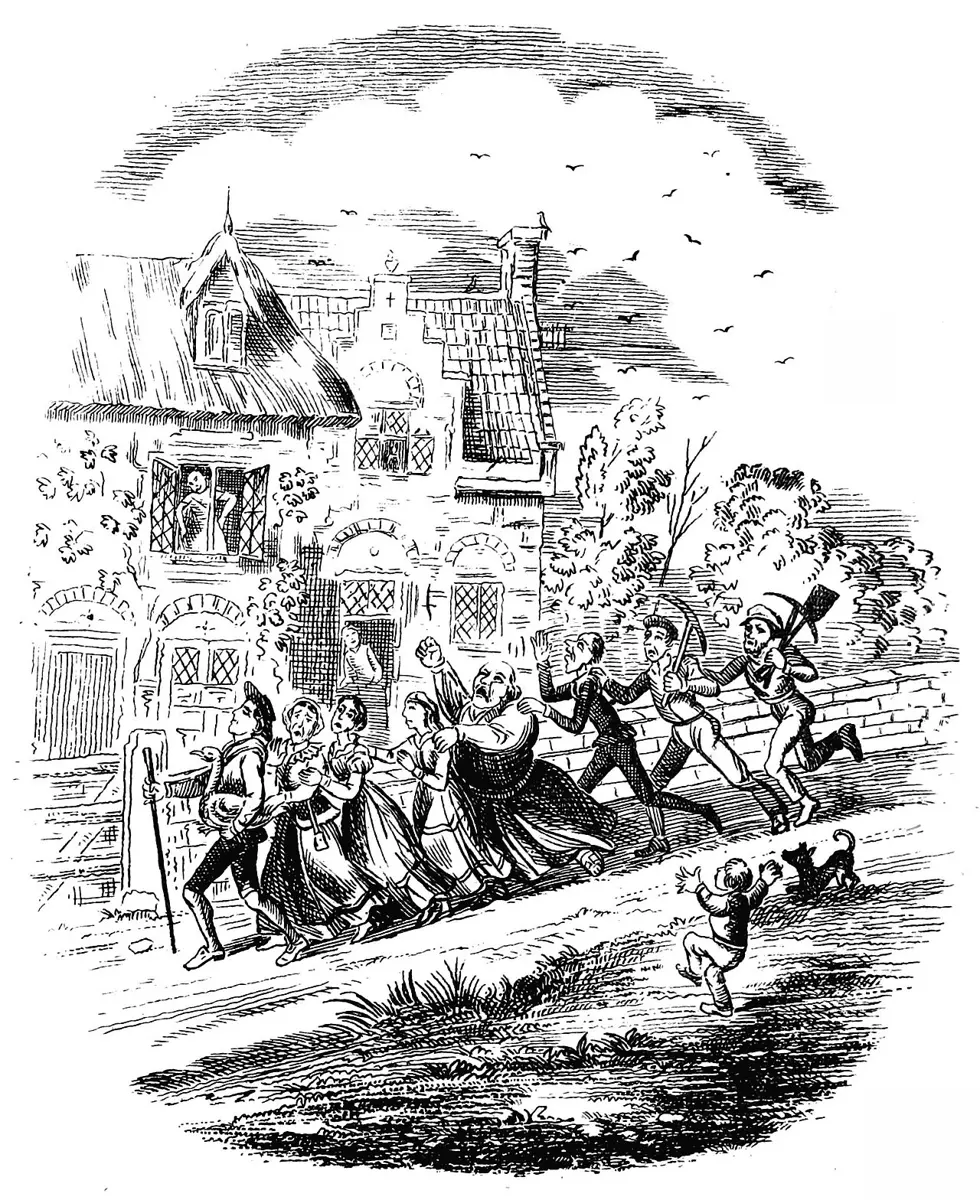
The sad princess. Simon set off to see the world with his goose. He came to a city where the king’s only daughter was sad and bored. The king had promised that whoever made her happy would marry her. When the princess saw the beautiful golden goose, she was happy at last. The king was glad too. Simon married the princess, and they lived happily ever after.
Why did Simon get the golden goose?
Pick an answer to see why.
A. Word meanings
Match the words in column A with their meanings in column B.
- a.eldest · b. wood · c. axe · d. loaf · e. goose · f. promise · g. glad
- i.a large waterbird · ii. happy, pleased · iii. to give your word · iv. oldest or first · v. an area of trees · vi. a tool for chopping wood · vii. a piece of bread
Answer
Wood has two meanings. It is what trees are made of (a wooden chair), and also a small forest (a walk in the wood). In this story, the sons go to cut wood in the wood!
Words linked here open in English Vocabulary, where you can practice them in a game.
| Word | Meaning |
|---|---|
| youngest | the one born last, the smallest in age |
| eldest | the oldest of three or more children |
| wood | what trees are made of; also a small forest |
| axe | a tool with a sharp metal blade on a long handle, for chopping wood |
| loaf | bread baked in one big piece |
| goose | a large bird with a long neck that lives near water |
| promise | to say that you will surely do something |
| glad | happy and pleased |
B. Complete the sentences
Complete the sentences below with the following words: cut, bread, wood, cake, hungry, water, marry.
- a.The eldest son went to the forest to cut ……… .
- b.The little old man asked for a piece of bread because he was so ……… .
- c.The second son also ……… his leg badly.
- d.Simon’s mother gave him a piece of ……… and ……… .
- e.The little old man turned the bread into big sweet ……… .
- f.The golden goose helped Simon ……… the princess.
Answer
C. Answer the questions
What did the mother give to the eldest son?
Answer
What happened to the eldest son when he started to cut the tree?
Answer
Whom did the second son meet in the forest?
Answer
Why did the little old man want to help Simon?
Answer
What had the king promised?
Answer
Why was the princess happy?
Answer
D. Which son was better?
Which son do you think was better? Why do you think so? Give reasons. Use the word because at the start of each reason.
A model answer
Pronunciation: the r at the end
In British English, an r at the end of a word isn’t said. Father sounds like “fa-thuh”, and her like “huh”, said long. The er at the end is a short, soft uh sound, /ə/. In American English, the r is said. Both are correct; just keep to one.
Pronounce these words. Notice how the final r is pronounced: clever, father, her, mother, brother, whoever, under, water, daughter.
Answer
Grammar I: regular and irregular past
You met the past simple in Unit 11. Here are the story’s verbs.
A. Find the past forms
Find the past forms of the following verbs in the story. One has been done for you (have – had).
b. call · c. want · d. give · e. meet · f. answer · g. walk · h. leave · i. ask · j. sit · k. turn · l. eat · m. rule · n. take · o. hear · p. live · q. be
Answer
B. Regular or irregular?
A regular verb makes its past with -ed or -d. An irregular verb changes in its own way, and you learn it by heart.
Put the verbs you have written in Grammar A into the correct boxes. Two verbs have been given (called, regular; had, irregular).
Answer
Which verb is irregular?
Pick an answer to see why.
C. Answer in full sentences
Answer the following questions in full sentences. Underline all the verbs in the past tense.
- a.When were you born?
- b.Where were you born?
- c.When did you join this school?
- d.Where did you go yesterday?
- e.Did you see a cat yesterday?
- f.What did you eat this morning?
- g.Did you talk to anyone yesterday?
- h.What did you see on the way to school this morning?
Hint
Model answers (yours will be about you)
D. Find the answers
Find the correct answers from the box to the questions below.
| Questions | Answers |
|---|---|
| a.Did she go on vacation? | i.She ate some biscuits. |
| b.What did she eat? | ii.Yes, because there were no trains. |
| c.How much did he spend? | iii.Yes, she went on vacation to Pokhara. |
| d.What time did you leave the school? | iv.No, we lost. |
| e.Did they go by bus? | v.He spent about Rs. 5000. |
| f.Did you get any mail? | vi.I left around 4 p.m. |
| g.Did we win the competition? | vii.Yes, I got three emails. |
Answer
Reading II: An email message
Before you read
Beside the title are two small pictures: the logos of Gmail (a red letter M, like an envelope) and Yahoo Mail. They are two email services: websites where you write, send and get emails.
Look at the picture and identify what they are.
Answer
The email, part by part
Neil, from the UK, visited Nepal last week and stayed with Priti. Now he writes to her. The top of the email shows who it is from (Neil), who it is to (Priti) and the subject, Hi.
- Thank you. He thanks Priti for welcoming him. It was a very special visit.
- What he liked, with reasons. He loved the scenery (what you see around you in nature) because he saw huge mountains. He enjoyed the food because it was spicy and tasty. He liked the people because they were amazing, friendly and helpful. Our culture was different from his because we have many traditions.
- Two surprises. The roads scared him a little because they were busy with cars, motorbikes and people. And the house where he stayed was very cold: it had no heating.
- Again! He would definitely (surely) visit Nepal again, because it was the best holiday he has ever had.
- He ends with Kind regards and his name.
Count the becauses: Neil gives a reason for almost everything he says. That makes his email easy to believe.
A. Word meanings
Match the words on the left with their meanings on the right.
- a.special · b. stay · c. amazing · d. friendly · e. tradition
- i.customs followed for a long time · ii. kind and pleasant · iii. different from the normal · iv. live for a period · v. wonderful and excellent
Answer
| Word | Meaning |
|---|---|
| special | different from the usual, and better |
| stay | (a noun here) a time when you live somewhere for a while |
| scenery | what you see around you in nature: mountains, rivers, forests |
| amazing | wonderful, very surprising in a good way |
| friendly | kind and pleasant to others |
| tradition | a custom followed for a long time |
| scared | afraid |
| definitely | surely, with no doubt |
B. Answer the questions
Who wrote this email?
Answer
Did Neil like his time with Priti?
Answer
Why did he like the scenery?
Answer
Why did the roads scare him?
Answer
Why was the house cold at night?
Answer
Does Neil want to come to Nepal again? Why?
Answer
C. What did Neil like?
What did Neil like about Nepal? Talk to your friends without looking at the email.
A model answer
Writing: a reply to Neil
An email has a top part, filled in on the screen: To (the address), and the Subject (what it is about, in a few words). When you reply, the subject often starts with Re:, meaning “about”. Then the email itself: a greeting, an opening, the body, a closing line, and your name.
Read Neil’s email again. Imagine you are Priti, and write a reply email to Neil. Write why he should come to visit Nepal again.
Hint
A model answer
Grammar II: and, but, because
Three small words join two ideas into one sentence. Each does its own job.
| Word | Its job | Example |
|---|---|---|
| and | adds one more thing of the same kind | The people were friendly and helpful. |
| but | joins two things that are different, or a surprise | I lost the match, but I’m happy. |
| because | gives the reason: it answers why? | I loved the scenery because I saw huge mountains. |
A. From the email
The following sentences are from the email. Complete them with the missing words.
- a.I loved the scenery ……… I saw lots of huge mountains.
- b.They were amazing, friendly ……… helpful.
- c.The room was cold ……… it didn’t have any heating system.
Answer
B. Fill the gaps
Complete these sentences with and, but or because.
- a.I didn’t go to school yesterday ……… I had a toothache.
- b.His mother made a cake ……… it was his birthday.
- c.I lost the match ……… I’m happy.
- d.My father likes tea ……… my mother likes coffee.
- e.I am hungry ……… I didn’t have my breakfast.
- f.Paul gets up ……… has a bath in the morning.
- g.I am going to Kathmandu ……… I want to visit the zoo.
- h.He gave me a pen, a book ……… a pencil.
- i.I didn’t call her ……… she was talking to someone.
- j.I am tall ……… I can run fast.
Answer
Rinjin wanted to play outside, ___ it was raining.
Pick an answer to see why.
We closed the windows ___ the wind was blowing hard.
Pick an answer to see why.
C. Join the sentences
Join the following pairs of sentences using and, but or because.
- a.My sister bought a new bag. Her old one got lost.
- b.I saw a snail. I saw a tortoise.
- c.Sita cannot play. She is sick.
- d.Mina has a toy car. Her brother has a bike.
- e.No one likes Jim. He is not polite.
- f.The room is dirty. You didn’t clean it.
- g.My name is Mary. My sister’s name is Leena.
- h.I have a sister. I have a brother.
- i.I love singing. My sister loves dancing.
- j.Mathematics is difficult. I like it.
Hint
Answer
Listening
A. Before you listen
Why is it important to learn English?
A model answer
Do you like English? Why?
A model answer
Now listen. A young woman talks about why she is learning English. Read the sentences in B first.
B. One word each
Listen to the audio and complete the sentences. Use ONLY one word.
- a.Justyna is a ……… for a newspaper.
- b.She needs better English to ……… at a university.
- c.Her teacher Kate is ……… and helps in class.
- d.She is worried about her ……… in tests.
- e.She is not good at tests and ……… .
Answer
C. Improve your study
How can you improve your study? Give two examples with reasons.
Model answers
Speaking
A. A talk about books
Kajol asks Rahul about books. His favorite is Snow White, by the Brothers Grimm (who also wrote down The Golden Goose). He has just read Hansel and Gretel: two children left alone in the forest by their parents. Kajol asks if he liked it, and why. He says yes, because the brother and sister get home safely in the end, with treasure from the witch’s house.
B. Match, with because
Make sensible sentences by matching the first part to the second part using because. Read them aloud to your friends.
| First part | Second part |
|---|---|
| My room is still messy | they can sting me. |
| I am afraid of the bees | she didn’t have a good sleep. |
| Sister Mina is sleepy | I didn’t clean it. |
| Nitesh gets good marks | he ran quickly uphill. |
| Urgen is very tired | he studies hard. |
Answer
C. Give reasons
Give possible reasons in the following situations, as in the example. Example: You are angry now. → I am angry because my friend teased me.
- a.You are happy now.
- b.You are bored.
- c.You are excited.
- d.You are sad.
- e.You want to thank someone.
- f.You are scared.
Model answers (any sensible reason is right)
Do it yourself
Exercise
Practice the whole unit. Try each one, then open the answer.
Write the past forms, and say regular or irregular.
a. meet · b. rule · c. take · d. answer
Answer
Fill the gaps with and, but or because.
- a.I wore a sweater ……… it was cold.
- b.Sonam is small ……… very strong.
- c.We bought apples ……… oranges.
Answer
Join with because, putting it before the reason.
- a.The plant died. Nobody watered it.
- b.I took an umbrella. The sky was cloudy.
Answer
Answer with a reason: Why did Simon’s brothers go home early?
Answer
Which word in each pair has a silent final r in British English? Say both.
a. father, river · b. car, red
Answer
Printable PDFs
- Study notes 2 pages
- Harder practice questions 2 pages Answer key
Practice every question in the book, and keep track of the ones you miss →
A companion to your textbook, not a replacement for it: study from the book your school uses, and where the two differ, follow your teacher. Found a mistake? Please tell us.