
Ask your grandparents what they did after school when they were your age. They will probably say things like We used to swim in the river or We used to walk two hours to school. They are telling you about past habits: things they did again and again, which they don’t do any more.
This unit is about the past and how places and people change. You will read how a village lost its old resting place under two great trees, listen to how another village changed in ten years, and read about the short life of Anne Frank, a girl whose diary is now read all over the world. You will learn used to, didn’t use to and Did you use to…?, make a timeline of your own life, and in the Extra bit, put words in dictionary order.
Getting started
A. Then and now
The unit opens with two pairs of pictures, each showing one place then and now.
- A hill covered in green forest; then the same hill with its trees gone and a big landslide down its side.
- Children resting on a stone platform under a big shady tree; then the same spot with the tree gone and a jeep driving along a road.
Observe these two sets of pictures and say the differences.
Model answers
B. Listen and sing
The song is sung by someone who looks back at childhood. In a dream they are a child again, playing with three or four friends. The friends crack jokes and laugh out loud. They don’t care about rain or clouds, and they play in the mud all day without feeling hungry or tired. At the end, the singer asks where those happy days have gone. Remembering them hurts a little, and they wish they could have the same dream again.
The song uses used to three times, for the dream that came again and again, for playing, and for not caring about the rain. Listen for them.
C. A day to remember
Recall a memorable event of your life and share it in your class.
A model answer
Reading I: Gairigaun: Then and Now
Before you read
In the first picture, an old man in a topi and waistcoat sits on a bench, telling something to a boy, who listens with a smile.
Who are the people in the first picture?
A model answer
What are they talking about?
A model answer
The story, part by part
- Mukesh can’t believe it. Mukesh is eleven and studies in Grade 6 in Gairigaun. His English teacher says that the village used to be very different. Mukesh finds it hard to believe, so as soon as he gets home he asks his grandfather, who knows a lot about the past.
- The Bar Pipal Chautaro. Grandfather tells him about a quiet resting place for travelers in the middle of the village. It had two trees, a bar (a banyan) and a pipal, so people called it the Bar Pipal Chautaro. He thinks the pipal was the bigger of the two. He himself spent a lot of time there and met many people.
- What happened there. People came to rest and to enjoy themselves. Birds sang sweetly in the trees. There were big, flat, smooth stones to sit on while the villagers talked about village matters, and a water tap nearby. Children played all sorts of games there, sometimes all day, without even going home for a snack. Schoolchildren loved resting there and stayed longer on their way home. It belonged to everyone in the village.
- And now. The chautaro is gone. Both trees have been cut down, a road has been built beside the place, and its beauty has gone. People have nowhere left to rest.
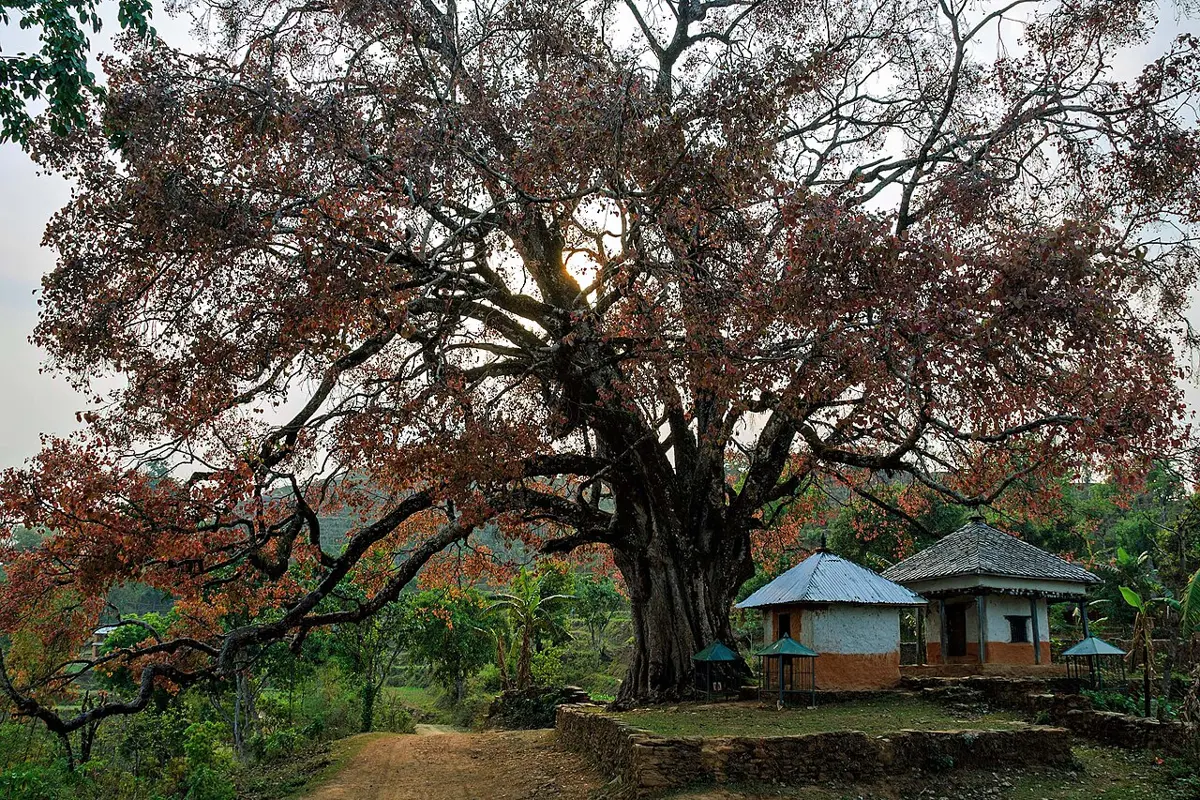
Why did people come to the chautaro?
Pick an answer to see why.
Words from the story
| Word | Meaning |
|---|---|
| attract | to make someone interested |
| peaceful | quiet and calm |
| chautaro | a rest stop along a foot trail, with a stone platform and shade trees |
| recreation | things done for fun and rest |
| melodious | sweet to listen to, like a pleasant tune |
| public | of or for all the people, not one person |
| property | something that belongs to someone |
A. Match the words
Match the words in column A with their meanings in column B.
| Column A | Column B |
|---|---|
| a.Chautaro | i.belongings |
| b.melodious | ii.of all, not of an individual |
| c.public | iii.a rest stop along foot trails |
| d.property | iv.sweet and pleasant tune |
Answer
B. True or false?
Write whether the following statements are True or False.
- a.There has been no changes in the village.
- b.Mukesh asked his grandmother about the village.
- c.There was a tap near the Chautaro.
- d.Bar Pipal Chautaro has been destroyed now.
Answer
C. Short answers
Where does Mukesh live?
A model answer
Why did people use to come to the Chautaro?
A model answer
Who used to play at the Chautaro?
A model answer
Does the Chautaro still exist in the village?
A model answer
Speaking: past habits
A. Find used to in the story
Underline all the sentences with ‘used to’ in the text ‘Gairigaun: Then and Now’. What do they mean?
Model answers
B. Ronish and Rina
In the conversation, Ronish asks Rina what game she used to play in Grade 3. She used to play hide and seek, with her sister. Ronish used to play dandi biyo, with his classmates.
Here is the pattern from the conversation:
| Used to | |
|---|---|
| a statement | I used to play hide and seek. |
| a question | What did you use to play? · Who did you use to play with? |
| a negative | I didn’t use to play cricket. |
Answer these questions.
- a.Does Rina still play hide and seek?
- b.Does Ronish still play Dandibiyo?
Model answers
C. What do you say?
What do you say in the following situations? Use ‘used to’.
- a.John doesn’t like apples now.
- b.You don’t wear shorts now.
- c.Nasib doesn’t like tea now.
- d.My brother doesn’t throw things away.
- e.I/live in a flat when I was a child. But, now I don’t.
- f.I/play football when I was at school. But, now I don’t.
- g.She/be able to speak French, but she has forgotten it all.
Model answers
Which sentence means the habit has stopped?
Pick an answer to see why.
Listening: Dadagaun then and now
A. Before you listen
One picture shows a green village of small houses with straw roofs among trees. The other shows a crowded town street full of cars, motorbikes and smoke, with people wearing masks.
- a.Where do you live? Is it a village or a town?
- b.Which do you like: village or town? Why?
- c.What can we do to minimize pollution?
Model answers
The recording
A speaker describes Dadagaun ten years ago and how it is now: the houses, the roads, what people did when someone was ill, the schools, and the lights. Listen for used to and for how things are now.
B. Tick the best answer
Listen to the recording again and tick the best answer.
- a.There were small houses with ……… roof. (i. thatched / ii. zinc / iii. concrete)
- b.People used to carry the patients in the ……… to hospital. (i. car / ii. ambulance / iii. stretcher)
- c.Children now use school bus and ……… to go to school. (i. motorbike / ii. taxi / iii. van)
Answer
C. True or false?
Listen to the recording and write True or False.
- a.Dadagaun was a developed village 10 years ago.
- b.There was a road in Dadagaun village ten years before.
- c.Now, the children go to school on foot.
- d.People now have electricity in Dadagaun.
Answer
D. Your school then and now
What differences have you observed in your school from the time you were at grade 1 and now? What changes have occurred? Discuss with your friends.
A model answer
Grammar: used to
A. How used to works
We use used to + the plain verb for something that happened again and again in the past, or was true for a long time, and that has stopped.
| Example | |
|---|---|
| a habit that stopped | I used to walk to school, but now I go by bus. |
| a state that stopped | She used to have long hair, but now it’s short. |
| a negative | It didn’t use to snow much in winter. |
| a question | Did they use to have a dog? |
| then and now | Aayush reads a lot now, but he didn’t use to read at all. |
On the line below, a row of dots is a habit, the same thing again and again; a bar is a state that lasted a long time; both stop before now. A single dot happened once.
B. 200 years ago
Think about what people had then, and what they didn’t.
Choose the correct words to complete each sentence. 200 years ago …
- a.people used to / didn’t use to make their own clothes.
- b.people used to / didn’t use to have mobile phones.
- c.people used to / didn’t use to read books.
- d.people used to / didn’t use to watch TV.
- e.people used to / didn’t use to drive cars.
- f.people used to / didn’t use to walk everywhere.
Answer
C. used to, use to or didn’t use to?
Choose the correct words to complete each sentence. (i. used to / ii. use to / iii. didn’t use to)
- a.Why did people ……… mend their clothes?
- b.I ……… like watching football, but now I do.
- c.What did you ……… like doing when you were young?
- d.John ……… like Mary, but he doesn’t now.
- e.People ……… produce as much rubbish as we do nowadays.
- f.Did you ……… collect anything when you were young?
Answer
D. used to or didn’t use to?
Read the second half of each sentence first: it tells you what is true now, and the first half is the opposite.
Complete these sentences with used to or didn’t use to.
- a.I ……… play the guitar, but I do now.
- b.I ……… ride a bike, but I don’t any more.
- c.I ……… collect stamps, but I don’t any more.
- d.I ……… enjoy getting up early, but I do now.
- e.I ……… be worried about the environment, but I am now.
- f.I ……… be afraid of flying, but I’m not anymore.
- g.I ……… know how to use a computer, but I do now.
Answer
Reading II: Anne Frank: A Short Life
Before you read
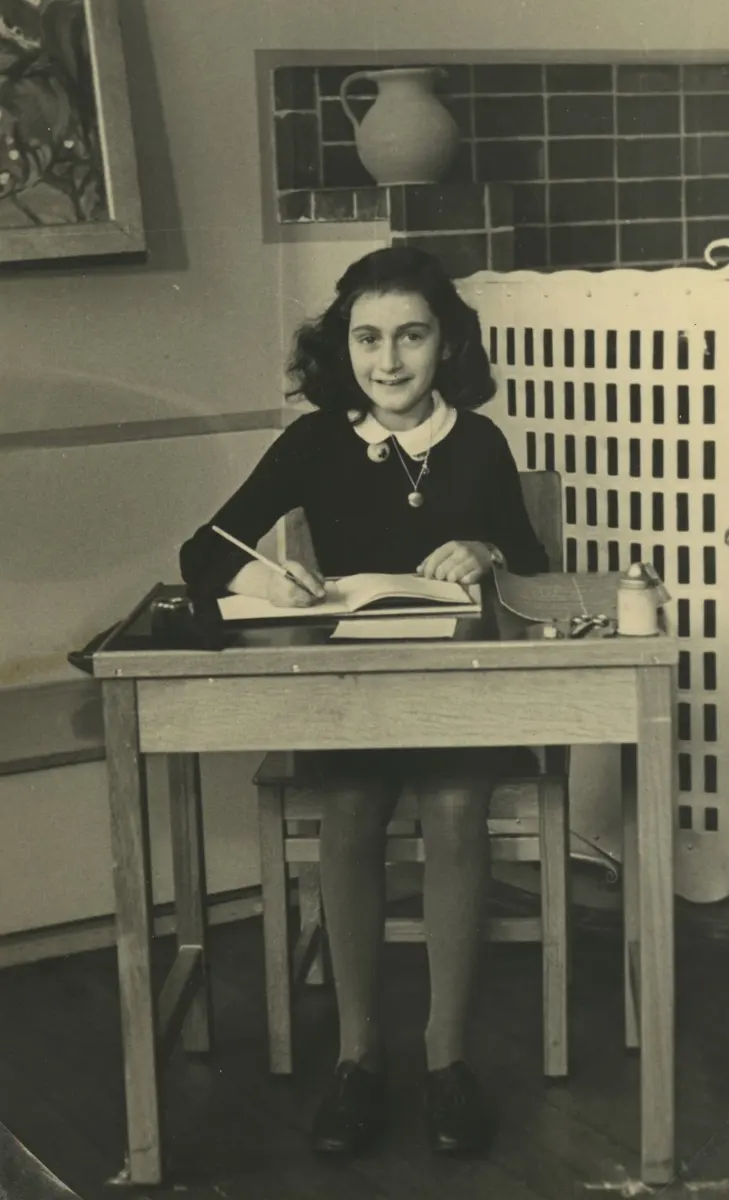
The photo shows a dark-haired girl with a white collar, sitting at a school desk with a pen in her hand and smiling a little.
What is the name of the girl in the picture?
A model answer
Why is she popular?
A model answer
Her life, year by year
The text is a timeline: each paragraph starts with a year.
- 1929. Anne Frank was born on 12 June in Frankfurt, Germany. Her family was Jewish, and she was their second daughter. Her sister Margot was three years older.
- 1933. Adolf Hitler and his Nazi party came to power in Germany. Hitler said the Jews were to blame for everything that was wrong with Germany, and Jewish families could no longer live a normal life there. So the Franks moved to Amsterdam, in the Netherlands, where Anne’s father, Otto Frank, set up a company.
- 1934. Anne, the last of the family to arrive, settled in fast: she picked up Dutch, found lots of friends and was happy at school.
- 1939. German armies invaded Poland, which began the Second World War in Europe.
- 1940. On 10 May, the Germans attacked the Netherlands and occupied it, took control of it. It was too late for the Franks to leave again. The Nazis began to make law after law against the Jews, and over the next two years Jewish people were banned from owning businesses, from trams, buses and cars, from cinemas, parks and swimming pools. They could shop only between three and five in the afternoon, and had to be indoors from eight at night. (Later, from May 1942, every Jew had to wear a yellow star on their clothes.)
- 1941. A new law said Jewish children could no longer go to school with other children, so in the autumn Anne had to change to a school for Jewish pupils and teachers only.
- 1942. For her thirteenth birthday, on 12 June, Anne got a diary. In it she wrote that she hoped she could tell it everything, and that it would be a great comfort to her. On 5 July, Margot was ordered to report to a camp. The very next day, the four Franks went into hiding in the Secret Annex, rooms at the back of Otto Frank’s office building. A week later the three van Pels moved in with them, and in November a dentist made eight. People from Otto Frank’s company brought them food and came to see them.
- 1944. On 4 August, after more than two years, the hiding place was found. Police came to the building, 263 Prinsengracht, led by an Austrian Nazi officer, and arrested all eight people. The pages of Anne’s diary lay scattered across the floor, until one of the helpers gathered them up and hid them.
Words from the text
| Word | Meaning |
|---|---|
| blame | to say that something bad is someone’s fault |
| invade | to enter another country with an army, to attack it |
| occupy | to take control of a country by force |
| confide in | to tell your secrets and feelings to someone you trust |
| hiding | staying where others can’t find you |
| receive | to get something that someone gives or sends you |
| arrest | (of the police) to take someone and hold them |
| scattered | spread about in many places, untidily |
A. Complete the table
Complete the table.
| Year | The events |
|---|---|
| 1929 | Anne Frank was born. |
| 1933 | |
| 1934 | |
| 1939 | |
| 1940 | |
| 1941 | |
| 1944 |
Answer
B. Make the questions
Write down the questions corresponding to these dates in the life of Anne Frank.
1929: When … ?
1933: Why … ?
1939: What … ?
1944: Who … ?
Model answers
C. Answer the questions
What were the Jews not allowed to do in 1940’s?
A model answer
How old was Anne in 1942?
A model answer
Where did her family hide?
A model answer
D. Your own timeline
Here is one student’s life, laid out as a timeline.
Prepare a timeline of your life till now. Write the years and events.
A model answer
E. Past forms of verbs
Write all the past forms of verbs from the text and use them in your own sentences. Write true to yourself which are applicable to you.
Model answers
Writing
A. What I used to do
With the help of your parents recall some of your past habits. Write what you used to do and what you did not use to do.
A model answer
B. Two pictures
The first picture shows green hills with snowy mountains behind, a river and a few small houses. The second shows a crowded city of tall buildings, with smoke pouring from factory chimneys.
Observe the pictures and write the differences you find. Use the given clues: greenery, less population, pollution, big buildings.
A model answer
Project work
Extra bit: alphabetical order
The words in a dictionary are in alphabetical order, the order of the letters of the alphabet, from a to z. Words starting with a come at the beginning, and words starting with z at the end.
When two words start with the same letter, look at the second letter. When the second letters are the same too, look at the third, and so on.
| Look at | Words in order | Why |
|---|---|---|
| the first letter | ash, credit, epic, manual, water | a, c, e, m, w |
| the second letter | credit, cricket | ce… before cr… |
| the third letter | debate, decide, demand | deb, dec, dem |
| the fourth letter | deaf, dear | deaf before dear: f before r |
| a word inside another | key, keyword · know, knowledge | the shorter word comes first |
Try it: tap the words in dictionary order, one at a time.
Which list is in alphabetical order?
Pick an answer to see why.
Exercise
Practice the whole unit. Try each one, then open the answer.
Complete with used to, didn’t use to or use to.
- a.My grandmother ……… carry water from the spring every morning.
- b.……… you ……… play dandi biyo?
- c.We ……… have a television, but now we have one.
- d.Bishal ……… be shy, but now he talks to everyone.
Answer
Correct the mistakes.
- a.I use to live in Ilam.
- b.Did you used to walk to school?
- c.I used to visit Pokhara last year.
Answer
Put these words in alphabetical order: village, chautaro, public, property, melodious.
Answer
Why was the Bar Pipal Chautaro important to the people of Gairigaun?
A model answer
How did Anne Frank’s diary survive?
A model answer
Printable PDFs
- Study notes 2 pages
- Harder practice questions 2 pages Answer key
Practice every question in the book, and keep track of the ones you miss →
A companion to your textbook, not a replacement for it: study from the book your school uses, and where the two differ, follow your teacher. Found a mistake? Please tell us.