
You write, read, play and run every day. Could you do all this without eating? Not for long. Could a bus, a tractor or a plane run without diesel or petrol? No. Could a phone, a radio or a television work without electricity? No again.
We get energy from our food. Buses and planes get their energy from fuels such as diesel and petrol. A phone, a fan or a computer gets its energy from electricity. Energy is what lets things do work: move, lift, push, heat up, light up or make a sound.
The capacity (ability) to do work is called energy. Energy is measured in joules (J). The joule is the SI unit of energy.
In this unit you will meet the different forms of energy and how one form changes into another (7.1), find out why some things soak up the sun’s heat faster than others (7.2), see that light travels in straight lines, makes shadows and works a camera with no lens (7.3), and find out how sound travels to your ears (7.4).
7.1 Forms of energy
Many kinds of work go on around us: a fan turns, a bulb glows, a drum booms, a kettle boils, a magnet picks up pins. Each needs energy in a different form. The main forms of energy are:
- mechanical energy (the energy of moving or raised things)
- heat energy
- light energy
- sound energy
- electrical energy
- magnetic energy
- chemical energy (stored in food, fuels and batteries)
- nuclear energy (also called atomic energy, stored in the centers of atoms; it makes the sun shine)
In which form is energy stored in the food you eat and in a battery?
Pick an answer to see why.
Mechanical energy
Some things around us are moving: a rolling ball, a flying bird, a running bus. Others are still, but kept in a special position: water in a tank on the roof, a stretched catapult. Both kinds have energy.
The energy a body has because of its motion or its position is called mechanical energy. Mechanical energy is of two types: potential energy and kinetic energy.
a. Potential energy
Your arm’s muscles have energy (from your food). When you stretch the catapult, that energy is stored in the stretched rubber. When you let go, the stored energy throws the stone a long way. Energy stored like this is called potential energy. (“Potential” means “ready to be used”.)
A footballer does the same: as he swings his leg back, energy from his muscles is stored in his raised leg and his stretched muscles. As he kicks, it sends the ball rolling far away.
The energy stored in a body because of its position, or a change in its position or shape, is called potential energy.
Potential energy is stored in many things:
- because of their height: water stored in a tank on a roof or behind a dam, a stone or a brick lifted up, a ripe mango high on its tree;
- because their shape is changed: a spring squeezed, stretched, bent or coiled; a stretched rubber band or bow; the wound-up spring of a mechanical (key) watch or a toy car.
Which of these has potential energy?
Pick an answer to see why.
b. Kinetic energy
It is easy to catch a ball thrown slowly, but hard to catch one thrown fast. And it is easy to catch a light tennis ball, but hard to catch a heavy cricket ball thrown at the same speed. A moving ball hits your hands with energy, and some balls bring more energy than others.
So everything that is moving has energy. The energy a body has because of its motion is called kinetic energy. (“Kinetic” comes from a Greek word for “moving”.)
A rolling ball, a flying bird, flowing water, blowing wind and a moving bus all have kinetic energy.
Factors affecting kinetic energy
The kinetic energy of a body depends on two things:
- its mass: the heavier the body, the more kinetic energy it has at the same speed. A cricket ball has more kinetic energy than a tennis ball thrown at the same speed. A motorbike has more than a bicycle going at the same speed.
- its speed (velocity): the faster it moves, the more kinetic energy it has. A cricket ball thrown fast has more kinetic energy than the same ball thrown slowly.
That is why a crash at high speed does so much more damage than one at low speed.
Which has the most kinetic energy?
Pick an answer to see why.
Transformation of energy
Water stored in a tank, behind a dam, in a lake or in a pond has potential energy. When it flows down, its potential energy changes into kinetic energy. Energy changes from one form to another like this, but it is never destroyed and never made from nothing.
Energy can neither be created nor destroyed; it can only be changed from one form to another. This is called the law of conservation of energy. (“Conserve” means “keep safe”: the total amount of energy is kept the same.)
In daily life we need energy in different forms: sometimes kinetic energy, sometimes light, heat, sound, magnetic or electrical energy. So we use machines and appliances to change the energy we have into the form we need. The change of energy from one form into another is called transformation of energy.
| Appliance | Energy it takes in | Energy it gives out |
|---|---|---|
| solar panel | light energy (from the sun) | electrical energy |
| electric bulb | electrical energy | light energy (and some heat) |
| electric heater | electrical energy | heat energy |
| torch | chemical energy in its cells → electrical energy | light energy |
| electric fan | electrical energy | kinetic energy |
| radio, loudspeaker | electrical energy | sound energy |
| LP gas stove | chemical energy (in the gas) | heat energy (and some light) |
A chain of changes can be shown in a flow chart. In a hydropower plant:
water stored behind a dam (potential energy) → water rushing down from the dam (kinetic energy) → turbine turned by the water, driving a generator (electrical energy) → a bulb lit in your home (light energy)
At Dashain, children swing high on a bamboo ping. As the swing goes down and up again, its energy keeps changing from one form to the other. (A real ping slowly loses its energy to the air, as a little heat and sound, so someone must keep pushing it; the energy still isn’t destroyed.)
What energy change happens in an electric fan?
Pick an answer to see why.
Exercise (7.1 Forms of energy)
1. Fill in the blanks with the right word
kinetic energy, mechanical energy, energy, forest, potential energy
The capacity to do work is called ______.
Answer
The energy a body has because of its motion or position is called ______.
Answer
Water stored in a reservoir has ______.
Answer
A moving vehicle has ______.
Answer
2. Choose the correct answer
a. Which of these has kinetic energy?
Pick an answer to see why.
b. Which of these has potential energy?
Pick an answer to see why.
c. What is the SI unit of energy?
Pick an answer to see why.
d. Read these statements about energy: (1) Energy cannot be destroyed. (2) Energy cannot be created. (3) Energy cannot be changed from one form to another. Which is correct?
Pick an answer to see why.
3. Answer these questions
What is energy? Write its SI unit.
Answer
Define mechanical energy, and name its types.
Answer
Define kinetic energy and potential energy, with two examples of each.
Answer
On which factors does the kinetic energy of a body depend?
Answer
Write any two differences between kinetic energy and potential energy.
Answer
What is transformation of energy? What difficulties would we face if energy could not be transformed?
Answer
“The food we eat is also a form of the sun’s energy, transformed.” Explain this statement.
Answer
We can work for a short time without eating, but not for a long time. Explain both in terms of energy.
Answer
7.2 Heat
In summer we feel hot, and in winter we feel cold. A piece of ice feels cold to touch, and hot water feels warm. What makes us feel hot or cold?
The cause is heat. Heat is a form of energy that gives us the feeling of hotness. Its SI unit is the joule (J), like every form of energy.
Heat always flows from a hotter body to a colder body: from a body at a higher temperature to a body at a lower temperature.
- When you touch something hotter than your skin, heat flows from it into your skin, and you feel hot.
- When you touch something colder than your skin, heat flows from your skin into it, and you feel cold.
So cold is not something that flows into your hand from ice. Your hand feels cold because it is losing heat to the ice.
You hold a cold glass of water. Which way does heat flow?
Pick an answer to see why.
Heat absorption
When we sit in the sun or in front of a heater, or put on clothes dried in the sun, we feel warm. When we touch a pot left in the sun, it feels hot. In each case our body is taking in heat from something hotter than itself.
The process in which a body takes in heat from hotter things around it is called heat absorption (absorption of heat). Not all things absorb heat equally well; it depends on several factors.
Factors affecting the absorption of heat
How well a thing absorbs heat depends mainly on two things: its surface area and its color.
1. Surface area of the object
The more surface a thing spreads out to the heat, the more heat it absorbs. The heat absorbed by an object increases with its surface area, and decreases when its surface area is smaller.
Try both factors in the widget after the next activity.
2. Color of the object
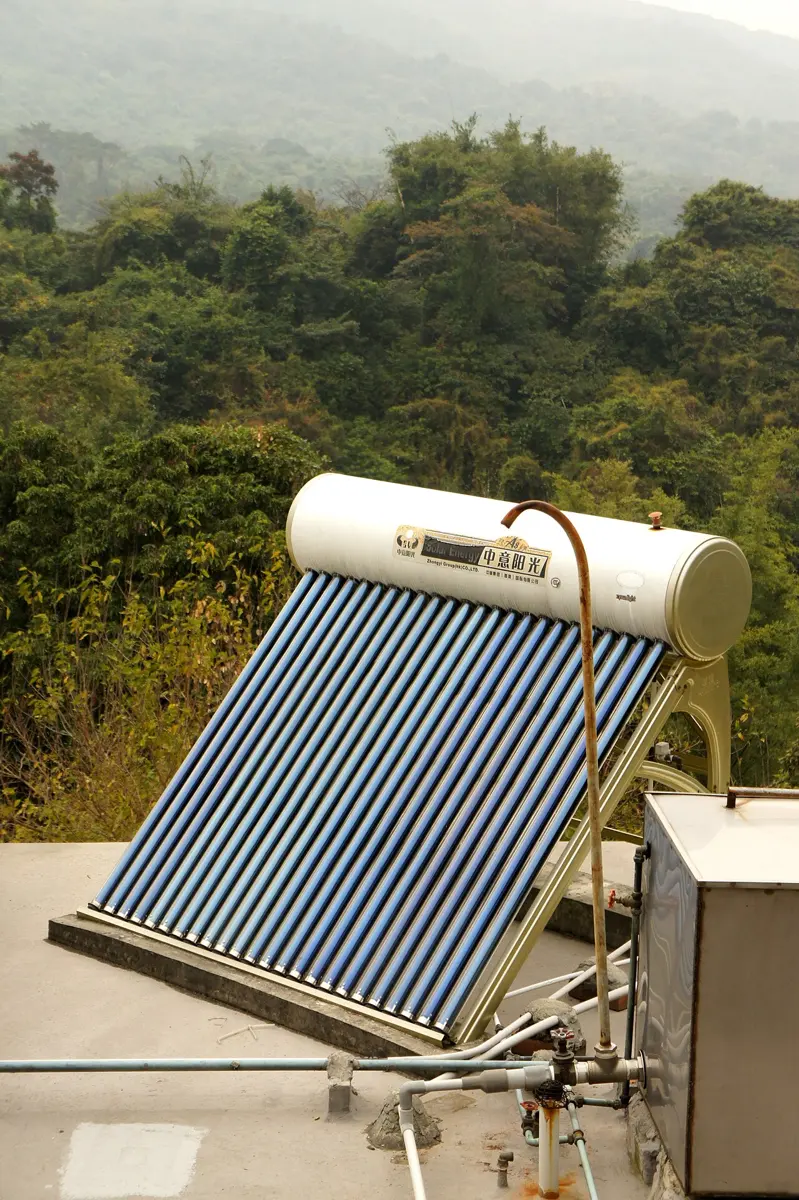
A black object absorbs heat well; a white object absorbs little heat, because it reflects most of the light falling on it. Other colors are in between: darker colors absorb more than lighter ones.
That is why:
- light-colored, white clothes are cooler to wear in the hot season, and black or dark clothes are better in the cold season;
- the collecting surface of a solar water heater is painted black, so that it absorbs as much of the sun’s energy as possible;
- the outer bottom of a cooking pot is often black, so the food cooks faster and fuel is saved.
Which would warm up fastest in the sun?
Pick an answer to see why.
Exercise (7.2 Heat)
1. Fill in the blanks with the right word
less, energy, joule, negligible, more
The SI unit of heat is ______.
Answer
Heat is a form of ______.
Answer
A larger surface area absorbs ______ heat.
Answer
White objects absorb ______ heat.
Answer
2. Write true or false
When we touch an object hotter than our skin, heat flows from the hot object into the skin.
Answer
When we touch an object colder than our skin, heat flows from the cold object into the skin.
Answer
The heat absorbed decreases when the surface area increases.
Answer
A black object absorbs less heat.
Answer
3. Choose the correct answer
a. Which is the correct way heat flows?
Pick an answer to see why.
b. Which color absorbs the most heat?
Pick an answer to see why.
c. Why do we feel very hot in black clothes on a strong sunny day?
Pick an answer to see why.
d. Why do we spread out wet or washed clothes in the sun?
Pick an answer to see why.
4. Give reasons
Bedding is spread out in the sun in winter.
Answer
White clothes are more comfortable than black ones in summer.
Answer
5. Answer these questions
Write the importance of heat in our daily life.
Answer
What is heat absorption? On which factors does it depend?
Answer
What is the relation between the heat absorbed and the color of an object? Give an example you have seen or know.
Answer
Explain an example from daily life which shows that more surface area absorbs more heat.
Answer
What color of clothes would keep you cool in summer, and what color warm in winter?
Answer
7.3 Light
On your way to school you see houses, vehicles, trees, animals and flowers of many colors. How can you see them? What do you need?
In the daytime we see things around us because of the light from the sun; at night, because of the light from lamps and bulbs. Things like the sun, a flame and a glowing bulb give out their own light. Most other things don’t: we see them only when light from a bright source falls on them and bounces back (reflects) into our eyes. In a completely dark room you can see nothing at all. So we need light to see.
Light is a form of energy that helps us see the things around us.
Tree: W. Heubach (d. 1923) in O. Schmeil, Lehrbuch der Botanik (1911), No restrictions, via Wikimedia Commons
Transmission of light
Have you seen light moving from one place to another? How does sunlight get from the sun to the Earth?
Light travels from its source to other places. Sunlight travels all the way from the sun to the Earth, through space. Light is the fastest thing there is: it travels about three lakh kilometers (300,000 km) in one second. The process in which light travels from one place to another is called transmission of light.
Rectilinear propagation of light
In the morning, watch the sunlight coming into a dark room through a small hole or gap in the window. You can see dust floating in it. Is the beam straight or bent? At night, have you shone a torch up at the sky? The beam is straight. Both show that light travels in straight lines. This is called the rectilinear propagation of light (“rectilinear” means “in a straight line”; “propagation” means “traveling”).
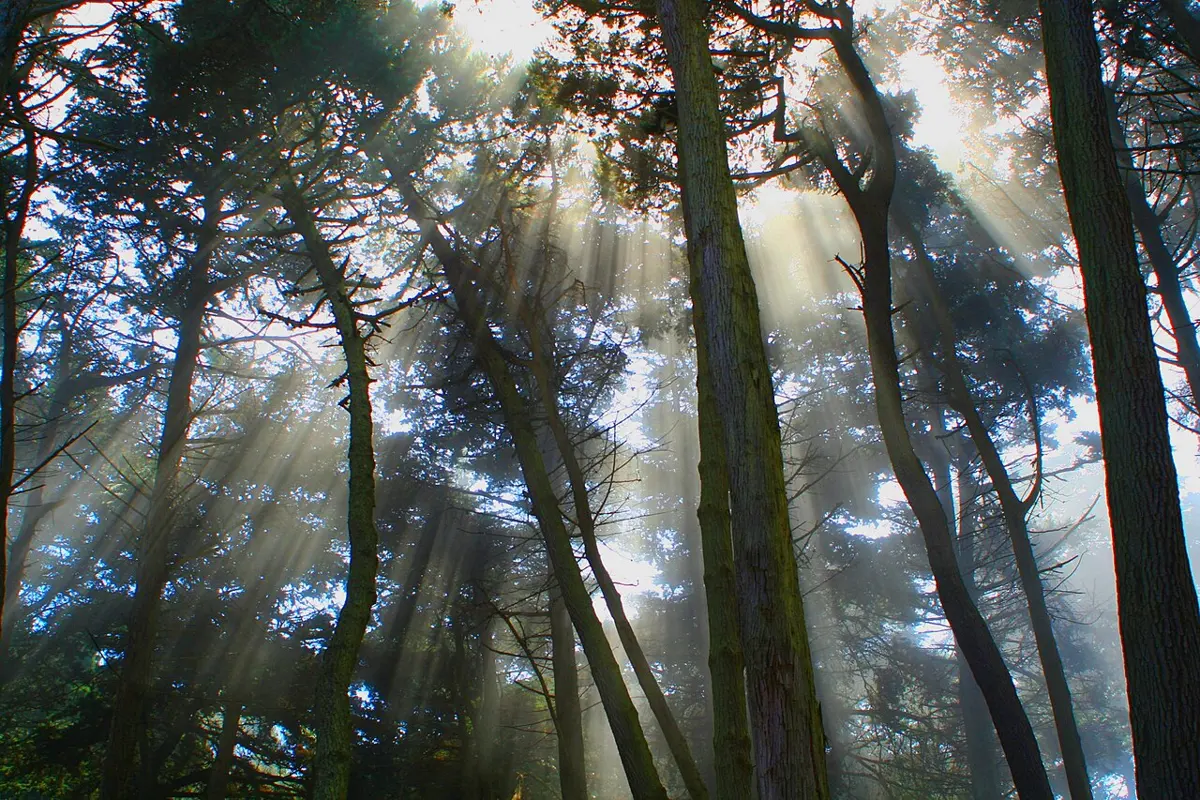
Does this rule hold for the light from the lamps and torches we see every day? Yes. Sometimes the light from a bulb or a torch seems to curve or bend, but that is only an illusion. In air, or in any one clear material, light doesn’t travel in a curved path. It goes out from its source in straight lines, in whichever direction it starts.
Why can’t you see a candle through a bent pipe?
Pick an answer to see why.
Ray of light
When you walk at night with a torch, you can see its light going far ahead. The headlights of vehicles at night shine a long way too. A stream of light like this is called a beam of light. The smallest part of a beam, a single thin line of light, is called a ray of light. A beam is made of many rays.
A ray is drawn as a straight line, because light travels in straight lines, with an arrow on it to show which way the light is going.
What is the smallest part of a beam of light called?
Pick an answer to see why.
Pinhole camera
You can make a camera with no lens at all, just a tiny hole. It is called a pinhole camera.
Where does the light that makes the picture come from? From the object itself. Light from every point of the object travels in straight lines, and the only way in is through the tiny hole. A ray from the top of the object passes through the hole going downwards, and lands at the bottom of the screen. A ray from the bottom passes through going upwards, and lands at the top. Rays from all the other points land in between, each in its own place. So an inverted (upside-down) image forms on the screen. The pinhole camera works only because light travels in straight lines.
The farther the screen is from the hole, the more the rays spread apart before they land, so the bigger the image.
What kind of image does a pinhole camera make?
Pick an answer to see why.
Shadow
On a sunny day, when you stand in an open field, your shadow falls on the ground on the side away from the sun. Houses, trees and animals also cast shadows on the side opposite to the sun. Why does a shadow form, and how? Think about it.
Things are of three kinds, by how much light they let through:
- Transparent things, like clear glass and clean water, let light pass through easily. They make almost no shadow.
- Translucent things, like tracing paper, butter paper and frosted glass, let some light through. They make a faint shadow.
- Opaque things, like wood, a book, a wall or your body, let no light through. They make a dark shadow.
A shadow is the dark area formed behind an opaque object when it blocks the light from a source. To get a shadow, you need three things: a source of light, an opaque object, and a screen (a wall or the ground) for the shadow to fall on. And it all works because light travels in straight lines.
Which of these makes the darkest shadow?
Pick an answer to see why.
Types of shadow
Look closely at a shadow made by a candle or a big bulb. It has a dark middle and a paler edge. So there are two types of shadow, or two parts of a shadow:
- Umbra: the dark part, where the light is blocked completely: no light from the source reaches it.
- Penumbra: the paler part round the umbra, where the light is blocked only partly: light from part of the source still reaches it.
A penumbra forms because a real source of light, like a flame, a bulb or the sun, has a size: it isn’t just a point.
The size of a shadow depends on the distances between the source of light, the object and the screen:
- If the object is moved closer to the source (or the source closer to the object), the shadow gets bigger.
- If the source is moved farther from the object, the shadow gets smaller.
- If the screen is moved closer to the object (or the object closer to the screen), the shadow gets smaller and sharper.
Try it with your hand and a torch: hold your hand close to the torch, and a huge hand-shadow fills the wall.
Sundial
Did you know how people told the time before clocks and watches were invented? Our ancestors used simple instruments. One was the sundial: a stick or a slanting blade that casts a shadow on a flat dial marked with the hours. The direction and the length of its shadow tell the time.

Exercise (7.3 Light)
1. Fill in the blanks with the right word
ray, straight, shadow, screen, bending
Light travels only in a ______ line.
Answer
The smallest part of a beam of light is called a ______.
Answer
Light can’t pass through an opaque object, so its ______ is seen behind it.
Answer
In a pinhole camera, the tracing paper works as a ______.
Answer
2. Choose the correct answer
a. How does light travel?
Pick an answer to see why.
b. Which of these is not needed to form a shadow?
Pick an answer to see why.
c. What is the smallest part of a beam of light called?
Pick an answer to see why.
d. What kind of image is seen in a pinhole camera?
Pick an answer to see why.
e. How can the size of a shadow be increased? i. by moving the source closer to the object; ii. by moving the object closer to the source; iii. by moving the screen closer to the object.
Pick an answer to see why.
3. Write the differences
A ray of light and a beam of light
Answer
Umbra and penumbra
Answer
4. Answer these questions
What is a shadow? How many types of shadow are there? Why is a shadow’s length different in the morning, at midday and in the evening?
Answer
Light travels in a straight line. Explain this with a suitable diagram.
Answer
Can we make a camera without a lens? What is it called?
Answer
If light travels in straight lines, why is the image in a pinhole camera upside down?
Answer
When a bulb is switched on, the light spreads out in all directions. How is this possible if light travels in straight lines? Give your opinion.
Answer
Complete the chart by filling in the boxes.
Light, with five boxes: 1. How does a shadow form? 2. What is it? 3. Why do we need it? 4. In what kind of line does it travel? 5. Which activity proves it?
Answer
7.4 Sound
What is sound? How is it made? How does it reach our ears? Let’s find out.
Sound is a form of energy. It is produced when things vibrate (shake quickly to and fro), and it travels as a wave to our ears. We hear many kinds of sound every day. Some are useful and pleasant, like music, a friend’s voice or a warning horn. Others are unwanted and unpleasant, like the noise of traffic and machines; unwanted sound is called noise.
Wave
Drop a stone into the still water of a pond. Ripples move out towards the edge, going up and down as they go. These are waves. They spread out in all directions. But the water itself doesn’t flow to the edge: a leaf floating on it just bobs up and down in its place. A wave on a stretched rope is the same: humps run from one end to the other, while each bit of the rope only moves up and down.
So a wave carries energy from one place to another, but not the water or the rope. When an object vibrates, the process in which its energy is passed on through a medium (the water, the rope, the air) is called a wave.
Sources of sound
The vibrating plate pushes on the air around it and makes waves in the air. These waves reach our ears as sound. So the main thing needed to make sound is a vibrating body.
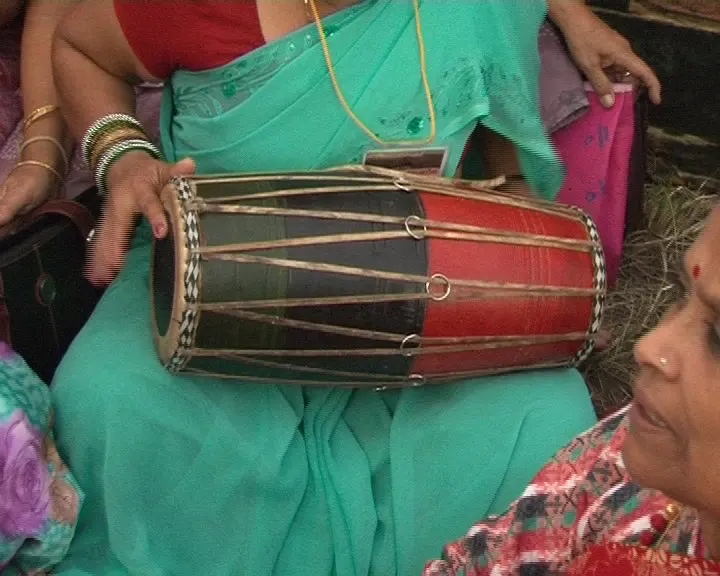
An object that produces sound is called a source of sound. A madal, a guitar, a bell, a flute (bansuri), your own throat and a loudspeaker are all sources of sound.

What is needed to produce sound?
Pick an answer to see why.
Origin of sound waves
As we saw in activity 7.21, when the plate vibrates, it pushes the air around it forward and back (to and fro). This disturbance is passed on through the air from one particle to the next, until it reaches our ears. Then we hear the sound.
So to make a sound wave, two things are needed: a vibrating body, and a material medium (a solid, a liquid or a gas) around it. Even if a body is vibrating, if there is no medium around it, no sound wave is made, and we can’t hear it.
Propagation of sound
On the slinky, each ring moves to and fro in the same direction as the wave travels. A wave like this, in which the particles of the medium vibrate in the same direction as the wave travels, is called a longitudinal wave.
Sound is a longitudinal wave. It travels from place to place through the particles of solids, liquids and gases, and the particles of the medium vibrate to and fro in the same direction as the sound travels. Sound spreads out in all directions around its source.
Process of propagation of sound wave
Sound needs a material medium: a solid, a liquid or a gas. It can’t travel through a vacuum (completely empty space).
In a solid, a liquid or a gas, the particles (molecules) are lined up next to one another. When a body vibrates, it pushes the molecules next to it; they push the next ones, and so on. As they push one another, the molecules move to and fro. Where they are pushed together, they are crowded: a compression (C). Where they move apart, they are spread out: a rarefaction (R). So sound travels as a series of compressions and rarefactions of the molecules of the medium.
Ear: traced from Henry Vandyke Carter, Gray’s Anatomy (1918), Fig. 904, public domain
In a sound wave, how do the particles of the air move?
Pick an answer to see why.
Propagation of sound in different media
Sound needs a solid, liquid or gas to travel through, but its speed is different in each.
In a solid
In a solid, the molecules are very close together and held tightly to each other. When one is pushed, it pushes its neighbors almost at once. So the wave passes from molecule to molecule very quickly: sound travels fastest in solids.
In a liquid
In a liquid, the molecules are a little farther apart and less tightly held than in a solid. A pushed molecule takes a little longer to pass on the push. So sound travels slower in liquids than in solids.
In a gas
In a gas, the molecules are far apart from one another. A pushed molecule has a long way to go before it bumps into the next one. So sound travels slowest in gases, much slower than in solids and liquids.
Speed of sound: solid > liquid > gas.
| Medium | Speed of sound (roughly) |
|---|---|
| steel | 5200 m/s |
| water | 1500 m/s |
| air | 332 m/s at 0 °C (about 340 m/s on a warm day) |
Does sound travel in a vacuum?
Sound needs a solid, liquid or gas to travel through. There is no air in the huge space between the sun and the Earth: it is a vacuum. So the sound of the giant explosions on the sun never reaches us, though its light and heat do. In the same way, there is no air on the Moon, so astronauts there can’t talk to each other directly, even standing side by side. They talk by radio, through special electronic sets in their helmets. Radio waves, like light, can travel through a vacuum.
Two astronauts stand next to each other on the Moon. Why must they use radios to talk?
Pick an answer to see why.
Exercise (7.4 Sound)
1. Fill in the blanks with the right word
solid, vacuum, source of sound, sound, liquid
When a body vibrates, ______ is produced.
Answer
Sound travels fastest in a ______ medium.
Answer
Sound can’t travel through a ______.
Answer
An object that produces sound is called a ______.
Answer
2. Choose the correct answer
a. In which medium does sound travel fastest?
Pick an answer to see why.
b. What is the speed of sound in air?
Pick an answer to see why.
c. What is an object that produces sound called?
Pick an answer to see why.
d. Which order of the speed of sound is correct?
Pick an answer to see why.
3. Give reasons
On the Moon, an electronic device (a radio) is needed to talk with a friend.
Answer
The speed of sound is highest in solids.
Answer
The speed of sound is lowest in gases.
Answer
4. Answer these questions
What is a wave? How is it produced?
Answer
Explain, with a diagram, how a sound wave is produced and how it travels.
Answer
What are the similarities and differences when sound travels through solids, liquids and gases?
Answer
We see the lightning in the sky first and hear the thunder later. Why?
Answer
You put your ear to one end of the longest wall of your classroom, and a friend scratches the other end of the wall gently with a nail. Then you try to hear the scratch without your ear on the wall. In which case do you hear the sound, and why? Explain in terms of how sound travels.
Answer
Complete the chart by filling in the boxes.
Sound, with four boxes: 1. What is it? 2. Sources 3. Media it travels through 4. How it travels
Answer
Worksheet: Energy in Daily Life: forms of energy and heat (PDF, 4 pages)
Worksheet: Energy in Daily Life: light and sound (PDF, 3 pages)
Quiz yourself: Energy, Heat, Light and Sound, Grades 5–10 →
Practice every question in the book, and keep track of the ones you miss →
A companion to your textbook, not a replacement for it: study from the book your school uses, and where the two differ, follow your teacher. Found a mistake? Please tell us.