Kick a football and it flies across the ground. Your friend stops it with a foot. A swing goes higher each time you push it. A lump of dough becomes a flat roti under a rolling pin. In each of these, something pushes or pulls, and something changes.
We walk, run, play, dig and carry loads every day. None of it can be done without a push or a pull, that is, without force. In this unit you will find out what it means for a thing to be moving or still, what a force can do, how a force can be passed from one place to another, and how simple tools like a sickle, a pulley and an iron bar make hard work easy.
Remember?
6.1 Motion and its types
While you push the book, it keeps changing its position. We say it is in motion.
Flowing water, a flying bird, a moving bus, a walking man and a moving bicycle are all in motion. When you walk to school, you are in motion too: your position keeps changing compared with the houses and trees you pass.
The state in which a body keeps changing its position compared with the objects around it is called motion.
The tables, chairs, benches and desks in your classroom are not changing their position. They are at rest. A house, a bridge and an electric pole are also at rest.
The state in which a body does not change its position compared with the objects around it is called rest.
So whether a thing is “moving” or “at rest” depends on what we compare it with. We say that rest and motion are relative. The thing we compare with is called the reference. Usually we compare with the ground, the trees and the buildings around us, so we just say “the bus is moving”.
Who is moving?
Sita sits in the bus. Gopal stands by the road. Choose where you watch from, then press Drive.
Watch from
Sita (in the bus)
?
Gopal (by the road)
?
the trees
?
From the roadside, press Drive and watch who changes place.
Seen from the roadside, the bus and Sita moved; Gopal and the trees stayed at rest.
From Sita’s seat, press Drive and watch who changes place.
Seen from Sita’s seat, Sita stayed at rest beside her window, and Gopal and the trees moved backwards. Both views are right!
A book lies on the seat of a moving bus. Compared with the bus, the book is…
Pick an answer to see why.
The book stays on the same seat, so compared with the bus it is at rest. Compared with the road outside, it is moving with the bus. Rest and motion depend on what you compare with.
Which of these is at rest compared with the ground?
Pick an answer to see why.
An electric pole stays in the same place. The river, the bird and the bicycle keep changing their positions.
Types of motion
Things don’t all move in the same way. A falling stone goes straight down. A butterfly flutters this way and that. We sort motion into two main types: linear motion and curvilinear motion.
a. Linear motion
The motion of a body along a straight line is called linear motion. (It is also called rectilinear motion: recti means “straight”.)
Examples: a vehicle moving along a straight road, a ball rolling on flat ground, a stone falling straight down, a bullet fired from a gun.
b. Curvilinear motion
When a body keeps changing its direction instead of moving in a straight line, its motion is called curvilinear motion. In other words, the motion of a body along a curved path is curvilinear motion.
Examples: a vehicle going round a bend, the tips of the hands of a clock, a swing, a fluttering butterfly, a snake sliding along. When the wind blows, dust, leaves and bits of paper fly about. They have no fixed direction: they keep changing direction as they fly. Their motion is curvilinear too.
Figure 6.1 The paths of moving things, drawn as dashed lines. Linear motion (top row): a stone falling straight down, a carrom striker shot across the board, a marble rolled along the ground. Curvilinear motion (bottom row): the tip of a clock’s hand going round a circle, a swing moving along an arc, a butterfly fluttering in a wavy path.
Which of these is curvilinear motion?
Pick an answer to see why.
A swing moves along an arc, a curved path. The other three move along straight lines.
The motion of the tip of a clock’s hand is…
Pick an answer to see why.
The hand itself is straight, but its tip moves round a circle, changing direction all the time. That is curvilinear motion.
6.2 Force
We need force for every kind of work. But what exactly is a force?
The bag stays at rest until it is pushed or pulled. A push or a pull moves it. A push or a pull is a force.
Pushing or pulling can change whether a body is at rest or in motion. So we define force like this:
The external push or pull that changes, or tries to change, the state of rest or motion of a body is called force.
Why “tries to change”? Push hard on the wall of your classroom. You are using force, but the wall doesn’t move. The force only tries to move it.
We use force to walk, to run, to carry loads, to play football, to ride a bicycle and to open a door. No work can be done without force. A force is needed to set a body at rest moving, and to bring a moving body to rest.
What is a force?
Pick an answer to see why.
A force is a push or a pull. It can start, stop, speed up, slow down or turn a body, or change its shape.
Measuring force
A spring balance has a spring inside. The harder you pull its hook, the more the spring stretches, and the farther its pointer moves along the scale. The scale is marked in newtons, so it reads the force directly.
Figure 6.2 Two spring balances. The small stone stretches the spring a little: its weight is 2 N. The big stone stretches it more: 6 N. The pointer shows the force on the scale.
The SI unit of force is the newton (N). It is named after the scientist Isaac Newton.
Weight is a force too, so it is also measured in newtons. The weight of a body is the force with which the Earth pulls it towards its surface. On the Earth’s surface, a body with a mass of 1 kilogram weighs about 9.8 newtons.
The SI unit of force is…
Pick an answer to see why.
Force, including weight, is measured in newtons (N). The kilogram is the unit of mass.
Which instrument measures force?
Pick an answer to see why.
A spring balance measures force: the spring stretches more for a bigger force, and the pointer shows it in newtons.
Effects of force
A force can do many things to a body. Here are six of them.
a. A force can make a body at rest move. Kick a ball lying on the ground, and it starts moving. Press the pedals, and a bicycle moves. Push a wheelbarrow, and it starts rolling.
b. A force can bring a moving body to rest. A force is needed to stop a moving ball. When the brakes of a moving bicycle or bus are pressed, it stops. In football, the goalkeeper uses force to stop the ball.
c. A force can change the speed of a moving body. (Books also call this changing its velocity: its speed in a direction.) Push a moving swing, and it goes faster. Turn a bicycle’s pedals faster, and the bicycle speeds up. A force can also slow a body down: brakes slow a bicycle before they stop it.
d. A force can change the direction of a moving body. A ball that hits a wall or a post bounces off in a new direction. When a batsman hits a cricket ball with the bat, it flies off in a new direction.
Push the ball
Push the ball with a kick from behind, a push against it, or a push from the side, and watch what each force does. The grass rubs on the ball and slowly stops it.
The ball is
at rest
Speed
0.0 m/s
The ball is at rest. Kick it from behind.
Your kick made the ball at rest start moving.
A kick from behind made the moving ball go faster.
A push against it slowed the moving ball down.
A push against it brought the moving ball to rest.
A push from the side changed the ball’s direction.
The edge of the field pushed the ball back: its direction changed.
The grass rubbing on the ball (friction) slowly brought it to rest.
e. A force can change the shape of a body. Press a balloon full of air, and its shape changes. Dough is pressed and rolled into the round, flat shape of a roti. Squeeze a paper bag or a plastic bag between your hands, and its shape changes.
f. A force can change the size of a body. Blow into a balloon, and it gets bigger. Crumple a sheet of paper, or press clothes into a bag, and they take up less space.
Figure 6.3 Forces changing shape and size. Pressing and rolling changes the shape of a ball of dough into a flat roti. Blowing changes the size of a balloon. Crumpling changes the size (and the shape) of a sheet of paper.
So a force can change a body’s state of rest or motion, its speed and its direction, and also its shape and its size.
A batsman hits a moving cricket ball. Which effect of force is this mainly?
Pick an answer to see why.
The ball was already moving towards the batsman. The bat sends it off another way: the force changes its direction (and its speed too).
When you blow up a balloon, the force…
Pick an answer to see why.
The air you blow in pushes on the rubber from inside, and the balloon gets bigger: its size changes.
Transformation of force
When you cut wood with a sickle (hasiya), a khukuri or an axe, you hold and push the handle. But the cutting is done by the sharp edge. The force you put on the handle is passed along the tool to its edge, and the edge cuts the wood. The same happens when you dig a field with a spade or a kuto: you push the handle, and the blade cuts the soil.
Figure 6.4 The force passes along the tool. With an axe, the hands push on the handle (effort), and the sharp edge splits the log (work done). With a spade (kodalo), the hands swing the handle, and the edge of the blade cuts into the soil.
To stop a moving bicycle, motorcycle or bus, we use the brakes. You press a brake lever with your hand, or a pedal with your foot. That force is carried to the turning wheels, where the brake pads press on them. The rubbing of the pads (friction) slows the wheels down and stops them. In motorcycles, buses and airplanes too, the force on the brakes is carried to the wheels. In this way, the brakes pass a force from one place to another.
Figure 6.5 Passing a force along a rope. Left: at a well, the rope runs over a pulley. Pulling down on one end lifts the bucket of water on the other. Right: the same idea in Activity 6.11, with a pipe on a stick held by two friends in place of the pulley.
When you push the piston of one syringe, the force is passed along the water in the tube to the other syringe. The passing of a force from one place to another is called the transformation of force. (It is also called the transfer or transmission of force.)
Figure 6.6 Two syringes joined by a tube full of water. Push piston A in, and the water carries the force along the tube, round its bends: piston B is pushed out by the same distance.
In most of our daily work, we pass force along in the same way. Tools like the kuto, the spade, the hoe (chande), the sickle, the khukuri, the axe and the wedge all carry the force from where we push to where the work is done. We use different tools to transfer force.
When you cut wood with a khukuri, where is your force applied, and where is the work done?
Pick an answer to see why.
You push on the handle. The force is passed along the blade to the sharp edge, which cuts the wood. That is transformation of force.
In Activity 6.12, why does piston B move out when you push piston A in?
Pick an answer to see why.
The water fills the tube and can’t be squashed, so pushing it at one end pushes it out at the other: the force is transferred.
6.3 Simple machine
We do all kinds of work every day, and we use tools to do it. Tools make our work easier and faster. The tools that help us work in this way are called simple machines.
In villages, a sickle (hasiya) and a khurpa are used to cut grass and firewood. An axe splits firewood and cuts down trees. A spade (kodalo) and a kuto dig the fields. At home we use a chulesi, tongs (chimta), a knife, a nut cutter (sarauta), a shovel and a spinning wheel (charkha). A pulley draws water from a well. Heavy loads are pushed up a slanting plank into a truck. A screwdriver turns screws in and out.
These tools look simple, but with them work gets done quickly and with less force. The tools of simple structure that help us do work easily, quickly and conveniently are called simple machines.
A simple machine is a single tool that works with our own effort. It uses no fuel like diesel or coal. A complex machine is made of many simple machines joined together, working as one. A bicycle is a complex machine: its pedals and gears are wheels and axles, its brake levers are levers, and its bolts are screws.
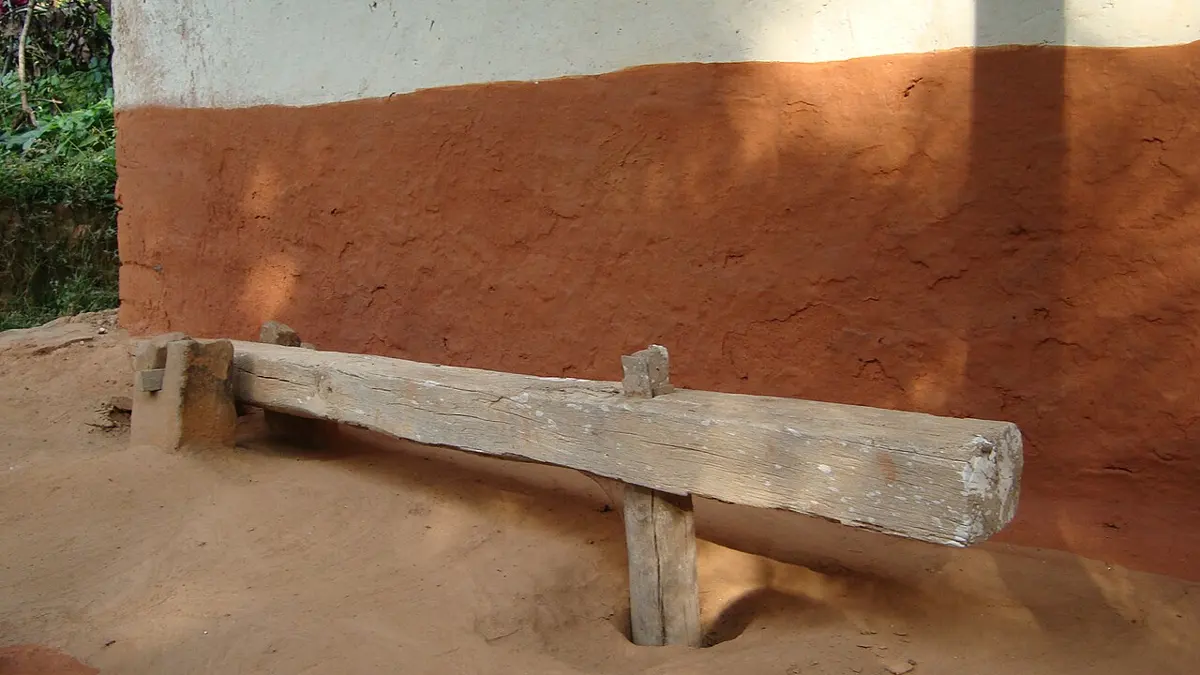
Figure 6.7 A dhiki, the wooden rice-pounder of Nepali villages. It is a lever: a person steps on the short end, beyond the pivot, and the long, heavy arm swings up with its wooden pestle; when the foot is lifted, it drops and the pestle pounds the grain in a hole in the floor. Photo: Krish Dulal, CC BY-SA 3.0
Which of these is a simple machine?
Pick an answer to see why.
Scissors are a simple machine: two levers joined at a pivot, worked by your own effort. A motorcycle, a tractor and a bus are complex machines run by fuel.
Application of simple machine
We use simple machines every day, and they help us a lot. Their main uses are:
a.A heavy load can be lifted with less effort.
b.More work can be done in less time.
c.Effort can be applied in a convenient way (in an easier direction, or from an easier place).
We need force for every kind of work. But sometimes the force we must work against is very large. Suppose you have to roll a stone with a mass of about 1000 kg. You can’t roll it alone with your hands. But with a simple machine, you can.
Push a long iron rod or a strong wooden pole under the stone, and put a small stone under the rod as its fulcrum (the point it turns on). Now press down on the other end of the rod with a small effort. The rod pushes up on the big stone, and the stone rolls over. In this way a small effort can work against a much larger force. The rod makes the work easier, and it also changes the direction of the force: you push down, and the stone is pushed up.
Tip the stone with a bar
Move the small stone (the fulcrum) along. How hard must you push down on the end of the bar to tip a 1000 kg stone?
Push needed
1,225 N
Like lifting
125 kg
Lifting the edge by hand
4,900 N
Small stone close to the big one: a push of a few hundred newtons tips it, about what a grown-up can press down with their weight. Your end moves a long way, while the big stone’s edge rises only a little.
Move the small stone closer to the big one, and the push you need gets smaller.
With the small stone far from the big one, you must push nearly as hard as lifting the edge by hand. Halfway along the bar (100 cm), just as hard: the bar no longer helps.
In the same way, scissors cut paper and cloth with a small squeeze. A shovel throws soil and sand. A pulley draws water from a deep well.
What does a single pulley over a well do?
Pick an answer to see why.
A single fixed pulley changes the direction of your force: you pull down, the bucket goes up. Pulling down is easier and safer than lifting straight up.
The state in which a body changes its position compared with the objects around it is the state of ______.
Answer
The state in which a body changes its position compared with the objects around it is the state of motion.
b.
The push or pull that changes the state of rest or motion of a body is called ______.
Answer
The push or pull that changes the state of rest or motion of a body is called force.
c.
The SI unit of force is ______.
Answer
The SI unit of force is the newton (N).
d.
______ is needed to bring a body at rest into motion.
Answer
Force is needed to bring a body at rest into motion.
e.
The motion of a bullet fired from a gun is ______ motion.
Answer
The motion of a bullet fired from a gun is linear motion.
f.
A simple machine makes our work ______ and faster.
Answer
A simple machine makes our work easy (easier) and faster. The word “simple machine” is not needed, and “force” fills two blanks.
2. Write the differences between
a.
Linear motion and curvilinear motion
Answer
Linear motion
Curvilinear motion
The body moves along a straight line.
The body moves along a curved path.
The direction of motion stays the same.
The direction of motion keeps changing.
Examples: a stone falling straight down, a car on a straight road.
Examples: a swing, a butterfly flying, a car going round a bend.
b.
Rest and motion
Answer
Rest
Motion
The body does not change its position compared with the things around it.
The body keeps changing its position compared with the things around it.
Examples: a house, a bridge, an electric pole.
Examples: flowing water, a flying bird, a moving bus.
3. Answer the following questions
a.
How are rest and motion relative terms? Give an example of each.
Answer
Whether a body is at rest or in motion depends on what we compare it with. The same body can be at rest compared with one thing and in motion compared with another. So rest and motion are relative. Example: A passenger sitting in a moving bus is at rest compared with the bus and the other passengers, because the passenger stays in the same seat. But the same passenger is in motion compared with the trees and houses by the road, because their position keeps changing. Another example: a student sitting on a sack pulled along the ground is at rest compared with the sack, but in motion compared with the ground.
b.
Define force.
Answer
A force is a push or a pull that changes, or tries to change, the state of rest or motion of a body. Its SI unit is the newton (N).
c.
List the effects of force.
Answer
A force can:
make a body at rest move (kicking a ball);
bring a moving body to rest (a goalkeeper stopping the ball);
change the speed of a moving body (pushing a swing harder);
change the direction of a moving body (a bat hitting a cricket ball);
change the shape of a body (rolling dough into a roti);
change the size of a body (blowing up a balloon).
d.
What is transformation of force? Give examples.
Answer
The passing of a force from one place to another is called transformation of force (or transfer of force). Examples:
When we cut wood with an axe, we push on the handle, and the force is passed to the sharp edge, which cuts the wood.
When we press a bicycle’s brake lever, the force is carried along the cable to the brake pads at the wheel, which stop it.
When we push the piston of one syringe, the water in the tube passes the force to the piston of another syringe joined to it.
When we pull down a rope over a pulley, the force is passed along the rope and lifts the bucket.
e.
Sort the motions of the things you have seen into linear motion and curvilinear motion.
Answer
Linear motion
Curvilinear motion
a stone falling straight down
a swing moving to and fro
a bus on a straight road
a bus going round a bend
a marble rolled along flat ground
the tips of a clock’s hands
a carrom striker shot across the board
a butterfly or a bee flying
a bullet fired from a gun
a snake or an ant moving
a lift going up or down
leaves and dust blown by the wind
f.
“A force can change the state of a body.” Justify this statement with an example.
Answer
A force can change a body from rest to motion, or from motion to rest. Example: A football lying on the ground is at rest. When a player kicks it, the force of the kick makes it move: its state changes from rest to motion. When the goalkeeper catches it, the force of the goalkeeper’s hands brings it to rest again: its state changes from motion to rest. So a force can change the state of a body.
g.
Give examples of tools that transfer force.
Answer
An axe, a khukuri, a sickle (hasiya), a spade (kodalo), a kuto, a hoe (chande), a wedge, a knife, a pulley, a broom, a bicycle’s brakes and a bicycle pump all transfer force from where we push to where the work is done.
h.
How can force be measured with a spring balance? Explain with a suitable diagram.
Answer
A spring balance has a spring inside a case, a hook at its lower end, a pointer fixed to the spring, and a scale marked in newtons.
Hold the balance by its top ring, or hang it from a hook.
Hang the thing on its hook (or hook it onto the thing and pull).
The force stretches the spring. The bigger the force, the more the spring stretches, and the farther the pointer moves down the scale.
When the pointer stops, read the scale at the pointer. That is the force, in newtons.
For example, a stone that stretches the spring to the 6 N mark has a weight of 6 N.
Figure 6.8 A spring balance measuring the weight of two stones: 2 N and 6 N. The heavier stone stretches the spring more, and the pointer moves farther down the scale.
i.
How does transformation of force take place when you sweep with a broom at home?
Answer
When you sweep, you hold the top of the handle with one hand and push the middle of the handle sideways with the other. The force of your hands is passed down the handle to the bristles at the bottom. The bristles press on the floor and push the dust and dirt along. So the force applied at the handle is transferred to the bristles, where the work (sweeping) is done.
j.
What is a simple machine?
Answer
A simple machine is a tool of simple structure that helps us do work easily, quickly and conveniently, using our own effort and no fuel. Examples: scissors, a pulley, a crowbar, an axe, a slanting plank.
k.
Write the main uses of simple machines in points.
Answer
A heavy load can be lifted or moved with a small effort (a crowbar rolls a big stone).
More work can be done in less time (an axe splits wood quickly).
Effort can be applied in a convenient way or direction (a pulley lets us pull down to lift a bucket up).
l.
Why is a pulley used to draw water from a deep well? How does it help to do the work well?
Answer
A pulley is used because it lets us lift the bucket by pulling the rope down instead of lifting it straight up. It helps in these ways:
Pulling down is easier: we can use our own weight and keep our back straight.
The rope runs smoothly over the turning wheel, so it doesn’t rub against the edge of the well; the rope lasts longer and the work is lighter.
We can stand to one side of the well, safely, while the bucket comes up straight from the middle.
The water comes up quickly and with less tiredness.
4. Draw clean diagrams of these simple machines
a–d.
Draw clean, labeled diagrams of: a. a spade (kodalo), b. scissors, c. a pulley, d. a khukuri.
Answer
Draw each one large and clear, and label its parts.
Figure 6.9 a. A spade (kodalo): a wide iron blade fixed to the end of a long wooden handle, at an angle. b. Scissors: two blades joined by a pivot, with a ring-shaped handle on each. c. A pulley: a grooved wheel turning on an axle in a frame, hung from a hook, with a rope over it: the load on one end, the effort on the other. d. A khukuri: a curved blade, sharp on its inner (lower) edge, with a thick back, a small notch (cho) near the handle, and a wooden handle.