
Can you ride a bike? Can you whistle, or swim across a river, or say “thank you” in three languages? Everybody can do some things and can’t do others yet. What matters is what you do with the things you can do.
This unit is about ability: saying what people can and can’t do. You will read an old story of a baby quail trapped by a forest fire, and a poem by William Blake about feeling another person’s sadness. You will read a table of who can do what, listen to a call to a hospital, give reasons with because, since, as and because of, and put a story about a lion and a rabbit in order. In the Extra bit, you will see the twelve tenses of English side by side.
Getting started
A. What are they doing?
The unit opens with four pictures: a man pouring hot tea into cups, a boy climbing a tree, a man carrying a heavy sack on his back, and a girl putting a book on a bookshelf.
- a.What are they doing?
- b.Can you do these activities?
- c.Do you need others’ help to do so?
Model answers
B. Listen and sing
The song is a short, funny list of what a hen can do: lay a big brown egg, stand on one leg, run, walk and cluck. The lines rhyme in pairs (egg and leg, walk and bawk), and every line starts the same way, A hen can…, so it is easy to sing. Then the last two lines turn round with a question: is there anything a hen can’t do? The answer is a compliment to you, the singer: a hen can’t read and write, and you can.
Notice how can works in the song. It never changes: a hen can, I can, they can, never a hen cans. And the verb after it is always plain: can lay, can stand, never can lays.
C. What can you do?
Tell your friends what you can and cannot do.
A model answer
Reading I: The Baby Quail
Before you read
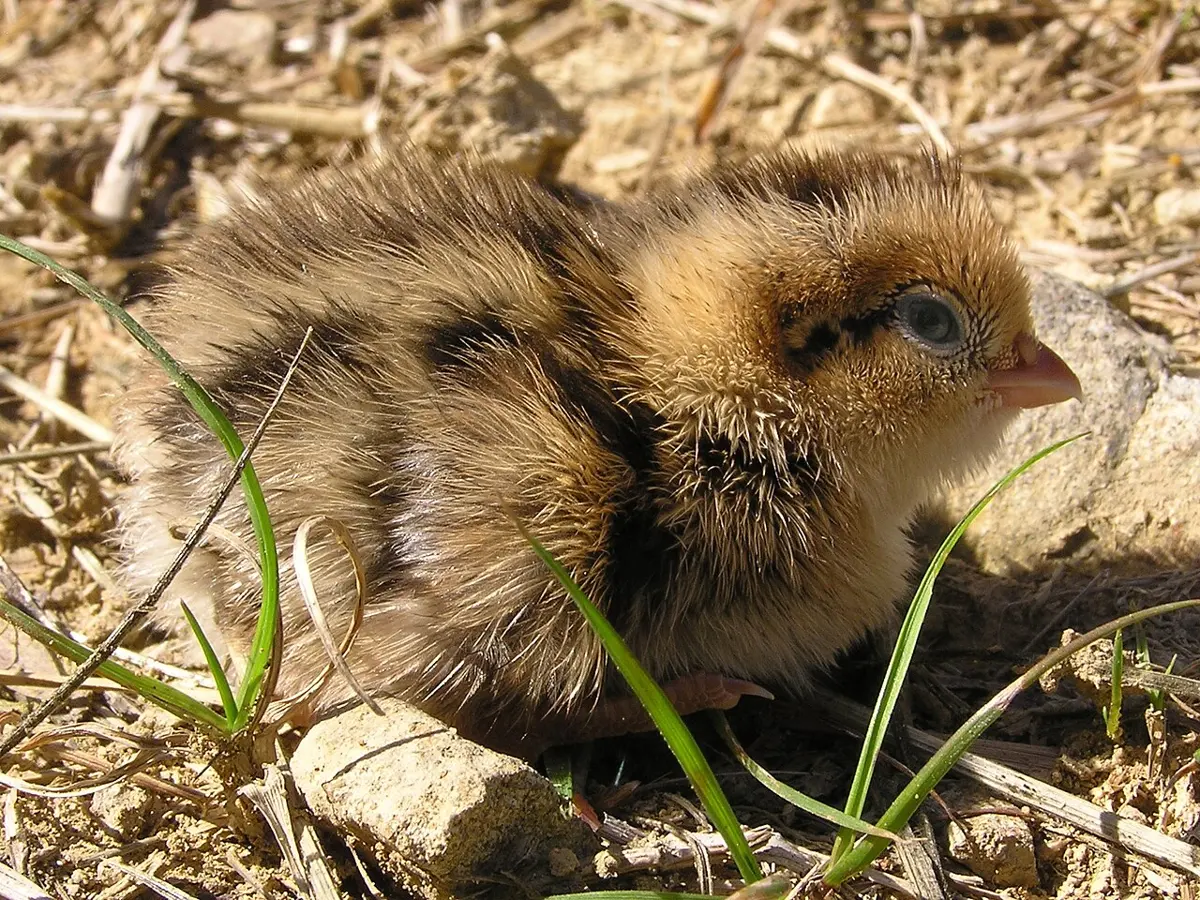
The story has two pictures: a small brown bird standing on the grass, and a forest on fire, with flames under the trees and smoke rising.
What is happening in the second picture?
A model answer
How does it affect the bird?
A model answer
The story, part by part
- The quail. Long ago, the Enlightened Being was born as a tiny quail, a small, round brown bird that lives on the ground. He had little feet and wings, but he couldn’t walk or fly yet. His parents worked hard to feed him.
- The fire. One day a huge forest fire broke out. Every bird that could fly flew off as soon as it saw smoke. As the fire came closer, the quail’s parents stayed by his nest. In the end the flames were so near that they had to fly away too, or die.
- Alone. The trees were burning and crackling (making short, sharp, loud sounds). The little quail saw everything being destroyed. He couldn’t save himself: he seemed helpless.
- Thinking. Then the quail thought about his parents. They had loved him without thinking of themselves. They had built his nest and fed him, and they had stayed with him long after the other birds had gone. They had risked their lives for him, but they couldn’t carry him. He thanked them in his heart and wished them safe, well and happy.
- What he still had. He was alone. He had wings but couldn’t fly, and feet but couldn’t run. But he could still think. His mind was the one thing left.
- The miracle. Then he felt an amazing change inside his small body. The Enlightened Being in him woke up, and he felt powerful: his wishes could now come true. He wished by the power of truth that every bird and creature still trapped by the fire would be saved, and that this spot would stay safe from fire for a million years. And it happened as he wished.
The story turns on can and can’t. The quail can’t walk, fly or run. His parents can’t carry him. But he can still think, and he can be grateful and wish others well. That turns out to be the strongest ability of all.
What does the quail still have, when he can’t fly or run?
Pick an answer to see why.
Words from the story
| Word | Meaning |
|---|---|
| enlightened | wise and free from wrong ideas; the Enlightened Being here is the one who will become the Buddha |
| quail | a small, round, brown bird that lives on the ground |
| crackling | making a series of short, sharp sounds, like wood in a fire |
| helpless | not able to do anything to help yourself |
| unselfishly | thinking of others before yourself |
| greed | wanting more than you need |
| risk | to put something in danger |
| miracle | a wonderful thing that can’t be explained |
| trapped | caught in a place you can’t get out of |
A. Words with the same meaning
Complete the sentences with words from the story that mean the same as the words in brackets.
- a.The fire got so ……… (nearer) that the parent birds had to fly away too.
- b.All the trees were burning and crackling with a loud ……… (sound).
- c.The quail’s parents risked their lives to save him, but they were ……… (powerless).
- d.The quail felt a ……… (surprising) change in his body.
- e.The tiny quail wished for the spot to be ……… (out of danger) from fire forever.
Answer
B. Answer the questions
Who was born as a tiny quail?
A model answer
Why did all the birds fly away from the forest?
A model answer
Why did the bird’s parents have to fly away without the little bird?
A model answer
What was the amazing miracle?
A model answer
Was the little bird’s wish fulfilled?
A model answer
How do you feel about the little bird’s parents?
A model answer
C. Have you seen a forest fire?
Have you ever seen a forest fire? How do you feel about it? Share your feelings.
A model answer
Speaking: can and can’t
A. Ask and answer
Can asks and answers about ability in the shortest way. A question starts with Can; a short answer repeats it.
| Question | Yes | No |
|---|---|---|
| Can you climb up a tree? | Yes, I can. | No, I can’t. |
| Can you play badminton? | Yes, I can. | No, I can’t. |
| Can you cross the river? | Yes, I can. | No, I can’t. |
| Can you run? | Yes, I can. | No, I can’t. |
B. What can they do?
There are six pictures: a girl singing, a man carrying a heavy load, a boy playing a madal, a man dancing, children playing football (one of them on a crutch, kicking the ball), and a boy swimming.
Ask and answer about each picture, then ask your friend about the same things.
Model answers
C. Who can do what?
This table shows what four friends can (✓) and can’t (✗) do. Tap the rows to answer the questions.
Say what each of them can and can’t do.
Model answers
D. Find out about your friends
Work in pairs. Think of four questions to ask your friend to find out what he or she can do. Ask them, then tell the class what your friend can do.
A model answer
Listening: a call to the hospital
A. Before you listen
The picture shows the front of a hospital called Teaching Hospital. A woman doctor and a man doctor in white coats are talking. Patients are walking in, and there is a help desk.
- a.What do you see in the picture?
- b.What are the people talking about?
- c.What do you do to meet a doctor?
Model answers
The recording
You will hear a phone call to the inquiry desk of a hospital. Listen once for who is calling and why, and a second time for the times.
B. True or false?
a. Pemba and Phurba are talking in the morning.
Pick an answer to see why.
b. Pemba wants to see a doctor.
Pick an answer to see why.
c. Raghu Yadav is a doctor.
Pick an answer to see why.
d. The doctor is available on Tuesday morning.
Pick an answer to see why.
C. Complete the sentences
Listen again and complete the sentences.
- a.Phurba works in a/an ……… .
- b.The best time for Phurba is ……… .
- c.Pemba wants to ……… Phurba’s name.
Answer
D. A visit to the hospital
Have you ever been to a hospital? Tell your friends about it.
A model answer
Grammar: because, since, as and because of
A. Four ways to give a reason
All four join a reason to what happened. The difference is what comes after them.
| Word | What follows | Example |
|---|---|---|
| because | a whole sentence (with a verb) | He was absent because he was sick. |
| since | a whole sentence | Since I was hungry, I ate first. |
| as | a whole sentence | As he wasn’t ready, we went without him. |
| because of | a noun or noun phrase (no verb) | Amar won a prize because of his honesty. |
So the first test is easy: is there a verb in the reason? the traffic jam has none, so it takes because of. we didn’t want Raju to hear has one (want), so it takes because, since or as.
And between because, since and as, there is a small difference of focus.
- Because puts the weight on the reason. It is new and important to the listener, so it usually comes after the main part: He was absent because he was sick. It also answers Why? on its own: Why are you late? — Because the bus broke down.
- Since and as give a reason the listener already knows, or that matters less than the result. They usually come first, with a comma: As we lost the quarterfinal, we couldn’t play in the semi-final.
Tap the word or words that can join each pair. Sometimes only one fits; sometimes three do.
B. Fill the gaps
Complete the sentences with because, since, because of or as.
- a.I could not come to the office in time ……… the traffic jam.
- b.We spoke quietly ……… we didn’t want Raju to hear.
- c.He got success ……… his hard work.
- d.……… there was a rumor of a public holiday, many students are absent today.
- e.……… I was away from home the whole day, the water is less consumed.
- f.He could not finish the work ……… he was busy in other work.
- g.……… everyone already knows each other, there is no need for introduction.
Answer
C. Join the sentences
Join each pair of sentences with the word in brackets.
- a.You don’t see the vehicles on the road. There is a strike. (because of)
- b.All the staff respect him. He is honest. (because)
- c.She behaves well. Everyone wants to meet her. (since)
- d.It was a beautiful day. We decided to have a picnic. (as)
- e.All the seats on the train were taken. We had to stand. (since)
Answer
Writing
A. The Lion and the Rabbit
Here are ten sentences of a well-known story, all mixed up. Put them in order to tell the story.
Rewrite these sentences in the right order to make a story, and give it a title.
- a.The lion became angry and jumped to kill it.
- b.The rabbit reached late.
- c.The lion was killed.
- d.A lion was the king of that forest.
- e.There came the turn of a rabbit.
- f.The rabbit told the lion that there was another king in the forest.
- g.All animals became happy.
- h.The rabbit took the lion to a deep well and showed the lion’s own image in the water.
- i.Once upon a time, there was a dense forest.
- j.The lion ordered the animals to come in front of it turn by turn so that it would eat them.
Answer
B. An interesting event
A good paragraph about an event answers when, where, who, what happened and how you felt, in the order things happened, in the past.
Write a paragraph about an interesting event in your life.
A model paragraph
Reading II: On Another’s Sorrow
Before you read
When and why do you feel sorrow? Discuss.
A model answer
The poem
The poem is by William Blake (1757–1827), an English poet and painter. It comes from his book Songs of Innocence (1789), which he printed himself: he etched the words and pictures of each page together on a copper plate, printed it, and then colored each copy by hand.
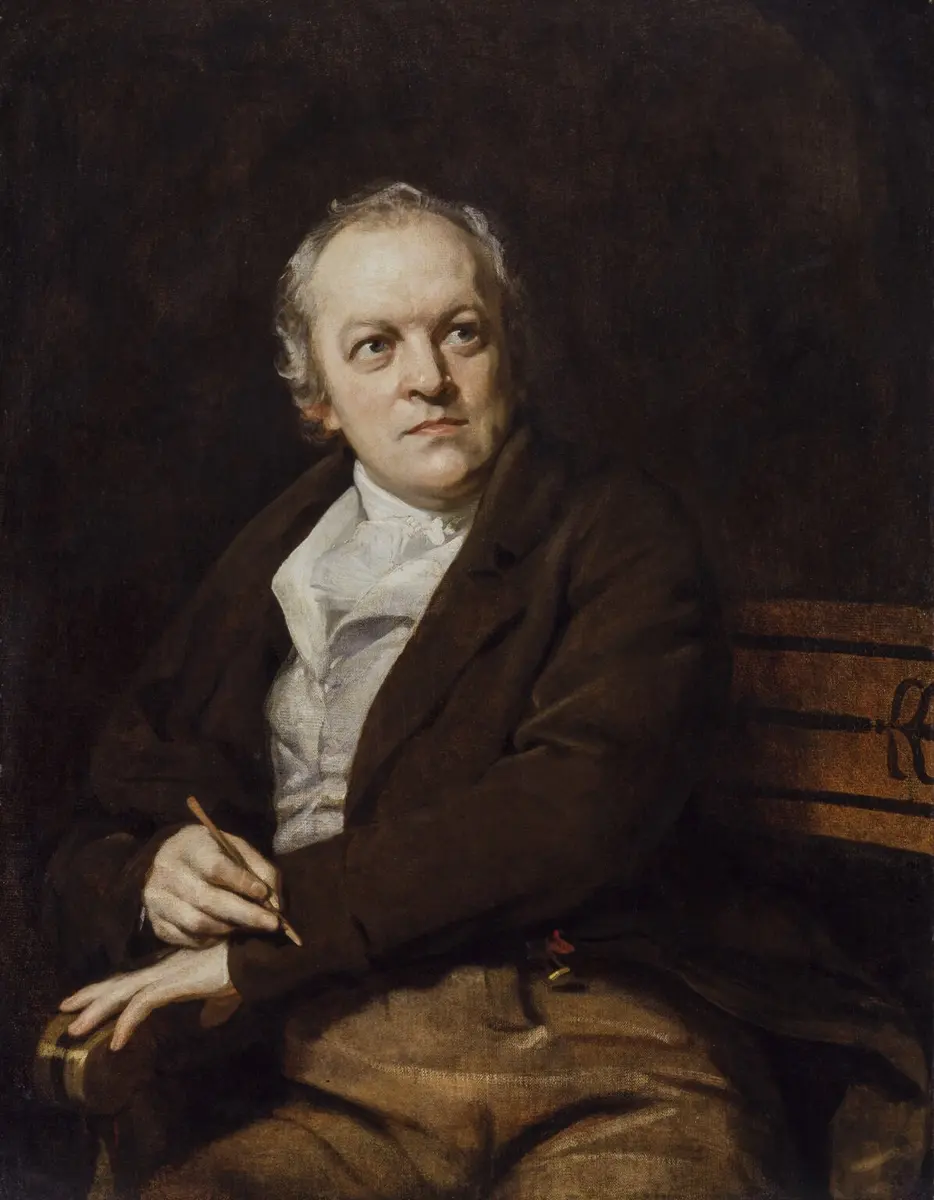
What it says. The poem is a string of questions, and every question expects the answer No.
- Verses 1–2. Can I see someone else’s pain and not feel sad? Can I see someone cry and not want to help? Can a father watch his child cry, or a mother hear her baby moan or be afraid, without feeling sorrow? The poet answers himself loudly: No, never!
- Verses 3–4. Then he asks about “he who smiles on all”: God, who looks kindly on everyone. Can he hear a small bird’s sadness, or the cries of babies, and not sit beside the nest pouring love into them, and not sit by the cradle crying with the baby? Can he not stay day and night, wiping all our tears away? Again: No, never!
The idea is that feeling another’s sorrow is part of loving, and it isn’t weakness: a good parent, and God too in Blake’s poem, can never see someone suffering without sharing it.
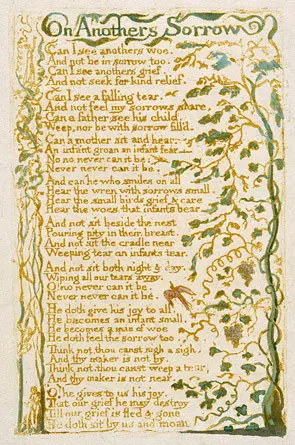
How it sounds. Each pair of lines rhymes (woe and too nearly, grief and relief, child and filled, nest and breast). The lines are short and beat like a song, with questions piling on questions, so by the end you feel the poet’s No! coming before he says it. The refrain, Never, never can it be!, comes twice, like the chorus of a song.
| Word | Meaning |
|---|---|
| woe | great sadness |
| grief | deep sorrow, especially when someone dies |
| relief | the ending of pain or worry |
| weep | to cry |
| infant | a baby |
| groan | to make a low sound of pain |
| wren | a tiny brown bird |
| pity | sadness for someone who is suffering |
| cradle | a small bed for a baby |
A. Rhyming words
Sort the poem’s rhyming words into the right sound.
Complete the table with rhyming words from the poem.
Answer
B. Answer the questions
What can a father and a mother not do?
A model answer
How does a bird show pity on its baby?
A model answer
Project work
Extra bit: the twelve tenses
English has three times (present, past, future) and four aspects for each: simple, continuous, perfect and perfect continuous. Three times four makes twelve.
| Present | Past | Future | |
|---|---|---|---|
| Simple | I cook dinner every day. | I cooked dinner yesterday. | I will cook dinner tomorrow. |
| Continuous | I am cooking now. | I was cooking when you called. | I will be cooking at seven tonight. |
| Perfect | I have cooked the rice. | I had cooked the rice before Dad came home. | I will have cooked it by eight. |
| Perfect continuous | I have been cooking for an hour. | I had been cooking for an hour when the power went off. | I will have been cooking for two hours by then. |
What each one does:
- Simple: a fact, a habit, or a finished action: I cook, I cooked, I will cook.
- Continuous (be + -ing): an action in progress at a time: I am / was / will be cooking.
- Perfect (have + past participle): an action finished before a time: I have / had / will have cooked.
- Perfect continuous (have been + -ing): an action going on for a stretch of time up to a time: I have / had / will have been cooking for an hour.
“By next Saturday, Dawa ___ the whole book.” Which fits?
Pick an answer to see why.
“When the bus came, we ___ for forty minutes.” Which fits?
Pick an answer to see why.
“Look! It ___ outside.” Which fits?
Pick an answer to see why.
Exercise
Practice the whole unit. Try each one, then open the answer.
Write two sentences about what you can do, and two about what you can’t do.
Model answers
Correct the mistakes.
- a.She can sings well.
- b.Can you to swim?
- c.He cans speak Newari.
- d.I can not to come today.
Answer
Fill the gaps with because, since, as or because of.
- a.The flight was late ……… the fog.
- b.……… it was raining, we stayed inside.
- c.Rojina was happy ……… she passed the test.
- d.The road was closed ……… a landslide.
Answer
Join each pair with the word given.
- a.We couldn’t see the mountains. It was cloudy. (because)
- b.Our team trained hard. We won the cup. (since)
- c.The match was canceled. The heavy rain. (because of)
Answer
Name the tense of the verb in bold.
- a.She has lived here for ten years.
- b.They were playing when it started to rain.
- c.We will be traveling at this time tomorrow.
- d.He had finished before we arrived.
Answer
Why did the baby quail’s parents fly away, and what did the quail do then? Write three or four sentences.
A model answer
Printable PDFs
- Study notes 2 pages
- Harder practice questions 2 pages Answer key
Practice every question in the book, and keep track of the ones you miss →
A companion to your textbook, not a replacement for it: study from the book your school uses, and where the two differ, follow your teacher. Found a mistake? Please tell us.