
The word pen comes from the Latin word for a feather. The word vegan was cut out of the word vegetarian. And on one cold night, a boy at a bus shelter looked up from his phone and saw that a stranger had moved closer. All three are in this unit, and all three are about the same thing: what came first, what came next, and how to tell it.
This unit is about narrating a sequence of events: telling what happened, in an order your listener can follow. You will read how one writer became a vegan, and how the pen changed from a cut reed to a ballpoint. You will find the silent letters in debt and knee, use the three past tenses to move a story forward and back, put a jumbled story in order, write a story from pictures and a few paragraphs of history, and meet blends, the words made from pieces of other words, like brunch.
Getting started: tell the story
The unit opens with nine small pictures in three rows, and they tell one story. Here they are in words:
- A green field by a stream.
- A brown dog runs across the field with a bone in its mouth.
- An old wooden bridge over the water.
- The bridge and the stream seen from farther off.
- The dog walks onto the bridge with the bone.
- The water under the bridge, with a pale bone shining in it.
- The dog looks down from the bridge. It thinks: Another dog with a bone. I want that too.
- The bone falls toward the water.
- The dog stands on the bridge with nothing, looking sad.
Take turns to tell the story to each other.
A model story
Look at what makes this easy to follow. It has a time at the start (one afternoon), small words that carry us on (soon, while, now), and all of it is in the past. That is what this unit is about.
Reading I: Why I Became a Vegan
Before you read
What food do you like the most?
A model answer
Do you prefer veg or non-veg food items? Why?
A model answer
What kind of text it is
This text is a personal account: a true story from a person’s own life, told to make a point. It comes from an article by Jessica Sharp on the website GenTwenty. She writes as I, in everyday language, and she is telling us how she changed the way she eats and why. Watch how she moves through her life. That is the skill of this unit.
The text, part by part
Before. The writer says she never thought about her weight as a girl. In middle and high school she cheered: she was a cheerleader, one of the students who shout and dance to support the school’s sports teams. At college she didn’t worry about it either. After college, though, she began to put on weight. She ate in restaurants more, and work made her stressed more consistently (all the time, not just now and then). One day she looked up and wasn’t happy.
The Whole30. She has also come to know her own body better, she says, and this began with the Whole30, a 30-day diet that cuts out many foods. Afterwards she could tell when her body didn’t feel good, and she wasn’t thrilled (very pleased) about how often that was.
The podcast. At the same time she began to listen to a podcast called Almost 30, which made her think about a holistic lifestyle: looking after the whole of yourself, not one part. She has already changed to a natural deodorant (a product that stops the body’s smell), and she calls that change a transition, a move from one thing to another. She pictures all these changes as branches of one tree, and the last branch is becoming a vegan.
The family. Her aunt and uncle started it in her family. Her father came next, and she came after him.
Her reason. People have many reasons, she says. Hers was to take out, or eliminate, the foods her body doesn’t like, and to eat what makes her feel good.
What it means for her. A vegan eats nothing that comes from an animal. For her that means no dairy (milk and the things made from it), no eggs and no meat. But she will eat ordinary butter in a restaurant, and she eats honey. She says this on purpose: to her, a vegan doesn’t have to be strict, and a change of lifestyle should be whatever works for that person.
Was it hard? People often ask. She thought it would be, but she was surprised at how easy it has been.
What changed. The Whole30 taught her that dairy doesn’t suit her. She used to go to bed with a stomach ache and thought that was normal. Now she rarely has a stomach ache or a headache, she has more energy, and she has less acid reflux (when acid from the stomach rises into the throat).
Protein and plenty. She gets protein from beans and chickpeas. There is an abundance (a great many) of vegetables to incorporate into her meals (to make them part of what she eats), and there are other choices for people’s favorite foods, so you don’t have to give them up.
How she moves through time
The writer doesn’t go straight from start to end. She jumps back and forward, and small phrases tell us where we are:
| Words from the text | Where they take us |
|---|---|
| growing up, in middle and high school | her childhood |
| in college, post-college | her college years and after |
| one day | the moment things changed |
| following those 30 days | just after the Whole30 |
| during this same time | beside it, at the same time |
| before those 30 days | back to before the diet |
| now | today |
So a good narrative doesn’t need a list of dates. It needs a few of these signposts, in the right places.
Who started the trend of being vegan in the writer’s family?
Pick an answer to see why.
What does “the last branch of that holistic tree” mean?
Pick an answer to see why.
Words from the text
Words linked here open in English Vocabulary, where you can see an example and practice them in the word game. The meanings below are the ones the words have in this text.
| Word | Meaning here |
|---|---|
| cheered | shouted to support a team; was a cheerleader |
| consistently | always in the same way |
| Whole30 | a 30-day diet that cuts out sugar, grains, dairy and more |
| thrilled | very pleased and excited |
| holistic | caring for the whole of something, not just one part |
| transition | a change from one thing to another |
| deodorant | a product that stops the smell of sweat |
| eliminating | removing; getting rid of |
| dairy | milk and the foods made from it |
| reflux | stomach acid coming back up into the throat |
| abundance | a very large amount |
| incorporate | to include something as a part |
A. Which meaning fits?
Each word has two meanings. Decide which one is the meaning in this text. Go back and read the sentence the word is in.
a. cheered
Pick an answer to see why.
b. consistently
Pick an answer to see why.
c. eliminating
Pick an answer to see why.
d. dairy
Pick an answer to see why.
e. incorporate
Pick an answer to see why.
B. Fill in the gaps
Use the above words to fill in the gaps below.
- a.Despite our requests, the manager ……… denied the changes we wanted to bring.
- b.The plan for ……… the risk of nuclear weapons is still lingering.
- c.The audience clapped and ……… when she stood up to speak.
- d.These designs ……… the best features of our earlier models.
- e.Many people find it difficult to digest milk, and get a stomachache if they eat ……… products.
Answer
C. True or false?
Decide whether the given sentences are True or False.
- a.The writer started gaining weight when she was at college.
- b.She listened to only 30 podcasts that guided her to live a holistic life.
- c.She became vegan because she did not like non-veg food.
- d.Cutting those foods out of her diet was an easy task for the writer.
- e.According to the writer, there is food outside of animals from which she can get proteins.
Answer
D. Answer the questions
Who are vegans?
Answer
When did the writer start gaining the weight?
Answer
Who first started to become vegan in the writer’s family?
Answer
Mention the reason for which the writer became a vegan.
Answer
What was the impact of Whole30 on the writer?
Answer
Do you think all the nutrients needed for our body can be achieved from non-veg food? How?
A model answer
E. Food and your own story
Has any incident caused you to adopt or avoid eating a particular food item? Discuss.
A model answer
Pronunciation: silent letters
A silent letter is a letter that is written but not said. English has many of them, because spelling and speech have grown apart.
| Word | Silent letter | Say it | Dictionary |
|---|---|---|---|
| debt | b | DET | /det/ |
| muscle | c | MUS-ul | /ˈmʌsl/ |
| ledger | d | LEJ-er | /ˈledʒə(r)/ |
| comb | b | KOHM | /kəʊm/ |
| design | g | dih-ZINE | /dɪˈzaɪn/ |
| psychology | p | sy-KOL-uh-jee | /saɪˈkɒlədʒi/ |
| knee | k | NEE | /niː/ |
| heir | h | AIR | /eə(r)/ |
| calf | l | KAHF | /kɑːf/ |
| autumn | n | AW-tum | /ˈɔːtəm/ |
| scene | c | SEEN | /siːn/ |
| foreign | g | FOR-in | /ˈfɒrən/ |
In ledger, the letters d and g together make one sound, /dʒ/, so you hear no separate d. In American English, calf has the vowel of cat.
Why are the letters there at all? There are two main reasons.
- The sound was lost, and the spelling stayed. The k in knee was once said, and it still was in the 1500s. It dropped out of educated speech in about the 1600s. German’s word for a knee, Knie, still has its k.
- Scholars put the letter in. English took dette from French with no b. Later, writers added a b to make it look like the Latin debitum. Everyday speech never took it up.
Here is a trick: a silent letter sometimes wakes up in a word of the same family. You can’t hear the c in muscle, but you can in muscular.
Which word has a silent letter at the start?
Pick an answer to see why.
Speaking: a story in pictures
When you tell a story from pictures, don’t describe each picture (In this picture there is a boy). Tell what happened, as if you had been there. Say who it was and where, go through the steps with time words, and finish with how it ended.
The pictures show four moments:
- A boy in a red sweater bends down on a path in a forest and picks up a small bird.
- He puts the bird in a tall cage on a table.
- He stands at his window. Outside, wild birds are sitting in the branches and flying about, and the bird in the cage is behind him.
- He opens the cage and the window, and holds up his hands to let the bird fly away.
Study the pictures. Tell the story in groups.
A model story
Grammar I: the past tenses in a story
You met the three past tenses in Unit 8. Now we use them for a bigger job. In a story, each tense does its own work.
| Tense | Its job in a story | Example |
|---|---|---|
| Past simple | moves the story forward, step by step | Bibisha shut the gate and ran to the road. |
| Past continuous | paints the background: what was going on around the step | Rain was falling, and the road was shining. |
| Past perfect | steps back to something that came before | She had left her books at home. |
Most of a story is in the past simple. The other two are there to fill it out.
Told order and real order
You can tell a story in the order it happened. But a good storyteller often starts in the middle, where things get exciting, and looks back later. As soon as you do that, the things that came before your starting point go into the past perfect.
So the past perfect isn’t a “more past” tense. It only says: this came before the moment I am telling you about. Once the time is clear, you can often go back to the past simple.
Words that give the order
| Words | What they do | Example |
|---|---|---|
| first, then, next, after that, later, finally | carry on to the next step | First we boiled the water. Then we added the tea. |
| when, as soon as | one step comes straight after another | As soon as the bell rang, we ran out. |
| while | something long is going on | While I was sweeping, the phone rang. |
| before, after, by the time | show which of two came first | By the time we got there, the shop had closed. |
| suddenly, all of a sudden | something cuts in | All of a sudden, the lights went out. |
“Pema ……… to the shop when she remembered her purse.” Which fits best?
Pick an answer to see why.
Read this: By the time the doctor came, the fever had gone. Which happened first?
Pick an answer to see why.
Which sentence moves a story forward?
Pick an answer to see why.
A. Find the tenses
Underline the verbs in the following sentences and identify their tenses. One example has been given.
Example: The incident changed my life completely. (past simple)
- a.We had a cow at our home.
- b.I felt as if I was taking away somebody else’s right.
- c.By the time my mother came to me, I had already drunk all the milk.
- d.My mother was serving food for my father when he started talking with me.
- e.Perhaps, I was not prepared to share the real reason.
Answer
B. About you
Answer these questions in complete sentences.
- a.What did you eat yesterday evening?
- b.What were you doing when the teacher came into the classroom this morning?
- c.What had your mother cooked when you reached home yesterday?
- d.What did you see as soon as you opened the door this morning?
- e.Had the class already started when you reached school yesterday?
Model answers
C. The correct form
Complete the sentences with the correct form of the verbs given in the brackets.
- a.The car ……… (hit) the tree while the driver was talking on the phone.
- b.The bus ……… (leave) the stop before I reached there.
- c.A boy ……… (dig) the field when his father saw him.
- d.When I woke up, the birds ……… (chirp).
- e.I ……… (not/do) anything wrong, but my friend still shouted at me.
- f.My father ……… (order) the food before I reached home.
- g.The girl ……… (speak) quite fast. So, we didn’t understand her.
- h.The customers ……… (order) the food at the counter before the waiter came to their table.
- i.What ……… (you/do) when I called you yesterday evening?
Answer
Listening: a night at the bus stop
A young man remembers something that happened to him when he was 17. He tells it in order, with the past tenses you have just practiced. Read the tasks in B and C first, then listen, as many times as you need. The recording is CDC’s; the answers are hidden under the questions.
Words to know: gym (a place for exercise), bus shelter (a small roofed place to wait for a bus), layers (clothes worn one over another), stare (to look at someone for a long time), delayed (late), relieved (glad that something bad is over).
A. Before you listen
The picture shows a dark bus shelter at night, with snow falling. A person in dark, heavy clothes with long hair sits at one end of the bench, and a younger man with a bag sits at the other end.
Who do you think these people are?
A model answer
Where are they?
A model answer
B. Complete the sentences
Listen to the audio and complete the sentences. Use one word only.
- a.The incident happened when the speaker was going to ……… .
- b.He did not call his ……… because they were out for the evening.
- c.Instead of calling his parents or a taxi, he decided to ……… for a bus in the bus shelter.
- d.He got his phone out and listened to some ……… .
- e.He saw a ……… guy dressed in thick layers of clothing, walking slowly towards him.
Answer
C. True or false?
Listen to the audio again and write whether these statements are True or False.
- a.The man seemed average and smart.
- b.The bus arrived on its scheduled time.
- c.The man grabbed the speaker’s bag.
- d.The speaker ran away to another bus stop.
- e.The man followed the speaker to another bus stop too.
Answer
D. What would you do?
What would you do if you were in the speaker’s situation? Tell your friends.
A model answer
Writing I: putting a story in order
What holds sentences together
Sentences in a story aren’t like beads you can put on a string in any order. Each one has hooks in it that catch the one before.
- Time words: once upon a time can only start a story; later needs something earlier; finally comes near the end.
- Pointing words: he, it, them, this need something to point back to. This session can’t come before we know about a session.
- Growing steps: a tiny plant comes before a slightly bigger one.
A. Arrange the sentences
Arrange the sentences in order to make a story.
- a.Now he said, “Bad habits are like them. It is easy to pull them out when they are young but it is impossible to uproot them later.”
- b.Once upon a time, a rich businessman asked a wise man to wean his son away from his bad habits.
- c.And he had to struggle for it.
- d.The man took his son to a garden and asked him to pull out a tiny plant.
- e.This session changed the son’s life completely.
- f.He grasped the trunk but it was impossible for him.
- g.Later he asked him to uproot a slightly bigger plant.
- h.Finally he asked him to uproot a guava tree.
- i.The boy held the plant between his thumb and forefinger and pulled it out easily.
Answer
Words: to wean someone away from something is to get them slowly to stop it; to uproot is to pull out a plant with its roots; to grasp is to hold tightly; your forefinger is the finger next to your thumb.
B. A story from pictures
Four pictures show the same street, with a traffic light and a zebra crossing.
- A boy in an orange shirt walks along eating a banana.
- He walks on, smiling. The banana peel is lying on the ground behind him.
- A boy in a red shirt and cap comes along, whistling, with his hands behind him. He doesn’t see the peel just in front of his foot.
- His feet fly up, the peel goes into the air, his cap falls off, and he lands on his head.
Before you write, make a short plan.
| Plan | Your notes |
|---|---|
| Who and where? | a little boy, Sanam, on a city street |
| What did he do? | ate a banana and dropped the peel |
| What happened next? | another boy stepped on it |
| How did it end? | he fell; what should Sanam have done? |
Study the pictures and write a story based on them. You can start in the following way.
Once upon a time, there was a little boy named Sanam in a city. ………
A model story
Reading II: The History of Pens
Before you read
What are the different types of pens you know?
A model answer
What type of pen do you use for your everyday writing?
A model answer
What kind of text it is
This text is a short history, adapted from an article on historyofyesterday.com. It tells a long story in order, and every paragraph brings a new pen. Look for two things: the words that tell you when, and the problem with each pen, because that is what leads to the next one.
The text, part by part
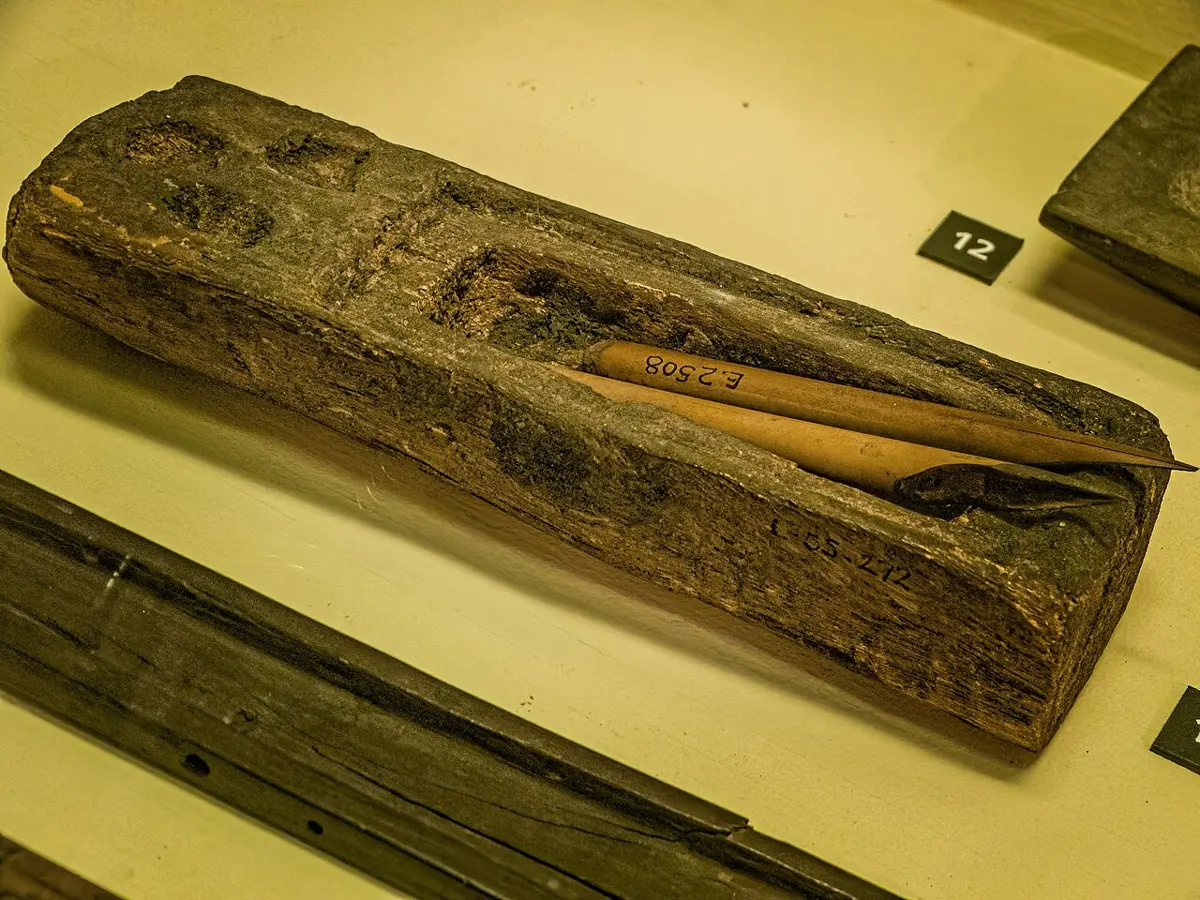
The reed pen. People needed a pen once they had papyrus, the paper-like sheets the Egyptians made from a water plant. The Egyptians made a reed pen from hollow (empty inside) marsh grass, especially bamboo, the text says. They sharpened one end of the tube into a nib and filled the tube with ink. Squeezing the pen made the ink flow.
The quill pen. After centuries of reeds, says the writer, the quill was created in Seville, Spain. It was made from the feathers of birds such as swans, turkeys and geese. The feathers were dried to discard (get rid of) oils that would react with the ink, and the end was cut with a knife to make the tip. You dipped it in ink, which rose into the shaft, the long hollow stem of the feather, and stayed there as a reservoir (a store). Quills were durable (they lasted), but they had to be sharpened again and again.
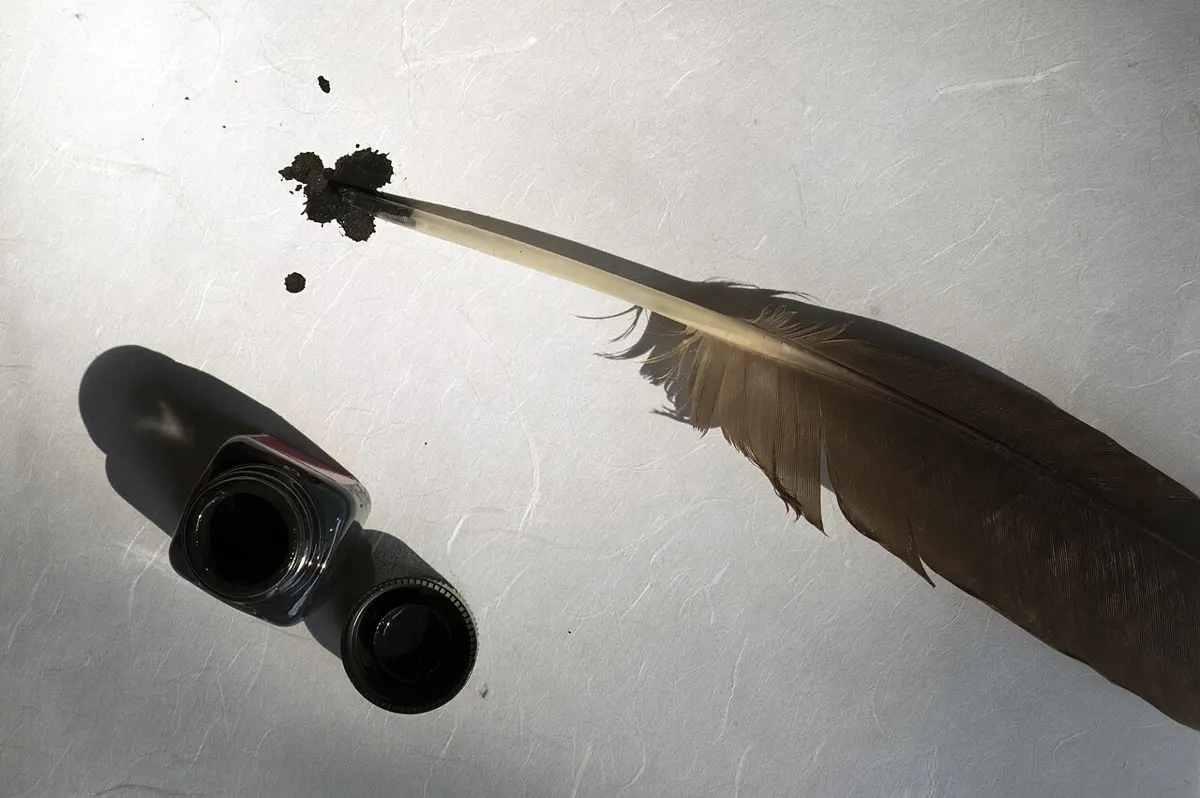
What the quill changed. Before it, says the writer, people wrote in capital letters. The quill was smoother and faster, so more decorative and quicker writing grew up, with small letters too. It stayed in use for nearly twelve centuries.
The steel-point pen. John Mitchell of Birmingham, England, began making steel-point pens, or dip pens, by machine on a large scale. They worked as quills did but were much cheaper and sturdier (stronger). As writing got faster, though, stopping to dip them became more and more annoying.
The fountain pen. So came the fountain pen. Petrache Poenaru, a Romanian inventor, patented one in 1827: he got the legal right to his invention. It had an ink barrel, so you didn’t have to keep dipping. In 1884 the American Lewis Edson Waterman designed and patented a fountain pen with a three-channel ink feed. The ink flowed smoothly, and the pen became truly transportable (easy to carry). In the 1900s came replaceable and refillable ink cartridges, and pens of plastic, metal and wood.
The first ballpoint. The American John J. Loud patented the earliest design for a ballpoint pen in 1888, but he could never get the ink to flow well.
Bíró’s ballpoint. Decades later, a Hungarian journalist living in Argentina took up the problem. László Bíró knew the annoyance of ink smudging on paper (making a dirty mark). He used a quick-drying ink and a small metal ball that turned at the tip. The ball stopped the ink from drying in the pen, and it spread the ink smoothly. László and his brother György, a chemist, patented this design in 1943.
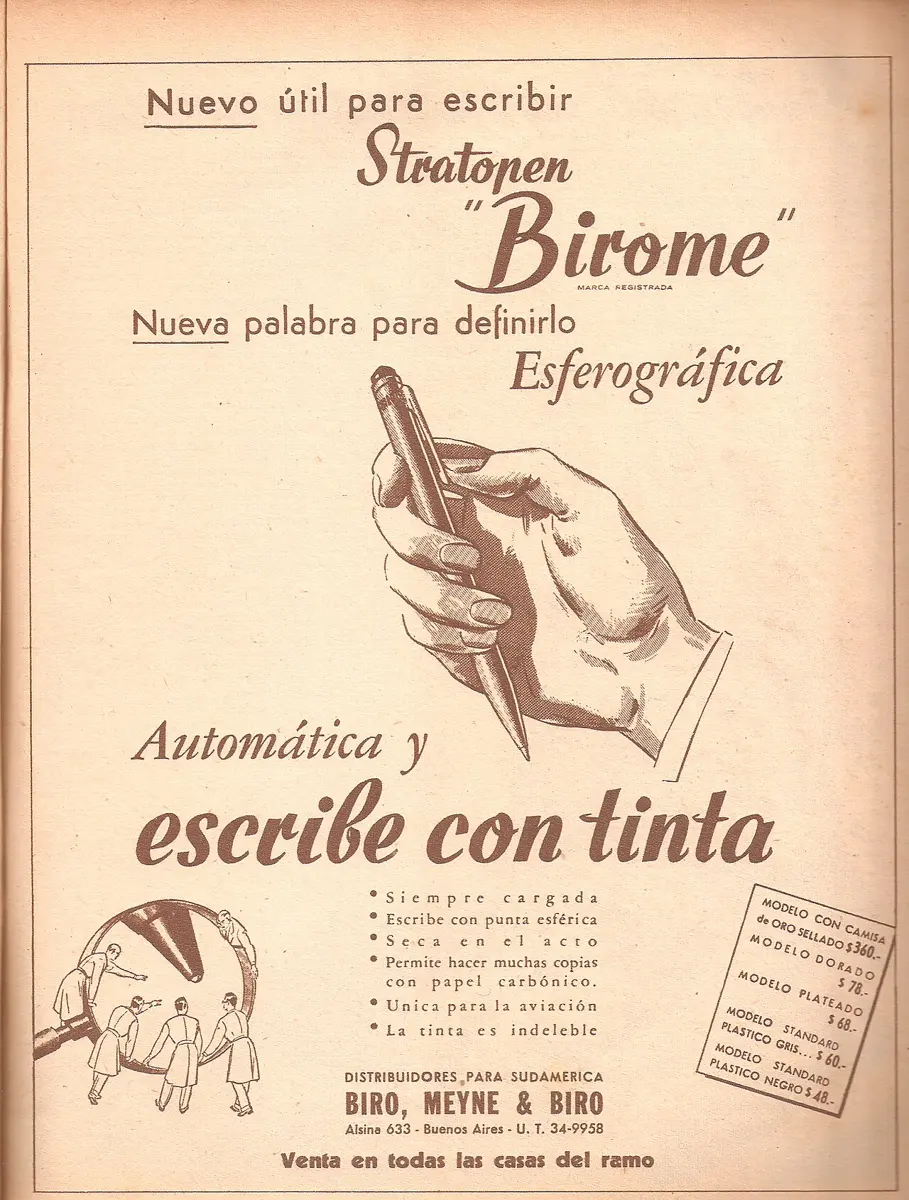
Biromes. These pens were called biromes, and they were the first commercial success among ballpoints: the first to sell well. Marcel Bich bought the patent (in 1945, says the writer), and his company has sold over 100 billion ballpoint pens around the world.
A turning point. The ballpoint was a turning point in the evolution (slow development) of pens. It lasted well, it was more convenient (easy to use), and it could write on cardboard and wood, under water and high in the air.
Today. With the advent (the arrival) of new technology, phones, tablets and laptops are taking the place of pens, and fewer pens are used each year. Even so, says the writer, the pen will be remembered as one of the most important inventions in human history.
Now look at how each pen’s problem led to the next. This is what turns a list of facts into a story.
| Pen | What was good | What was the trouble |
|---|---|---|
| Reed | Hollow, so it could hold ink | Had to be filled and squeezed |
| Quill | Smoother and faster | Had to be sharpened often |
| Steel-point | Cheap and sturdy, made by machine | Had to be dipped again and again |
| Fountain | Carried its own ink | Its ink dried slowly and could smudge |
| Ballpoint | Quick-drying ink, no smudges, writes on many surfaces | Now being replaced by screens |
Why did people move from steel-point pens to fountain pens?
Pick an answer to see why.
What was the small metal ball in Bíró’s pen for?
Pick an answer to see why.
Words from the text
| Word | Meaning here |
|---|---|
| papyrus | a paper-like material made from a water plant |
| reed | a tall, hollow grass that grows in wet places |
| hollow | having an empty space inside |
| squeezed | pressed hard |
| quill | a pen made from a large feather |
| discard | to get rid of |
| shaft | the long, narrow stem of a feather |
| reservoir | a place where a liquid is stored |
| durable | able to last a long time |
| steel-point | having a tip of steel |
| sturdier | stronger; less easily damaged |
| patented | got the legal right to an invention |
| barrel | the long tube of a pen that holds the ink |
| transportable | easy to carry from place to place |
| cartridges | small closed tubes of ink that you can change |
| annoyance | the feeling of being a little angry |
| smudging | making a dirty mark by rubbing |
| biromes | the first ballpoint pens to sell well |
| evolution | slow, steady development |
| convenient | easy and useful |
| advent | the arrival of something important |
A. The pens in a table
Find the different types of pens mentioned in the text and write their details as mentioned in the example below.
Example: S.N. 1, Reed pen, when humans developed papyrus, Egyptians
Answer
B. Match
Match the following words with their correct meanings.
- a.hollow
- b.discard
- c.shaft
- d.sturdy
- e.patent
- f.smudge
- g.evolution
- h.advent
- i.strong and not easily damaged
- ii.to obtain a right for an invention or a process
- iii.having a hole or empty space inside
- iv.slow steady development of something
- v.the long narrow part of an arrow, hammer, etc.
- vi.the coming of an important event, person, invention, etc.
- vii.to get rid of something that you no longer want or need
- viii.to make a dirty mark on a surface
Answer
C. Answer the questions
How were the reed pens made?
Answer
What were the quill pens made of?
Answer
Mention the changes brought by quill pens in writing.
Answer
How were steel-point pens different from quill pens?
Answer
What were the variations of the fountain pen?
Answer
Who designed the ball pens for the first time?
Answer
Describe the features of biromes.
Answer
Do you think the use of pens will decline in the days to come? Why?
A model answer
D. A timeline of pens
Prepare a timeline illustrating the historical development of pens.
A model timeline
Writing II: a historical event
Writing about history is narrating, with one difference: everything must be true, so find it in a book or on a reliable website first. Here is how to build it.
- Choose one event and find the facts: when, where, who, what happened, what came of it.
- Paragraph 1 says what the event was, and tells it in order, using dates and time words.
- Paragraph 2 says what came of it, and why it matters.
- Use the past simple for the steps, the past continuous for background, and the past perfect for what came before. Use your own words.
Write a couple of paragraphs about one of the historical events you know.
A model answer
Which sentence is the best opening for paragraphs on a historical event?
Pick an answer to see why.
Project work
Extra bit: blending
Blending is a word-formation process, a way of making a new word: parts of two or more words are joined, and the new word has something of the meaning of both. A blend is different from a compound like blackboard, which keeps both words whole. In a blend, at least one word loses a piece.
| Word | Word | New word (blend) |
|---|---|---|
| breakfast | lunch | brunch |
| motor | hotels | motels |
| information | entertainment | infotainment |
| biography | picture | biopic |
| romantic | comedy | romcom |
| documentary | drama | docudrama |
| emotion | icon | emoticon |
| friend | enemy | frenemy |
| motor | pedal | moped |
| sports | broadcast | sportscast |
| stay | vacation | staycation |
| work | alcoholic | workaholic |
| camera | recorder | camcorder |
| video | blog | vlog |
| hungry | angry | hangry |
| web | seminar | webinar |
Which word is a blend?
Pick an answer to see why.
A frenemy is:
Pick an answer to see why.
Exercise
Practice on this unit in the style of the final exam. Try each one as in the exam, then open the answer.
Read “Why I Became a Vegan” again and write whether the following statements are True or False.
- a.The writer thought a lot about her weight when she was at school.
- b.Her father became a vegan before she did.
- c.She eats honey.
- d.She found it very difficult to give up dairy.
- e.She gets protein from beans and chickpeas.
Answer
Read “The History of Pens” again and complete the sentences with the correct words.
- a.The Egyptians created the reed pen to write on ……… .
- b.Quills were used for nearly ……… centuries.
- c.John Mitchell came from ……… , England.
- d.Lewis Edson Waterman patented his fountain pen in ……… .
- e.László Bíró worked as a ……… .
Answer
Read the story and write whether the following statements are True or False.
Last winter, Ishwori’s family was traveling to Ilam by night bus. Ishwori had packed her school bag herself, and she had forgotten her jacket. At about midnight, while everyone was sleeping, the bus stopped suddenly. A tree had fallen across the road. The driver and some passengers got out and cut it with a borrowed saw, and Ishwori’s father gave her his own coat. By the time they reached Ilam, the sun had risen. Ishwori never forgot her jacket again.
- a.They traveled to Ilam during the day.
- b.Ishwori’s mother packed her bag.
- c.The bus stopped because of a tree.
- d.Ishwori’s father gave her a coat.
- e.They reached Ilam before sunrise.
Answer
Do as indicated.
- a.Amisha locked the door. (Change into the past perfect, using before she left.)
- b.The children were playing in the yard. (Change into the negative.)
- c.Rakesh had finished his work. (Change into a question.)
- d.Ganga swept the floor. (Change into the past continuous, using when the guests arrived.)
- e.The bus left on time. (Change into a question.)
Answer
Choose and copy the best answer for the blanks.
- a.……… I was reading, the lights went out. (While, By the time, Until)
- b.He ate his lunch ……… he went to the field. (by, before, during)
- c.The phone rang ……… she was cooking. (during, while, by)
- d.……… the rain stopped, the river had risen. (Finally, Then, By the time)
- e.I had a bath, and ……… I went to bed. (then, while, before)
Answer
Identify ten errors in the given paragraph. Rewrite the paragraph by correcting the errors.
last tuesday nabin lost his pen in the school bus he looked under every seat but he couldnt find it later his friend saw it in a bag
Answer
Write a story with the help of the given clues. Give it a suitable title.
a girl finds a hurt kitten on the road ………. she takes it home ………. her mother says no ………. she feeds it in secret ………. one night a snake comes into the kitchen ………. the kitten cries and wakes the family ………. her mother lets it stay
A plan
Write an account of an important day in your school’s or your town’s history, in about 150 words. Say what happened, when and where, who was there, and why it matters.
A plan
Printable PDFs
- Study notes 3 pages
- Harder practice questions 2 pages Answer key
Practice every question in the book, and keep track of the ones you miss →
A companion to your textbook, not a replacement for it: study from the book your school uses, and where the two differ, follow your teacher. Found a mistake? Please tell us.