
What did you do yesterday after school? To tell anyone, you need the past: I walked home. I ate dal bhat. I was reading when the lights went out.
This unit is about narrating past events. To narrate is to tell what happened, in order, like a story. You will read about an old farmer who did a very funny thing at a bank. You will learn the past simple (walked, ate) and a new tense, the past continuous (was reading). And you will put a story back in order.
Getting started
A. Sumina’s day
The unit opens with a smiling girl, Sumina, and four clocks. Each clock shows a time from yesterday, with what Sumina did then written under it:
- left the school
- reached home and played
- took a meal
- went to bed
To tell what she did, read each clock. Then say the time with at, and what she did: At 3:45, Sumina left school.
Look at the pictures of the clocks. They show what Sumina did at different times yesterday. Use the phrases to explain what she did.
Model answers
Look at the verbs: left, reached, played, took, went. They all tell about yesterday, a finished time. They are in the past simple.
B. Listen and sing
This song is a little joke. A child says, I got a new game for my brother. That sounds kind: he bought his brother a present. But no! He traded his brother. He gave his brother away and got a game in return.
His mum and dad were upset. They told him never to do something he would be sorry for later. He nodded and said sorry. Then he sat back, smiled and played his new game. He thought it was an excellent trade (a swap).
Underline all the past forms of the verbs in the song. Write their present forms, as in the example (got → get).
Hint
Answer
Some past forms just add -ed or -d: nod → nodded, smile → smiled, play → played. These are regular verbs. Others change in their own way: get → got, sit → sat, tell → told. These are irregular verbs. There is no rule for them: you learn them by heart.
Which past form is regular?
Pick an answer to see why.
Reading I: A Villager and his Money
Before you read
The picture shows a woman sitting at a counter. Behind it, a man in glasses holds out some money to her.
Where do you think they are?
A model answer
Why do people go there?
A model answer
What do you think the man is holding in his hand?
A model answer
The story, part by part
The careful farmer. An old farmer lived in a village. He had a lot of money, and he kept it at home, under his mattress (the soft, thick part of a bed). He was very careful with it. Every night he checked that all the doors were locked. But one evening he was too tired, so he asked his wife to lock up.
The open door. His wife loved chatting with her neighbor. That night, as usual, she went next door for a long talk. When she got back, she went straight to bed. She forgot to lock the back door.
The thief. In the night, a thief walked in through that back door without a sound. On his way to the bedroom, he knocked over a pot. The farmer woke, sat up and shouted, “Who’s there?” The thief was frightened (very scared). He ran away with nothing.
To the bank. In the morning, the farmer asked his wife why she hadn’t locked the door. She said sorry. Then she told him, as she had many times before, to put his money in a bank. So the next day he took it to a bank in the city. He counted it and gave it to the clerk. The clerk gave him a receipt (a paper that shows the money was paid in) and a cheque book.
The joke. A year later, the farmer came back and asked for his money. He counted it carefully. Then he handed it straight back to the clerk and said he didn’t need it! The surprised clerk asked why he took it out at all. The farmer said he only wanted to make sure the bank hadn’t spent it.
The farmer thinks a bank keeps each person’s notes in a box. That is why the ending is funny.
Why did the farmer take his money out of the bank?
Pick an answer to see why.
Words from the story
Words linked here open in English Vocabulary, where you can practice them in a game.
| Word | Meaning |
|---|---|
| mattress | the soft, thick part of a bed that you lie on |
| careful | thinking about what you do, so that nothing goes wrong |
| properly | in the right way |
| enjoy | to like doing something and have fun |
| knock | to hit something so it makes a sound; knock over: to hit something so it falls |
| frightened | very scared |
| count | to say numbers in order to find how many |
| receipt | a paper that shows you paid or gave money (say “ri-SEET”: the p is silent) |
A. Complete the sentences
Complete these sentences with the words: mattress, careful, properly, enjoy, knocked, frightened, count, receipt.
- a.Be ……… of what you say.
- b.Last night, someone ……… on my door.
- c.The thief was ……… of the old man.
- d.Do you need a ……… for these goods?
- e.Did you ……… the goats? There were five.
- f.The TV is not working ……… . I can’t hear the sound.
- g.Did you ……… your holiday?
- h.Please go and sleep on the ……… on the floor.
Answer
B. Who said it, and to whom?
“Why didn’t you lock it?”
Answer
“I am sorry.”
Answer
“Sir, will you please tell me why you took your money out of the bank, if you didn’t need it?”
Answer
“Thank you. Now, take it back again, please. I do not need it.”
Answer
C. True or false?
a. The elderly farmer didn’t have much money.
Pick an answer to see why.
b. The farmer’s wife forgot to lock the door.
Pick an answer to see why.
c. The thief stole lots of money from the bedroom.
Pick an answer to see why.
d. The bank was in the farmer’s village.
Pick an answer to see why.
e. The farmer counted his money and immediately returned it to the clerk.
Pick an answer to see why.
D. Answer the questions
Where did the elderly farmer keep his money?
Answer
When did the thief break into the house?
Answer
What did the thief knock over?
Answer
Why did the farmer take his money to the bank?
Answer
Why did the elderly farmer give the money back to the clerk?
Answer
E. Retell the story
Retell the story in your own words.
Hint
A model retelling
Pronunciation: -ed again
You met the three sounds of -ed in Unit 4. Here they are again, with words from the story.
| Sound | When | Words from the story |
|---|---|---|
| /t/ | the verb ends in a quiet sound (k, p, s, sh, ch, f) | locked, asked, walked |
| /d/ | the verb ends in a buzzing sound or a vowel | lived, enjoyed, replied, surprised |
| /ɪd/ (an extra beat) | the verb ends in t or d | counted, handed, wanted |
Which word has an extra beat at the end?
Pick an answer to see why.
Pronounce these words. Notice the sound you hear at the end: lived, locked, asked, enjoyed, walked, replied, counted, handed, surprised, wanted.
Answer
Grammar I: the past simple and the past continuous
A. The past simple in the story
These sentences are from the story. Complete them with the missing words.
- a.Once, there was an elderly farmer who ……… in a village.
- b.He ……… his wife to lock the doors.
- c.A thief ……… into the house.
- d.He ……… a pot over.
- e.Why ……… you lock it?
- f.He ……… it straight back to the clerk.
- g.The clerk ……… very surprised.
Answer
All these verbs are in the past simple. We use it for an action that happened and finished in the past: yesterday, last week, in 2020, a year later.
| Example | |
|---|---|
| Yes (positive) | He counted the money. She forgot the door. |
| No (negative) | He didn’t count it. (did not + the plain verb) |
| Question | Did he count it? Why did he take it out? |
The past simple is the same for everyone: I walked, she walked, they walked. No -s, ever.
How to spell the regular past:
- Most verbs add -ed: walk → walked, count → counted.
- A verb ending in e adds -d: live → lived, smile → smiled.
- A consonant + y changes to -ied: reply → replied, carry → carried. But a vowel + y keeps it: play → played, enjoy → enjoyed.
- A short verb ending in one vowel + one consonant doubles it: nod → nodded, stop → stopped.
B. What were they doing?
Study what different people were doing yesterday at this time.
- a.I was writing a letter.
- b.My father was talking over the phone.
- c.The teacher was teaching in Grade 4.
- d.My friend Dev was dancing at the wedding party.
These verbs are in the past continuous. It is made of was or were + the verb with -ing. It tells what was going on, in the middle, at a time in the past. It had started before, and it went on after.
| Example | |
|---|---|
| I, he, she, it, one name | I was writing. Dev was dancing. |
| you, we, they, two or more | They were singing. We were playing. |
| No | He wasn’t (was not) sleeping. |
| Question | Were you sleeping? What was she doing? |
Think of a photo taken yesterday at this time. The past continuous tells what each person was doing in the photo. The past simple tells a whole action, from start to end.
Draw it on a line of time. A long action that was going on is a bar. A short action, over at once, is a dot.
At 7 o’clock yesterday evening, my sister ___ her homework.
Pick an answer to see why.
Which sentence is correct?
Pick an answer to see why.
C. Rewrite the sentences
Rewrite the following sentences as in the example. Example: I wrote a story. → I was writing a story.
- a.I walked down the stairs.
- b.The teacher drove a car.
- c.She didn’t wear trousers.
- d.They didn’t dance.
- e.He played football.
- f.She sang a beautiful song.
- g.We drank the cold drinks.
- h.They had a party.
Hint
Answer
Writing I: the camel story
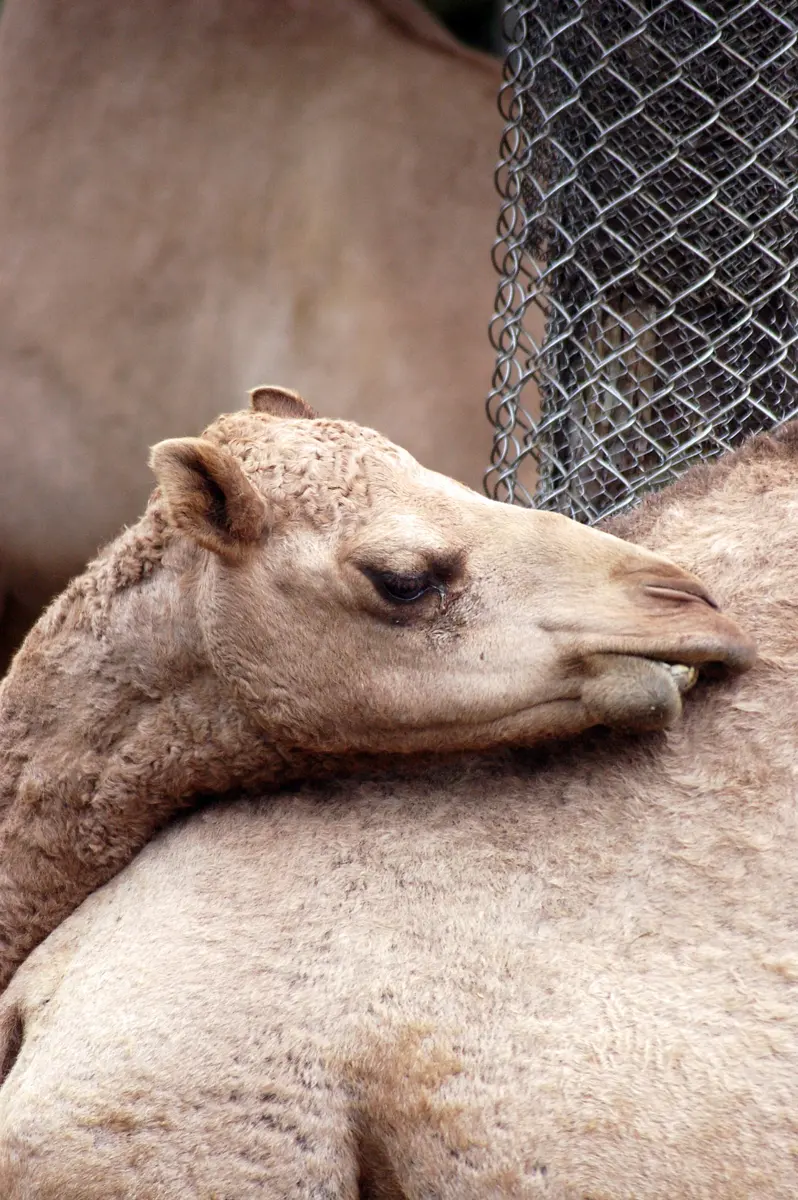
A baby camel asks its mother three questions: why they have humps, why their feet are round and wide, and why their eyelashes are long. Each answer says how that part helps in the desert. Then the baby asks the last question: so what are they doing in a zoo? The mother has no answer!
To finish a story like this, think about each verb. Was the action going on for a while (past continuous)? Or did it happen and finish (past simple)?
Complete the story. Use the past simple or past continuous forms of the verbs in the brackets.
One day, a camel and her baby ……… (talk). The baby ……… (ask), “Mother, why do we have humps?” The mother ……… (reply), “Our humps are for storing water so that we can survive in the desert.” “Oh,” ……… (say) the child, “and why do we have rounded feet, mother?” …
“To protect our eyes from the desert dust and sand. They are the protective covers for the eyes,” ……… (reply) the mother camel.
The baby camel ……… (think) for a while and ……… (say), “So we have humps … Then what are we doing in a zoo?”
Answer
Listening
A. Before you listen
The picture shows a boy and a girl in school uniform, standing and talking. The boy is pointing and telling something.
- a.Who do you think these people are?
- b.What do you think they are talking about?
Model answers
Now listen. Read the questions in B first, so you know what to listen for.
B. Answer in four words or fewer
Listen to the audio and answer the questions. Write a maximum of four words.
- a.Where did Levi go on his holiday?
- b.What happened to their car?
- c.What was the weather like there?
- d.How were the staff at the restaurant?
- e.What happened when Levi went shopping?
Answer
C. Your best trip
Describe one of your best holidays or trips to a friend.
A model answer
Speaking
A. Questions and answers about the past
Work in pairs. Match the questions with their answers, then take turns to ask and answer.
| Questions | Answers |
|---|---|
| a.Who taught you English in grade four? | i.I went to the market. |
| b.When did you do your homework? | ii.Miss Kalika taught us English in grade four. |
| c.What were you doing at this time yesterday? | iii.No, I didn’t. |
| d.Did you buy the tickets for the movie? | iv.I bought some chocolates. |
| e.Where did you go last Saturday? | v.I was studying English. |
| f.What did you buy for your younger brother? | vi.I did it this morning. |
Answer
A question word asks for something; the answer gives it: Who → a person, When → a time, Where → a place, What → a thing. A question with Did at the start is answered Yes, I did or No, I didn’t.
B. Ask and answer
To ask about the past, put did before the person, and keep the verb plain: Did you buy the tickets? What did you eat? But when who asks about the person who did it, there is no did: Who prepared food?
Take turns to ask questions and answer them, as in the example. Example: who/prepare food in the morning – my father → A: Who prepared food in the morning? B: My father prepared it.
- a.when/your father go to the USA – last year
- b.what/you buy yesterday – some fruits
- c.you/do your homework – yes
- d.Kriti/play chess last week – no
- e.what/you eat for breakfast yesterday – some bread
Answer
Which question is correct?
Pick an answer to see why.
Reading II: Melinda’s Snowman
Before you read
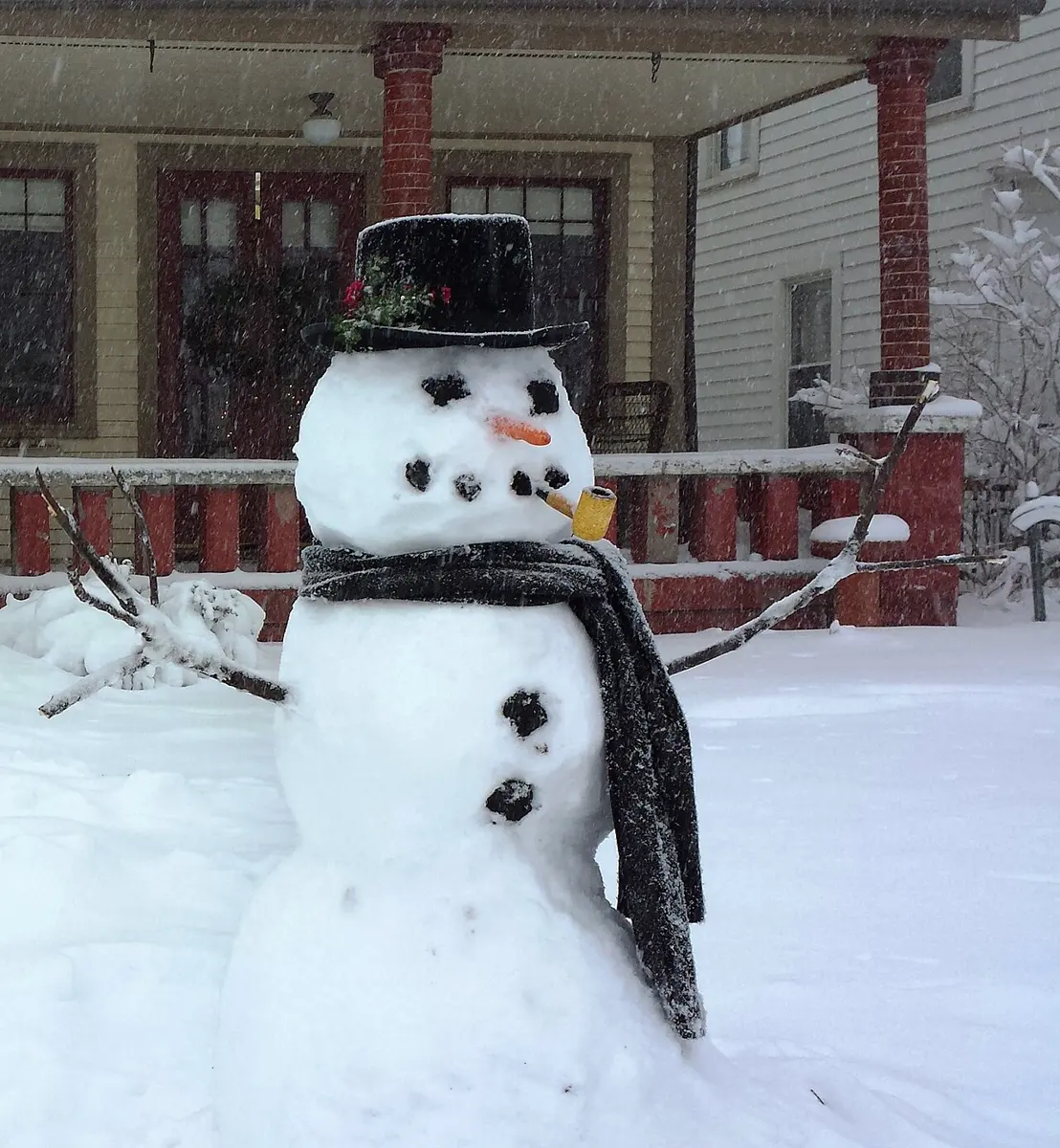
The picture shows a big, happy snowman in a hat and a scarf, in a snowy garden. Birds sit on his stick arms.
What do you see in the picture?
A model answer
Does a snowman stay unmelted inside a house? Why?
A model answer
The poem, verse by verse
The poem is by Linda Knaus and Kenn Nesbitt. It has five verses of four lines, and it tells a story.
- Making him. Melinda makes a snowman. She gives him a carrot for a nose, and puts rubber boots where she figured (guessed) his toes would be.
- The face and the hat. She gives him eyes of charcoal (black pieces of burnt wood). She gives him one last pat (a gentle touch) and puts her father’s hat on his frozen head.
- The tie. He is nearly finished. As a last touch, she takes her father’s favorite tie and ties it round his neck.
- So proud. Melinda feels very proud (happy about what she did). Full of glee (great joy), she rushes (runs quickly) up the stairs and calls her mum and dad to come quickly.
- Too late. When her parents get downstairs, Melinda is in tears. They tell her that snowmen belong outside.
So where did she make him? Inside the house, downstairs! By the time her parents came, he had melted. The poem never says it. You work it out from the last line. That is the joke.
A. Rhyming words
Find the words in the poem that rhyme with the words in the box, and read both together: nose, pat, note, glee, cried.
Answer
B. Word meanings
Match the words with their meanings.
- a.snowman · b. pat · c. favorite · d. proud · e. rush
- i.feeling happy about something you have done · ii. to go or run very quickly · iii. a figure like a person made out of snow · iv. to touch somebody or something gently · v. something you like the most
Answer
C. True or false?
a. The snowman wore rubber boots.
Pick an answer to see why.
b. Melinda used charcoal to make the eyes.
Pick an answer to see why.
c. Melinda did not show her snowman to anybody.
Pick an answer to see why.
d. The parents were happy to see Melinda’s snowman.
Pick an answer to see why.
e. Melinda’s mother and father said nothing to her.
Pick an answer to see why.
D. What do you know about snowmen?
You may have heard about snowmen. Where did you learn about them? What facts do you know about them? Share your ideas with the class.
Some ideas
Grammar II: putting past sentences together
A. Words in order
An English sentence keeps its words in order: who (the subject), then the verb, then the rest. A time phrase (last evening, this morning) usually goes at the end. In a question, was, were or did comes first.
Put the jumbled words in the correct order to make meaningful sentences.
- a.English songs/They/sang/last evening.
- b.Nani/food/preparing/Was/in the morning?
- c.He/go to/did not/school/because of an illness.
- d.yoga/were/They/doing/some hours ago.
- e.call/Didn’t/you/the meeting?
- f.the madal/She/played/in the concert.
- g.was shining/The sun/this morning.
Answer
B. Past simple or past continuous?
Often a short action cuts into a long one. The long one is in the past continuous, the short one in the past simple.
- While I was washing the dishes, a dog came in. (while + the long action)
- Meena was cutting vegetables when she cut her finger. (when + the short action)
Choose the correct option from the brackets to complete the sentences.
- a.I ……… a new job yesterday. (joined/was joining)
- b.What ……… at this time last Saturday? (did you do/were you doing)
- c.While I was washing the dishes, a dog ……… in. (was coming/came)
- d.Gopi didn’t hear the phone ring. He ……… to loud music. (was listening/listened)
- e.The shop was closed when I ……… there. (was getting/got)
- f.The teacher told us to stop what we ……… . (did/were doing)
- g.……… the book you were searching for? (Did you find/Were you finding)
- h.Meena ……… vegetables when she cut her finger. (cut/was cutting)
- i.While Namuna ……… TV, I turned the light off. (watched/was watching)
Answer
While Pratik ___ his bike, it started to rain.
Pick an answer to see why.
Writing II: the puppy and the well
A story has a beginning (who, where), a middle (what goes wrong) and an end (how it ends, and the lesson). Words like one of the pups, in there, there was no dog link each sentence to the one before.
The jumbled sentences below make a story. Rearrange them to make a sensible story.
- a.The puppy had learned his lesson.
- b.The puppy saw his reflection which was doing whatever he was doing, and got angry with it for copying him.
- c.The mother dog told the puppies not to go near the well or play around it.
- d.A dog and her puppies lived on a farm, where there was a well.
- e.In there, he saw his reflection and thought it was another dog.
- f.He decided to fight with the dog and jumped into the well. There was no dog.
- g.He barked and barked and swam until the farmer came and saved him.
- h.One of the pups wondered why they shouldn’t go to the well and decided to explore it anyway. He went to the well, climbed up the wall and looked inside.
Hint
Answer
Do it yourself
Exercise
Practice the whole unit. Try each one, then open the answer.
Write the past forms.
a. go · b. sit · c. reply · d. stop · e. tell · f. enjoy
Answer
Complete with the past continuous.
- a.At six this morning, my mother ……… (milk) the buffalo.
- b.Where ……… you ……… (go) when I saw you?
- c.The children ……… not ……… (listen) to the teacher.
Answer
Join each pair with while or when.
- a.I was sleeping. The phone rang.
- b.Anish was walking to school. He found a coin.
Answer
Make questions for these answers.
- a.I went to Lumbini last month. (When …?)
- b.Yes, she cleaned her room. (Did …?)
Answer
Say which sound each -ed makes: /t/, /d/ or /ɪd/.
a. jumped · b. needed · c. played
Answer
Printable PDFs
- Study notes 2 pages
- Harder practice questions 2 pages Answer key
Practice every question in the book, and keep track of the ones you miss →
A companion to your textbook, not a replacement for it: study from the book your school uses, and where the two differ, follow your teacher. Found a mistake? Please tell us.