
On a weekday morning in the nuclear medicine department of Bir Hospital in Kathmandu, a patient with an overactive thyroid swallows a capsule. Inside it is a little sodium iodide made with iodine-131, a radioactive isotope. The thyroid gland, which collects iodine from the blood to make its hormones, takes it up as if it were ordinary iodine; then, over the next weeks, the iodine-131 nuclei break down one by one, and their beta particles destroy the overactive tissue from inside, while the rest of the body is barely touched. A few rooms away, a camera that sees gamma rays maps a patient’s kidneys from the technetium-99m injected an hour before.
Both depend on a kind of change chemistry hadn’t imagined before 1896: a change not in the electrons of an atom but in its nucleus, which turns one element into another. This unit is about those changes: radioactivity, the radiations it gives out, how nuclear equations are written and balanced, natural and artificial radioactivity, fission and fusion, nuclear power, and the uses of radioisotopes in industry, medicine and archaeology, with their dangers.
21.1 Introduction
The atoms of certain elements, such as uranium, plutonium, thorium, radium and polonium, are unstable: they keep giving out invisible radiation, and as they do, they turn into atoms of other elements. This change of one element into another is called transmutation. In an ordinary chemical reaction only the electrons around the nucleus change; here the nucleus itself changes. Such a change is a nuclear reaction (or nuclear transformation), and the branch of chemistry that studies nuclei, their changes and their uses is nuclear chemistry.
A nucleus is written with its mass number A (protons + neutrons) at the top left of the symbol and its atomic number Z (protons) at the bottom left. Uranium-238, with 92 protons and 146 neutrons:
Atoms of one element with different mass numbers are isotopes: , and are all carbon. A radioactive isotope is a radioisotope.
21.2 Radioactivity
A nucleus is made of protons and neutrons held together by the strong nuclear force. Most nuclei are stable, but some have an unbalanced mix, too many neutrons, too many protons, or simply too many of both, and are unstable. Such a nucleus becomes more stable by giving out particles or energy. The spontaneous breaking down of an unstable nucleus, with the emission of radiation, is radioactivity; the breakdown itself is nuclear disintegration (or radioactive decay). The new nucleus may be of another element, or the same nucleus at a lower energy. Elements that show radioactivity are radioactive elements.
Every element heavier than lead (beyond Z = 82) is radioactive: uranium, thorium, radium, polonium. But light elements have radioactive isotopes too: carbon-14 in every living thing, and potassium-40 in every banana and in your own body, where it gives out a few thousand beta particles every second without harm.
The radiations given out by radioactive substances are of three kinds: α (alpha) particles, β (beta) particles and γ (gamma) rays, which are electromagnetic waves. Passed between charged plates or through a magnetic field, they separate: α bends one way, β the other way and much more, and γ goes straight on.
Properties of α, β and γ rays
| Property | α (alpha) | β (beta) | γ (gamma) |
|---|---|---|---|
| Nature | particle: a helium nucleus, 2 protons + 2 neutrons | particle: a fast electron from the nucleus | electromagnetic radiation (photons) |
| Charge | +2 | −1 | 0 |
| Mass | 4 u | about 1/1840 of a hydrogen atom | 0 |
| Symbol | (or ), α | , β | γ |
| Ionizing power | greatest | about 100 times less than α | least: about 10,000 times less than α |
| Penetrating power | least: stopped by a sheet of paper or a few cm of air | more: stopped by a few mm of aluminium | greatest: reduced only by thick lead or concrete |
| Speed | about 1/20 of the speed of light (roughly 5–7%) | up to about 99% of the speed of light | the speed of light |
Some books give the speed of α particles as 1/10 of the speed of light. The α particles from radioactive nuclei (4–9 MeV) move at 5–7% of it, about 1/20.
An α particle is slow and heavily charged, so it pulls electrons off almost every atom it passes and uses up its energy within a few centimeters of air: strongly ionizing, weakly penetrating. A γ ray has no charge and ionizes only now and then, so it goes a long way. The ratios of ionizing power are only rough (they depend on the energies).
Units of radioactivity
The activity of a sample is the number of nuclei that disintegrate per second.
| Unit | Definition |
|---|---|
| Becquerel (Bq), the SI unit | 1 Bq = 1 disintegration per second (dps) |
| Curie (Ci) | 1 Ci = 3.7 × 10¹⁰ dps, about the activity of 1 g of radium-226 |
| Rutherford (Rd) | 1 Rd = 10⁶ dps |
Writing nuclear equations
A nuclear equation can be written in two ways. In symbols, each nucleus carries its mass number and atomic number:
In words: “uranium-238 decays to thorium-234 by emitting an alpha particle.” The usual symbols are α or for an alpha particle, β or for a beta particle, (β⁺) for a positron, γ for a gamma ray, for a neutron and (or p) for a proton.
In every nuclear equation both the mass numbers and the atomic numbers balance: the total at the top is the same on both sides, and so is the total at the bottom.
Check the first: top 27 + 1 = 24 + 4 = 28; bottom 13 + 0 = 11 + 2 = 13. Each kind of decay changes A and Z in its own way:
| Decay | What leaves | Change in A | Change in Z |
|---|---|---|---|
| α | − 4 | − 2 | |
| β⁻ | (a neutron has become a proton) | 0 | + 1 |
| β⁺ | (a proton has become a neutron) | 0 | − 1 |
| γ | a photon | 0 | 0 |
21.3 Natural and artificial radioactivity
Radioactivity is of two kinds.
1. Natural radioactivity
Uranium-238 occurs in rocks, and it keeps decaying by alpha emission into thorium-234 with nothing to start it. The spontaneous breakdown of an unstable nucleus found in nature, with the emission of radiation, is natural radioactivity. It is shown by uranium-238, thorium-232, radium-226, polonium-210, potassium-40 and carbon-14, among others:
Thorium-234 is itself radioactive: uranium-238 is the start of a chain of fourteen decays, through radium and radon, that ends at stable lead-206.
Applications of natural radioactivity: carbon-14 dates once-living things (Section 21.8); uranium-238 and its end product lead-206 (half-life 4.47 billion years) date the oldest rocks, and so the Earth itself; the tritium and carbon-14 made by cosmic rays trace how old groundwater is and how it moves. Radon, from the uranium in the ground, is the largest part of the natural radiation we all receive.
2. Artificial radioactivity
Aluminium-27 is stable: it never decays on its own. But when it is bombarded with neutrons, some of its nuclei become sodium-24, which is radioactive:
Radioactivity produced in a stable nucleus by bombarding it with particles (neutrons, alpha particles, protons) is artificial (or induced) radioactivity: people start it, though the decay that follows is as spontaneous as any other.
Other examples of artificial radioactivity:
| Stable nucleus | Bombarded with | Radioisotope made | Radiation it gives out |
|---|---|---|---|
| Aluminium-27 | neutron | sodium-24 (+ α) | β⁻, γ |
| Aluminium-27 | alpha particle | phosphorus-30 (+ n) | β⁺ |
| Nitrogen-14 | neutron | carbon-14 (+ p) | β⁻ |
| Phosphorus-31 | neutron | phosphorus-32 | β⁻ |
| Cobalt-59 | neutron | cobalt-60 | β⁻, γ |
| Tellurium-130 | neutron | tellurium-131, which decays to iodine-131 | β⁻, γ |
The iodine-131 used in medicine decays to xenon-131:
Its β particles are energetic enough to kill the cells around it, and its γ rays escape the body and can be counted from outside.
Applications of artificial radioactivity are found in medicine, agriculture, research, industry and nuclear power:
- i.Iodine-131 is used to diagnose and treat disorders of the thyroid.
- ii.Cobalt-60 is used in radiotherapy to destroy cancer cells, and to sterilize medical equipment.
- iii.Plutonium-239, made in reactors from uranium-238, is a fuel in nuclear reactors.
Which of these is an example of natural radioactivity?
Pick an answer to see why.
21.4 Nuclear reactions
The joining of deuterium and tritium into helium makes a new element: it is a nuclear reaction. A nuclear reaction is a process in which the nucleus of an atom is changed into the nucleus of another element (or into a different state of the same nucleus), usually with the emission of radiation and energy. Unlike a chemical reaction, which involves only the outer electrons, it changes the nucleus and releases far more energy.
Types of nuclear reaction
The two most important are fission and fusion. In fission a heavy nucleus splits into two lighter nuclei; in fusion light nuclei join to form a heavier one. Both release energy because both end with nuclei that are more tightly bound, nearer the middle of the periodic table (iron and nickel); how the binding energy per nucleon explains this is in Grade 11 Physics, Unit 24.
Nuclear fission
In the activity at the start of the unit, a slow neutron is absorbed by uranium-235, which splits into barium-141 and krypton-92, with three neutrons and a large amount of energy:
A nuclear reaction in which a heavy nucleus splits into two (rarely more) lighter nuclei, with the release of a large amount of energy and radiation, is nuclear fission. Each fission of uranium-235 releases about 200 MeV. The nucleus doesn’t always split the same way: more than a hundred different pairs of fragments are found, for example
Each balances: 235 + 1 = 95 + 139 + 2 = 236 at the top, 92 = 38 + 54 at the bottom. (The alpha decay of uranium-238, , sometimes listed beside these, isn’t fission: the nucleus only throws out a small helium nucleus.)
Fission hardly ever happens in nature (only rarely, spontaneously). But each fission gives out two or three neutrons, and each of them can split another uranium-235 nucleus: one fission can lead to two, then four, then eight… This is a chain reaction.
Nuclear fusion
In Activity 3, deuterium and tritium fuse to give a helium nucleus and a neutron, releasing a tremendous amount of energy. A nuclear reaction in which two light nuclei join to form a heavier nucleus, with the release of a huge amount of energy and radiation, is nuclear fusion. Other examples:
(Two deuterium nuclei almost always give one of the first two pairs, in about equal shares; some books write D + D → helium-4, which happens only about once in ten million times.)
Nuclei are positively charged and repel each other strongly, so they fuse only when they collide very fast: at temperatures of tens of millions of degrees, as in the core of the Sun and other stars. Fusion is not a chain reaction carried by neutrons, as fission is; in a star it keeps going because the energy it releases keeps the gas hot.
Applications of nuclear fission: generating electricity in nuclear power stations; making radioisotopes for medicine (the molybdenum-99 from which hospitals get technetium-99m is a fission product); powering submarines and aircraft carriers; and nuclear weapons.
Applications of nuclear fusion: fusion could be a clean and almost limitless source of energy: its fuel, deuterium, is in all sea water, it gives no long-lived radioactive waste like fission’s, and a fusion reactor can’t run away like a chain reaction (if anything goes wrong, the plasma cools and fusion stops). The aim of fusion research is to make power from it sustainably and safely. It is hard: the fuel must be held at over 100 million °C. In December 2022 the US National Ignition Facility for the first time got more energy out of a fusion target (3.15 MJ) than its lasers put into it (2.05 MJ), and the international reactor ITER is being built in France, but no fusion power station yet makes electricity.
21.5 Nuclear power and nuclear weapons
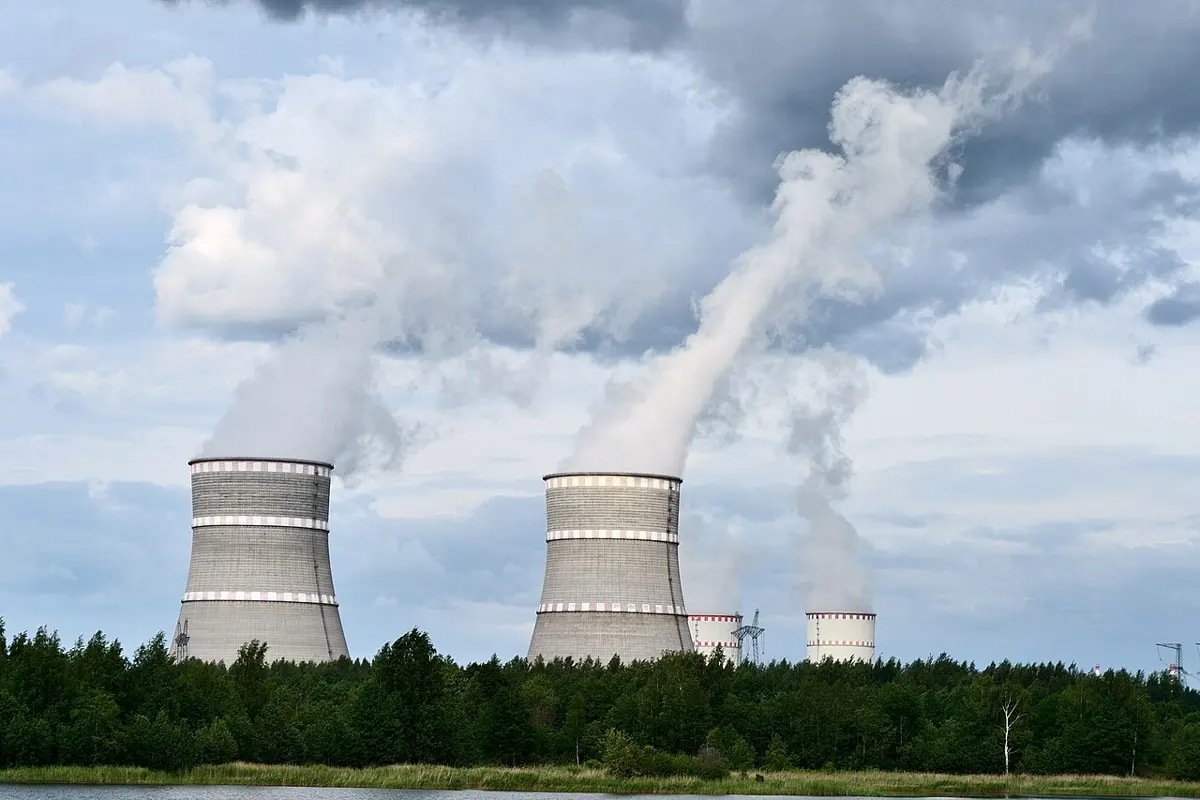
The energy obtained from nuclear reactions, today from fission, in which nuclei of a heavy element such as uranium split into smaller ones, is nuclear power. In a nuclear power station it is used to generate electricity. Reactors burn uranium-235, and plutonium-239, made inside them from uranium-238, adds to the fuel. Nuclear power made about a tenth of the world’s electricity in 2025 (8.9%), and it is still the second-largest low-carbon source of electricity in the world, after hydropower (about 14%), though solar (8.7%) and wind (8.5%) are close behind and growing fast.
The same science is also used in nuclear weapons: explosive devices that cause massive destruction by nuclear reactions. Fission weapons (atomic bombs) depend on the splitting of heavy nuclei, uranium-235 or plutonium-239; fusion weapons (hydrogen or thermonuclear bombs) release far more energy by fusing light nuclei, using a fission bomb to start them.

| Advantages of nuclear power | Disadvantages of nuclear power |
|---|---|
| It produces very little carbon dioxide, so it doesn’t add to global warming the way coal and gas do. | An accident can cause long-term harm to people and the environment. |
| A small amount of fuel produces a very large amount of energy. | It produces dangerous radioactive waste that must be kept safe for thousands of years. |
| It produces steady power day and night, in any weather. | Building and running power stations, and finally taking them apart, is very costly and slow. |
| Counted over all the electricity made, it has caused far fewer deaths than coal, oil or gas (mostly from their air pollution). | Its fuel and technology can be misused to make weapons. |
21.6 Industrial use of radioactivity
Radioisotopes and the radiation from them are used in industry for radiotracers, radiography and nucleonic gauges: to watch processes, to measure, and to change materials. They are very sensitive, quick to set up and cheap compared with other methods. Common industrial radioisotopes include iridium-192, thulium-170, cesium-137, strontium-90, cobalt-60, iron-55 and americium-241, used for their β and γ radiation. Some uses:
- Non-destructive testing (NDT): checking welds and castings for hidden cracks without damaging them. In gamma radiography, a small iridium-192 or cobalt-60 source is placed on one side of a weld in an oil pipeline or a pressure vessel, and a film or detector on the other: a crack lets more rays through and shows up as a dark line. (X-ray machines are used the same way, where a power supply can be brought to the job.)
- Thickness gauging: measuring and controlling the thickness of a material as it is made. In paper mills and plastic-film factories, a beta source (krypton-85 or strontium-90) sits above the moving sheet and a detector below: if the count rises, the paper is too thin, and the rollers are adjusted at once. Gamma sources do the same for steel sheet.
- Leak detection: a little radioactive tracer, for example sodium-24, is added to the liquid in a buried pipe. Where the pipe leaks, the tracer collects in the soil, and a detector carried along the ground above finds the spot without digging up the whole pipe. Sodium-24 is chosen because its gamma rays pass through the soil and its half-life, 15 hours, is long enough for the search and short enough that it soon dies away.
- Sterilization: medical supplies such as surgical gloves, syringes, sutures and bandages are sealed in their packets and then passed through the gamma rays of a cobalt-60 source, which kill every bacterium inside without heating them; the packets stay sterile until opened. Spices and some foods are treated the same way. The items do not become radioactive.
- Power generation (RTGs): a radioisotope thermoelectric generator turns the heat of a decaying plutonium-238 source (half-life 87.7 years) into electricity with thermocouples. Spacecraft too far from the Sun for solar panels use them: the Voyager probes (1977), still sending signals from beyond the planets, and New Horizons, which flew past Pluto; on Mars, the rovers Curiosity and Perseverance, whose generators keep them working through dust storms and the nights.
- Smoke detectors: an ionization smoke detector has a tiny americium-241 source (about 30–40 kBq). Its alpha particles ionize the air between two plates, so a small current flows; smoke particles soak up the ions, the current falls, and the alarm sounds. The alpha particles can’t get out of the detector’s case. (Many smoke detectors sold today work by light instead and have no source.)
Why is sodium-24 (half-life 15 hours, a β and γ emitter) a good tracer for a buried pipe?
Pick an answer to see why.
21.7 Medical use of radioactivity
In medicine, radioisotopes let doctors look at how organs are working and treat diseases from inside. They are used in imaging, which shows doctors the internal organs and finds diseases such as cancer and heart disease early; in radiotherapy, to destroy cancers while doing as little harm as possible to the healthy tissue around them; and to follow blood flow and how organs work, which helps doctors plan treatment.
1. Diagnostic imaging (nuclear medicine)
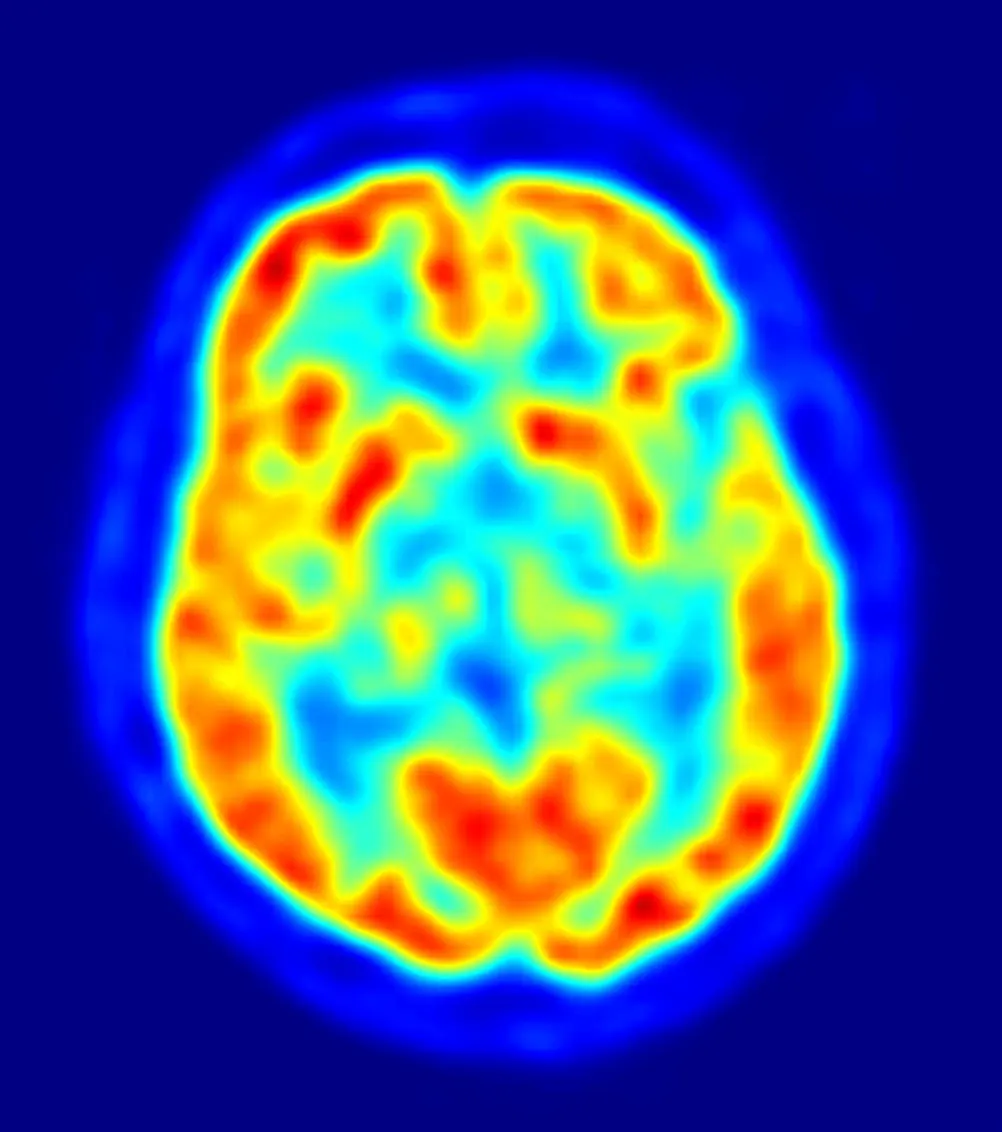
A small amount of a radioisotope, attached to a substance the organ takes up, is injected or swallowed, and a gamma camera outside the body maps where it goes. In SPECT (single photon emission computed tomography) the camera turns around the patient to build a 3D picture. These pictures show what an organ is doing; they are often combined with a CT (computed tomography) scan, which uses X-rays to show its shape. The workhorse is technetium-99m (half-life 6.0 hours, gamma rays of 140 keV and no beta particles to harm the tissue), used to image bones, the heart, kidneys, thyroid, liver and lungs. Hospitals get it each day from a “generator” of molybdenum-99, which decays to it.
In Nepal, Bir Hospital’s nuclear medicine department in Kathmandu does renal (kidney), thyroid, bone, heart, brain and breast scans this way, and runs a clinic for radioactive iodine treatment.
2. Cancer treatment (radiotherapy)
Radiation kills cells by breaking their DNA, and cancer cells, which divide fast, are less able to repair it. Iodine-131 goes to the thyroid gland and treats thyroid cancer and an overactive thyroid from inside. Cobalt-60’s strong gamma rays (1.17 and 1.33 MeV) have been aimed at tumors from outside the body for seventy years (teletherapy). Newer treatments attach an alpha emitter such as bismuth-213 to a molecule that seeks out cancer cells; its alpha particles go only a few cells deep (targeted alpha therapy, still largely in trials).
3. Brachytherapy
In brachytherapy (from the Greek brachys, short), a sealed radioactive source is placed inside or right next to the tumor, so it gets a high dose while the tissue a few centimeters away gets little. It is used for cancers of the cervix (one of the commonest cancers of women in Nepal), prostate, breast and skin. Iridium-192 (half-life 74 days) is pushed by a machine through thin tubes to the tumor for a few minutes, then pulled back; tiny iodine-125 seeds are left in the prostate for good. (Radium-223 also treats prostate cancer, but differently: it is injected and, behaving like calcium, settles in the bones where the cancer has spread.)
4–6. Other medical and research uses
- Iron-59 is used to study iron metabolism: how the body absorbs iron and uses it in the bone marrow to make red blood cells, and where it is stored, in the liver and spleen.
- Sodium-24, injected into a vein, is followed by a detector to measure how fast blood circulates and to find blocked or narrowed blood vessels.
- Sulphur-35 and phosphorus-32 label proteins and nucleic acids in biological research, so scientists can follow them through cells. In 1952, Alfred Hershey and Martha Chase grew viruses with sulphur-35 in their protein coats and phosphorus-32 in their DNA, and showed that only the DNA entered the bacteria the viruses infected: the experiment that convinced biologists that genes are made of DNA.
21.8 Radiocarbon dating
Carbon-14 is made in the upper atmosphere when neutrons from cosmic rays strike nitrogen-14 nuclei:
It is oxidized to carbon dioxide, ¹⁴CO₂, which mixes through the air; plants take it up in photosynthesis, and animals eat the plants. So every living thing has the same tiny share of carbon-14 as the air, about one atom in a million million of its carbon. When the plant or animal dies, it stops taking in carbon, and the carbon-14 already in it begins to fall by beta decay:
Measuring how much carbon-14 is left in once-living material, and so how long ago it died, is radiocarbon dating.
The half-life of carbon-14 is 5,730 years. By measuring the carbon-14 that remains in a dead sample (or the beta particles it gives out per minute per gram of carbon), its age is found from:
where N₀ is the amount of carbon-14 the sample had when it was alive, N the amount left now, and t₁/₂ = 5,730 years.
Radiocarbon dating works for things that were once alive (wood, charcoal, bone, cloth, seeds, paper) and are up to about 50,000 years old; after that too little carbon-14 is left to measure. It can’t date rocks or metals: for those, uranium–lead and potassium–argon dating are used.
21.9 Harmful effects of nuclear radiation
Radiation is used in energy, industry, research and medicine, but exposure to it can cause serious harm. Nuclear radiation is ionizing: as it passes through the body it knocks electrons out of molecules, breaking bonds and making reactive ions and free radicals. Some of its harmful effects:
- It damages cells and their DNA. A cell may die, or survive with its genes changed (a mutation).
- It increases the risk of cancer, such as leukemia and thyroid cancer, sometimes years after the exposure.
- It causes radiation burns and radiation sickness. A large dose in a short time causes nausea, vomiting, hair loss, bleeding and, above a few sieverts, death.
- It may cause infertility or birth defects, by harming the reproductive organs or an unborn baby.
- It weakens the immune system, by killing the fast-dividing cells of the bone marrow that make white blood cells.
- It contaminates the environment: radioactive substances released into air, water and soil enter food chains, as cesium-137 did after the Chernobyl accident.
The effect of radiation on the body is measured in sieverts (Sv). Everyone receives natural background radiation, from the ground, radon, cosmic rays and the potassium-40 in our own bodies: about 2.4 millisieverts a year on average worldwide. A chest X-ray adds about 0.1 mSv, a CT scan several mSv. Workers with radiation keep their dose low by three rules: time (as short as possible), distance (as far as possible: doubling the distance from a small source cuts the dose to a quarter) and shielding (lead, concrete, water).
Exercise
A. Multiple choice questions
- Which of the following is used in radiocarbon dating?
Pick an answer to see why.
- Which type of radiation has the least penetrating power?
Pick an answer to see why.
- What type of nuclear reaction powers nuclear reactors?
Pick an answer to see why.
- Which of the following is the correct symbol of an alpha particle?
Pick an answer to see why.
- Which is true for nuclear fusion?
Pick an answer to see why.
- Which process releases the most energy (per kilogram of fuel)?
Pick an answer to see why.
- What is the SI unit of radioactivity?
Pick an answer to see why.
- Which of the following is used as a fuel in a nuclear fission reactor?
Pick an answer to see why.
- Which radioisotope is produced artificially?
Pick an answer to see why.
- Which of the following is not given out in natural radioactive decay?
Pick an answer to see why.
B. Short answer questions
Give reasons:
- a.Carbon-14 is used in the dating of ancient biological substances.
- b.Alpha particles have low penetrating power.
Answer
Nuclear fusion is not yet used widely for energy production. Why?
Answer
What is radioactivity? Write its unit.
Answer
What are radioactive substances? Give examples.
Answer
Differentiate between:
- a.nuclear reaction and chemical reaction
- b.natural and artificial radioactivity
Answer
Compare nuclear fusion and nuclear fission.
Answer
Plutonium-239 absorbs a neutron and splits into xenon-140 and strontium-94, releasing neutrons and energy. Present a schematic diagram for the nuclear fission of plutonium.
The textbook gives xenon-140 and strontium-94, but their atomic numbers add up to 54 + 38 = 92, the atomic number of uranium, not plutonium’s 94, so the book’s numbers don’t work; the pair xenon-140 + strontium-94 (with two neutrons) comes from uranium-235. A plutonium-239 fission that gives xenon (54) must give zirconium (40) with it: with three neutrons, zirconium-97.
Answer
Two carbon-12 nuclei fuse to form neon-20 and helium. Write the balanced nuclear equation for this fusion reaction.
Answer
Write the nuclear reaction for the formation of carbon-14 in the upper atmosphere.
Answer
What is natural radioactivity? Give one example. Also mention any one application of it.
Answer
Define artificial radioactivity with an example. Write one important application of it.
Answer
What is nuclear power? Write the advantages and disadvantages of nuclear power.
Answer
What do you mean by nuclear weapons? Give some examples.
Answer
Write an example each of fission-based and fusion-based nuclear weapons.
Answer
What are radioisotopes? List some medical uses of radioisotopes.
Answer
What are controlled and uncontrolled nuclear fission?
Answer
Write down the medical uses of radioisotopes.
Answer
Write the uses of the following radioisotopes: Co-60, I-131, Na-24, F-18.
Answer
What are the harmful effects of nuclear radiation?
Answer
Write a note on radiocarbon dating.
Answer
Compare the properties of alpha, beta and gamma rays.
Answer
C. Long answer questions
Radioisotopes are widely used in both medicine and industry, but they also pose risks. Evaluate the benefits and potential dangers of using radioisotopes in modern society. How can their use be made safer?
Answer
What is radiocarbon dating? Explain the principle of radiocarbon dating.
Answer
Printable PDFs
- Study notes 3 pages
- Worksheet 4 pages Answer key
Quiz yourself: Matter, Atoms and Reactions, Grades 5–12 →
Practice every question in the book, and keep track of the ones you miss →
A companion to your textbook, not a replacement for it: study from the book your school uses, and where the two differ, follow your teacher. Found a mistake? Please tell us.