
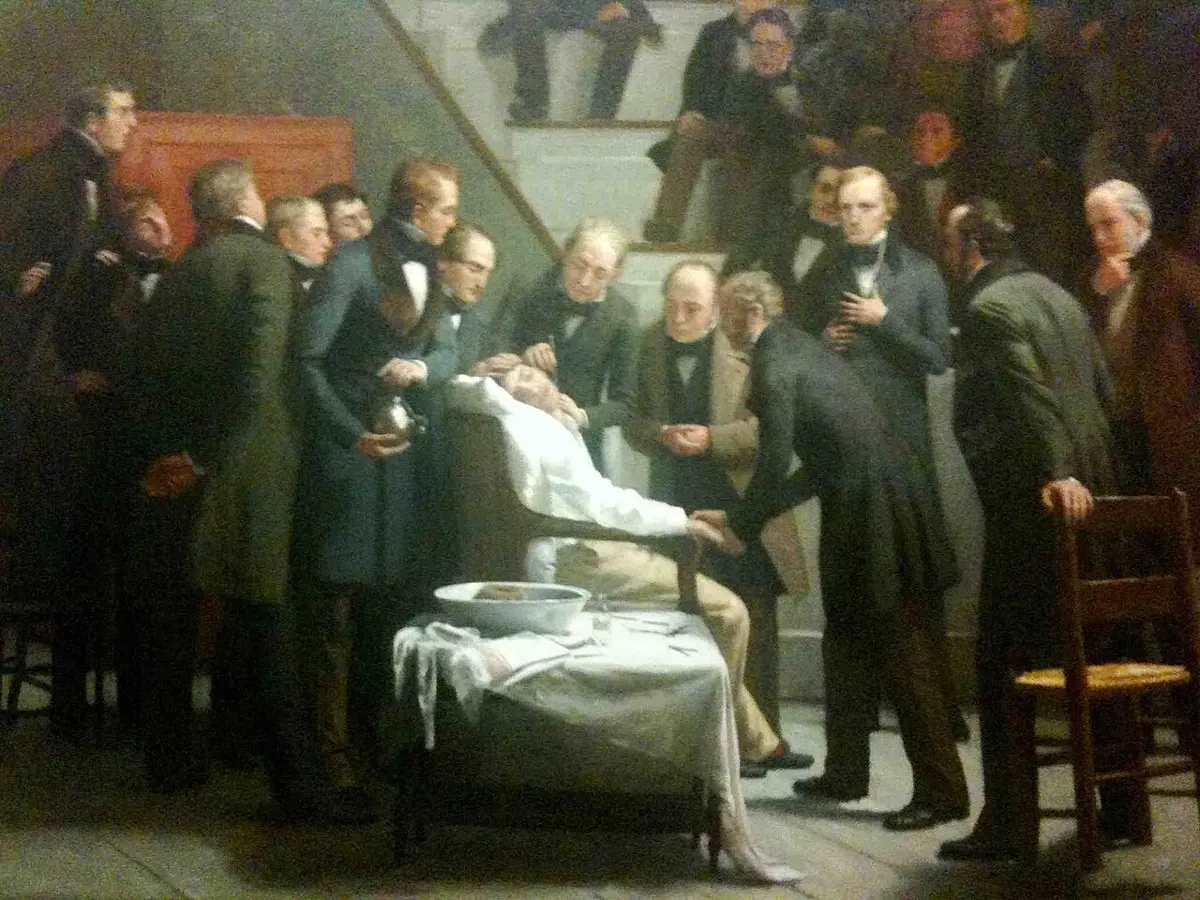
On 16 October 1846, in the operating theater of the Massachusetts General Hospital in Boston, a dentist named William Morton held a glass flask to the mouth of a young man, Edward Gilbert Abbott, and told him to breathe. A few minutes later the surgeon John Collins Warren cut a tumor out of Abbott’s neck, and Abbott didn’t cry out. Until that morning, surgery meant being held down, awake. Morton’s flask held ethoxyethane, the “ether” that still gives its name to the whole family of compounds in this unit.
Ethers are among the quietest compounds in organic chemistry. They have no acidic hydrogen, no double bond, nothing that an acid, a base or an oxidizing agent easily attacks, which is exactly why chemists use them as solvents. This unit covers how they are named and made, why they boil so low, the few reactions they do have, and the one danger every chemist who uses them must remember.
12.1 Introduction
Many resins and waxes, which won’t dissolve in water, dissolve in ether. That is how ether first earned its place in the laboratory, and in the making of varnishes and perfumes.
An ether is a compound in which an oxygen atom is bonded to two alkyl or aryl groups: R–O–R′. The –O– between them is the functional group, called the ether linkage. A saturated, open-chain ether has the same formula as an alcohol with the same number of carbons, CₙH₂ₙ₊₂O.
Nomenclature, classification and isomerism
Common names
In the common system, the two groups on the oxygen are named in alphabetical order, followed by the word ether. If the two are the same, the prefix di is used.
| Formula | Common name |
|---|---|
| CH₃–O–CH₃ | dimethyl ether |
| CH₃–CH₂–O–CH₃ | ethyl methyl ether |
| CH₃–CH₂–O–CH₂–CH₃ | diethyl ether |
“Ethyl” comes before “methyl” because e comes before m in the alphabet.
IUPAC names
In the IUPAC system an ether is an alkoxyalkane. The larger group is the parent alkane, and the smaller one, with its oxygen, is an alkoxy prefix (–OCH₃ methoxy, –OC₂H₅ ethoxy, –OC₆H₅ phenoxy), numbered where it sits: substituent + alkoxy + alkane.
| Formula | IUPAC name | Common name |
|---|---|---|
| CH₃–O–CH₃ | methoxymethane | dimethyl ether |
| CH₃–CH₂–O–CH₃ | methoxyethane | ethyl methyl ether |
| CH₃–CH₂–O–CH₂–CH₃ | ethoxyethane | diethyl ether |
| CH₃–CH₂–O–CH₂–CH₂–CH₃ | 1-ethoxypropane | ethyl propyl ether |
| (CH₃)₂CH–O–CH₃ | 2-methoxypropane | isopropyl methyl ether |
| (CH₃)₃C–O–CH₃ | 2-methoxy-2-methylpropane | tert-butyl methyl ether |
| C₆H₅–O–CH₃ | methoxybenzene | methyl phenyl ether, anisole |
| C₆H₅–O–CH₂CH₃ | ethoxybenzene | ethyl phenyl ether, phenetole |
| C₆H₅–O–C₆H₅ | phenoxybenzene | diphenyl ether |
What is the IUPAC name of CH₃–O–CH₂–CH₂–CH₃?
Pick an answer to see why.
Classification
a. By the two groups on the oxygen. If the two groups are the same, the ether is simple or symmetrical (R–O–R). If they are different, it is mixed or unsymmetrical (R–O–R′).
b. By the kind of groups. If both groups are alkyl groups, the ether is aliphatic. If one or both are aryl groups (a benzene ring on the oxygen), it is aromatic.
Isomerism
Ethers show these two kinds of isomerism most often:
a. Functional isomerism: the same molecular formula with a different functional group. Ethers and alcohols are functional isomers of each other: methoxyethane and propan-1-ol are both C₃H₈O.
b. Metamerism: the same molecular formula and the same functional group, with different groups on either side of it: ethoxyethane and 1-methoxypropane.
Ethers can also show position isomerism (1-methoxypropane and 2-methoxypropane: the oxygen on a different carbon of the same chain) and chain isomerism, like alkanes.
Ethoxyethane and butan-1-ol are:
Pick an answer to see why.
12.2 Preparation of ethers: Williamson’s synthesis
When a haloalkane is heated with a sodium alkoxide (made by dissolving sodium in an alcohol), an ether forms and sodium halide is left. This is Williamson’s ether synthesis (Alexander Williamson, London, 1850). It makes both symmetrical and unsymmetrical ethers:
The alkoxide ion is a strong nucleophile. It attacks the carbon that holds the halogen from the side opposite the halogen, and the halide ion leaves as the new C–O bond forms: an SN2 reaction Grade 12: Unit 8.
The haloalkane must be primary
The alkoxide ion is also a strong base. With a tertiary haloalkane it doesn’t substitute; it eliminates (E2), taking a hydrogen from a carbon next to the one that holds the halogen, and an alkene forms instead of an ether. A secondary haloalkane gives mostly alkene too. The reasons:
a. Steric hindrance. The carbon holding the halogen in a tertiary haloalkane carries three alkyl groups. They block the back of that carbon, so the alkoxide can’t reach it for an SN2 attack.
b. A strong base. The alkoxide easily removes one of the nine hydrogens on the carbons around it, which stick out where it can reach them: E2 elimination wins.
c. Heat favors elimination over substitution, since elimination makes more molecules (an alkene, an alcohol and a salt from two).
(The halide is a good leaving group, but that helps substitution and elimination alike; it is not why the alkene forms.) So 2-chloro-2-methylpropane and sodium methoxide give 2-methylpropene, and 2-chloro-2-methylbutane and sodium ethoxide give the two possible alkenes, the more substituted one being the major product (Saytzeff’s rule):
In the same way, 2-chloro-2-methylpentane with sodium methoxide gives mainly 2-methylpent-2-ene and some 2-methylpent-1-ene. To make an ether with a tertiary group, put the tertiary group on the alkoxide and use a methyl or primary halide:
Which pair would you use to make 2-methoxy-2-methylpropane, (CH₃)₃C–O–CH₃?
Pick an answer to see why.
Aromatic ethers
Phenol is acidic enough to be turned into sodium phenoxide by NaOH Grade 12: Unit 11. Heated with a haloalkane, phenoxide gives an aromatic ether: with iodomethane, anisole.
The halogen must be on the alkyl group. Chlorobenzene with sodium methoxide gives no anisole, since the ring’s C–Cl bond is partly double and can’t be attacked by SN2 Grade 12: Unit 9.
By dehydration of alcohols
Simple symmetrical ethers are made from alcohols. When excess ethanol is heated with concentrated sulphuric acid at 413 K (140 °C), two ethanol molecules lose one molecule of water between them:
The temperature must be watched: at 443 K (170 °C) the same mixture gives mostly ethene, by elimination Grade 12: Unit 10. The method works for primary alcohols only; secondary and tertiary alcohols, whose bulky groups hinder the substitution, give alkenes. It is how ether has been made since 1540, when Valerius Cordus distilled ethanol with sulphuric acid, then called oil of vitriol, and named the product “sweet oil of vitriol”.
12.3 Physical properties of ethers
a. State. Methoxymethane (boiling point −24 °C) and methoxyethane (7 °C) are gases at room temperature; the higher ethers, from ethoxyethane (35 °C) on, are liquids, colorless, with a sweet smell. Ethoxyethane is very volatile and very flammable: its vapor, heavier than air, flows along a bench and can catch fire from a flame meters away, and it ignites on a surface at only 160 °C, without a flame.
b. Density. Ethers are lighter than water (ethoxyethane 0.71 g/cm³). Shaken with water in a separating funnel, ether forms the upper layer (Figure 12.15): this is how chemists extract an organic compound from a water solution.
c. Solubility. Ethers are slightly polar (the C–O bonds are polar and the molecule is bent: ethoxyethane’s dipole moment is about 1.2 D), so they dissolve a little in water: about 6 g of ethoxyethane in 100 mL, about as much as butan-1-ol. Their oxygen’s lone pairs accept hydrogen bonds from water molecules, though the ether has no H of its own to give. They mix in any amount with non-polar and slightly polar solvents: benzene, chloroform, carbon tetrachloride, alcohols.
d. Boiling point. An ether molecule has no O–H, so ether molecules can’t hydrogen-bond to each other. Ethers therefore boil far lower than alcohols of the same molar mass, and about the same as alkanes of that mass (Figure 12.16).
| Compound | Formula | Molar mass | Boiling point |
|---|---|---|---|
| pentane | C₅H₁₂ | 72 g/mol | 36.1 °C |
| ethoxyethane | C₄H₁₀O | 74 g/mol | 34.6 °C |
| butan-1-ol | C₄H₁₀O | 74 g/mol | 117.7 °C |
12.4 Chemical properties of ethoxyethane
Ethers are among the least reactive organic compounds: the C–O–C linkage isn’t broken by bases, by dilute acids, by sodium or by oxidizing agents in the cold. That makes ether a good solvent for reactions with sodium (the Wurtz reaction) and with Grignard reagents, which react with water and alcohols but not with ether. Their reactions all begin at the lone pairs of the oxygen.
a. Action with HI
Hot concentrated hydrogen iodide breaks the C–O bond. First the ether’s oxygen takes a proton, becoming an oxonium ion; then the iodide ion, a good nucleophile, attacks one of the carbons on the oxygen and pushes out an alcohol. A symmetrical ether gives an alcohol and an iodoalkane:
With excess HI, the alcohol formed reacts too, and the only organic product is the iodoalkane: two molecules of it from one of ether.
Which bond breaks? In an unsymmetrical ether there are two different C–O bonds, and the iodide ion picks one by the rules of substitution Grade 12: Unit 8:
a. If both groups are methyl, primary or secondary, I⁻ attacks by SN2, from behind, so it attacks the less crowded carbon. The smaller group becomes the iodoalkane, and the oxygen stays with the larger group as an alcohol. Methoxyethane gives iodomethane and ethanol; 2-methoxypropane gives iodomethane and propan-2-ol.
b. If one group is tertiary, it leaves as a stable tertiary carbocation (SN1), which then takes up I⁻. Now the tertiary group becomes the iodide: 2-methoxy-2-methylpropane gives 2-iodo-2-methylpropane and methanol.
c. In an aryl alkyl ether, such as anisole, the ring–oxygen bond never breaks. It is partly double, by resonance of the oxygen’s lone pair with the ring, and I⁻ can’t attack an sp² ring carbon from behind. So anisole always gives phenol and iodomethane, never iodobenzene and methanol, even with excess HI (phenol does not react further).
What are the products when 2-methoxypropane is heated with one mole of concentrated HI?
Pick an answer to see why.
b. Action with cold concentrated acids: oxonium salts
The lone pairs on an ether’s oxygen make it a weak base. Cold concentrated sulphuric acid or hydrochloric acid gives it a proton, forming an oxonium salt: a salt whose cation has three groups (here two alkyl groups and an H) on a positive oxygen.
Because they form salts, ethers dissolve in cold concentrated acids, while alkanes don’t; adding water gives back the ether. This tells an ether from an alkane in the laboratory.
c. Action with air: peroxides
Left standing in air and light, ethers are slowly oxidized. Oxygen attacks the carbon next to the ether’s oxygen and forms a hydroperoxide, with an –O–O–H group, and from it other peroxides:
Test for peroxides. Shake a little of the ether with a freshly made solution of iron(II) sulphate and a few drops of potassium thiocyanate (KSCN). Any peroxide oxidizes Fe²⁺ to Fe³⁺, and Fe³⁺ with thiocyanate gives a blood-red color:
No red color: the ether is free of peroxides.
Preventing peroxides. Ether is kept in dark, tightly closed bottles, away from light, and is used soon after the bottle is opened. Pieces of iron wire or copper are often kept in the bottle; the metal reacts with the peroxides as they form, so they don’t build up. Peroxides already present are removed by shaking the ether with iron(II) sulphate solution. Commercial ether also carries a trace of BHT, a phenol that stops the oxidation (an antioxidant, Unit 11).
d. Action with chlorine
In the dark, chlorine replaces the hydrogens on the carbons next to the oxygen (the α-carbons), one on each side, giving α,α′-dichlorodiethyl ether. In sunlight, all ten hydrogens are replaced, giving perchlorodiethyl ether:
The α-hydrogens go first because the radical left on that carbon is stabilized by the lone pairs of the oxygen beside it.
e. Anisole’s ring
In anisole, the –OCH₃ group pushes electrons into the ring by its lone pairs (+R), as –OH does in phenol, though a little less strongly. It activates the ring and is an ortho, para director; the para product is usually the major one, since the –OCH₃ group gets in the way at the ortho positions.
12.5 Uses of ethers
- a.Solvents. Ethoxyethane dissolves oils, fats, waxes, resins and gums, and is the standard solvent for Grignard reagents and the Wurtz reaction Grade 12: Unit 8, which need a solvent with no acidic hydrogen. It is also used to extract organic compounds from water.
- b.Anesthetics. Ether was the first general anesthetic used widely in surgery. It has been replaced by halogenated ethers (Figure 12.28), which don’t catch fire.
- c.Perfumes and flavors. Anisole, diphenyl ether (which smells of geraniums) and anethole, the ether that gives aniseed and fennel seeds (saunf) their taste, are used in perfumes, soaps and sweets.
- d.Fuel additives. Tert-butyl methyl ether (MTBE) is mixed into petrol to make it burn more smoothly, in place of the lead compounds once used. Dimethyl ether burns cleanly and is being tried as a diesel fuel and, mixed with LPG, as a cooking gas.
- e.Refrigerant and propellant. Dimethyl ether, a gas that is easily liquefied, is used as a refrigerant and as the propellant of aerosol sprays.
Exercise
Exercise 12.1: Multiple choice questions
- Which of the following is the product Y? CH₃–O–CH₃ + excess HI → Y
Pick an answer to see why.
- Which is correct about the table?
| Reactant(s) | Condition(s) | Product(s) |
|---|---|---|
| (w) | dry ether/heat | CH₃–CH₂–O–CH₂–CH₃ |
| ethanol | (x) | CH₃–CH₂–O–CH₂–CH₃ |
| CH₃–CH₂–O–CH₂–CH₃ | excess HI | (y) |
| (z) | sunlight/chlorine | CCl₃–CCl₂–O–CCl₂–CCl₃ + HCl |
Pick an answer to see why.
- What is Z? CH₃–CH₂–O–CH₂–CH₃ + conc. HCl (cold) → Z
Pick an answer to see why.
- Which is the most suitable condition for dehydrating ethanol to an ether?
Pick an answer to see why.
- Which is not favorable for the dehydration of an alcohol to an ether?
Pick an answer to see why.
- What is the major product when ethanol is heated with concentrated H₂SO₄ at 413 K?
Pick an answer to see why.
- What is the product when sodium methoxide is heated with bromoethane?
Pick an answer to see why.
- What is the product of the reaction between tert-butyl chloride and sodium ethoxide?
Pick an answer to see why.
- Which is correct about the boiling points of ethers and alcohols of comparable molecular mass?
Pick an answer to see why.
- Which compound is a functional isomer of CH₃–CH₂–O–CH₂–CH₃?
Pick an answer to see why.
- Which of the following is the least reactive?
Pick an answer to see why.
- How many molecules of alkyl halide does one molecule of a dialkyl ether give with excess halogen acid?
Pick an answer to see why.
- What is the major product of the Friedel–Crafts acylation of anisole with ethanoyl chloride?
Pick an answer to see why.
- Which compound is used to detect peroxides in ethers?
Pick an answer to see why.
- What is the product when sodium ethoxide is heated with chloroethane in dry ether?
Pick an answer to see why.
- What is the product when iodoethane is heated with sodium ethoxide in dry ether?
Pick an answer to see why.
- 4-nitroanisole is the major product when anisole reacts with:
Pick an answer to see why.
Exercise 12.2: Short questions
How are the following prepared?
- i.methoxypropane
- ii.ethoxyethane, by Williamson’s method
- iii.methoxybenzene
- iv.iodoethane, from diethyl ether
Answer
What happens when:
- i.ethanol is heated with concentrated sulphuric acid at about 140 °C?
- ii.ethoxyethane is treated with excess HI?
- iii.ethoxyethane is exposed to air?
- iv.ethoxyethane is treated with chlorine in sunlight?
- v.sodium ethoxide is heated with chloroethane in dry ether?
Answer
Identify P, Q, R and S, and write their IUPAC names with the reactions:
P →(conc. H₂SO₄, 140 °C) Q →(excess HI) R →(sodium ethoxide) S, where S is a symmetrical ether with 4 carbon atoms.
Hint
Answer
The second member of the aliphatic alcohols, P, reacts with sodium to form Q with hydrogen gas, and gives a yellow compound R when heated with sodium hydroxide and iodine. Heated with conc. H₂SO₄ at 140 °C, P gives S (C₄H₁₀O), which with conc. HI gives T. S is also obtained when Q is heated with T. Identify P, Q, R, S and T, with equations.
Answer
Give reasons:
- i.Ethers should be stored in bottles with pieces of iron.
- ii.It is dangerous to boil old samples of ether.
- iii.Ethers are functional isomers of monohydric alcohols.
- iv.Complete: a. methoxybenzene + HI → ? b. ethoxyethane + Cl₂ (sunlight) → ?
Answer
Complete the table with suitable reactants, conditions and products.
| Reactant(s) | Condition(s) | Product(s) |
|---|---|---|
| (A) | dry ether/heat | CH₃–CH₂–O–CH₃ |
| ethanol | (B) | CH₃–CH₂–O–CH₂–CH₃ |
| CH₃–CH₂–O–CH₃ | excess HI | (C + D) |
| (E) | sunlight/chlorine | CCl₃–CCl₂–O–CCl₂–CCl₃ + HCl |
Answer
Exercise 12.3: Long questions
An organic compound P reacts with sodium to form Q, giving hydrogen gas, and gives a yellow precipitate R with iodine and sodium hydroxide on boiling. Heated with concentrated sulphuric acid at 140 °C, P gives S (C₄H₁₀O), which with excess HI at about 100 °C gives T. S is also obtained when Q is heated with T.
- i.Identify P, Q, R, S and T, and write the reactions with their IUPAC names.
- ii.Complete: a. CH₃–CH₂–O–CH₂–CH₃ + oxygen → ? b. CH₃–O–CH₃ →(excess HI, heat) Y →(sodium phenoxide) Z
Answer
By mass, a symmetrical ether is 65% carbon, 13% hydrogen and 22% oxygen (Figure 12.30).
- i.Find its molecular formula and IUPAC name.
- ii.What is formed when it is treated with cold concentrated hydrochloric acid? Write the reaction.
- iii.If you wanted to keep the ether for about 80 years, how would you store it? Explain.
Hint
Answer
Project work
Printable PDFs
- Study notes 2 pages
- Worksheet 4 pages Answer key
Quiz yourself: Materials and Chemicals We Use, Grades 5–12 →
Practice every question in the book, and keep track of the ones you miss →
A companion to your textbook, not a replacement for it: study from the book your school uses, and where the two differ, follow your teacher. Found a mistake? Please tell us.