
Every one of us carries a few milligrams of a compound in which a metal is bonded straight to a carbon atom. It is vitamin B₁₂: at its heart sits a cobalt atom, and in the two forms the body uses, methylcobalamin and adenosylcobalamin, that cobalt holds a carbon atom by a direct cobalt–carbon bond. Without it, the body can’t make healthy red blood cells or keep its nerves in repair. Dorothy Hodgkin worked out the vitamin’s structure by X-rays in the mid-1950s, and in 1961 she and P. G. Lenhert found the cobalt–carbon bond in its working form, coenzyme B₁₂: the first metal–carbon bond ever found in a living thing.
Compounds with at least one bond between a metal and a carbon atom are called organometallic compounds. Chemists use them to build carbon chains one piece at a time, to make polythene and polypropylene by the million tonnes, to grow the crystals inside LED lamps, and to purify nickel. This unit is about the ones in the Grade 12 course: the alkyls of lithium, copper and cadmium, the nature of the metal–carbon bond, the Grignard reagents that turn a few simple starting materials into almost any alcohol, and Zeise’s salt, one of the first organometallic compounds ever made.
17.1 Introduction
What are organometallic compounds good for? A few of their uses, one for each field:
| Field | An organometallic compound at work |
|---|---|
| Catalysts | Ziegler–Natta catalysts, made from TiCl₄ and triethylaluminium, link ethene and propene into polythene and polypropylene: water pipes, buckets, bottle caps. |
| Purifying nickel | In the Mond process, impure nickel is warmed with carbon monoxide at about 50 °C; only nickel forms the volatile nickel tetracarbonyl, Ni(CO)₄, which is piped away and decomposed at about 230 °C, laying down nickel 99.99% pure. |
| Chemical synthesis | Grignard reagents, alkyllithiums and organocopper reagents join carbon to carbon, the most important step in making medicines, dyes and perfumes. |
| Agriculture | Organomercury and organotin compounds were once used to protect seeds and crops from fungi. They were so poisonous that almost all are now banned; in Iraq in 1971–72, bread baked from mercury-treated seed grain killed hundreds of people. |
| Medicine | Vitamin B₁₂ tablets; the heart-scan agent technetium-99m sestamibi, in which technetium is bonded to the carbon atoms of six isonitrile groups (Unit 21 is about technetium-99m). |
| Sensors | The first electronic blood glucose test strips, sold from 1987, and some still, carry the electrons from the enzyme to the electrode with a ferrocene compound (Section 17.7). |
| LEDs | The thin crystal layers that glow in white and blue LEDs (gallium nitride and indium gallium nitride) are grown from vapors of trimethylgallium, Ga(CH₃)₃, and trimethylindium. |
Have you seen any of these? The LED lamp in your room, a glucose meter in a pharmacy, a plastic HDPE water pipe on a village trail, a strip of methylcobalamin tablets: each owes something to a metal–carbon bond.
What are the differences in structure and in application of these compounds?
- The metal. Lithium is a group 1 metal; copper and cadmium are d-block metals. The less electronegative the metal, the more polar the M–C bond, and the more strongly the carbon behaves as a base and nucleophile: R–Li is by far the most reactive, R₂Cd and R₂CuLi much gentler.
- The formula. Lithium, with one valence electron, holds one R group (R–Li); cadmium holds two (R₂Cd); copper is used as a cuprate, two R groups on copper with Li⁺ beside it (R₂CuLi).
- The use. R–Li is used where a very strong base or a very reactive nucleophile is needed; R₂CuLi and R₂Cd where a gentler reagent must stop at one step, giving a coupled alkane or a ketone instead of attacking everything in sight.
So these compounds all have carbon atoms bonded to a metal: lithium, copper or cadmium. An organometallic compound is a compound with at least one direct bond between a metal atom and a carbon atom. A metal bonded to carbon through another atom doesn’t count: sodium ethanoate, CH₃COO⁻Na⁺, and sodium ethoxide, CH₃CH₂O⁻Na⁺, have the metal on oxygen, so they are just salts of organic acids and alcohols.
Which of these is an organometallic compound?
Pick an answer to see why.
17.2 Organolithium compounds
Organolithium compounds are organometallic reagents with a direct bond between a carbon atom and a lithium atom, written R–Li, where R is an alkyl or aryl group. They are made by warming a haloalkane with lithium metal in dry ether (or a hydrocarbon such as hexane). Each lithium atom gives up one electron, so two lithium atoms are needed for every C–X bond: one ends up bonded to carbon, the other as lithium halide.
Chloroethane gives ethyllithium. (Some books write R–X + Li → R–Li + LiX; it doesn’t balance: there are two lithium atoms on the right.)
Lithium is the least electronegative metal you meet in this unit (0.98 against carbon’s 2.55), so the C–Li bond is very polar, with the carbon carrying a large δ− charge. That makes organolithiums stronger bases and more reactive nucleophiles than Grignard reagents. They do the same reactions with carbonyl compounds (Section 17.6), only faster, and they attack water, oxygen and carbon dioxide even more violently.
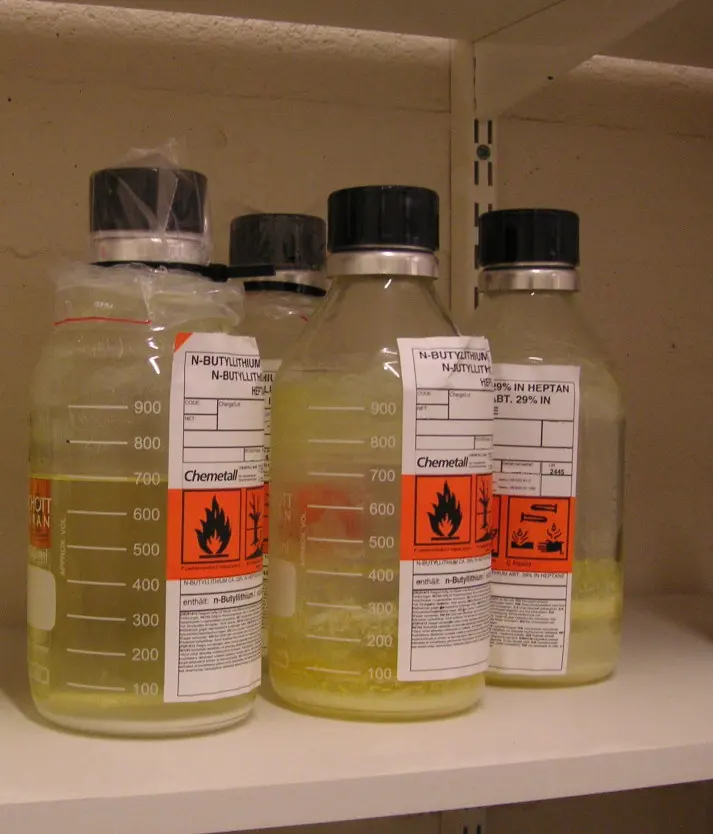
The best known is n-butyllithium, CH₃CH₂CH₂CH₂Li. Factories use it to start the polymerization of butadiene and styrene into the synthetic rubbers of tyres and shoe soles, and laboratories use it as a very strong base. Its relative, tert-butyllithium, catches fire by itself in air.
17.3 Organocopper compounds
Organocopper compounds are organometallic compounds in which copper is bonded directly to carbon. They are made by transmetallation: an organic group is passed from one metal to another, here from lithium to copper, by mixing an organolithium with a copper(I) salt. The kind of compound depends on how much organolithium is used:
| Kind | How it is made | Product |
|---|---|---|
| Monoorganocopper compound | CuX + RLi | RCu + LiX |
| Lower-order organocopper (Gilman reagent) | CuX + 2RLi | R₂CuLi + LiX |
| Mixed lower-order organocuprate | CuX + R₁Li + R₂Li | R₁R₂CuLi + LiX |
| Lower-order cyanocuprate | CuCN + RLi | RCu(CN)Li |
| Higher-order cyanocuprate | CuCN + 2RLi | R₂Cu(CN)Li₂ |
| Mixed higher-order cyanocuprate | CuCN + R₁Li + R₂Li | R₁R₂Cu(CN)Li₂ |
(In a mixed cuprate, R₁ is the “transferable” group, the one meant to end up in the product, and R₂ a “residual” group, chosen to stay behind on copper.)
The most used is the Gilman reagent, a lithium dialkylcuprate, named after the American chemist Henry Gilman, who made the first one in 1952. Two methyllithium molecules and copper(I) iodide give lithium dimethylcuprate:
Organocopper compounds are versatile reagents for coupling reactions and conjugate additions. In the Corey–House synthesis, a Gilman reagent joins its alkyl group to the alkyl group of a haloalkane, making a new C–C bond:
Here methyl and propyl join to give butane. The Wurtz reaction Grade 12: Unit 8 can only join two identical groups cleanly; with two different haloalkanes it gives a mixture of three alkanes. The Corey–House synthesis joins two different groups and gives one product. In a conjugate addition, a cuprate adds its R group to the far carbon of a C=C next to a C=O, where a Grignard reagent would attack the C=O itself.
17.4 Organocadmium compounds
Dialkylcadmium compounds are made from a Grignard reagent and cadmium chloride in dry ether, another transmetallation:
Methylmagnesium bromide gives dimethylcadmium. Cadmium (1.69) is more electronegative than magnesium (1.31), so the C–Cd bond is less polar and dialkylcadmiums are much less reactive than Grignard reagents. That is their whole point. They react with acid chlorides to give ketones, and stop there, because they are too weak to attack the ketone:
A Grignard reagent would go straight on from the ketone to a tertiary alcohol (Section 17.6).
17.5 Metal–carbon bond
A metal–carbon bond is a covalent bond between a metal atom and a carbon atom; it is what makes a compound organometallic. In the compounds of this unit, the metal is less electronegative than carbon, so the shared pair lies closer to the carbon: the bond is polar covalent, M^δ+^–C^δ−^.
| Metal | Li | Mg | Cd | Cu |
|---|---|---|---|---|
| Electronegativity (Pauling) | 0.98 | 1.31 | 1.69 | 1.90 |
| Difference from carbon (2.55) | 1.57 | 1.24 | 0.86 | 0.65 |
In methyllithium, H₃C–Li, the arrow of the bond’s polarity points at the carbon: carbon is the electron-rich end. This is the reverse of what carbon usually is in organic chemistry. In a haloalkane, C^δ+^–X^δ−^, the carbon is short of electrons and is attacked by nucleophiles; in CH₃^δ−^–Li^δ+^ the same carbon is the nucleophile. Turning a haloalkane into an organometallic reverses the carbon’s character, and that is why one haloalkane can now make bonds to the δ+ carbon of a C=O group.
With very electropositive metals such as sodium and potassium, the bond is so polar that it is better described as ionic, R⁻ M⁺. With d-block metals, there are two kinds of bonding:
- σ bond (sigma donation). The carbon atom gives a pair of electrons into an empty orbital of the metal. In metal alkyls like CH₃–Li, (CH₃)₂Cd or the Ti–C bonds of a Ziegler–Natta catalyst, this σ bond is the only metal–carbon bond.
- π back-bonding. A d-block metal can also give electrons back: a filled d orbital of the metal overlaps an empty antibonding π orbital (π*) of the ligand. This needs a ligand with a π* orbital, such as CO or an alkene.
Metal carbonyls, such as Ni(CO)₄ and Fe(CO)₅, have both. The carbon atom of CO gives its lone pair to an empty metal orbital (σ donation), and the metal gives electrons from a filled d orbital back into the empty π* orbital of CO (π back-bonding). The two strengthen each other, a give-and-take bond. Because the electrons pushed into CO’s antibonding orbital weaken the C≡O bond a little, the CO bond in a carbonyl is slightly longer and vibrates more slowly than in free carbon monoxide, which is how chemists measure back-bonding with infrared light.
In which compound would the carbon attached to the metal be the most strongly δ−?
Pick an answer to see why.
17.6 Grignard reagent
Preparation
A Grignard reagent is an alkylmagnesium halide, RMgX. It is made by warming a haloalkane (or haloarene) with magnesium turnings in dry ether (ethoxyethane) or tetrahydrofuran:
Iodomethane (methyl iodide) gives methylmagnesium iodide, and bromoethane (ethyl bromide) gives ethylmagnesium bromide.
How does it form? On the surface of the magnesium, a magnesium atom gives one electron to the haloalkane’s C–X bond, which breaks into an alkyl radical and a ·MgX radical; the two then combine:
The magnesium is inserted between the carbon and the halogen. (Each step moves single electrons, drawn with half-headed “fish-hook” arrows, not the full arrows of electron pairs.) Iodides react fastest and chlorides slowest, as the C–X bond strength suggests: C–I > C–Br > C–Cl in rate. A small crystal of iodine is often added to clean the oxide film off the magnesium and get the reaction started.
Why dry ether? Two reasons. First, a Grignard reagent is destroyed by water, alcohols, or anything with an O–H or N–H hydrogen (the next reaction). Second, ether isn’t just a liquid to dissolve it in: the lone pairs on two ether oxygens bond to the magnesium, RMgX(OEt₂)₂, and hold the reagent in solution. A hydrocarbon such as hexane, with no lone pairs, can’t do this.
How the reagents are made, and Victor Grignard’s story, are also in Unit 8. This unit is about what they do.
Chemical properties of Grignard’s reagent
In RMgX, magnesium (1.31) is far less electronegative than carbon (2.55). So the carbon bonded to magnesium is δ−, and it reacts as if it were a carbanion, R⁻: a strong base and a strong nucleophile. Almost every reaction of a Grignard reagent is one of two things:
- it takes a proton from anything acidic (water, alcohols, acids, NH₃, terminal alkynes), giving an alkane; or
- its R group adds to the δ+ carbon of a polar multiple bond (C=O, C≡N), making a new carbon–carbon bond.
a. Action with water
Water hydrolyzes a Grignard reagent to an alkane, with magnesium hydroxyhalide as the byproduct:
Alcohols do the same, which is why ethanol turns ethylmagnesium bromide into ethane. This is useful only to make an alkane, or to put a deuterium atom exactly where the magnesium was, using D₂O. Mostly it is a nuisance, and the reason everything must be bone dry.
b. Action with aldehydes
A Grignard reagent adds across the C=O bond of an aldehyde: the δ− carbon of R attacks the δ+ carbon of C=O, and the π electrons of C=O move onto the oxygen, which takes the MgX. The addition product is a magnesium alkoxide. Dilute acid then hydrolyzes it to an alcohol, with magnesium hydroxyhalide as the byproduct.
With methanal (formaldehyde), the alcohol is primary:
With any other aldehyde, the alcohol is secondary:
c. Action with ketones
A ketone adds a Grignard reagent the same way, and gives a tertiary alcohol: the carbonyl carbon already had two carbon groups, and now it has three. The reagent and ketone are mixed in dry ether; water and acid are added only afterwards, to hydrolyze the addition product. (Some books say the reaction happens “in the presence of water”; water would destroy the Grignard reagent before it could reach the ketone.)
d. Action with carbon dioxide
Can you explain how the product forms when a Grignard reagent is treated with carbon dioxide? Carbon dioxide has two C=O bonds, and its carbon is δ+. The R group of the Grignard reagent adds to that carbon, giving the magnesium salt of a carboxylic acid; acid hydrolysis then releases the carboxylic acid. In practice the Grignard solution is poured onto crushed dry ice (solid CO₂), which is both the reagent and a way to keep the mixture cold.
Methylmagnesium bromide gives ethanoic (acetic) acid. The acid has one more carbon atom than the Grignard reagent (and the haloalkane it was made from): this reaction lengthens a carbon chain by one.
e. Action with HCN
Hydrogen cyanide has a C≡N bond, like a nitrile, with a hydrogen on the carbon. The Grignard reagent adds to the carbon of the C≡N, giving the magnesium salt of an imine, which acid hydrolysis turns into an aldehyde:
f. Action with nitriles, RCN
Study the reaction below. A Grignard reagent attacks the electrophilic carbon of a nitrile’s C≡N, forming an imine salt, R′C(R)=NMgX. It stops there: the negative nitrogen won’t take a second R group. Acid hydrolysis then turns the imine into a ketone:
What are the differences between the reactions of a Grignard reagent with HCN and with RCN?
| HCN + RMgX | RCN + RMgX | |
|---|---|---|
| 1.Product after hydrolysis | an aldehyde, RCHO | a ketone, R′COR |
| 2.Groups on the new C=O carbon | R and H | R and R′ |
| 3.Acidic hydrogen | HCN’s acidic H reacts with RMgX first | none: a nitrile has no H on the C≡N carbon |
g. Action with esters
An ester, R′COOR″, has a C=O carbon with an OR″ group on it. A Grignard reagent adds to the C=O; the addition product throws out R″OMgX and leaves a ketone. But a ketone reacts with Grignard reagents faster than an ester does, so it takes a second molecule of RMgX at once, and acid hydrolysis gives a tertiary alcohol. Both steps are ordinary polar additions of R⁻ to a C=O carbon. (Some books call the reaction a single electron transfer; it is a nucleophilic addition, twice.)
Methyl benzoate gives 3-phenylpentan-3-ol: two of the three groups on the carbinol carbon come from the Grignard reagent. In general:
The one exception is a methanoate (formate) ester, HCOOR″: its C=O carbon carries a hydrogen, so after two R groups have been added the product is a secondary alcohol:
Ethyl methanoate and methylmagnesium bromide give propan-2-ol.
h. Action with acid chlorides
An acid chloride reacts the same way as an ester, with Cl⁻ leaving instead of an alkoxide. One molecule of Grignard reagent gives a ketone:
With more Grignard reagent the ketone reacts on, and acid hydrolysis gives a tertiary alcohol, with magnesium hydroxyhalide as the byproduct:
Ethanoyl chloride ends as 2-methylpropan-2-ol. To stop at the ketone, chemists use a gentler reagent instead, a dialkylcadmium (Section 17.4) or a Gilman reagent.
What are the differences between the reactions of a Grignard reagent with an ester and with an acid chloride?
| R′COOR″ + RMgX | R′COCl + RMgX | |
|---|---|---|
| 1.Group that leaves | an alkoxide, R″O⁻, as R″OMgX (giving R″OH on hydrolysis) | a chloride ion, as MgXCl |
| 2.Speed | slower: an ester’s C=O is less δ+ | faster: Cl pulls electrons from the C=O, so the carbon is more δ+ |
| 3.Stopping at the ketone | not possible with RMgX | possible with one equivalent at low temperature, or with R₂Cd or R₂CuLi |
In both cases, with enough Grignard reagent, the final product is a tertiary alcohol (or, from a methanoate ester, a secondary one).
i. Action with oxirane
One more reaction, not in the course list but often asked: a Grignard reagent opens the strained three-membered ring of oxirane (ethylene oxide), adding two carbons at once and giving a primary alcohol after hydrolysis:
17.7 Zeise’s salt
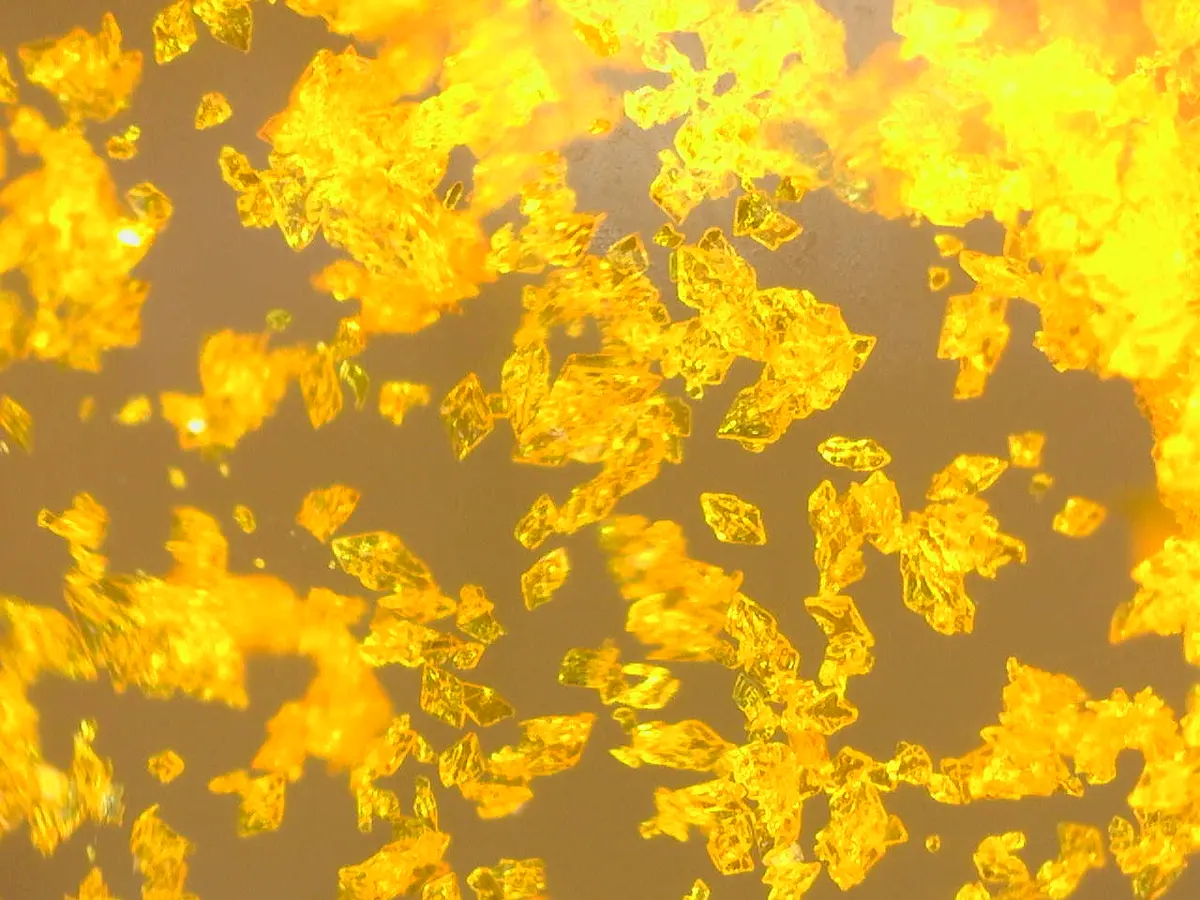
Zeise’s salt, K[PtCl₃(C₂H₄)]·H₂O, is potassium trichlorido(η²-ethene)platinate(II) monohydrate, written in older books as potassium trichloro(ethylene)platinate(II) monohydrate. The Danish pharmacist and chemist William Christopher Zeise made it in Copenhagen in 1830, by boiling platinum(IV) chloride in ethanol and adding potassium chloride. It is a lemon-yellow solid, stable in air, and it was the first organometallic compound of a transition metal, and the first complex of a metal with an alkene. Its structure stayed a puzzle for over a century; it was finally settled by X-ray diffraction in the 1950s.
The salt is made of K⁺ ions and [PtCl₃(C₂H₄)]⁻ anions (and water). In the anion, platinum(II) is d⁸ and square planar, like many Pt(II) complexes: three Cl atoms take three corners of the square, and the ethene molecule takes the fourth. But the ethene isn’t bonded through one of its carbons. It lies sideways, both carbons the same distance from the platinum, with its C=C bond perpendicular to the PtCl₃ plane. The platinum is bonded to the double bond as a whole: that is what “η²” (eta-two, two carbons bonded together) means.
The bond is a give-and-take bond, like the metal–carbonyl bond of Section 17.5 (it is called the Dewar–Chatt–Duncanson model, after the chemists who described it in 1951–53). The filled π orbital of ethene gives electron density to an empty orbital of platinum (σ donation), and a filled d orbital of platinum gives electron density back into the empty π* orbital of ethene (π back-bonding). Because some electrons go into ethene’s antibonding orbital, the C=C bond in Zeise’s salt is a little longer than in free ethene.
Zeise’s salt itself has no big industrial use, but it is the ancestor of a whole family: metal–alkene complexes are the working parts of the Wacker process, which turns ethene into ethanal with a palladium catalyst, and of the Ziegler–Natta catalysts that make polythene.
Exercise
A. Multiple choice questions
- Which of the following reagents is suitable to obtain ethane from a Grignard reagent?
Pick an answer to see why.
- What is Z in the following reaction sequence?
Pick an answer to see why.
- Which of the following is the molecular formula of Zeise’s salt?
Pick an answer to see why.
- What would be the product when methylmagnesium bromide is treated with HCN followed by hydrolysis?
Pick an answer to see why.
- Choose the best alternative from the following.
| Reactants | Condition | Products |
|---|---|---|
| M | dry ether, heat | CH₃Li + LiCl |
| CH₃COCl + CH₃MgBr | H₂O/H⁺ | N |
| Ester + Grignard reagent | O | secondary alcohol |
Pick an answer to see why.
- What is Z in the following chemical equation?
Pick an answer to see why.
- What is the chemical name of Zeise’s salt?
Pick an answer to see why.
- What happens when an alkyl cyanide is treated with a Grignard reagent (followed by hydrolysis)?
Pick an answer to see why.
B. Short answer questions
How is a Grignard reagent prepared? Explain with an example. Can we prepare a Grignard reagent from ethane? Explain the process. Why can’t we use water instead of ether?
Answer
Why is the given compound considered an organometallic compound? Write its name and use. In which respect does it have similarities with a Grignard reagent?
Answer
What are organometallic compounds? Give an example each of organolithium, organocadmium and organocopper compounds. Explain the nature of the bond formed in such compounds.
Answer
What happens when:
- a.a Grignard reagent is treated with water?
- b.ethyl ethanoate is treated with methylmagnesium chloride?
- c.methylmagnesium chloride is heated with ethanoyl chloride?
Answer
Starting from a Grignard reagent (CH₃MgBr), how would you prepare:
- a.methane
- b.ethyl alcohol
- c.acetic acid
- d.isopropyl alcohol
- e.propanol
Answer
How would you prepare a Grignard reagent from an aryl halide? Write the structural formula and IUPAC name of each of the following with the formula C₃H₈O:
- a.a primary alcohol
- b.a secondary alcohol
- c.Prepare these alcohols from Grignard reagents.
Answer
Printable PDFs
- Study notes 2 pages
- Worksheet 5 pages Answer key
Quiz yourself: Materials and Chemicals We Use, Grades 5–12 →
Practice every question in the book, and keep track of the ones you miss →
A companion to your textbook, not a replacement for it: study from the book your school uses, and where the two differ, follow your teacher. Found a mistake? Please tell us.