
The fever tablet in almost every Nepali home, paracetamol, very often starts as a pale yellow, oily liquid that smells of bitter almonds: nitrobenzene. Reduce it carefully, rearrange it, add one more group, and it becomes the medicine. Reduce it the plain way and it becomes aniline, the parent of the first synthetic dyes and of the foam in your mattress. The same nitro group sits in metronidazole, the tablet given for amoebic dysentery and giardia, and in the fuel that pushes a drag-racing car from standstill to 500 km/h in under four seconds.
All of these begin with one small group of atoms, –NO₂, the nitro group, joined to carbon through its nitrogen. This unit is about compounds that carry it: how they are named and made, why they behave as they do, and above all how the nitro group can be reduced, step by step, into the amines of the next unit.
Introduction
Where you meet the –NO₂ group
| Compound with a nitro group | Where it is used |
|---|---|
| Nitrobenzene | Almost all of it is turned into aniline, for dyes, medicines (paracetamol through 4-aminophenol), rubber chemicals and polyurethane foam |
| Nitromethane | A solvent, and a racing fuel for drag racers and model aircraft engines |
| Metronidazole, tinidazole | Medicines against amoebic dysentery, giardia and some bacterial infections |
| Chloramphenicol | An antibiotic |
| Trinitrotoluene (TNT), picric acid | Explosives: TNT is still the main military explosive; picric acid was used before it |
| Chloropicrin (trichloronitromethane) | A soil fumigant against pests and fungi |
Nitro compounds are organic compounds in which a nitro group, –NO₂, is bonded to a carbon atom through its nitrogen. They are of two kinds:
- aliphatic nitro compounds, or nitroalkanes, R–NO₂, the nitro group on an alkyl group: nitromethane, CH₃NO₂;
- aromatic nitro compounds, or nitroarenes, Ar–NO₂, the nitro group directly on a benzene ring: nitrobenzene, C₆H₅NO₂.
What the nitro group looks like
Count the electrons and the nitro group can’t be drawn with one honest structure. Its nitrogen makes four bonds (to carbon, a double bond to one oxygen and a single bond to the other), so it carries a positive formal charge, and the singly bonded oxygen a negative one. But nothing says which oxygen has the double bond. Both arrangements are equally good, and the real group is the resonance hybrid of the two (Figure 15.2).
That is why the two N–O bonds in nitromethane are measured to be the same length, about 122 pm, between a typical N–O single bond and an N=O double bond, and why each oxygen carries half a negative charge. The positive nitrogen next to the carbon makes the nitro group one of the strongest electron-withdrawing groups in organic chemistry: it pulls electrons from the carbon both through the bond (−I effect) and, when it sits on a benzene ring, by resonance (−R effect). Almost everything special about nitro compounds comes from this pull.
Which of these is a nitro compound?
Pick an answer to see why.
15.1 Nomenclature, isomerism and classification of nitroalkanes
Nomenclature
In the IUPAC system the nitro group is always named as a prefix, never as a suffix: “nitro” comes in front of the name of the parent alkane, with a number for its carbon when the chain is long enough to need one.
position number + nitro + alkane name: 2-nitropropane
Number the chain to give the nitro group the lowest number. When there are other prefixes, such as methyl, all of them are written in alphabetical order (m before n), each with its number.
| S.N. | Formula | IUPAC name |
|---|---|---|
| 1. | CH₃–NO₂ | nitromethane |
| 2. | CH₃–CH₂–NO₂ | nitroethane |
| 3. | CH₃–CH₂–CH₂–NO₂ | 1-nitropropane |
| 4. | CH₃–CH(NO₂)–CH₃ | 2-nitropropane |
| 5. | CH₃–C(CH₃)(NO₂)–CH₂–CH₃ | 2-methyl-2-nitrobutane |
Look at compound 5. Its longest chain has four carbons, so it is a butane, and both the methyl and the nitro group sit on carbon 2: 2-methyl-2-nitrobutane (methyl first, by the alphabet). Common names are rarely used for nitroalkanes: the IUPAC names are short enough, and nitromethane and nitroethane are what everyone calls them.
Classification
Nitroalkanes are classified, like alcohols and haloalkanes, by the carbon that carries the nitro group (Figure 15.4):
- primary (1°): the nitro group is on a carbon joined to one other carbon (or none, as in nitromethane), so that carbon still has two (or three) hydrogens, R–CH₂–NO₂;
- secondary (2°): on a carbon joined to two other carbons, with one hydrogen left, R₂CH–NO₂;
- tertiary (3°): on a carbon joined to three other carbons, with no hydrogen, R₃C–NO₂.
The classes matter because the hydrogens on that carbon, the α-hydrogens, are unusual: the nitro group pulls so hard that a base can take one off as H⁺ (Section 15.3). Primary and secondary nitroalkanes have them and dissolve in sodium hydroxide solution; a tertiary nitroalkane has none and doesn’t.
Which is a secondary nitroalkane?
Pick an answer to see why.
Isomerism of nitroalkanes
Isomerism is the existence of two or more compounds with the same molecular formula but different arrangements of their atoms, and so different physical and chemical properties. It is of two main kinds: structural isomerism (the atoms are joined in a different order) and stereoisomerism (the same order, a different arrangement in space). Nitroalkanes show three kinds of structural isomerism:
- Chain isomerism: the carbon skeleton differs, straight or branched (1-nitrobutane and 2-methyl-2-nitropropane).
- Position isomerism: the nitro group sits on a different carbon of the same chain (1-nitropropane and 2-nitropropane).
- Functional isomerism: a nitroalkane, R–NO₂, and an alkyl nitrite, R–O–N=O, have the same formula but different functional groups. Nitromethane, CH₃NO₂, and methyl nitrite, CH₃ONO, are the smallest pair.
15.2 Preparation of nitroalkanes
a. From haloalkanes (with silver nitrite)
A haloalkane heated with silver nitrite, AgNO₂, in ethanol gives a nitroalkane as the main product, with some alkyl nitrite, and silver halide precipitates:
Why two products? The nitrite ion, NO₂⁻, has lone pairs on its nitrogen and on both oxygens (Figure 15.11), so it can attack the carbon of a haloalkane with either end. If the nitrogen makes the new bond, the product is the nitroalkane, R–NO₂; if an oxygen does, the alkyl nitrite, R–O–N=O. A nucleophile that can attack through two different atoms is called ambident (Latin ambi, both, and dens, tooth).
Silver nitrite gives mainly the nitroalkane. The usual explanation is that the silver–oxygen link in silver nitrite is largely covalent, so the free nitrogen end does most of the attacking. With sodium or potassium nitrite, which are fully ionic, the oxygen end attacks more often and a good deal of alkyl nitrite forms. You met the same pair of reagents in Haloalkanes, with KCN and AgCN giving a nitrile or an isocyanide.
b. By nitration of alkanes
Alkanes are nitrated in the vapor phase: a mixture of the alkane and nitric acid vapor (or nitrogen dioxide) is heated to about 400–450 °C. One hydrogen is replaced by –NO₂:
At these temperatures the reaction goes through free radicals (the HNO₃ breaks up into ·OH and ·NO₂), like the chlorination of methane, not through ions. The radicals can take a hydrogen from any carbon and can also break the carbon chain, so an alkane gives a mixture. Propane gives 1-nitropropane and 2-nitropropane, and, from chains broken in two, nitroethane and nitromethane as well (Figure 15.12). This is how nitromethane, nitroethane and the nitropropanes are made in industry; the mixture is separated by fractional distillation.
15.3 Physical properties of nitroalkanes
- State. The lower nitroalkanes are colorless liquids (nitromethane boils at 101 °C, nitroethane at 114 °C); the higher ones are liquids or low-melting solids.
- Polar, with high boiling points. The nitro group, with its charged N and O, makes the molecule strongly polar: nitromethane’s dipole moment is about 3.5 D, larger than water’s (1.85 D). The strong dipole–dipole attractions give nitroalkanes much higher boiling points than hydrocarbons of similar molar mass: nitromethane (61 g/mol) boils at 101 °C, butane (58 g/mol) at −0.5 °C. They can’t form hydrogen bonds with one another (they have no H on N or O).
- Solubility. They are only sparingly soluble in water (about 10 g of nitromethane dissolves in 100 mL), though their oxygens can accept hydrogen bonds from water; they mix well with organic solvents and are good solvents themselves.
- Density. The lower ones are denser than water: nitromethane 1.14 g/cm³.
- Weakly acidic. A primary or secondary nitroalkane is a weak acid: the strong pull of –NO₂ lets a base remove an α-hydrogen as H⁺. Nitromethane’s pKa in water is about 10, close to phenol’s, so it dissolves in sodium hydroxide solution as a salt. A tertiary nitroalkane has no α-hydrogen and is not acidic.
- Smell. They have a mild, fairly pleasant smell. Smell is not a safe test: the vapors are harmful, and 2-nitropropane is a suspected carcinogen.
Nitromethane (61 g/mol) boils at 101 °C, but butane (58 g/mol) at −0.5 °C. The main reason is:
Pick an answer to see why.
15.4 Chemical properties of nitroalkanes: reduction
The most important reaction of nitro compounds is reduction. The nitrogen of –NO₂ (oxidation state +3) can take hydrogen atoms one pair at a time and lose its oxygens as water, ending as the amino group, –NH₂ (oxidation state −3). How far it goes depends on the reducing agent and the medium. In equations the hydrogen supplied by a reducing agent is written [H], “nascent hydrogen”: one hydrogen atom, in effect one electron and one proton.
a. Catalytic reduction
Hydrogen gas over a finely divided metal catalyst (nickel, platinum or palladium) reduces a nitroalkane all the way to a primary amine:
How is ethanamine formed? Count the atoms. The nitrogen loses both its oxygens, which leave with four of the hydrogen atoms as two molecules of water; the other two hydrogen atoms stay on the nitrogen. Three H₂ supply the six hydrogen atoms. Aromatic nitro compounds are reduced the same way (Section 15.7).
b. Reduction in acidic medium
Tin (or iron, or zinc) with concentrated hydrochloric acid also gives the primary amine:
What does the hydrochloric acid do? It is a strong acid: it reacts with the tin, which gives up electrons (Sn → Sn²⁺ → Sn⁴⁺), and supplies the protons that, with those electrons, make the [H]. Because the solution is strongly acidic, the amine, a base, comes out as its salt, the alkylammonium chloride, . Adding sodium hydroxide at the end sets the free amine loose:
Lithium aluminium hydride, LiAlH₄, in dry ether also reduces a nitroalkane to the primary amine ().
c. Reduction in neutral medium
Zinc dust with ammonium chloride solution, warmed, is a milder reducer. It stops one step earlier, and the product is an N-alkylhydroxylamine, R–NH–OH:
Why “neutral”? Ammonium chloride is the salt of a weak base and a strong acid, so its solution is only slightly acidic, and as the zinc reacts the ammonia it releases keeps the solution close to neutral. Without a strong acid, the reduction is slow enough to stop when the nitrogen still has one oxygen.
Nitroethane is reduced with zinc dust and ammonium chloride solution. The product is:
Pick an answer to see why.
Aromatic nitro compounds
15.5 Preparation of nitrobenzene
Nitrobenzene is made by nitrating benzene. Benzene is warmed with the nitrating mixture, concentrated nitric acid and concentrated sulphuric acid, at 50–60 °C:
It is an electrophilic substitution, in three steps.
- The electrophile forms. Sulphuric acid, the stronger acid, gives a proton to nitric acid, which then loses water, leaving the nitronium ion, NO₂⁺:
Overall:
- 2.The ring attacks NO₂⁺ (slow). Two π electrons of the ring form a bond to its nitrogen. The ring loses its aromatic sextet and becomes the arenium ion (σ complex), a carbocation whose positive charge is spread over three carbons.
- 3.The ring is restored (fast). A base (HSO₄⁻ or water) removes H⁺ from the carbon that holds the nitro group; the C–H electrons go back into the ring, and the aromatic ring is whole again.
The temperature is kept below 60 °C because above it a second nitro group goes in, giving 1,3-dinitrobenzene (Section 15.7). The mechanism is explained in more detail in Grade 11, Unit 15.
15.6 Physical properties of nitrobenzene
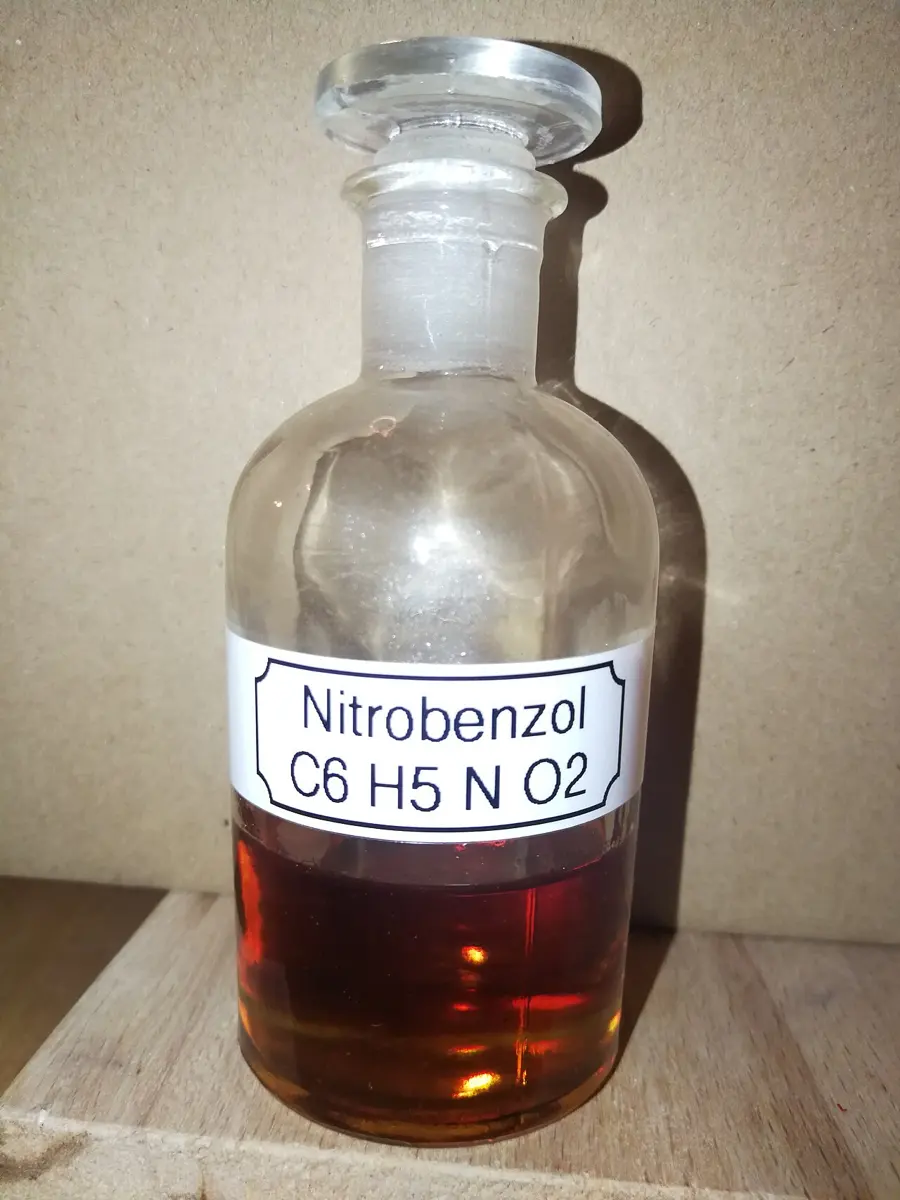
- A pale yellow, oily liquid, long called oil of mirbane (the name under which it was sold to scent soap). It boils at 211 °C and freezes at 6 °C, so it can solidify on a cold Kathmandu winter morning.
- Insoluble in water (only about 0.2 g dissolves in 100 mL), but soluble in organic solvents such as ethanol, ether and benzene. It is a good solvent itself.
- Heavier than water: density 1.20 g/cm³. Shaken with water and left to stand, it settles as the lower layer, so in a separating funnel it runs out first (Figure 15.18).
- It smells of bitter almonds, the same smell as benzaldehyde (and as hydrogen cyanide, which is why the smell is no comfort).
- It is toxic. Its vapor and the liquid are absorbed through the skin; in the blood it turns hemoglobin into methemoglobin, which can’t carry oxygen, and the lips and fingertips turn blue.
Nitrobenzene is shaken with water in a separating funnel and left to stand. What do you see?
Pick an answer to see why.
15.7 Chemical properties of nitrobenzene
A. Reduction
Nitrobenzene can be reduced to six different products. The reagent and the medium decide where the reduction stops.
a. Reduction in acidic medium
Tin (or iron) and concentrated hydrochloric acid reduce the nitro group all the way to the amino group: the product is aniline, exactly as nitroethane gave ethanamine.
As before, the acid turns the aniline into anilinium chloride, C₆H₅NH₃⁺Cl⁻ (with tin it forms a double salt with tin(IV) chloride). Making the mixture alkaline with sodium hydroxide frees the aniline, which is then separated by steam distillation. In industry, iron filings and a little hydrochloric acid were used for a century, because iron is cheap; today most aniline is made by catalytic hydrogenation (e below).
b. Reduction in neutral medium
Zinc dust and ammonium chloride solution give N-phenylhydroxylamine, the aromatic twin of the N-alkylhydroxylamines:
c. Reduction in alkaline medium
In alkali, something new happens. Partly reduced molecules, nitrosobenzene (C₆H₅NO) and N-phenylhydroxylamine, meet and join in pairs through their nitrogens, and the products have two benzene rings. How far the pair is reduced depends on the reagent:
Read the three as steps on one staircase: azoxybenzene (N=N with an oxygen still on one nitrogen) → azobenzene (the oxygen gone, an N=N double bond) → hydrazobenzene (two more hydrogens across it, an N–N single bond). Each step uses two more [H]. Lithium aluminium hydride also gives azobenzene from nitrobenzene, not aniline.
d. Electrolytic reduction
When nitrobenzene is reduced electrolytically in strongly acidic solution (concentrated sulphuric acid, at the cathode), it first takes four [H] and becomes N-phenylhydroxylamine. In the strong acid that molecule doesn’t survive: it rearranges, its OH moving from the nitrogen to the para carbon of the ring, and the stable product is 4-aminophenol (p-aminophenol, p-hydroxyaniline). This rearrangement is named after the German chemist Eugen Bamberger.
e. Catalytic reduction
Hydrogen gas with nickel, platinum or palladium reduces nitrobenzene to aniline:
This is how most of the world’s aniline is made today, about seven million tonnes a year: in the gas phase over a copper or palladium catalyst, or in the liquid over nickel.
B. Electrophilic substitution reactions
What is an electrophile? It is a species that is short of electrons (often a positive ion, such as NO₂⁺, or the δ+ end of a polarized molecule) and so seeks out electrons. A benzene ring, with its cloud of six π electrons, is just such a source. When an electrophile replaces a hydrogen on the ring, and the ring stays aromatic, the reaction is an electrophilic substitution.
Nitrobenzene undergoes the same substitutions as benzene, but with two big differences: it reacts far more slowly, and the new group goes to the meta position, carbon 3.
Why the ring is deactivated
The nitro group pulls electrons out of the ring in two ways.
- Inductive effect (−I): the positive nitrogen pulls electrons towards itself through the C–N σ bond.
- Resonance effect (−R): the ring’s π electrons can flow into the nitro group. In three of nitrobenzene’s resonance structures (Figure 15.26) this leaves a positive charge on the ortho and para carbons, 2, 4 and 6.
The whole ring is poorer in electrons than benzene, so it attracts an electrophile less: it is deactivated. Nitrobenzene is nitrated millions of times more slowly than benzene, and its substitutions need harsher conditions (higher temperatures, stronger reagents). This is also why nitrobenzene can’t be used in Friedel–Crafts reactions; it is so unreactive that it is sometimes used as their solvent.
Why meta
Look at the arenium ion that forms when the electrophile attacks. If it attacks the para carbon (Figure 15.27), or an ortho carbon, one of the three resonance structures puts the ring’s positive charge on carbon 1, right beside the positive nitrogen of the nitro group. Two positive charges side by side repel strongly, so that structure is very unstable, and so is the ion. If the electrophile attacks a meta carbon (Figure 15.28), the positive charge falls on carbons 2, 4 and 6 but never on carbon 1. The meta ion is the least unstable of the three, it forms fastest, and the meta product wins.
So the nitro group is a meta director and a ring deactivator. Note the reasoning: meta is not favored so much as less disfavored; every position of nitrobenzene is slower than benzene’s, meta least of all.
In nitrobenzene, why does an electrophile go mainly to the meta position?
Pick an answer to see why.
a. Nitration
Nitrobenzene heated with fuming nitric acid and concentrated sulphuric acid at about 100 °C takes a second nitro group, at the meta position: 1,3-dinitrobenzene (m-dinitrobenzene).
The ring now carries two deactivating groups, and a third nitro group goes in only with fuming nitric acid and fuming sulphuric acid after long heating, slowly and in poor yield. It goes to the one position meta to both: 1,3,5-trinitrobenzene (Figure 15.30).
b. Halogenation
With bromine and iron(III) bromide (or chlorine and iron(III) chloride), heated, nitrobenzene gives the meta-halogen compound:
c. Sulphonation
Heated with fuming sulphuric acid (or concentrated sulphuric acid, for longer), nitrobenzene gives 3-nitrobenzenesulphonic acid (m-nitrobenzenesulphonic acid). The electrophile is SO₃.
15.8 Uses of nitro compounds
- Solvents. Nitromethane, nitroethane and nitrobenzene dissolve many organic substances (oils, resins, cellulose esters); nitrobenzene is a solvent for Friedel–Crafts reactions.
- Making other compounds. Nitro compounds are reduced to amines (nitrobenzene to aniline, which uses about 95% of all nitrobenzene made), and nitroalkanes are starting materials for hydroxylamines, carboxylic acids and other chemicals.
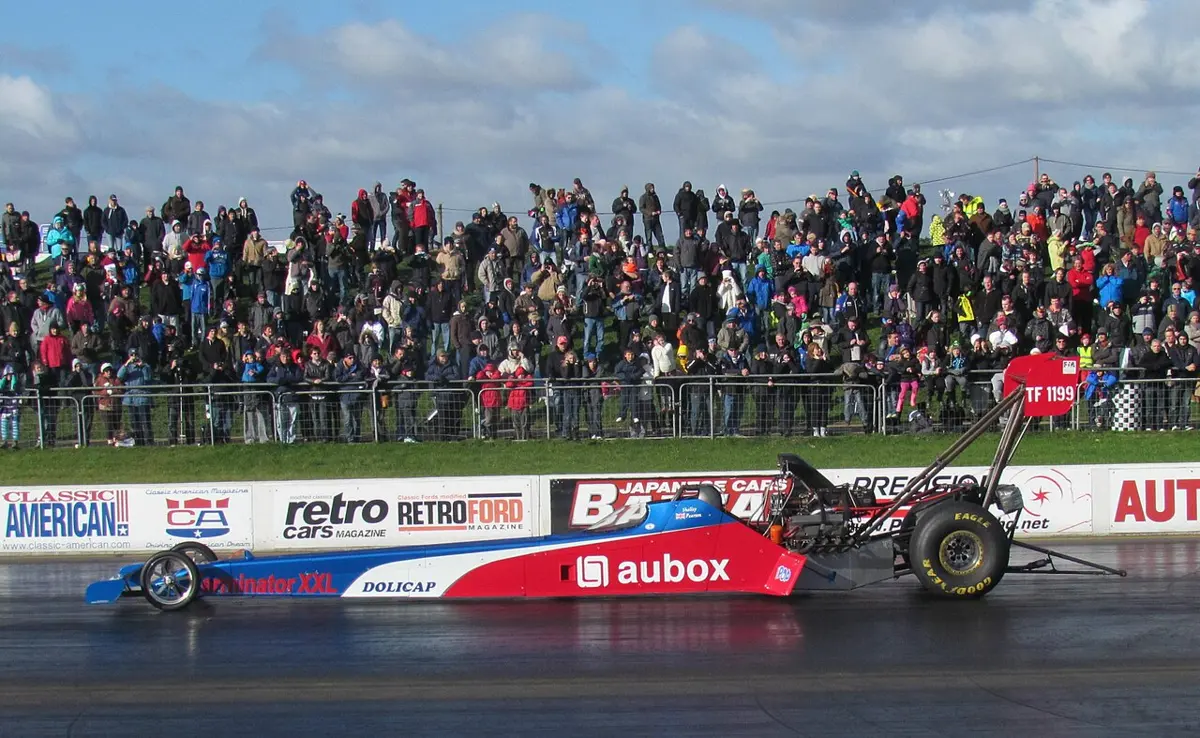
- Fuel. Nitromethane is burned in drag-racing (“Top Fuel”) cars and model aircraft engines: its molecule carries some of its own oxygen, so far more fuel can be burned in each stroke than with petrol.
- Medicines and agriculture. The nitro group is part of medicines such as metronidazole, tinidazole and chloramphenicol, and of chloropicrin, a soil fumigant.
- Oxidizing agent. Nitrobenzene is a mild oxidizing agent in some organic syntheses (it takes hydrogen and is itself reduced to aniline).
- Polishes and perfumes, in the past. As oil of mirbane, nitrobenzene was used to give shoe polish, floor polish and cheap soap an almond smell. Because it is toxic and absorbed through the skin, this use has largely stopped.
- Explosives. Compounds with several nitro groups, such as TNT (2,4,6-trinitrotoluene) and picric acid, are explosives. TNT is still the main explosive in shells and bombs; rock is now blasted mostly with cheaper ammonium nitrate mixtures.
Exercise
Multiple choice questions
- Which of the following is called an ambident group?
Pick an answer to see why.
- What type of isomerism is shown by 1-nitrobutane, CH₃CH₂CH₂CH₂NO₂, and 2-nitrobutane, CH₃CH₂CH(NO₂)CH₃?
Pick an answer to see why.
- What is the product when ethane is heated with concentrated nitric acid (as vapor) at about 430 °C?
Pick an answer to see why.
- What is the product Z in the reaction ?
Pick an answer to see why.
- Study the table and choose the correct alternative.
| Reactant | Condition/reagent | Major product |
|---|---|---|
| CH₃CH₂NO₂ | Sn/HCl | P |
| Q | AgNO₂/heat | CH₃NO₂ |
| CH₃CH₂NO₂ | R | CH₃CH₂NHOH |
Pick an answer to see why.
- Which of the following is a secondary nitroalkane?
Pick an answer to see why.
- Which of the following is used to convert nitroethane into ethanamine?
Pick an answer to see why.
- What is the product X in ?
Pick an answer to see why.
- What is the process of introducing a nitro group into a benzene ring called?
Pick an answer to see why.
- M is benzene. What is the product P in the sequence below?
The textbook gives LiAlH₄/heat for the second step, but LiAlH₄ reduces nitrobenzene to azobenzene, not aniline, so the sequence doesn’t work that way; with Sn/HCl, as here, it does.
Pick an answer to see why.
- What are the required conditions for the sulphonation of nitrobenzene?
Pick an answer to see why.
- Which is correct about the table?
| Reactant | Condition | Major product |
|---|---|---|
| C₆H₅NO₂ | Sn/HCl | P |
| C₆H₅NO₂ | Zn/NaOH(aq)/Δ | Q |
| C₆H₅NO₂ | R | C₆H₅NHOH |
Pick an answer to see why.
- In , M is an aromatic hydrocarbon of molecular mass 78 u. M, N and O are:
Pick an answer to see why.
- What is the nature of the –NO₂ group in electrophilic substitution?
Pick an answer to see why.
- What is Z in ?
Pick an answer to see why.
Short answer questions
Identify the compounds P, Q, R and S in the sequence:
Hint
Answer
Identify A, B, C, D and E:
Hint
Answer
Convert nitrobenzene into phenol, then treat the phenol with neutral ferric chloride solution. Write all the equations.
Answer
Identify the unknown reagents, conditions and products.
| Reactant | Conditions | Product |
|---|---|---|
| Benzene | … | Nitrobenzene |
| Aniline | NaNO₂/dil. HCl at low temperature | … |
| Nitrobenzene | Zn/NaOH in CH₃OH, heat | … |
| … | Zn/NH₄Cl | N-phenylhydroxylamine |
| Nitrobenzene | … | 1,3,5-trinitrobenzene |
The textbook gives nitrobenzene as the reactant with NaNO₂/dil. HCl, but nitrobenzene doesn’t react with nitrous acid, so the book’s row doesn’t work; with aniline, the compound diazotized in this unit and the next, it does.
Answer
Printable PDFs
- Study notes 2 pages
- Worksheet 4 pages Answer key
Quiz yourself: Materials and Chemicals We Use, Grades 5–12 →
Practice every question in the book, and keep track of the ones you miss →
A companion to your textbook, not a replacement for it: study from the book your school uses, and where the two differ, follow your teacher. Found a mistake? Please tell us.